How the Promise of a Utopian Future Was Used to Justify Mass Exploitation
On encountering the destructiveness of European colonialists, Native Americans concluded that the invaders must have a disease
Polytheism allowed people to embody the divine and feel connected to the unfolding of the universe. Their belief in reincarnation and the cyclical nature of time guaranteed that everything would remain interdependent and accountable to everything else.
Judaism replaced an embodied experience of the divine with abstract monotheism. In monotheism you don’t reenact the divine so much as worship God and follow his rules. Christianity replaced the circularity of reincarnation with the linearity of salvation. We have fallen from the paradise of timeless grace, live in sin, and pray for redemption.
There are pros and cons to this shift in belief. A civilization of laws, innovation, and a commitment to progress can still be balanced with reverence for nature, the cycles of life, and the divine moment. But once the progressive, linear expectations of the monotheist religions dovetailed with the expectations of capitalism, that balance was lost. It was replaced with an entirely triumphalist drive for growth, expansion, and extraction.
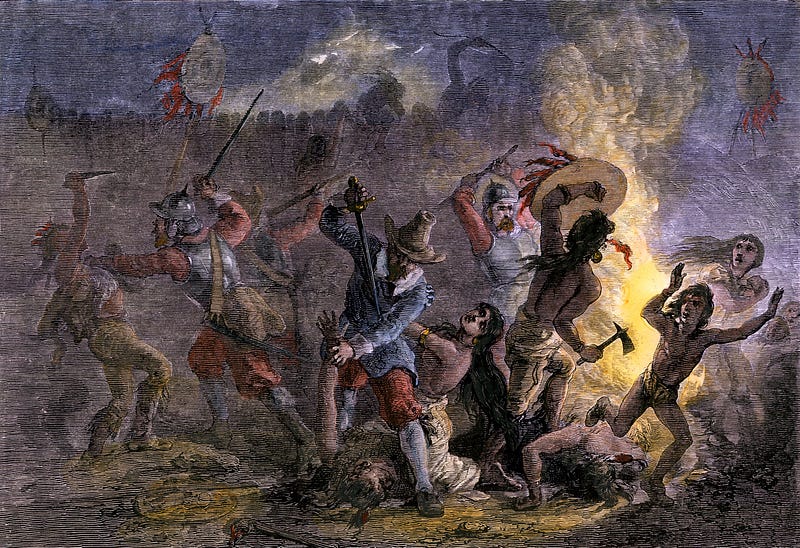
On encountering the destructiveness of European colonialists, Native Americans concluded that the invaders must have a disease. They called it wettiko: a delusional belief that cannibalizing the life force of others is a logical and morally upright way to live. The Native Americans believed that wettiko derived from people’s inability to see themselves as enmeshed, interdependent parts of the natural environment. Once this disconnect has occurred, nature is no longer seen as something to be emulated but as something to be conquered. Women, Natives, the moon, and the woods are all dark and evil, but can be subdued by man, his civilizing institutions, his weapons, and his machines. Might makes right, because might is itself an expression of the divine.
Wettiko can’t be blamed entirely on Europeans. Clearly, the tendency goes at least as far back as sedentary living, the hoarding of grain, and the enslavement of workers. Wanton destruction has long been recognized as a kind of psychic malady. It’s the disease from which Pharaoh of biblical legend was suffering — so much so that God was said to have “hardened his heart,” disconnecting him from all empathy and connection with nature. Pharaoh saw other humans as pests to be exterminated, and used his superior technologies — from agriculture to chariots — to bend nature to his divine will.
Both Judaism and Christianity sought to inoculate themselves from the threat of wettiko. Their founding priests understood that disconnecting from nature and worshipping an abstract God was bound to make people feel less empathetic and connected. Judaism attempted to compensate for this by keeping God out of the picture — literally undepicted. The Israelites had just escaped the death cults of Egypt, and developed an open-source approach to religion that involved constant revision by its participants. Even the letters of sacred texts were written in a script meant to look as transparent as flame. Unlike the arks at which they had worshipped in Egypt, the Israelites’ ark was to have no idol on the top. Rather, they venerated an explicitly empty space, protected by two cherubim. The removal of idols allows people to see the divine in one another instead. Law even dictates that people can read Torah only with a minyan, a group of 10 peers, as if to guarantee that worship is social.
Christianity, likewise, sought to retrieve the insight that a religion is less important as a thing in itself than as a way of experiencing and expressing love to others. The new version of Judaism turned attention away from the written law, which had become an idol of its own, and again toward the heart. Christ of the Bible was attempting to prevent religion from becoming the figure instead of the ground.
But the crucifix became an emblem of divine conquest, first in the Crusades, and later — with the advent of capitalism and industrialism — for colonial empires to enact and spread wettiko as never before. And the law, originally developed as a way of articulating a spiritual code of ethics, became a tool for chartered monopolies to dominate the world, backed by royal gunships. While Europeans took their colonial victories as providential, Native Americans saw white men as suffering from a form of mental illness that leads its victims to consume far more than they need to survive, and results in an “icy heart” incapable of compassion.
Clearly, the wettiko virus prevailed, and the society that emerged from this aggressive extraction still uses the promise of a utopian future to justify its wanton exploitation of people and nature in the present.
This was section 68 of the new book Team Human by Douglas Rushkoff, which is being serialized weekly on Medium. Read the previous section here and the following section here.