
How The Past Makes Us Who We Are
My Great-grandparents Were Colorado Pioneers
All of us identify ourselves in different ways: where we’re from, religion or no religion, age, education, likes and dislikes.
I identify as someone who is passionate about Bach, Willa Cather, the Colorado mountains, snow, and feminism. (I no longer identify myself as someone who plays the piano or sings in a choir!)
But most of all, I identify as a descendant of Colorado pioneers as was my Father. Not to mention as a descendant of Nebraska pioneers, but that’s another story.
Herman and Anna Leave Ohio
Between 1845 and 1855, more than a million Germans came to America, most arriving in New York. Anna and Herman Wagner were among them. From New York, the couple made their way to Ohio. Before long, Herman would leave for Kansas Territory, following the Overland Trail to what is now Denver, Colorado.
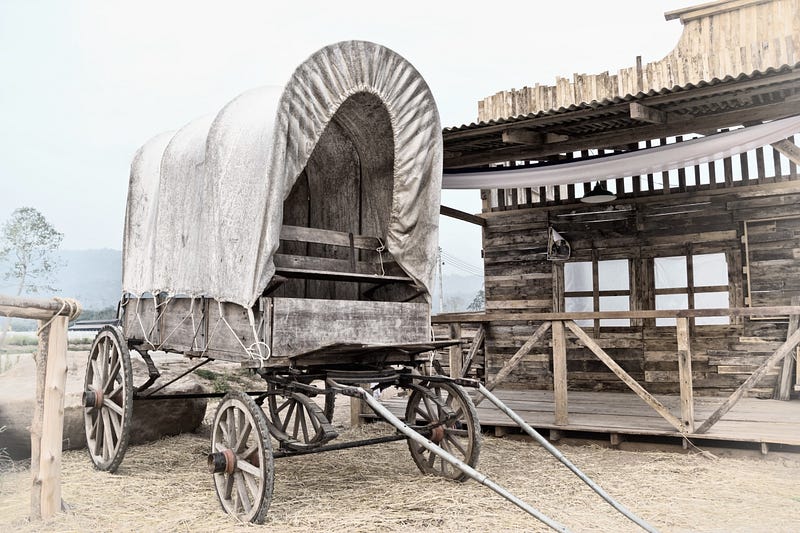
He came on horseback in 1859, the year of the Gold Rush (or maybe by foot, probably not following a covered wagon, and 10 years before the railroad reached Colorado).
Herman settled in Auraria, at the confluence of the Platte River and Cherry Creek. (Auraria derives from the Latin “aurum” meaning gold.) Denver would be established a few weeks later. In 1860, Auraria merged with Denver.
Joining a wagon train, Anna would join her husband a year later.
Herman had loaned money to a “friend” who didn’t pay it back. He and Anna needed the money. When he heard that gold had been discovered near the South Platte River not far from present-day Denver, he was on his way.
Hermann didn’t strike it rich in the gold fields but realized men digging and panning for gold needed boots. He knew how to make boots and other leather goods. After opening a saddlery business in Auraria where the University of Colorado-Denver is now located, he wrote to Anna telling her to come west.
Anna Becomes a Widow
Herman and Anna settled in a cabin next door to his shop. The couple had seven children. My Grandfather, the second youngest of the children, was born in 1871. His parents named him Harry Ulysses, after Ulysses Grant who had been the Union General during the Civil War before becoming President of the United States in 1869.
Their cabin and Herman’s shop are part of a diorama of Denver in the 1860s. Researched and constructed by out-of-work artists, craftspeople, and historians in the 1930s, the diorama includes includes 350 miniature structures: cabins, buildings, tents, outhouses, saloons, hotels, theaters, and an encampment of Arapaho Indians. Recently restored, the diorama is now displayed at the History Colorado Center.
In 1867 Herman helped build First Congregational Church at 15th and Curtis, one of the earliest churches in Denver. Eventually merging with Plymouth Church and moving around the city several times, this church would be the family church until an aunt’s death in 2005. My parents would meet and marry at First Plymouth. I would be baptized at First Plymouth.
Herman did well in the saddlery business. But free land was irresistible. He applied for 130 acres west of the city under the Homestead Act of 1855. In 1872, before he could prove-up on this land, Herman died of pneumonia while trekking through the mountains on horseback to peddle boots and saddles.
Anna, now a widow, moved to the homestead land. She believed that farming and raising cattle was a better life for seven children than living in Denver with its abundance of saloons and brothels.
With hard work, Anna knew she and the children would be able to prove-up in the required time. They had five years to build a house, make improvements, and begin farming in order to lay permanent claim to the homestead land.
She and the children built a cabin and Anna bought some cattle. Soon after, she obtained the cattle brand W-7 for her growing herd: W for Wagner and 7 for seven children. (I don’t know how many women had their own cattle brand in Colorado in the 1870s, but I’m guessing it was uncommon.)
In addition to raising cattle, Anna made money selling crops including cucumbers to the Kuner Pickle Company. John Kuner had opened the Kuner Pickle and Vinegar Company in Denver in 1872, a company his brother Max had started in St. Louis. Kuner’s still sells canned vegetables in Colorado and other Rocky Mountain States.
When drought struck, Anna’s son Philip and his brothers built a ditch that provided water to the Wagners and several neighbors. The Wagner Lateral Ditch exists today in what is now Lakewood, Colorado, and runs east into West Denver.
After the Great Fire of 1863, Denver decreed that no new building would be constructed of wood. Following this ordinance, Anna and the children built one of the first brick houses in Denver. Anna died in 1907. My Father was 3-years-old and living in the brick house with his parents, his Uncle Philip and Aunt Matt, and Anna, his grandmother. Not surprisingly, he remembered little of Anna. . . much to my chagrin.
Anna’s brick house still stands on the NW corner of 6th and Raleigh in West Denver, separated from Interstate 70 by a cement wall. Sadly, the current owners have painted the brick light green. There’s a boat in the driveway and plywood in an upstairs window at the back of the house. A small, old barn still stands in the alley behind the house with an opening and hook for dropping hay from the hay loft
When I was a child, my Great-uncle Philip and Great-aunt Matt still lived in the red brick house built by my pioneer great-grandmother, Philip and her other children. On Sundays after church, we often visited them. We had cookies and tea. I looked at the pictures in Arizona Highways magazine while the adults chatted. Now, I regret I didn’t ask questions about Herman, Anna, the children, and the house.
I think of my pioneer heritage and like to believe I have that pioneer spirit of perseverance and an eagerness to take on new endeavors.
Webster says “a pioneer is [not only] a person who is one of the first to settle in an area [but also] a person who begins or helps develop something new and prepares the way for others to follow.”
I am proud of being on the forefront of establishing women’s studies as an academic discipline (often called “gender studies” today). And the founding editor of the National Women’s Studies Journal. We asked where are the women . . . in history, in literature, in sociology, in music, in art, in all the disciplines.
It was a first.
And the first to write about radical feminists of the 1890s in Kansas, Nebraska, and Colorado. Proud that Colorado was a pioneer in being the first state to grant women the right to vote in 1893. (Wyoming thinks it’s the first state, conveniently forgetting it gave women the right to vote while it was still a territory.)
And now closer to 80 than 70, I’ve started writing again, wondering what took me so long to move from academic discourse to more accessible writing. For me it’s a first. Does that make me my own pioneer?
Read part of my Nebraska pioneers story and their friend Willa Cather