
Willa Cather Wrote 1,798 Letters
Thirty-six to My Great-aunts and an Uncle
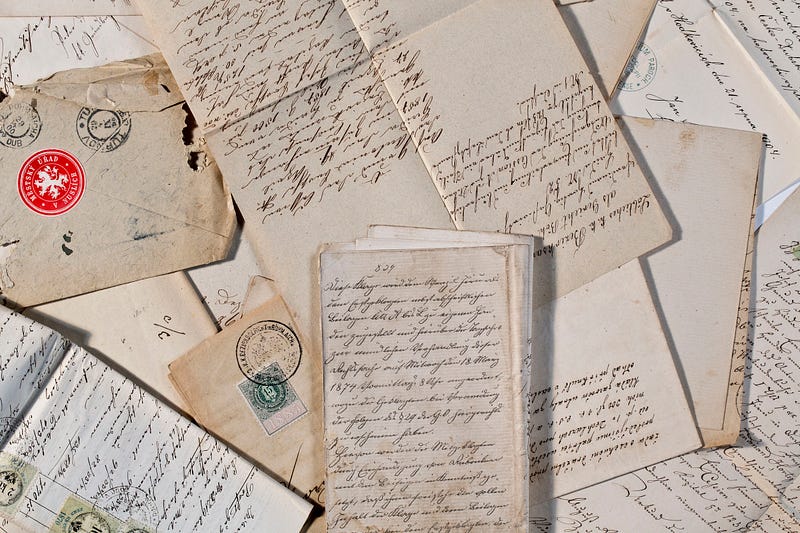
“We’re leaving as soon as possible to drive down to Reno to Bicky’s. We’ll stay overnight. She wants the Willa Cather letters back and asked that you deliver them in person so they don’t get lost in the mail.”
I was startled. “What do you mean she wants the letters back? They’re my letters. And besides, nobody but me is interested in them.”
“Well, you need to remember the letters belong to Bicky, not you. After all, they were written to Auntie Trix and Uncle Sid, Bicky’s parents. You will return them.” Trix was my great-aunt, my maternal grandfather’s sister. Bicky was my mother’s first cousin. They were all family.
“But Nana (my grandmother) had them and when she died, you found the letters in her things and gave them to me. Bicky never had them. She could have taken them from Trix a long time ago, even before Nana had them.”
But underneath the discussion of who gets the letters, those old feelings came up: undeserving, unworthy. After all, I was adopted. Maybe I didn’t belong in the family after all? Maybe I didn’t really deserve the letters.
Willa and Me
Trix had been one of Willa Cather’s schoolmates and friends. Trix’s husband, Sid Florence, was an officer of the Red Cloud bank. Much in the letters isn’t interesting, just requested business transactions to Sid and a few newsy tidbits to Trix. But I cherished the letters. I was the historian of the family and the biggest fan of Willa Cather.
I was the one who had read everything Willa Cather ever wrote. Death Comes for the Archbishop four or five times. My Antonia at least three times. All the short stories. And then read everything all over again while recovering from chemotherapy treatments. I was the one who had watched O Pioneers, with Jessica Lange playing Alexandra, at least three times.
I was the one who would go to Red Cloud, visit the Willa Cather Museum and the Willa Cather Center. Drive by the house Cather had grown up in and the Harling/Miner House, the prototype for the boarding house in My Antonia.
I was the one who would ask the Center for a copy of Sharon O’Brien’s recently published biography, Willa Cather: The Emerging Voice. O’Brien had been the first scholar to write openly about Cather as a lesbian. Of course, the Center didn’t sell the book. I was told they didn’t carry it because it told lies about Cather!
I already owned a dog-eared copy of the book and intuitively knew the Cather Center wouldn’t carry it. That was 1986. Fortunately, the Cather Center has become more progressive.
I was the one who would go to the Old Burial Ground in Jaffrey, New Hampshire to place a small rock on top of Willa Cather’s gravestone in the plot where her partner, Edith Lewis is also buried.
I was the one who has had a poster of Willa Cather hanging over my desk for the last thirty-five years.
I couldn’t imagine why Bicky would want the letters. But I stopped arguing, xeroxed a copy of the letters for myself, organized the originals in chronological order, and dutifully placed them in a large manila envelope labeled “Willa Cather’s Letters to Beatrice and Sydney Florance.
Yup, I didn’t deserve the letters. My Mother was right that we should “return” them to Bicky.
Giving Up “My” Letters
My Mother insisted we go in her car. She would drive. And drive she did! So fast I was afraid she’d get a ticket.
“Why are you driving over the speed limit?”
“We need to get to Bicky’s as fast as possible to return these letters.”
Really? Why the big rush? It’s not like we had stolen the letters from a bank vault and were being pursued by the FBI. Bicky knew we were coming with the letters. Had my Mother lost her mind? On the other hand, my Mother’s rush made me feel guilty that I had been given the letters.
As soon as Bicky opened the door, I handed her the letters. She offered us coffee and cookies. Explained how she knew an English professor at the University of Nevada who wanted to use these letters in his classes. Really? They weren’t about Cather’s writing. In this context, the letters were little more than a novelty.
And how on earth did Bicky know an English professor at the University? I knew she’d made up the story, not realizing that I also taught at a university and would know it was baloney.
Nevertheless, deep down I felt that unworthiness come up again. I didn’t deserve the letters. Again, I thought maybe I didn’t belong in this family? After all, I’d been adopted because my birth mother didn’t want me. Maybe this family didn’t want me either?
And this English professor was probably tenured while my job at Ohio State was just temporary. (I was teaching in the Women’s Studies Program instead of a department. The “rules” said programs couldn’t have permanent faculty.)
At the same time, I wondered: Why did Bicky want the letters?
Nana, Dad, and Willa
Nana, was born in Red Cloud where Willa had grown up. Her father, Albert, born in Winchester, Virginia would follow his friend George Cather, Willa’s uncle, to New Virginia. This “clannish” community of Virginians, located close to Catherton, was just a few miles from Red Cloud.
Two adventuresome young men, naive to farming on dry, rocky land where drought was more common than rain, had been tempted by 160 acres of free homestead land, 320 acres if you were married. Little did they know that life on the Nebraska prairies was tough. Really tough!
Nana’s Mother, my great-grandmother, Mary Frank Robinson, had come to Red Cloud from upstate New York as a young schoolteacher. She met Albert Wilson, married him, and stopped teaching as the law required of married women. Mary and Albert would raise three children: Vera, Maude, and Kenneth. My Grandmother, Vera, the oldest was born in 1888.
Albert died in 1901. Some say he fell in a well and drowned. Others believed he’d gone swimming in a pond too soon after eating lunch and drowned from stomach cramps. I’ve often wondered if he had taken his own life. A year later, Mary died. The couple left three orphans. Vera was just 12 years old.
After the burial, the children were put on the train for New York and lived with their mother’s relatives for a while. Eventually the girls, old enough to be on their own, returned to Red Cloud and lived in the Miner boarding house, the prototype for the Harling House in Cather’s My Antonia.
My grandfather, Frank Mizer, whom we all called “Dad,” was also born in Red Cloud. That the Wilsons and the Mizers had lived in the same small town where Willa Cather, a Pulitzer-Prize-winning 20th-century American author, had grown up was a proud part of the family’s heritage.
We all knew about Willa Cather and the Mizers.
After my Grandparents were married, Nana quickly became friends with Dad’s sisters Trix and Josephine. Along the way, the letters from Willa to Trix and Sid ended up with Nana.
That Dad’s sisters Trix and Jo had gone to school with Willa Cather!
That Willa Cather corresponded with Trix!
That Nana had lived in the boarding house featured in My Antonia!
Yes, the letters were a big deal. Nana, 15 years younger than Cather, didn’t care for her. Nana reminded me that Willa was gay and too intellectual for a woman. Nana hadn’t gone to college. Perhaps hadn’t finished high school. Willa graduated from the University of Nebraska.
Nana didn’t approve of unmarried women living in New York City while taking long vacations in Paris, spending weeks at the Shattuck Inn in New Hampshire while writing a novel about Nebraska. Such gallivanting about wasn’t proper.
Probably just as well that Nana didn’t know that Willa and Edith built a cottage on Grand Manan Island in New Brunswick. Women artists and writers from New York City would gather in the summer at the Inn at Whale Cove on Grand Manan, absent the company of men. None of Cather’s books found a place in Nana’s bookcase. I have my Mother’s 1956 edition of Death Comes for the Archbishop.
Despite Nana’s dislike of Willa Cather, she inherited the Cather letters.
How Did “My” Letters End Up in New Jersey?
In 2013 Knopf published The Selected Letters of Willa Cather. I bought the book immediately, read a bunch of letters, and then perused the index, never dreaming that “my” letters would be in this volume. I was wrong.
Of the 556 letters chosen from more than 3,000 letters, six were written to Sid and one to Trix, plus a few letters in which Trix or Sid are mentioned. So where did Andrew Jewell and Janis Stout, two editors living in Nebraska, find “my” Cather letters? Had they found all “my” letters and chosen just a sample?
Not surprisingly, it was all about money. A wealthy graduate of Drew University in Madison, NJ had a passion for Cather. Barbara Morris Caspersen, a 1991 graduate, and her husband Finn dedicated themselves to buying all the letters and other writings they could find by Willa Cather.
The Caspersen’s collection, worth thousands of dollars, was given to Drew. With this generous gift, Drew University now boasts a major Willa Cather archive. (In March 2020, one could buy a single letter from Cather on eBay for $2,500.)
It’s my guess that Bicky gave the letters to one of her sons who then sold the letters to the Caspersens. My plan had always been to give the letters to the Cather archives at the University of Nebraska. It never dawned on me that I would sell them. Much less give them to a university in a place Cather had never lived nor visited.
I’m pleased that the letters are in a permanent collection in a university archive, not buried in a bank vault, stuffed in an old attic trunk, or auctioned off to the highest bidder. But the deceit involved in asking me for the letters hurt my feelings.
That the letters didn’t end up in an archive in Nebraska, or New Hampshire where Cather spent summers writing, or New York where she and her partner Edith Lewis lived for many years is disappointing.
Not that my sense of “right” means much in the world of university archives. Not all of Einstein’s papers are at Princeton. Not all of Bach’s music in Leipzig.
What’s the Meaning of This Adoption Story about Unworthiness?
The most distressing part is not that I didn’t get to keep the letters. Not that I couldn’t leave them to my son Stephen who had little interest in them.
Losing the letters triggered that uncomfortable but common feeling of being undeserving. I wasn’t worthy of the letters. Feeling undeserving remains a shared challenge of many of us who are adopted.
And for me, it was a triple whammy!
Nana, never adopted, was an orphan until she married. She felt she didn’t deserve cake on her birthday nor presents at Christmas. My Mother would inherit this same sad trait, sometimes returning presents. Or complaining that the wrapping of a present was too nice. I would inherit the feeling of not deserving from the two women I was closest to.
This learned behavior reinforced that early rejection by my birth mother. Rejection often leads to feeling undeserving, especially for adopted women. Intellectually I knew I deserved the letters and would have seen to it they were given to the appropriate archives. (Of course, I wouldn’t sell the letters. I didn’t deserve the money.)
What one understands and believes intellectually often pales in comparison to what one feels, especially for those of us who’ve been adopted.
Reframing: Your Solution to Release Feeling Unworthy
Suppose I had felt worthy of the letters. Suppose my Mother had felt I was worthy of letters. What if I had immediately written to the archivist in charge of the Cather papers that I would be giving the letters to the University of Nebraska.
What if I had said to my Mother, “Tell Bicky it’s too late. The letters have already been promised to University of Nebraska where they belong.” What if I had then xeroxed them, arranged them chronologically, put them in the manila envelope addressed to the Cather Archives in Nebraska instead of handing them to Bicky?
The past doesn’t change what’s been done, but it’s a powerful way to practice a positive response to an emotion such as “unworthy.” To practice a scenario in which you follow through with your desires rather than caving into someone else’s demands.
Always notice your feelings as you reframe a situation that you could have responded to from a positive place. At first it may be scary and uncomfortable. You might even cry. Do it several times. Notice as it gets easier and you begin to feel stronger.
Originally published at https://livingwithadoption.com on May 12, 2020.
Watch for my forthcoming book, Oh Look, There’s a Squirrel and Other Stories.
If you’d like to be added to the list to receive a free copy of a short e-book, “9 Tips for Readable Writing” and a free review of one piece you’ve written (no longer than 1,500 words), send an email to [email protected].


