
How The Hustle Became a $27 Million Newsletter
And what’s holding them back from further growth
I recently wrote about Morning Brew, the newsletter that covers updates in the business and tech industry. Founded by two college students in 2015, Morning Brew grew rapidly and was sold in 2020 to Business Insider. The deal valued Morning Brew at $75 million.
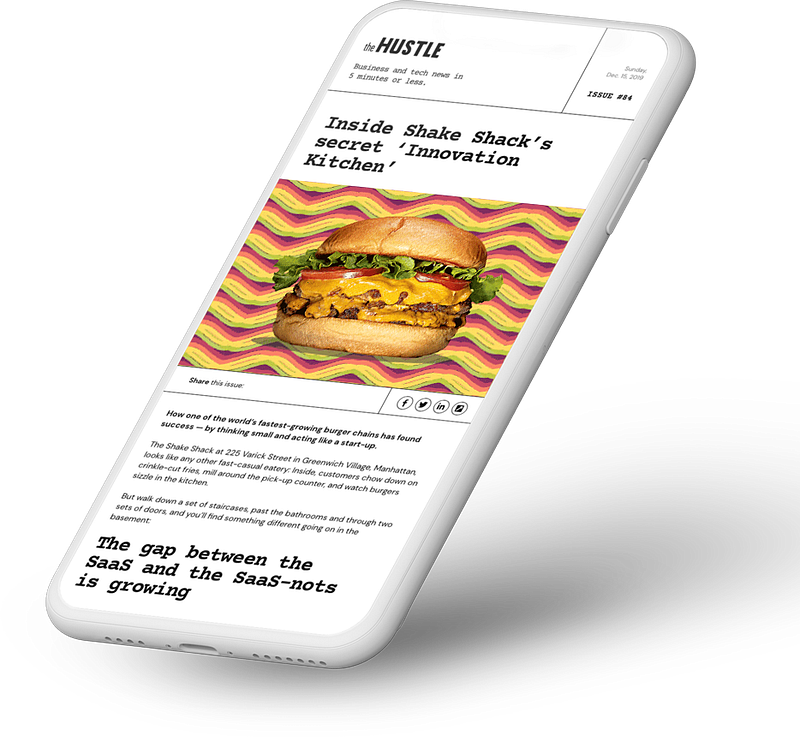
Morning Brew is not the only newsletter founded in 2015 that has amassed widespread success. Another 2015-established newsletter, The Hustle, was recently acquired in a deal that valued the company at an estimated $27 million.
Sure, $27 million is a bit smaller than Morning Brew’s $75 million valuation. But if you were Sam Parr, the founder of The Hustle, would you be complaining? Probably not. With nearly two million global readers, Sam Parr’s creation has become a superstar in the world of business news.
But is the platform really sustainable? Sam Parr thinks so, but there might be a few reasons to think otherwise.
Let’s take a look at the history of The Hustle. Along the way, we’ll look at another premium feature that Sam Parr created and see whether Parr’s premium pricing model is working.
300 Subscribers, a Conference, and Weird Content
The Hustle began with 300 subscribers. But, to be more accurate, it wasn’t actually called The Hustle then. After years of trying different ventures —including a hot dog stand and an online shop for moonshine — Parr joined forces with entrepreneurs Erik Bahn and Elizabeth Yin in San Francisco, CA. Bahn and Yin had already founded HustleCon, an entrepreneurial email list with 300 subscribers.
Parr decided to turn HustleCon into an actual conference for entrepreneurs, and he sold 400 tickets in seven weeks to generate $60,000 in revenue. With the birth of the conference came the creation of The Hustle, a newsletter that featured a wide variety of articles by a small team of writers.
How wide of a variety was the content? One of the initial articles was a writer’s self-experiment of living off of Soylent for 30 days. Another writer discussed his experiment of taking LSD each day for a month.
With its offbeat, weird content, Parr’s newsletter started to gain traction. And the rest is history, of course.
Sort of. Well, not really.
If you know anything about Sam Parr, it’s that his career trajectory looks more like a labyrinth than a straight arc. Success came slowly for The Hustle, and Parr realized that his small team couldn’t just publish articles that featured them starving themselves or doing drugs.
Parr shifted The Hustle to a business-only newsletter, focusing on updates, trends, and new ideas in the business world. His newsletter was growing, but it wasn’t the sustainable model he wanted.
To overcome the issue of sustainability, Parr and his team created Trends.co, a private community dedicated to exploring new business opportunities and innovative ideas.
Trends.co
Both The Hustle and Morning Brew are similar in terms of content, targeted consumers, and even layout and design. Where they differ, however, is in Trends.co.
Morning Brew does have a premium newsletter called Light Roast, but the only way that users can unlock Light Roast is by referring other members. If a member refers three new readers, they then receive access to Light Roast.
Trends.co is a bit different than Light Roast. Instead of being a premium newsletter, Trends.co is an actual community where subscribers can interact and network with entrepreneurs. As the platform states, Trends.co is like “Netflix for entrepreneurs.”
For $299, a subscriber can use Trends.co for one year. And with the 6,752 members that currently subscribe to the platform, Sam Parr’s creation is bringing in over $2 million per year.
Not too bad for an entrepreneur that once sold hot dogs from a cart in San Francisco, right?
But the premium feature might not be quite as good as it sounds. As any marketing guru would note, there can be pros and cons to employing a paid platform like Trends.co.
Premium Comes at a Cost
The Hustle is completely free, and the fact that nearly two million users now subscribe to the newsletter shows that the system is working. But Trends.co — The Hustle’s premium feature — might not provide the sustainability that Sam Parr hoped for.
Trends.co is a classic example of premium pricing. As ProfitWell states, premium pricing is “a strategy that involves tactically pricing your company’s product higher than your immediate competition. The purpose of pricing your product at a premium is to cultivate a sense in the market of your product being just that bit higher in quality than the rest.”
There are quite a few benefits that come with premium pricing. First, the profit margins that come with premium prices are steep. Trends.co likely costs Parr’s team very little, but the markup on the service — at $299 each year per subscriber — is high. And with a yearly revenue exceeding $2 million, it’s difficult to say that the system is flawed.
The second benefit of premium pricing is that it can raise consumer perceptions of the product. The price of $299 gives an impression of exclusivity surrounding Trends.co; the higher the price, the more consumers feel that they’re part of a select group.
As an article from Chron states, “The goal is to create the perception that the products must have a higher value than competing products because the prices are higher. The company is betting that the consumer will not investigate to find out if the product is truly a higher-quality item.”
Although benefits exist, the costs of premium pricing are high. The main disadvantage of premium pricing is that it relies on an inelastic consumer demand point. There must not be any alternatives, because if there are then consumers will choose the cheaper, more affordable option. If the product is the only one of its kind, however, then consumer demand is inelastic and the higher price is justifiable.
With the spread of COVID-19 and the rise of unemployment, consumers may be less willing to spend money on a premium product. This will directly hurt Trends.co, reducing a portion of the market for the foreseeable future.
Another disadvantage of premium pricing is that it cannot be marketed to mass markets. As ProfitWell explains, “Premium pricing limits your ability to sell your product to a mass market…[you’re] voluntarily pricing out some of your market share.”
This is the greatest problem that The Hustle faces. By offering a premium service, the company has potentially turned away a large portion of their market.
Morning Brew, The Hustle’s largest competitor, has intentionally avoided paid products and services. Everything at Morning Brew is “free,” even the premium content that can only be unlocked through referrals. Morning Brew does not have an equivalent of Trends.co, but that has evidently not hurt the company.
Perhaps, in the end, The Hustle would be better off by focusing solely on the newsletter. If the platform had a referral program like Morning Brew, the newsletter might become more sustainable and not be reliant on Trends.co for additional revenue.
Conclusion
This article is about The Hustle — but, in reality, it’s truly focused on Trends.co. I began this article with the mindset that it would reflect a positive review of The Hustle, but I discovered that Trends.co has changed the entire nature of the platform.
The premium service brings in over $2 million each year, but the pricing strategy may prove to be a barrier to growth in the future. The Hustle wants to grow to the market size of Morning Brew, but 6,500 subscribers with Trends.co just won’t cut it. $27 million is a hefty price tag, but the numbers aren’t necessarily there to support the acquisition.
If Sam Parr wants The Hustle to continue growing, the newsletter should be his main priority. Just as Morning Brew became a $75 million company through a formidable referral program, The Hustle can achieve greater growth by focusing on non-paying members.