
How Morning Brew Became a $75 Million Company in 5 Years
A deeper look into the company’s road to success
Like many college students, Morning Brew is my go-to source for business news and updates.
In fact, it’s not a huge stretch to say that I first realized the possibilities of writing as a career through Morning Brew. Before I knew about the company, making money from writing always seemed too foreign and improbable.
After all, it’s hard to make money by writing. It’s difficult to create a career from just words.
But Morning Brew’s founders did it.
In the span of five years, Alex Lieberman and Austin Rief were able to turn a college project into a multi-million dollar company.
Here’s how they did it.
Here’s how you could do it too.
The Timeline
As a senior majoring in finance at the University of Michigan, Alex Lieberman understood the importance of following business news. But there was a slight problem: Alex found most news sources to be dry and difficult to read.
Alex began to ask his friends where they went to receive business news and updates. Their answers gave him an idea.
As Alex told Ask a Genius:
“Every single student would have the same canned answer, something to the effect of, “I read the Wall Street Journal and I read it because I feel like I have to, because it’s a way of saying ‘I’m well-read in business.’ But it’s dense and it’s dry and I don’t have enough time in my day to read it cover to cover.”
This is crazy! These kids work their asses off to have careers in business, yet they don’t have content that really tells business news in an engaging way. So I started writing a business roundup.”
Alex’s writing list — originally called “Market Corner” — began with 45 students and quickly grew to a thousand readers. Alex then invited another student, Austin Rief, to become the co-founder.
With the help of a handful of other college students, Alex and Austin ran the newsletter part-time for two years. The newsletter continued to grow, evolving from “Market Corner” to “Morning Brew.”
At the same time as writing the daily updates, Alex managed to work for Morgan Stanley in New York City. Austin was still in school and continued to balance the newsletter with his classes.
In September of 2016, Alex quit his job at Morgan Stanley to work on the newsletter full-time. Austin also began working full-time when he graduated from Michigan in May of 2017.
Switching to work full-time on Morning Brew has paid off for Alex and Austin:
- Today, Morning Brew employs 60 people.
- Their revenue this year is projected to reach $20 million.
- They have three million email subscribers.
- They were recently acquired, with a company valuation of $75 million.
Hold on.
Yes, you read that right.
Seventy-five million dollars.
Surprised? In just one year of part-time work and four years of full-time work, Alex and Austin were able to take Morning Brew from a college project to a $75 million company.
A Specific Solution
Alex Lieberman and Austin Rief saw a problem and created a specific solution. The problem? College students viewed traditional business news sources as boring. The solution? Create a short newsletter to highlight business updates in a concise, easy-to-read manner.
Alex and Austin didn’t try to reinvent the wheel. They didn’t seek alternative news stories or try to create a new style of investigative journalism. The co-founders simply took business headlines from The Wall Street Journal and The New York Times and consolidated the articles.
It’s a simple solution — seemingly too simple to be successful. But sometimes simple solutions can provide the best results.
In addition to creating a specific solution, Austin and Alex targeted a specific audience base. Morning Brew was not created for the middle-aged banker or gray-haired CEO — it was created for college-aged readers who wanted to stay on top of current events without spending too long reading traditional newspapers.
Determining your specific solution and defining your niche audience is key to marketing your product and service.
Navigating Risks
A crucial step in Morning Brew’s growth was when Alex Lieberman quit his job with Morgan Stanley to begin working on the newsletter full-time. Making that leap into entrepreneurship required careful planning and an analysis of any potential risks.
The possibility of quitting a budding career in finance seems daunting, doesn’t it? But for Alex Lieberman, leaving Morgan Stanley wasn’t necessarily a difficult decision.
Alex explains the choice in this way:
“I think what holds people up from quitting their jobs is risk aversion, like what if it doesn’t work out? When I look back on my life at age 80, I’m not going to look back at quitting my job at Morgan Stanley. I’ll probably be senile and not even remember working at Morgan Stanley.
I asked myself, what is the worst-case scenario? I started walking through these ‘then what’ scenarios. That was the point when I decided that I was early in my career, I’m intellectually curious and feel like I can learn anything along the way. I actually need to give this a shot.”
If you have created a product or service and are exploring the possibility of pursuing the project as a full-time career, you need to understand the possible risks of failure. What is the worst-case scenario?
If taking the leap from part-time to full-time will cause your company to succeed, then you need to take that leap.
Referral Strategy
At Morning Brew’s inception, marketing growth was solely conducted on a word-of-mouth basis. College students would tell their friends about the newsletter, those friends would tell their friends, and so on.
Although this pattern of growth worked initially, Alex and Austin wanted to grow Morning Brew faster. What marketing avenues would cause growth to skyrocket?
To answer that question, the co-founders looked at the incentives behind their service. The incentive for students to read the newsletter was that they would stay updated on business news. But what was the incentive for those students to tell others about the newsletter?
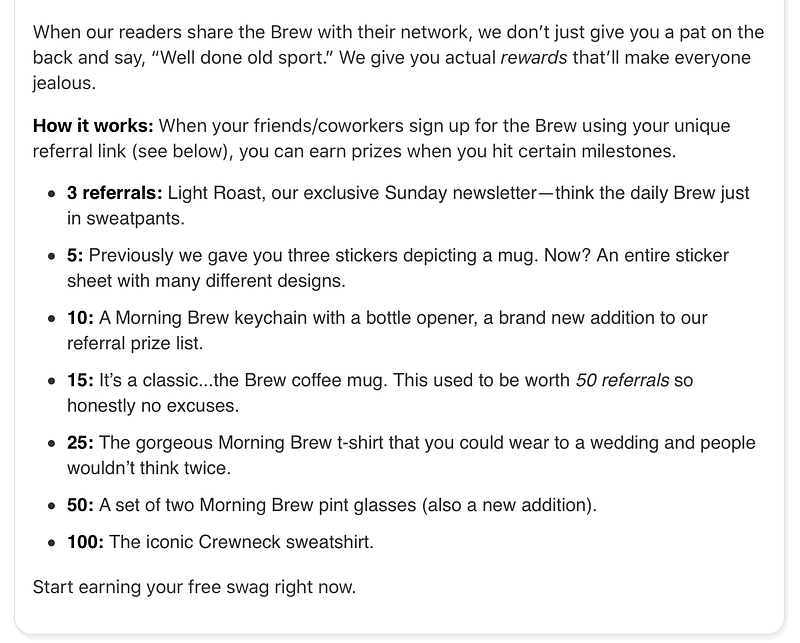
To create an incentive for readers to share Morning Brew with their friends, the co-founders implemented a referral system. When a reader sent Morning Brew’s online link to other readers, they could receive free prizes.
Here’s the referral breakdown, courtesy of Morning Brew’s website:
How can you incentivize your readers to share your service or product with others? What referral tactics can you employ to allow your readers to do the marketing for you?
Sponsorship
As an online newsletter with a growing subscriber base of over three million readers, Morning Brew has tremendous advertising potential for other companies.
Most of Morning Brew’s $20 million revenue comes solely from sponsorships.
If you take a look at the daily newsletter, you’ll see a wide variety of sponsors:
- November 5, 2020: Sponsored by Whoop.
- November 4, 2020: Sponsored by Skillshare.
- November 3, 2020: Sponsored by DiversyFund.
- November 2, 2020: Sponsored by PolicyGenius.
- October 31, 2020: Sponsored by Cariuma.
You get the idea.
The key here is that Morning Brew’s value does not only come from the company itself — instead, much of its perceived value is in what Morning Brew can offer to other companies.
As The Wall Street Journal points out:
Newsletters, including those operated by companies like Morning Brew, theSkimm and traditional media outlets, are viewed as attractive, partly because they can help companies expand the reach of their content and recruit new subscribers. Newsletters often command higher advertising rates than traditional display ads in news articles because they allow advertisers to reach engaged users directly in their email inboxes.
For marketers who are growing email lists, it’s important to understand that a readership base can be immensely valuable to other companies. If you’ve already found readers or subscribers, other companies will gladly pay you for the chance to advertise to those readers.
How can you leverage your audience to your advantage?
Acquisition
In October of 2020, Morning Brew was acquired by Insider Inc., the parent company to Business Insider. Although it’s unclear how much Insider Inc. paid for the company, the deal values Morning Brew at $75 million.
It’s a fairy-tale ending, isn’t it? Five years after its inception as a college project, Morning Brew is now the greatest testament to American entrepreneurship and ingenuity.
If anything, Morning Brew’s historic ascent should encourage budding entrepreneurs and business leaders. If Alex Lieberman and Austin Rief were able to build a $75 million company from nothing, why can’t you?
There’s nothing stopping you from building your project into something substantial.
Breakdown
What does the story of Morning Brew teach us? Let’s take a look at the lessons the company has to offer:
- Chart out your timeline — develop a clear plan.
- Know what problem you’re solving and find a clear, specific solution.
- Understand the risks and hurdles that lie in the way. How can you overcome those barriers?
- What strategies can you employ to have your audience do your marketing for you? Is a referral plan feasible?
- How will other companies find your audience attractive? Once you’ve built a fanbase, can you market that group to another company?
- If other companies find your project to be valuable, is acquisition an option that you would accept? If so, how much control and ownership are you willing to forfeit?
We might not all be able to turn our projects into $75 million companies. But by looking at these lessons and answering these questions, we can begin to add value to our future endeavors.