
How the Haitian Revolution, the German Coast Uprising, and the Nat Turner Revolt Changed America
The Fear of Revolution Caused Evolution, Though Not Always in a Good Way
Before America was America, the country feared the rebellion of Black people. One initial fear was that the Black enslaved might join forces with Blac and white indentured servants as they did during Bacon’s Rebellion in 1676. After those combined forces burned down Jamestown, then the capital of Virginia. The nation’s entire economic model was changed to eliminate indentured servitude and place Blacks on the lowest rung of the American caste system.
The early 1700s saw the introduction of slave patrols, the predecessor of modern police forces. Equally as important as returning any runaway enslaved was ensuring they had no weapons, didn’t congregate in groups, and had no means to contemplate revolt.
“I [patroller’s name], do swear, that I will as searcher for guns, swords, and other weapons among the slaves in my district, faithfully, and as privately as I can, discharge the trust reposed in me as the law directs, to the best of my power. So help me, God.”
North Carolina Slave Patrol Oath
When word of Black revolutions anywhere occurred, whether in this country or not. Fear swept the land, and more restrictions on Black people were imposed. This was true after the New York Slave Revolt of 1712, the Stono Revolt of 1739, and the New York Slave Conspiracy of 1741. Generally, Black people were forbidden to read and write as literacy meant more excellent knowledge of other revolutions and increased their ability to coordinate and strategize. However, more than 20 white people were killed during the Stono Rebellion in South Carolina. It wasn’t until the Haitian Revolution began in 1791 that fear truly swept the nation’s white population. Wherever there were large numbers of Black people, free or enslaved, there was fear that any trigger could set them off.
The Haitian Revolution was different as it was an example of a successful slave uprising where Black people won their freedom from their white masters. In the American South, enslaved people often greatly outnumbered white people. Northern cities like New York had already seen revolt; in New Jersey, a planned revolution was uncovered in 1734 involving as many as thirty enslaved people; individual acts of defiance and sometimes murder occurred in every colony and later states. Each one was believed to be the precursor to a massive revolt. However, the Haitian revolt was an example of what America feared most: freedom obtained through revolution.
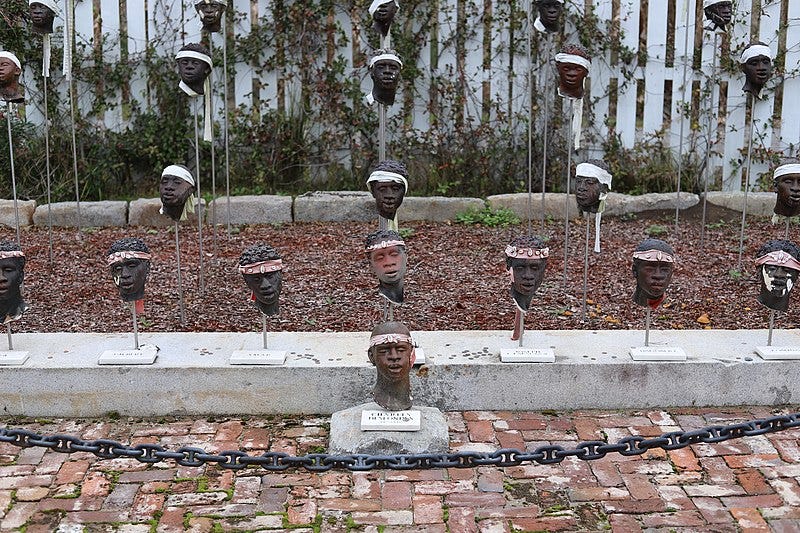
You probably haven’t heard much about the German Coast Uprising in 1811, and intentionally so. Covering up Black History didn’t begin in the 2020s in Florida. Over 500 slaves took up weapons and marched on New Orleans before being stopped. Did history cover up the revolt, or the fact that Black heads were placed on pikes as a warning against future revolts.
By the early 1800s, America was a powder keg. Gabriel Prosser’s planned revolt was uncovered, and over 35 leaders were executed. Denmark Vesey hoped to lead over 7,000 Black people in rebellion, but his plot was uncovered and stopped in 1822. In 1829, Irish immigrants attacked Blacks who’d crossed the River Jordan to Ohio over fights for scarce jobs. Abolitionist groups utilized new technology to publish pamphlets advocating freedom for the enslaved, distributed to Black and white people. The fear and hatred among slaveholders extended to abolitionists and the enslaved.
When Nat Turner led his revolt in 1831, killing 55 white people, it was more than America could stand. The fact he remained free for two months after the initial attack was quelled only heightened the fears of those who imagined Turner with a machete behind every corner. He was allegedly sighted in several states, though, in reality, he never went more than a few miles from where he started.
Because Nat Turner was responsible for killing so many white people and was for two months a boogeyman imagined to be everywhere. The hysteria created was felt throughout the land. Laws were again changed, and every Black enslaved person was suspected of being ready and willing to kill their white master and their families. Free Black people were seen as coconspirators.
Tensions did not fade as the questions about slavery and what to do with the Black population, now approaching four million, swept the nation by the years approaching the Civil War. Even the abolitionists disagreed as to what to do. Some favored immediately freeing the enslaved, and another camp wanted to export them all to Liberia or Central America. Abraham Lincoln was in that second camp.
The Haitian Revolution and Nat Turner’s Revolt considerably changed America. It would be nice to believe their effect wasn’t lasting and had been relegated to history, but the fears created in the early 1800s still exist today. The same motivations and fears are behind the laws that prohibit gatherings of protesters and “anti-riot” legislation. It’s why voter suppression never disappeared, and every Black organization, ranging from the NAACP to the Black Panther Party, needed to be infiltrated and suppressed. It’s why Martin Luther King, Jr, Malcolm X, Fred Hampton, and others were assassinated.
Fear of Black people can be found in the tenets of MAGA as much as the Neo-Nazis and white supremacists that publicly proclaim what MAGA whispers. It was the mantra of the Democratic Party until most of that ilk found solace in the Republican Party when Democrats implemented too many Civil Rights Acts. Racists departed not for a generation, as LBJ once theorized, but for what may be a lifetime.
The Great Replacement Theory targeted Blacks and Native Americans long before it was applied to the Jewish people. The fear of Black people, especially after the Haitian Revolution and Nat Turner, changed America, and the “Negro Question” has never been answered. Any individual or group coming from the Black community has needed to be stopped, ironically, by any means necessary. They accuse Barack Obama of dividing America when, in truth, his existence exposed it.
Many moments in time impacted race relations to different degrees, and the Haitian Revolution and Nat Turner’s Revolt are the most prominent among them. The George Floyd-related protests saw white people leading the movement against police brutality, qualified immunity, and murder or unarmed Black people. Progress is slow but ongoing. Perhaps that moral arc is bending toward justice after all.


