
The Haitian Revolution And How It Changed The World
America Banned Enslaved People From Reading To Keep Them From Duplicating It
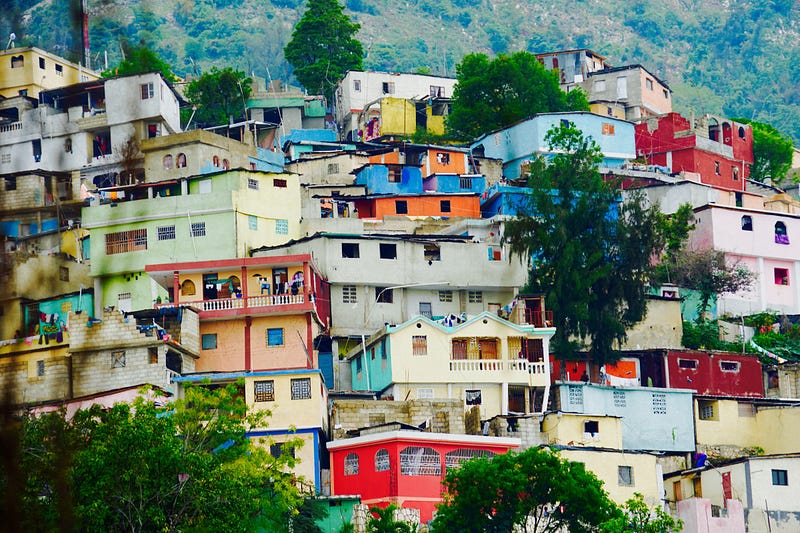
I’m old enough to remember when Black History Month was only Black History Week. Not only was the whole history of Blackness able to be condensed into five school days, there were apparently only seven or eight stories worthy of being told which we learned about year after year as if there were nothing else to discuss. One of those stories was about Toussaint Louverture, the Haitian general who fought the French for Haiti’s independence. The ripple effect the Haitian revolution had in America and worldwide was never taught in my schools.
As a refresher, let’s go over the basics of what happened. The Haitian Revolution was the only successful uprising of enslaved people that resulted in a new state led by truly independent People of Color. The participants were Black people, people of mixed Black and white ancestry (still considered Black people), and some French, Spanish, and British citizens who had reasons to side with the enslaved people. The most famous leader to emerge was Toussaint Louverture, who had gained military experience fighting for the French, which he then used against them. The revolt began on August 22, 1791, and ended in 1804, with Haiti gaining its independence. It was an example that colonizers worldwide didn’t want to be set, pushing back hard.
At the time, Haiti’s population consisted of about 40,000 white Europeans, about 28,000 mixed raced people along with free Black people, and an estimated 452,000 enslaved Black people. Compared to their white owners, the high percentage of Black enslaved people was mirrored on many American plantations, which helps explain why white Americans and Europeans freaked out as they did after a successful Black revolution. In my classes, Haiti’s independence was the end of the lesson.
In this story, it’s just the beginning.
It’s important to know how important Haiti was to France. France's money from sugar and other crops from Haiti was equivalent to all the goods sent from America to Britain. An average of six hundred ships per year left Saint-Domingue (Haiti’s previous name) for the port city of Bordeaux, France. Millions of French people depended directly or indirectly on Haitian goods to maintain their style of living. It wasn’t easy out there, being an enslaved Haitian, between malaria and yellow fever. The death rate exceeded the birth rate, which required the constant replacement of fresh enslaved people. Almost all of them came directly from Africa, and they tended to be less indoctrinated than domestic enslaved people raised in bondage.
It would take a book-length essay to describe the various ebbs and flows of the Haitian Revolution, but in essence, Toussaint Louverture wasn’t initially involved with the uprising but quickly established himself as a leader after joining. The war between Britain and France aided his success. This kept France from dedicating more resources to the conflict. Louverture knew that France would try to reassert control over Haiti once freed of their conflict with Britain. He established treaties with the French and secretly with the British to maintain the balance that kept Haiti from being overrun. Haiti had significant trade with both countries and America. Louverture was a bit paranoid in his dealings with Europeans, but that didn’t mean they weren’t out to get him. In 1802, Toussaint was invited to a French general meeting, where he was arrested and jailed. He died in captivity in 1803 after enduring constant interrogation because he was suspected of plotting an uprising. Haiti would finally gain its independence the following year.
America proved highly changeable in its reaction to the Haitian Revolution. Sometimes America supported the French in suppressing the revolt, and others supported the rebels. Haitian independence wasn’t officially recognized by America until 1862, fifty-eight years after it actually occurred. America initially rushed to the aid of the French when the revolt broke out in 1791. Two years later, Britain and Spain both invaded the island, with everybody looking to take advantage of Haiti’s lucrative sugar production.
America immediately saw the risk to themselves if enslaved people revolted similarly. Thomas Jefferson was reportedly terrified by “French Negroes.” Charleston, South Carolina, America’s leading port of entry for enslaved people, restricted the entry of Black mariners. There was a small revolt in Pointe Coupee, Louisiana, after the arrival of Haitian refugees in 1795. Virginians felt Gabriel Prosser’s Rebellion in 1800 was in response to the Haitian Revolution. When Thomas Jefferson became President in 1801, he acted on his fears.
I need to take a second to credit the Thomas Jefferson family and America in general for perpetuating one of the greatest public relations campaigns in history. They would have you believe that while yes, he happened to own enslaved people, many of whom he inherited or obtained through marriage. And he was yet a kind and benevolent owner who treated his people well, only occasionally needing to set an example so he wouldn’t have to punish them again. Not wanting to tarnish Jefferson’s image, historian Edward Betts covered up letters he discovered showing Jefferson allowed the teenage enslaved boys who worked in Monticello’s nailery to be whipped to increase productivity.
Jefferson is personally responsible for eliminating the international slave trade, which sounds good. But he did it as a form of protectionism to increase the value of domestic enslaved people, of whom he was one of the nation’s largest owners. The increase of domestic enslaved people’s production was often the result of forced pairings and the rape of Black women. I’ve tried not to mention his continual rape of Sally Hemings beginning at age fourteen. The family denied the relationship for decades until DNA proved otherwise. Now it’s promoted as a consensual relationship. I ask, “Could a fourteen-year-old enslaved girl, legally or otherwise, refuse?”
The law established by the Virginia House of Burgesses made any child of an enslaved woman also enslaved, absolved fathers of any responsibility, and effectively legalized rape. That happened before Jefferson was a member, but he made good use of Monticello’s law throughout the land. When you take the tour of Monticello, your guides will tell you how conflicted Jefferson was about enslavement though he owned up to four hundred slaves. They curiously leave out the other two hundred he owned at other properties and that over his lifetime, he freed only two of them, one of whom had to pay $200 for his freedom.
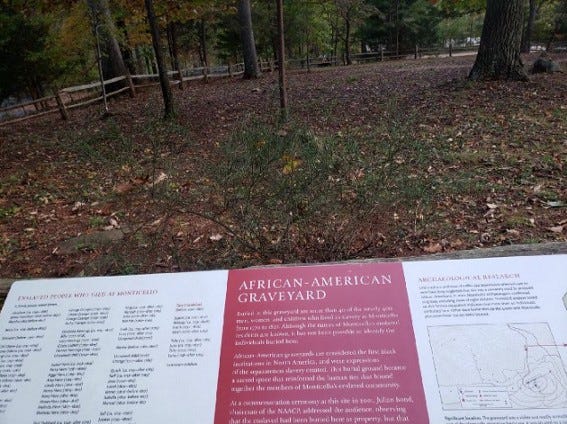
Almost all those remaining at Monticello after Jefferson’s death were sold to pay off his debts. Jefferson’s family members have a fine cemetery with raised headstones, obelisks, and tombs. No enslaved people are buried there. There exists an African-American Graveyard where a few stones show where some of the bodies are buried, and all graves are unmarked. There is a plan to upgrade the African-American Graveyard in 2021, so there’s that.
As early as 1791, while he was Secretary of State, Thomas Jefferson wrote to Lafayette regarding the Haitian Revolution, encouraging him to reverse the effects of the Haitian revolution:
Behold you then, my dear friend, at the head of a great army, establishing the liberties of your country against a foreign enemy. may heaven favor your cause, and make you the channel thro’ which it may pour it’s [sic] favors. while you are exterminating the monster aristocracy, & pulling out the teeth & fangs of it’s associate monarchy, a contrary tendency is discovered in some here. a sect has shewn itself among us, who declare they espoused our new constitution, not as a good & sufficient thing itself, but only as a step to an English constitution, the only thing good & sufficient in itself, in their eye. . . . what are you doing for your colonies? they will be lost if not more effectually succoured. indeed no future efforts you can make will ever be able to reduce the blacks. all that can be done in my opinion will be to compound with them as has been done formerly in Jamaica. we have been less zealous in aiding them, lest your government should feel any jealousy on our account. In truth, we as sincerely wish their restoration and their connection with you, as you do yourself.
When Jefferson became President of the United States in 1801, Jefferson cut off the little aid America was giving to Haiti and did what he could to isolate them. Protecting the institution of slavery in America was his primary goal. After Toussaint Louverture died in prison, Jefferson became even more aggressive with his successor, Jean-Jacques Dessalines, who had apparently gone too far when he executed some white people after Napoleon tried to reconquer Haiti and reimpose slavery. After being beaten back, Napoleon sold the United States a huge territory in the Louisiana Purchase at a bargain price because he wanted no more to do with rebellious enslaved people. Frankly, the territory of Louisiana had too many Black people.
The Haitian Revolution is thought to have inspired the Nat Turner Rebellion in 1831, among others. These revolts led to the harsh treatment of enslaved people, including increased corporal punishment and the banning of literacy. This increased the divide between those who approved of enslaving people and those who opposed it.
Fears of what would happen if enslaved people were ever freed occupied the minds of American leaders. As Thomas Jefferson said in 1820, “We have the wolf by the ear, and we can neither hold him, nor safely let him go.”
J.B. Lyon of Pennsylvania wrote the following in 1861, referring specifically to the Haitian Revolution that had occurred over half a century earlier:
A correspondent asks (in good faith) what shall be done with the slaves of our Southern States, if they are suddenly emancipated? He says that a great many would be in favor of that course if they knew what to do with them. As the difficulties of war gather before us, I also hear that question asked by very many who see in emancipation the only chance of peace and permanent union. But to let loose on those whom we so lately called “our Southern brethren” a repetition of “the horrors of St. Domingo,” is what none of us feel disposed to do. We feel no disposition to surrender our own race to the knife, to the lust and cupidity of African barbarism. You see we don’t know any better than to imagine that emancipation would result in the utter extinction of civilization in the South, because the slaveholders, and those in their interest, have persistently for a half-century told us that such would be the effect of making the negroes free; and they always instance the “horrors of St. Domingo” to show the inevitable result of emancipation.
When being taught “Black History” in my Minneapolis classrooms over the years, I got the graphic novel version of the conflict, including animated pictures. There was no mention of the atrocities committed against enslaved people and the response throughout the white universe to a “Black” country winning its freedom. France didn’t recognize Haitian independence until 1825; the United States, as previously stated, waited until 1862. In response to the Haitian Revolution, slave patrols were increased and literacy for enslaved people was banned in more locations. A case can be made that without the Haitian Revolution, there would have been no Civil War. How long would it have taken for the enslavement of Black people to end without it? The Haitian Revolution helped lead to the end of enslavement in Britain and other European nations. In other nations like Portugal and its colonies, it led to crackdowns and harsher treatment of the enslaved.
Now Black History has a month instead of a week. I’m nowhere near a classroom to see what is being taught and how. I can only hope and pray that justice is being done to the legacy of Black people in America and around the world. The more Black and white people learn about the past, the closer we can achieve racial justice and equality. The next step will be to treat Black History, not as a separate thing but to place it in its proper place in American and world history. I think it’s time to stop taking baby steps and to replace propaganda with facts. Wouldn’t that be nice?


