
How The Samurai Concept of “Pen & Sword” Can Help You Live a Winner’s Life
Balance is key.
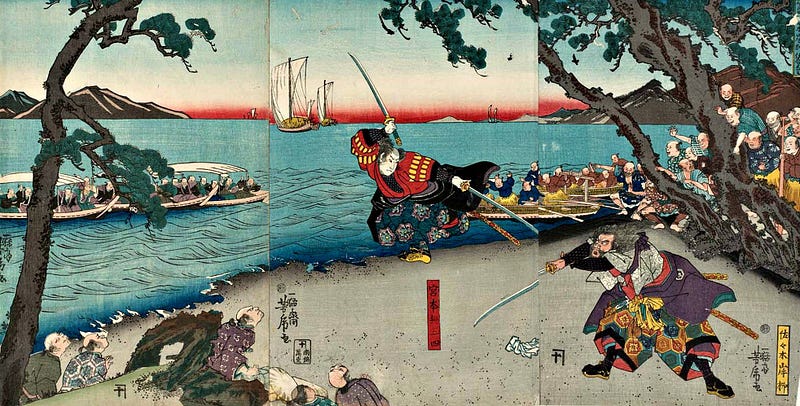

The samurai fascinate me because they were not just cold-blooded killers. They were warriors when the situation called for it, yes, but outside of combat, they were poets, painters, craftsmen, artists. They were in short, learned men with the ability to kill.
One, in particular, stands out. His name is Miyamoto Musashi, a samurai who was undefeated in upwards of 61 duels, many of them to the death. However, what makes Musashi special was he wasn’t just an expert swordsman — he was also an acclaimed artist. Musashi forged his own weapons, opened a school of swordplay and painted beautiful black-ink watercolours, many of which are now considered national treasures in Japan.
Towards the end of his life, Musashi wrote The Book of Five Rings, a treatise explaining his views towards fighting, strategy and life. In the very first chapter, Musashi recommended those who wish to learn from him to “live with pen and sword in accord.” He wrote:
“It is said the warrior’s is the twofold Way of Pen and Sword, and he should have a taste for both Ways. Even if a man has no natural ability he can be a warrior by sticking assiduously to both divisions of the Way.”
— Miyamoto Musashi, The Book of Five Rings
This concept is not just found among the Japanese. The Chinese idea of a true gentleman is one who is “文武雙全”, literally meaning “well-versed in both the martial and studious arts.” Halfway around the world in 15th century Italy, the idea of the Reinassance Man took root. And more than two millennia ago in ancient Greece, Plato wrote that the ideal ruler would be a Philosopher King; a monarch skilled in both wisdom and statesmanship.
Some concrete examples of this duality in action are:
- Muhammad Ali. The famously quick-witted three-time heavyweight champion also wrote his own poems —using them to taunt his opponents (and generate interest) before fights.
- Ernest Hemingway, one of the greatest writers of all time. The Nobel Prize winner lived an adventurous life. He boxed, hunted, sailed and served as both a combatant and journalist in several battles.
- Theodore Roosevelt. The 26th President of the United States was an avid sportsman who wrote many fond letters extolling the merits of living a “strenuous life.”
In this article, we’ll take a look at the idea of incorporating the dual way of the pen and sword into your life. If applied, this concept will forge your scholarly and martial nature into one, and help you become a more complete human being.
A Scholarly Man Without The Capacity For Violence Is a Pushover
Psychiatrist Jordan Peterson controversially said,
“Weak men cannot be virtuous.”
He then elaborated further, “Those who have swords and know how to use them but choose to keep them sheathed will inherit the world.” Many people mistake a harmless man for a good man, but there is a distinct difference. The harmless man has no choice but to be meek — he is akin to a toothless rabbit, unable to defend itself. Peterson argues that a truly good man is a dangerous man, but one who has the ability to control his violence.
There is truth to what Peterson is saying. To declaw yourself is to do a disservice to yourself and your loved ones. A harmless man will not be able to:
- Protect his family from sudden danger.
- Serve his country in times of crisis.
- Explore to the fullest extent what strength and beauty his physical body is capable of.
- Get in touch with, and therefore master, his darker nature.
When the great Greek philosopher Socrates ran into a young but out of shape acquaintance of his named Epigenes, Socrates told him he ought to get some exercise. Epigenes replied, “But I’m not an athlete.” At this point Socrates then chastised the young man, and later concluded:
“No citizen has the right to be an amateur in the matter of physical training. It is a shame for a man to grow old without seeing the beauty and strength of which his body is capable.”
Socrates frowned upon the leisurely lifestyle of the Athenian elite. They were learned men of culture, but at the same time, they were also pasty, flabby and unfit. Socrates believed that it was the responsibility of every individual to not only educate their minds so they can better lead their fellows but also train their bodies so that they can better defend the state in times of war. I agree.
Man’s capacity for violence is a taboo topic, particularly in the era of peace we live in. Don’t be mistaken, I’m not suggesting that people should engage in random acts of spontaneous violence. In fact, I’m advocating the very opposite; that we should explore, discover and eventually learn to harness the innate savage that is within each and every one of us. For it is only when we master our darker natures that we can channel them towards constructive rather than destructive purposes.
So make yourself strong — then keep yourself in check. Make sure you have your sword by your side, finely honed and firmly sheathed. That is how you best serve yourself and your loved ones.
Cross-Learning Creates Well-Rounded Human Beings
The benefits of physicality go beyond the defence of self and state. Paradoxically, being more physically capable will also help you develop a sharper intellect— and vice versa.
Just as the finest steel can only be forged from the right combination of iron and carbon, the best people are made from the marriage of willowy scholarliness and the iron of martial prowess. The myth that athletes are dumb brutes is just that — a myth. Studies have consistently demonstrated the link between physical health and mental acuity.
And the opposite is also true. Modern sports and warfare have become increasingly reliant on science because of one cold hard truth: combining brawn with thinking creates winning results. A perfect example is that World War II was won by millions of brave riflemen…riflemen whose sacrifice bought a handful of scientists enough time to figure out how to build a little something called the Atomic Bomb.
Many people have the misconception that duality brings strife. They think in terms of absolutes; black and white, light and dark, good and bad. The fact of the matter is that it is impossible for one end of the spectrum to exist without the other — indeed, it is the combination of two or more disparate things that give life flavour and meaning. The heat would mean nothing without the cold, the flames would have no colour if not for the shadows, and the flamboyant cannot be highlighted without the plain.
Duality brings not stratification, but unification. This brings us to our last point, a point that everyone, from The Buddha to Yoda, the philosophers of old to the psychologists of the present have been harping on to include in our lives:
Balance.
Duality Is The Key To Living a Balanced Life
The Taoists have the concept of Yin Yang, devout Buddhists believe in walking the Middle Way, and the Jedi’s continually extol the importance of bringing balance to the Force. All of them are talking about the same thing: the benefits of living a balanced life.
People love to double down on their strengths, believing that more is more. While focusing on your forte is important, there comes a time in our lives when we hit the brick wall known as the point of diminishing returns. And at this point, doing the same thing over and over again will not serve to break us out of our plateau. To get to the next level, we must introduce something new and out of left-field to shake up our routines. Here are some examples:
- A bodybuilder incorporating yoga into his workouts to help him limber up and recover better between sessions.
- A stoic intellectual watching a touching film to get out of his head and in touch with his emotions.
- A writer doing basic deadlifts to improve his posture so he can continue banging out words without back pain.
The key is introducing unorthodox routines that will serve to buttress your main purpose — not take away from it. For example, the boxer who picks up tap-dancing so that he can learn better footwork is a personification of this ideal. The boxer that gets drunk every night on the pretext of diversity? Not so much.
The idea that duality brings balance has been echoed throughout antiquity. At the beginning of this article, we took a look at recent examples of men who live in accord with the pen and the sword. And now that we are near its end, it is only appropriate for us to look back at some examples from yore.
Marcus Aurelius is an obvious choice. The emperor spent much of his reign waging war to protect the borders of Rome, yet still found the time to write “Meditations”, perhaps the best-known Stoic philosophy book of all time. Another example would be Alexander the Great, the conquerer who was taught by Aristotle and who loved Homer. Alexander quoted The Illiad often and carried a copy of it wherever he went. And of course, the aforementioned Musashi, a samurai better known today for the words he left behind than his martial exploits.
Should these men have stuck only to war, they would have gone down as a brutish warlord, one among the thousands in history. Should they have stuck to learning, they would have been relegated to a common scholar. It is only through the blending of their martial and studious natures that these men rose above their peers and became the transcendental figures we know today.
In Summary
To be an educated man is a noble pursuit. To devote one’s life to the arts, to study, to contemplation, to advancing the frontiers of human understanding. But to live a life of pure intellect is to live only a half-life. Even if you are a pacifist against the very idea of combat, it is prudent to keep this Japanese saying in mind:
“It is better to be a warrior in a garden than a gardener in war.”
The world is not always sunshine and rainbows. Even if you do not wish to do harm, there will always exist men of a darker nature willing to hurt you and all you hold dear. This is an unfortunate but indisputable fact of life. So keep your sword sheathed all you want — just make sure you have one sharp and ready by your side in the first place.
Secondly, I disagree with the saying, “The pen is mightier than the sword.” I think the pen is equal to the sword, and that the opposite is also true. Thus, seek to fill your life with both intellectual and physical pursuits. Remember that learning without violence turns one into a pushover, and violence without learning turns one into a brute.
Keeping that in mind, welcome duality with both arms. Learn the subtle art of “living in accord with the pen and the sword.” For it is only through the careful balance of opposites that we can escape the pigeon-holes that lesser men seek to label us in. It is only when we become men adept at a myriad of seemingly opposing subjects that we become complete human beings, one capable of tasting the full spectrum of sweet-fruits that life has to offer.
Mind Cafe’s Reset Your Mind: A Free 10-Day Email Course
We’re offering a free course to all of our new subscribers as a thank you for your continued support. When you sign up using this link, we’ll send you tips on how to boost mental clarity and focus every two days.