
9 Tips From a Samurai to Help You Live a Winner’s Life
“Do nothing that is of no use.”
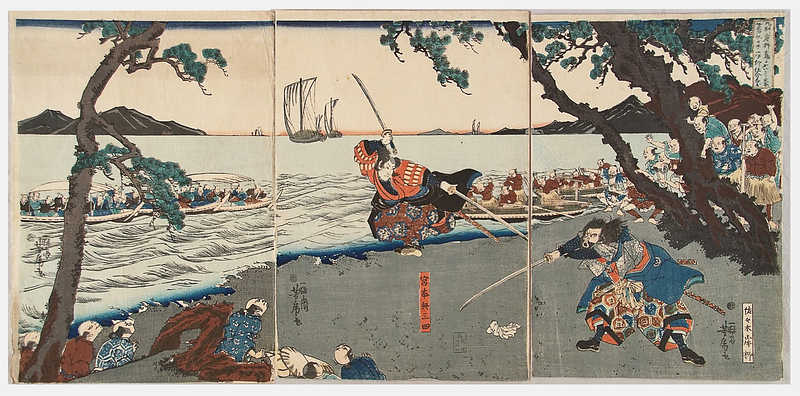
“Study strategy over the years and achieve the spirit of the warrior. Today is victory over yourself of yesterday; tomorrow is your victory over lesser men.”
— Miyamoto Musashi, The Book of Five Rings
I’ve been writing about a samurai named Miyamoto Musashi a lot recently, but I can’t seem to help it. He was a remarkable man.
Musashi was a legendary 17th-century samurai who is renowned for being undefeated in 61 duels, many of them to the death. He wasn’t just a skilled swordsman, though. Musashi was also a multi-hyphenate, a man armed with deep expertise and knowledge in many areas.
Musashi counselled feudal lords, opened his own school of swordplay, and created beautiful ink paintings now considered national treasures of Japan. He is so well-respected he was given the honorary title of Kensei, which literally means “Sword Saint.”
Impressive though these achievements may be, Musashi’s main claim to fame is being the author of The Book of Five Rings, a classic treatise on strategy. Written during his final years, the Five Rings contains the samurai’s personal philosophy regarding swordplay, martial arts, and life itself.
Ever no-nonsense and brusque, Musashi included in his book 9 quick tips that anyone can follow to learn from him. I have taken the liberty to include all of them here.
1. Do Not Think Dishonestly
Musashi struck a chord with me when he wrote,
“Truth is not what you want it to be; it is what it is. And you must bend to its power or live a lie.”
Being dishonest is far more damaging than we think. We all tell white lies, lies we tell ourselves are well-meaning, harmless, and inconsequential. They’re not.
The problem is these fibs have a terrible habit of compounding. It always begins with one little lie, but after a while, you need several other lies to support the original falsehood. Before you know it, the spider has become the fly. The hell that awaits all serial liars is the unenviable fate of becoming entrapped by the web of their own distorted thinking.
Being radically honest is an easy way to avoid this. In your dealings with others, be sincere and forthright, but take extra care to be frank with yourself. Musashi concurs:
“Why would you want to appear as one thing and be another? If you are a warrior then you are a warrior and if you are not a warrior then you are not a warrior. The Way of the warrior is the Way of the warrior. To be a warrior, look like a warrior and stand like a warrior. Do not be false to yourself.”
Remember, be bold and truthful, both to yourself and others. Life is too short to live a lie.
That is the first step to developing a winner’s mindset.
2. The Way is in Training
Unsurprisingly, Musashi was a vehement proponent of constant practice. He wrote:
”You can only fight the way you practice…
A bullet from a gun does not make a distinction between practice and combat. You are training to be one and the same way in your life.”
We are all taught tons of theory in school, but theory without application is sound without fury.
Possessing knowledge without an appropriate level of skill is like being a gunslinger who owns thousands of bullets…but doesn’t know how to shoot. And as Musashi repeatedly points out, the only way to transmute knowledge into skill is through constant practice.
So don’t be afraid to roll up your sleeves — remember, we learn best by doing. Seek to hone your skills ceaselessly and realistically.
That’s how you prepare to win.
3. Become Acquainted With Every Art
In true Reinassance man fashion, Musashi wrote:
“It is difficult to realize the true Way just through sword-fencing. Know the smallest things and the biggest things, the shallowest things and the deepest things”
It is difficult to understand the universe if you only study one planet”
Learning something about everything makes you appreciate the interconnected nature of the universe. You begin to understand that far from being small, inconsequential, and alone, you are a vital player in a grand cosmic tapestry. You are, after all, made from stardust.
In a less philosophical vein, being a generalist helps you pivot and adapt to change. This is an invaluable skill in the swiftly evolving 21st century.
We now live in a brave new world where the rules of success are changing faster than ever. To be a specialist in the age where a 10-year-old can make millions by reviewing toys on YouTube is to risk being stranded by the next big innovation, one that occurs seemingly every 5–10 years.
I’ll end off this section with a quote from Robert Heinlein:
“A human being should be able to change a diaper, plan an invasion, butcher a hog, conn a ship, design a building, write a sonnet, balance accounts, build a wall, set a bone, comfort the dying, take orders, give orders, cooperate, act alone, solve equations, analyse a new problem, pitch manure, program a computer, cook a tasty meal, fight efficiently, die gallantly. Specialization is for insects.”
4. Know the Ways of All Professions
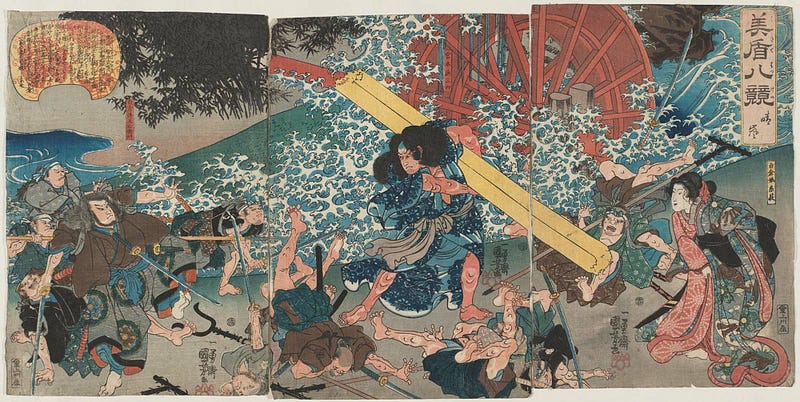
Musashi was a big fan of cross-learning. Nothing was considered too lofty or too inconsequential. During Musashi’s pilgrimage throughout 17th century Japan, he would observe the rice farmer, the feudal lord and the wandering swordsman with equal focus.
Musashi believed there was an effective Way of doing all things, and that it could be discerned through the keen study of various professions. He wrote,
“If you know the way broadly you will see it in everything.”
He was right. This all-permeating Way is called Strategy, and once Musashi figured this out, he would lay down his weapons and devote the rest of his life to the study of what he considered the one-true Way.
In the introduction of the Five Rings, Musashi wrote that he,
“…studied morning and evening searching for the principle, and came to realize the Way of Strategy when I was fifty. Since then I have lived without following any particular Way. Thus with the virtue of strategy I practice many arts and abilities — all things with no teacher. To write this book I did not use the law of Buddha or the teachings of Confucius, neither old war chronicles nor books on martial tactics.”
The essence of Musashi’s Book of Five Rings is not about the teaching of a specific style of swordplay or martial art, but of strategy in general. Becoming a strategist was how Musashi was able to overcome all opponents and become a self-taught polymath.
Study strategy. It is the one thing that will help you find success in all areas of life.
5. Distinguish Between Gain and Loss in Worldly Matters
Musashi has a way of cutting to the essence of things. He wrote,
“The only reason a warrior is alive is to fight, and the only reason a warrior fights is to win”
In a bid for clarity, we often ironically end up overthinking and muddying the waters even further. Musashi advises in his typical no-nonsense manner not to exist in the grey world of in-betweens.
A profession has black and white definitions of success. A warrior’s purpose is to win fights, and in the same vein, a carpenter’s purpose is to build sturdy furniture, a cook’s purpose is to whip up delicious meals and a home-makers purpose is to keep the house neat.
The achievement of those goals equals success, and on the flip side, the failure to attain them equates to professional failure.
That is the sole meaning of gain and loss. All else is frippery.
6. Develop Intuitive Judgement and Understanding for Everything
The last chapter of the Five Rings is titled “Void” and it concerns itself with the nature of things.
“Polish the twofold spirit heart and mind, and sharpen the twofold gaze perception and sight. When your spirit is not in the least clouded, when the clouds of bewilderment clear away, there is the true void….
Then you will come to think of things in a wide sense and, taking the void as the Way, you will see the Way as void. In the void is virtue, and no evil. Wisdom has existence, principle has existence, the Way has existence, spirit is nothingness.”
It is the most philosophical chapter of the book, and thus it may be difficult to understand what Musashi is trying to convey.
I take it to mean that understanding comes full circle. We begin life as babies with an intuitive understanding of the world. As we mature, we discover and explore the validity of our emotions. Finally, as adults, we graduate to primarily using logic to navigate the world. Most people stop here, thinking that they have mastered the art of thinking.
Musashi disagreed. He argues that prior to popular belief, intuition, not logic, is the highest form of understanding. This does not mean that we should adopt an infantile mindset — quite the opposite. It means that when making important decisions we should strive to clear our minds of the trappings of emotions and logos.
Emotions and logic, though great tools, can act as biases if overly relied upon. We think we are using them to make decisions when it is they who are using us. It is only with what Musashi calls “the mind of no-mind” that one can perceive the true nature of things.
Learn the art of thinking without thinking. It will help you dispel all illusions. It will serve to cut to the truth like a sword.
7. Perceive Those Things Which Cannot Be Seen
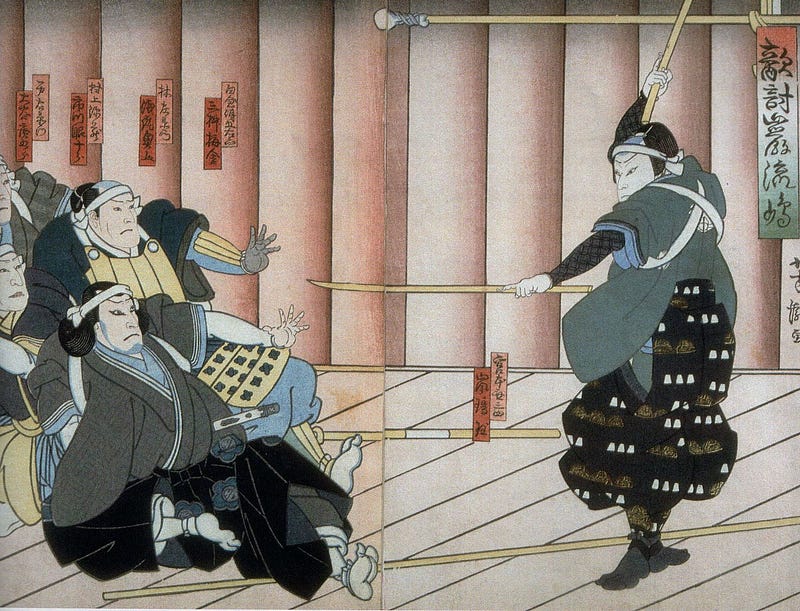
Continuing the topic of intuitive understanding, Musashi advises one to adopt a mountain-like viewpoint, one that is tall and far-seeing.
“Aspire to be like Mt. Fuji, with such a broad and solid foundation that the strongest earthquake cannot move you, and so tall that the greatest enterprises of common men seem insignificant from your lofty perspective. With your mind as high as Mt Fuji you can see all things clearly. And you can see all the forces that shape events; not just the things happening near to you.”
Adopting a broad viewpoint gives you a perspective of the whole situation, not just the sum of its parts. This gives you the rare ability to be objective, to see the reality of things, as opposed to what you want them to be.
Musashi writes further:
“Perception is strong and sight weak. In strategy, it is important to see distant things as if they were close and to take a distanced view of close things.”
The mature strategist seeks to see close things as though they are far away, and far off things as though they are close. By striving not to see a single thing, the strategist perceives everything.
Remember to adopt these two abilities:
- An intuitive mind
- An objective way of looking at things
The combination of both these abilities is a rare and fearsome formula, one that will help you sense things that cannot be seen and see moves that are not yet made.
8. Pay Attention Even to Trifles
There is a Buddhist saying that goes something like: “The meaning of the world can be understood by observing a single raindrop.” This is the real meaning of enlightenment, and is exactly what Musashi is referring to when he wrote:
“From one thing, know ten thousand things.”
Even though he was already a renowned samurai, Musashi has what in martial arts circles is known as a “white belt mentality”. An open mind and a humble heart allowed him to learn from carpenters, rice farmers and even rival schools of swordplay.
Once you are enlightened to the way, you will realise that there is nothing so small or trivial that you cannot benefit from studying.
Humility is the key to continuous growth.
9. Do Nothing That is of No Use
This last point is also my personal favorite.
Time is the one thing paupers and billionaires have in common. How they use this common resource, however, is what sets them apart.
One of my secrets to productivity is working on public transport. I take advantage of my 1 hour daily commute time to read, market my business and edit my articles. I’ve done this for years, and can’t help but notice that many of my fellow commuters elect to spend their travelling time on entertainment such as watching Netflix series or playing popular video games.
Now there is nothing wrong with doing any of the above — I used to be a pretty hardcore gamer myself. Your life is yours to live, and if watching Stranger Things or getting a high rank in Mobile Legends fulfils you, then, by all means, do it!
However, if you have lofty dreams of being a successful businessman and successful author (like I do), you have to give up some things you do for fun. For example, I chose to give up all my gaming time to write, because I know that in the long-run, my writing career will fulfil me more than any pixelated achievement gaming can give me. There is a success quote that goes like this:
“You can have it all, just not all at once.”
To be a winner, you have to protect your time. In Musashi’s words, you have to “do nothing that is of no use.” Then, and only then, will you have the time and energy to pursue the things that will take you one step closer to your dream life.
Figure out what you’re willing to sacrifice on the altar of success. Mine is gaming. What’s yours?
Final Thoughts
Miyamoto Musashi was a remarkable man, but like all standouts, he wasn’t born that way.
It is only through stalwart study and ceaseless practise that he managed to reach the heights that he did. In the closing chapter of his magnum opus, he writes that all men can understand his way of strategy through these 9 tips. In summary, they are as follows:
- Do not think dishonestly.
- The Way is in training.
- Become acquainted with every art.
- Know the Ways of all professions.
- Distinguish between gain and loss in worldly matters.
- Develop intuitive judgement and understanding for everything.
- Perceive those things which cannot be seen.
- Pay attention even to trifles.
- Do nothing which is of no use.”
These 9 tips are meant to be applied, and like all things worth doing, their application isn’t going to be easy.
You have to live a life of radical honesty. You have to cut away all unnecessary fluff and develop a keen interest in all arts and professions. You have to train day and night, as the samurai did, practising their mortal art under leaves pink and red, dead and falling, so many forgotten moons ago.
Most importantly, you have to kill the old you. Be merciless in expunging the bad habits and damaging thoughts holding you back, so that a better version of yourself can emerge: hot, blue and steaming, a new sword reforged from old, tired iron.
Seek dominion over yourself. Strive to be one per cent better, every day, for more than anything, continuous personal growth is the way of winners. Remember that today is victory over your old self, and tomorrow is your new self’s victory over the world.
See you at the top, champ.
If you enjoyed this story, consider supporting me and thousands of writers by signing up for a Medium membership! A membership here costs only $5 a month and will unlock all stories written on this platform. Aside from all that, you stand a chance to make some money with your writing as well. I made $6500 during my first year of consistent writing here — and you can, too.
By signing up with this link, you’ll support me directly with a portion of your fee, without any extra charge to you. If you choose to do so, I’d like to personally thank you — and be the first to welcome you to Medium!
Mind Cafe’s Reset Your Mind: A Free 10-Day Email Course
We’re offering a free course to all of our new subscribers as a thank you for your continued support. When you sign up using this link, we’ll send you tips on how to boost mental clarity and focus every two days.


