
NBA FINALS ANALYSIS, PART 1
How Sports Analysis Went To The Dark Side
Armed with the same data tools as meteorologists, why is the media filled with terrible hot takes, recency bias, and reductionist thinking?
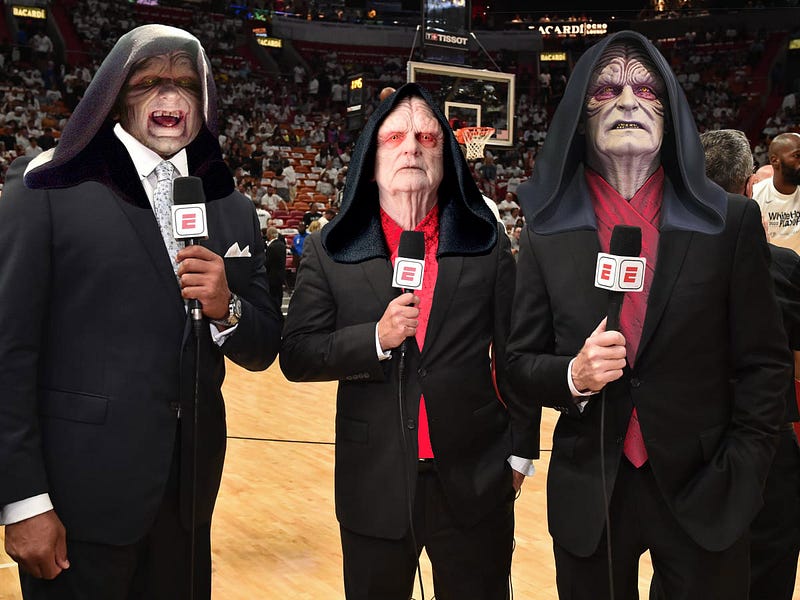
If you’re a basketball fan, all you heard on TV during the NBA playoffs was the mindless chant, “Since January 23 the Celtics have been the best team in basketball.”
While it’s true the Celtics had the best record (28–7), it includes an 8–1 streak where they beat up on bad teams or good teams missing their best players while using a roster with three players who were gone by the trade deadline.
To objectively analyze Boston’s season and their chances to win the title, I looked at the data compiled by their current playoff roster.
February 11 was the date the team added Derrick White and jettisoned Dennis Schroder, Josh Richardson, and Romeo Langford. Per NBA.com, here are the advanced stats for the Celtics since White’s first game:
- 20 wins, 6 losses (a 63-win pace)
- Defensive Rating: 108.3 (#1 in the NBA)
- Net Rating: +13.3
True enough, the Celtics did have the best record, a game ahead of Dallas. On the other hand, injuries and load management can affect standings on a day-to-day basis — on March 1, Dallas and Boston were tied. But no one talked about the Mavericks being the best team in the NBA or having the highest chance of winning the Finals.
ESPN’s vaunted analytics machine 538 ranked the Celtics #1 and gave them the highest probability to win the title as early as February 18, when they were still 15 games behind the Suns in the standings.
In addition, the Celtics did have the #1 rated defense. But was it “historically great” according to media hyperbole? The stats say otherwise.
Boston’s #1 defensive rating this year would have ranked the team outside the top 10 in 2018–2019, the season before the pandemic.
The pandemic has affected the NBA’s competitive level for the past three seasons. In the bubble season, players had to deal with mental issues due to isolation. After that, the compressed schedules, shortened off-seasons, Covid protocol restrictions, and the high number of injuries to superstars made the level of play even more choppy. We haven’t two elite teams battle each other for an entire season since 2017 when the Warriors and Spurs had incredible seasons.
Finally, we come to Boston’s incredible net rating.
For context, the 72-win 1996 Bulls had a +13.4 net rating and the 73-win 2016 Warriors had only a +10.86 net rating.
But the strength of the schedule plays a strong role in net rating. Like the boy who cried wolf, the Celtics have gone on runs in past seasons where they put up huge net ratings and flamed out early in the playoffs.
Young, hungry teams like Boston try to make a statement during the regular season. They registered blowout wins over bad to lower-level playoff teams (Sacramento +20, Denver +20, Utah +28, Washington +42, Chicago +23), and elite teams playing without one or more stars (Philadelphia +48, Brooklyn +23, Golden State +22, Memphis +29)
But their overall record against the top 4 teams in each conference was only 5–4, with the four wins against teams missing their stars, and a single win over Memphis. Meanwhile, they lost four games (Dallas, Toronto, Miami, and Milwaukee). To be fair, the Celtics were missing Robert Williams in some of those games.
Over the last 26 games of the season, the Celtics became a very, very good regular season team. But they did not dominate the elite teams in the league — a big leap to NBA champion-level greatness.
Now let’s analyze the Warriors’ play during the first 37 games, before the injury to their DPOY-candidate center Draymond Green.
One question comes to my mind...
Is amnesia a contagious disease or did every talking head in basketball lose their collective minds?
After starting the season 18–2, the Warriors looked like the best team in the NBA. Here are the advanced stats from NBA.com, between October 19 and January 5, 2022, when the Warriors were healthy:
- 29 wins, 8 losses (a 64-win pace)
- Defensive Rating: 102.2 (#1 in the NBA)
- Net Rating: +9.1
The Warriors’ projected record was one game better than the Celtics.
The Warriors’ defensive rating was 6.1 points better than the Celtics, the best rating in the NBA since the 2015–2016 season. That’s what you call an “historic defense.”
Their net rating should be looked at in the context of a dynasty team that just wants to get through the regular season without injuries.
While their +9.1 net rating was not far off from their first title season, they had games where they sat three starters (Curry, Green, and Wiggins) in a 19-point loss at Toronto and sat Green in a loss at Denver.
Finally, their record against the top playoff teams was better than the Celtics at 7–4, including a signature road win against Phoenix to take back the top record in the NBA. They were 2–1 vs Phoenix, 1–0 vs Boston 1–0 vs Miami, and split with Memphis, Philadelphia, and Toronto.
Not a super team, but a team with the experience and continuity to not make many mistakes in the biggest games.
A team whose superior system and selfless players would eventually break down its opponents.
Meteorologists analyze data and come up with probabilities, but NBA talking heads spread their opinions like a flock of pigeons who have landed on their favorite statue.
NBA media power is centered in three East Coast hubs — ABC/ESPN (Connecticut), TNT (Atlanta), and The Ringer (Boston homer Bill Simmons). Naturally, they chose to hype the Celtics’ mid-season turnaround.
But that doesn’t explain the glaring difference in defensive ratings between the teams, or the historical evidence that shows the negative impact of the pandemic.
Why were the so-called experts saying that the Celtics might have the greatest defense in history?
In part, you could point to East-Coast bias and blind homerism.
When Boston teams are not involved in a title run, Bill Simmons can be an entertaining and moderately knowledgeable basketball analyst* and his Ringer.com media empire offers interesting takes on a wide range of sports. But if the Celtics look like they can make a run, the “Massholes” take over the asylum and their content loses all credibility.
But the main answer is money.
Terrible, horrible, no-good, very bad hot takes are bread and butter for rabble-rousing hacks like Skip Bayless, Stephen A. Smith, and Charles Barkley.
Even professional analysts like ex-NBA executive John Hollinger are so biased (small-market team apologists, Warriors haters, Curry detractors) that there were no references to the Warriors other than as “the second-best defense in the league.”
Major media forces like ABC/ESPN and TNT want to increase playoff viewer ratings. Why would they talk about the possibility that the Warriors were the better team?
Everyone — except Lakers fans — wanted to see if the young Celtics and their historic regular season turnaround would end in a championship against the old, tested champions.
The Warriors played like a team expecting to dominate the series, as they took their foot off the gas at times during the first three games.
In Game 1, they had a double-digit lead for most of the game and went into cruise control instead of dealing a knockout punch.
Boston got a miracle from Al Horford (.360 career 3P%), Derrick White (.342 career 3P%), and Marcus Smart (.321 career 3P%), as they made 15 of 23 three-pointers.
Counting Horford’s stats since he started shooting three-pointers in 2015, here are the number of games played when each play shot as well or better than their performance in Game 1:
- Horford (6 of 8, .750 3P%): 1 in 436 games = 0.023%
- White (5 of 8, .625 3P%): 2 in 296 games = 0.068%
- Smart (4 of 7, .556 3P%) = 22 in 578 games = 3.8%
Multiply those numbers together and the probability is 0.000059432%, or roughly 60 in 100,000.
There was less than a 1 in 10,000 chance of Horford, White, and Smart making 15 of 23 three point shots in Game 1, but the media acted like Boston’s offense would continue to score 120 per game.
In Game 2, the Warriors went up by 29. Boston had scored only 64 points when they cleared their bench at the 10:46 mark of the fourth quarter.
In Game 3, Boston played a strong game at home, got the calls (Curry picked up two ridiculous ticky-tack fouls), and led by 17 in the first half. The Warriors still took the lead with 3:45 left in the third quarter.
Fortunately for the networks, the Warriors went ice cold in the fourth quarter, and Curry got hurt on a loose ball play the refs allowed to turn into an 8-second scrum where Al Horford dove on Curry’s legs.
In the last three games, the Warriors figured out how to beat the Celtics, but the media didn’t acknowledge this fact until after the series ended.
In Game 4, coach Steve Kerr made his only big adjustment. Jordan Poole’s offense was an essential spark for the Warriors, but his defense was a big liability that needed to be covered. To provide size and rim protection when Poole was on the floor, Kerr brought Looney off the bench.
Stephen Curry made history in the NBA Finals, with 43 points, ten rebounds, and surprisingly stout defense. Only three point guards in Finals history have put up those stats while hitting 7 of 14 three-pointers. As Boston tried to contest Curry’s outside shots, it opened up the paint for Andrew Wiggins and he killed the Celtics with 16 rebounds and a couple of key baskets on the offensive glass.
This pivotal game was the only one hotly contested the entire way. It was only decided with 1:42 left in the fourth quarter when Curry hit another long three-pointer to push the lead to 100–94.
The Warriors’ defense and non-stop off-ball movement wore Boston down physically and mentally, and the Celtics’ coach had no more cards to play.
Game 5 was marked by another miracle in favor of the Celtics as Stephen Curry had the worst playoff shooting night of his career.
Curry missed all nine of his three point shots and broke three of his record-setting shooting streaks:
- 223 consecutive games with at least one three-pointer
- 132 career postseason games with at least one three-pointer
- 38 straight postseason games with multiple three-point makes
Even worse, the Warriors hit only 22.5% of their three-pointers (9 of 40).
On the other hand, Boston got everything they wanted:
- Tatum had a great game (10 of 20 field goals, 5 for 9 from deep, 27 points, 10 rebounds, 4 assists)
- The Celtics shot16 more free throws
- Draymond Green fouled out for a record-tying third time in 5 Finals games
And yet, the Warriors led by 16 points in the first half, overcame Boston’s big third-quarter run, and eventually rebuilt their lead to 16 points. Both teams cleared their benches with the score 104–88.
Boston coach Ime Udoka played his last card in an attempt to stop Curry from killing them. Instead, it killed them.
In response to Curry’s historic Game 4 performance, Udoka asked his centers to go out even further past the three-point line to contest Curry on the pick and roll. While they succeeded in limiting Curry’s open looks, this tactic allowed the Warriors to create the 4-on-3 advantages they have feasted on throughout their dynasty.
As a result, the Warriors dominated in the paint, as Curry drove past Horford and Williams in iso situations or hit pull-up jumpers at will.
Once again, Boston’s ball handling weakness was exposed by a Warriors defense that forced 22 turnovers.
In Game 6, a brief 12–2 run to start the game fired up the Celtics’ home crowd. The Warriors responded with a 52–21 run to lead by 21 with two minutes left in the half.
After the Warriors dominated the last three games, the talking heads framed the series in terms of what Boston didn’t do.
The Warriors won Games 4 through 6 by double-digits, holding Boston to an average of just under 94 points per game.
Instead of recognizing the dominance of the Warriors’ defense, the media narrative was a series of excuses: Tatum wasn’t ready to assume his place as a top 5 player; Boston just had to take better care of the ball; the Celtics’ bench disappeared; etc, etc. etc.
And despite the consistent brilliance of Golden State’s core players, some talking heads still believe the Celtics were the more talented team.
Aside from the anomaly of Game 1, this was a series that should have ended in 5 games.
That’s the kind of dominance that kills network ratings.

If you got this far, you must be starving for NBA reading material during the dog days of summer. Here’s Part 2.
FOOTNOTES
*Simmons is best known for putting in meticulous research to write the Book of Basketball and create his Hall of Fame Pyramid. In addition, he founded Grantland, the best sports writing ever found online.


