
NBA FINALS ANALYSIS, PART 2
The NBA Playoffs: Doubling Down on Hot Takes, Recency Bias, and Reductionist Thinking
Even though every sign along the way pointed in the opposite direction
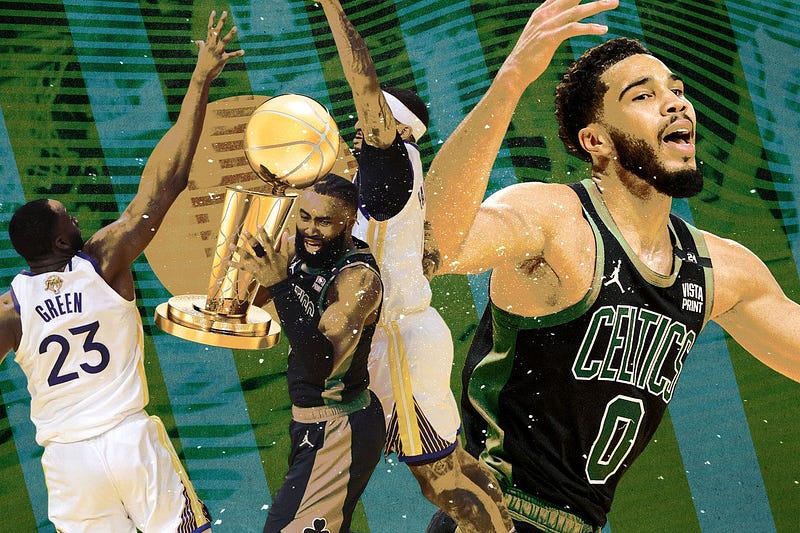
As Boston’s mid-season turnaround became the regular season’s biggest story, the narrative gained even more traction during the playoffs, becoming less and less connected with reality.
In the West, the Golden State Warriors dominated each series. But instead of asking if the team was as good as their first title run, the media decided it was because it was the West was weak.
It reminded me of the 2019–2020 Lakers’ title run. In each series, the opponent was hailed for being a real threat to L.A. In each case, after the Lakers won the series in five games, the media said it proved nothing because the competition was not good. The Lakers won the Finals easily but it meant nothing because of Miami’s injuries. Now revisionist trolls call it the bubble right as if it doesn’t count. As if the Lakers’ domination of the regular season before the league shut down never happened.
The Warriors hammered Denver, so people pointed out their terrible roster while conveniently forgetting that Jokic was the two-time MVP and flanked by a couple of athletic wings. Were the Nuggets really that much worse than a dysfunctional Brooklyn team with Kevin Durant, Kyrie Irving, a 6'4" center, and no defense?
Somehow, Boston’s sweep was a sign of the Celtics’ strength.
When the Warriors took a 3–1 against Memphis, all people talked about was Ja Morant’s injury. But the Grizzlies’ use of a two-big lineup of Steven Adams and Jaren Jackson, combined with their strength and size on the wing gave the Warriors far more difficulty.
Golden State knew they could beat Memphis at full strength because every game would come down to Morant (career .327 3P%) needing to hit five or more 3-pointers a game. Morant hit 4 of 7 (.571 3P%) in Game 3 of the series and the Warriors won by 30 points.
Analysts were also fooled by the Warriors relaxing in a Game 5 elimination game and losing by 39 points.
After the Suns’ Game 7 meltdown against Dallas, the media devalued the Suns’ regular-season dominance and convinced themselves that the West was the weaker conference.
News flash: Dallas was 2–0 over Boston in the regular season, holding them to under 100 points both times.
Dallas had an elite defense and Luka Doncic, the best player on the court. But their series win against Phoenix came because of ridiculous shot variance (15.6 made three-pointers on 40% shooting).
With stretch big Maxi Kleber (career .359 3P%, only .325 3P% this season) hitting 13 of 28 three-pointers, center DeAndre Ayton had to extend out to the 3-point line. This allowed Doncic and Brunson to score at will in the paint against the Phoenix guards.
In contrast, the Warriors switching defense and mobile centers incapacitated the Mavericks’ offense. Andrew Wiggins did a great job of forcing Doncic to work for his points. The rest of the team stayed with their man to contest the three-point shooters.
Against the Warriors, Kleber made 26.3% of his three-pointers. Dallas shot under 29% from deep in two of the first three games of that series en route to a 0–3 deficit.
The Warriors made it look so easy against Dallas that the talking heads devalued the West even more.
Meanwhile, the media and Boston fans conflated 7-game struggles against the Bucks and Heat as anyting more than a big fat bunch of asterisks.
Asterisk #1: Kris Middleton was out with a knee injury. Without him, the Bucks lost their best mid-range shooter and shot-creator in crunch time. All Boston had to do was prevent Giannis from scoring 50 points in the paint.
Asterisk #2: The loss of Middleton created a terrible slotting problem. People don’t understand how losing a star creates a chain of events that hurts a team far more than replacing the points he scores. Middleton was not only the Bucks’ best shot creator but their best big wing defender.
With Middleton injured, Milwaukee served up a pupu platter of defenders that Tatum destroyed.
Those defenders ranged from terrible (Grayson Allen, Bobby Portis) to washed (the corpses of Wesley Matthews and George Hill) to little guys that were easy to shoot over (Connaughton and Holiday).
Watch these highlights from his 46-point night in Game 6. Most of these baskets looked like Tatum was playing in a Summer League game instead of a playoff elimination game.
Asterisk #3: Insane shooting variance. The Bucks love to pack the paint, and their perimeter defense was compromised without Middleton. They were the worst defense in the NBA in giving up made and attempted 3-pointers (14.3 out of 40.5). While the percentages work during the regular season, if a team gets hot in a playoff series, the injured Bucks had no Plan B. And guess what happened?
- Al Horford had the best shooting night of his career (5 of 7 three-pointers, 11 of 14 shots, and 30 points) to save Game 4
- Jayson Tatum had the best shooting night of his career (17 for 32 field goals, 7 of 15 three-pointers, and 46 points) to save Game 6
- Grant Williams had the best night of his career (7 of 18 made three-point shots and 27 points) to win Game 7, while they hit a playoff record of 22 out of 55 three-pointers as a team
- All told, Boston won four of five games against the Bucks in which they made more three-pointers (22, 20, 18, 17, 14) and shot almost 4% above their regular-season averages
It was only after the Celtics lost the Finals that media talking heads admitted that Milwaukee would have probably been in the Finals if they were healthy.
The same thing applied to the Miami series.
Rather than recognize the impact of injuries and the disappearance of Bam Adebayo, the talking heads convinced themselves that Game 7 proved:
- The Celtics could put it together when their backs were against the wall
- The Celtics’ defense was historically great, so they could stop the Warriors
- The tough series would give them the experience needed to win in the Finals
- Jayson Tatum won the Larry Bird MVP trophy proving he was a top-5 player who could lead a team to a title
Asterisk #4: Jimmy Butler almost beat the Celtics by himself. This Miami Heat team was a shadow of the team that beat the Celtics to reach the 2020 Finals. With Kyle Lowry and Tyler Herro injured, the Heat had no real offense other than Butler and they ended up a front-rim three-pointer away from winning in Game 7. If the Celtics were a championship-level team, they would have won in five games.
That’s how the media ended up approaching the Finals. The Warriors’ march through Memphis and Dallas was seen as conference weakness, while the Celtics’ self-sabotage and struggles against wounded teams were somehow evidence of the East’s strength.