
How Social Media affects Your Brain…
Realize how Social Media affects our brain and how you can preserve yourself

We all exist in this world where we can tweet at somebody or engage with somebody who could even be the President of the United States, and they might react to us back. Social media has thrust us all into the head of a pin, socially speaking, existentially speaking. Even if they are on the other side of the planet, we can still interact with them even if they have more money than we do. We can still compete with them on engagement. They’re inside of our world.
We have a Mimetic machine in our pocket where all these people exist.
What is Mimetic Desire?
Mimetic desire means that we adopt another person’s desire as our own, usually without realizing that we’re doing it. Social media has given us millions of magnetic models that we now have to compete alongside. Some people have gone from having ten mimetic models to have a million, and we haven’t quite come to grips as a culture with what that means for our mental and emotional health. There are two kinds of mimetic models.
The first kind is called an external mediator of desire. These are models that are outside of our world. Whether because they exist in a different social sphere than we do, there’s no possibility of us coming into contact with them and indeed not becoming rivals with them. They are, in some sense, outside of our world of desire, outside of our world of competition. Now, these external models of appetite can be natural, or they can be fictional.
The other kind of model is inside our world called internal mediators of desire. These are the people that we contact. Whether people in our family, workplace, or friends.
It’s easier to compare ourselves to them. These are the kinds of people that we look too as benchmarks. We’re far more likely to be envious of somebody we went to high school with who now has a great job and a beautiful spouse than we are to be jealous of the wealthiest person in the world.
The danger with external mediators of desire, with keeping up with very successful people, with people who have modeled a particular lifestyle, is that there’s no end to that process. All desire is a form of transcendence. We desire to go beyond the boundaries, go just over the mountain, and be the kind of person we don’t feel currently have positive models of desire.
Too emulate is a perfect thing.
It’s essential to have people who model the virtues and goodness we would like. We have to understand the limitations of any model, and understanding how the dynamic between our models changes in that scenario and us is essential. It’s also important to know when somebody is an internal model of desire to us because, in that case, we have to have boundaries. All desire comes from us feeling like we lack something, which can lead to a dangerous vicious cycle because there will always be another model to find.
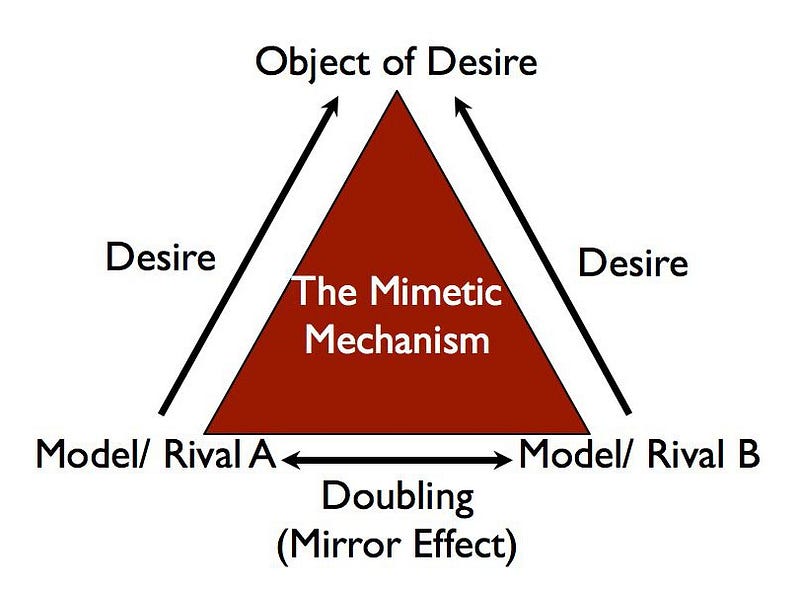
We have to choose our models wisely. In addition we have to know when the model is inflaming us with the desire for something that will bring accurate fulfillment. Whether it will bring a dopamine hit or allow us to fantasize about a life that we will probably never have.
Even if we did have, it would probably make us miserable. All you need to do is go on Instagram and spend five minutes. You see lifestyles model; you see vacation destinations, model fashion manners of speech, ways of engagement, speaking, and political preferences. These desires are modeled for us 24 hours a day, billions of them.
We need to understand the mimetic landscape of social media or become controlled by it.
Thanks So much For Reading!


