How Reincarnation Failed Outside Tibet
The Truth Shall Free Tibetan Buddhists
A few years ago, a British newspaper reported a Spanish media exposé of a reincarnated lama who had decided to abandon his re-born identity. Then 24-year-old Tenzin Osel Rinpoche, one of the most renowned Buddhist “golden children” who were determined through dreams, oracular riddles, and their own “memories” to be tulkus, or reincarnations of high or senior Tibetan Buddhist lamas. He wanted to be a filmmaker instead and reverted to his original Spanish name, Osel Hita Torres.
In 1989, the 4-year-old Osel became the designated reincarnation of Lama Thubten Yeshe, the dead co-Founder of the powerhouse Foundation for the Preservation of the Monastic Tradition (FPMT), which is the foremost Tibetan teaching organization in the West. In 1986, only 14-months-old, his Spanish parents took him to see the Dalai Lama in Dharamsala, India. The toddler was chosen out of 9 other candidates. He was subsequently confirmed, affirmed, chosen, and eventually “enthroned” by the current 14th Dalai Lama, the supremo of Tibetan Buddhism.
It seemed that the 14th Dalai Lama consulted an oracle, and the clincher decisive evidence was that young Osel was able to “recall’ the colour of the dead Lama’s car. His Spanish parent were Tibetan Buddhist converts. His name was changed to Tenzin Osel Rinpoche (see photo below).
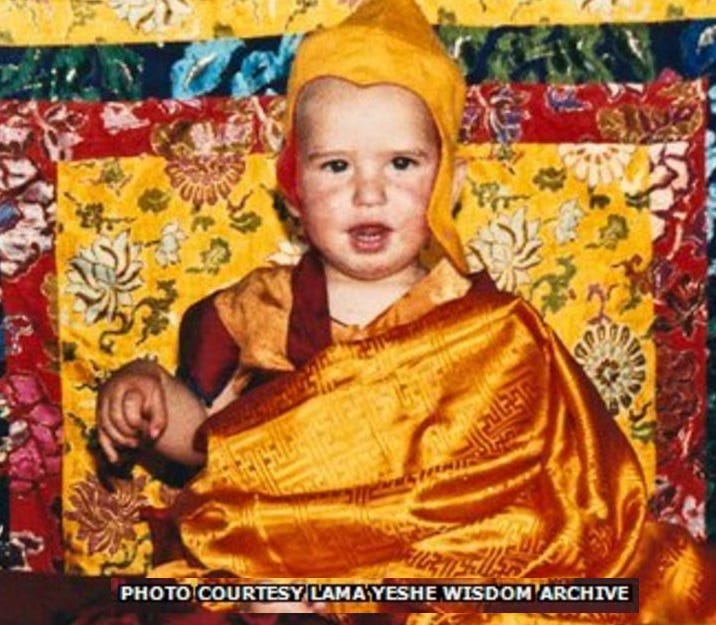
In Tibetan Buddhism, a lama belongs to a lineage of reincarnated spiritual leaders, the most famous of which is the Dalai Lama. As a toddler, Osel was put on a throne and worshipped by monks who treated him like a god. His “abdication” from reincarnation understandably caused consternation and embarrassed Tibetan Buddhism, and many Tibetan Buddhists were dismayed by his rejection of karmic destiny.
After denouncing the Tibetan Buddhist order that elevated him to a divine “god” status, he began to study filmmaking in Madrid. Having left the monastic life, Osel Hita Torres bemoaned the misery of a youth deprived of television, football, movies, and girls. He also prefers sporty baggy trousers and wears long hair. By 18, he had never seen kissing couples. His first disco experience was a shock. “I was amazed to watch everyone dance. What were all those people doing, bouncing, stuck to one another, enclosed in a box full of smoke?”. For him, it was a long-lost childhood in a surreal previous life.
“They took me away from my family and stuck me in a medieval situation in which I suffered a great deal,” said Osel, describing how he was whisked from obscurity in Granada to a monastery in southern India with his parents’ permission. “It was like living a lie,” he told the Spanish newspaper El Mundo. Despite his departure, he is still known as Lama Tenzin Osel Rinpoche and is revered by the Tibetan Buddhist community in the FPMT.
He continues to be remembered by some Tibetan Buddhists. A prayer for his “long life” adorns the website of the Foundation to Preserve the Mahayana Tradition, which has 130 centres around the world. The website features a biography of the rogue Lama, and highlighted his peaceful, meditative countenance as a baby.
Tibetan Buddhism is evolving into a passing man-made religion. In a wide-ranging 2014 interview with the BBC’s Newsnight program, the current 14th Dalai Lama announced that “the Dalai Lama institution will cease one day. These man-made institutions will cease,” the Dalai Lama told the BBC
It also ushered the rebirth of Tibetan Buddhism as it abandons its wrongful understanding of reincarnation and returns to original Buddhism roots to begin Tibetans on the long journey of enlightenment towards the Truth. The Truth of Reincarnation shall free Tibetans from historical bondage.
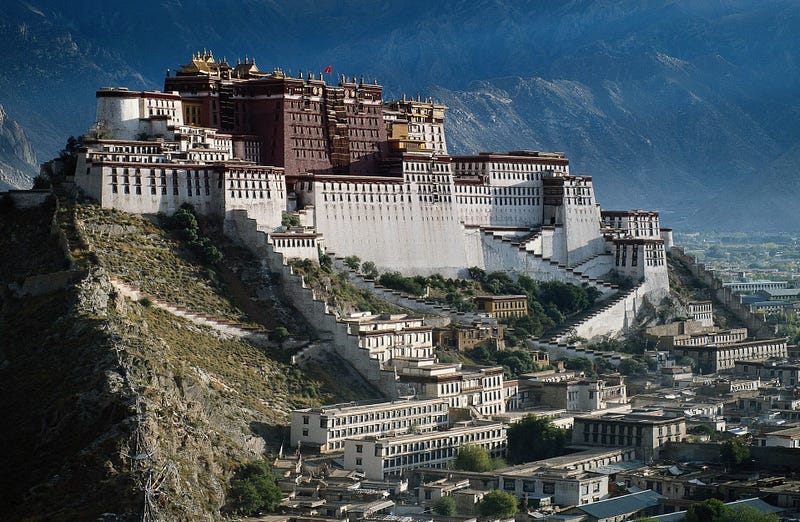
“Reincarnation” is popularly, but wrongfully, understood to be the transmigration of a soul to another body after death. Each successive Dalai Lama thus justifies his continual entitlement as the spiritual and political head of the Tibetans residing in the posh and luxurious Potala Palace overlooking the world’s highest plateau.
The term “Reincarnation” is uniquely a Tibetan conceptualization and emerged only from the 14th century to explain, justify and legitimise political succession in perpetuity by attesting to the continuity of impersonal charisma inherent in repetitive reincarnation. Herein is the point of departure for Tibetan Buddhism from its original Mahayana Buddhism roots.
Quite contrary to Buddha’s teachings, the concept of “reincarnation” was a political innovation in Tibetan Buddhism. It developed rapidly from the 17th Century for political reasons to provide Tibetan religious elites with a metaphysical lineage instead of patrimonial connections which are unavailable to celibate monks. The theocratic elites thus wrestled power from the lay and non-clergy aristocratic elites effectively to establish the Dalai Lamas reincarnation lineage as Tibetan rulers for over 500 years.
There is no such teaching as Tibetan “reincarnation” in Buddhism. In Buddhism, there is only the concept of “incarnation”. Outside Tibet, Buddhists globally understand the key fundamental doctrine of “incarnation” in the original Buddha’s Buddhism as “anatta” — simply means “no soul or no-self”. There is no permanent essence of an individual self that survives death. Since there is no soul or permanent self, what is it that is “reborn” or “reincarnated” at “rebirth”?
According to Buddha’s teachings, the “self” — ego, self-consciousness, and personality — is a creation of the “skandhas”. Very simply, our bodies, physical and emotional sensations, conceptualizations, ideas and beliefs, and consciousness work together or to create the illusion of a permanent, distinctive “me.”
In other words, the self is merely an idea or a mental construct in Buddhism.
The Buddha taught that all phenomena, including beings, are in a constant state of flux — always changing, always becoming, and always dying. For him, “every moment one is born, decay, and die.” That is, the illusion of “me” renews itself every moment. Not only is nothing carried over from one life to the next, nothing is also ever carried over from one moment to the next, or from yesterday into today.
Read More here:
Acknowledgment and gratitude to my Bhutanese friend who in 1983 first shared with me the Tibetan slavery conditions. They were subsequently validated by many other friends and sources in the region who also confirmed my research and empowered here a true picture of Tibetan struggles with serf slavery.
Please enjoy my recent Articles.
You can also subscribe to my stories and social media posts via your email. Enjoy more interesting Articles by signing up to Medium here: https://thefuturistoracle.medium.com/membership