
The Truth that Freed Tibetans from Historical Bondage
“The man-made Dalai Lama institution will cease”, said the 14th Dalai Lama
In a wide-ranging 2014 interview with the BBC’s Newsnight, the then 79-year-old spiritual leader had conceded that he may not have a successor.
“The Dalai Lama institution will cease one day. These man-made institutions will cease,” the Dalai Lama told the BBC. He added, “Whether another Dalai Lama came after him … was “up to the Tibetan people”. In 2011 the Dalai Lama handed his duties to a leader of the Tibetan government in exile, and pointed out that the role no longer included political responsibilities but did not state what the new responsibilities would be.
The end of the Dalai Lamas was also announced by the current 14th Dalai Lama in an interview with the German newspaper Welt am Sonntag. It also ushered the rebirth of Tibetan Buddhism as it abandons its wrongful understanding of reincarnation and return to original Buddhism roots to begin Tibetans on the long journey of enlightenment towards the Truth.
The Truth of Reincarnation shall free Tibetans from historical bondage.
Free at last, Tibetans are finally and completely free to create their own future through the cultural transformation of the worldviews and mental paradigms which has locked them in a timeless medieval prison of theocratic serf bondage for centuries until the 1950’s.
And with this change, ordinary Tibetans can prepare their children for the crucial reforms, radical social reconstruction, and education towards a better, more modern future society with the rest of the world.
The Dalai Lama’s Tibetan system, which began in the 14th Century, tolerated no democracy, freedom, or human rights in any form. In fact, the Tibetan serf slavery system was the darkest human slavery system in the history of mankind, and which spanned many centuries longer than the 400+ years of black slavery in the USA. The Tibetan conditions were also more debasing and dehumanizing than medieval Europe in the latter’s darkest periods.
Before her 1959 liberation by China, Tibet was a feudal serfdom created by the integration of religion, politics, and the dictatorship of monks and aristocrats, and one even darker and more backward than medieval Europe. The 14th Dalai Lama, like other Dalai Lamas before him, ruled over a Tibetan society that had integrated religion with politics as a feudal serfdom under a theocracy ruled by a combined dictatorship of monks and aristocrats.
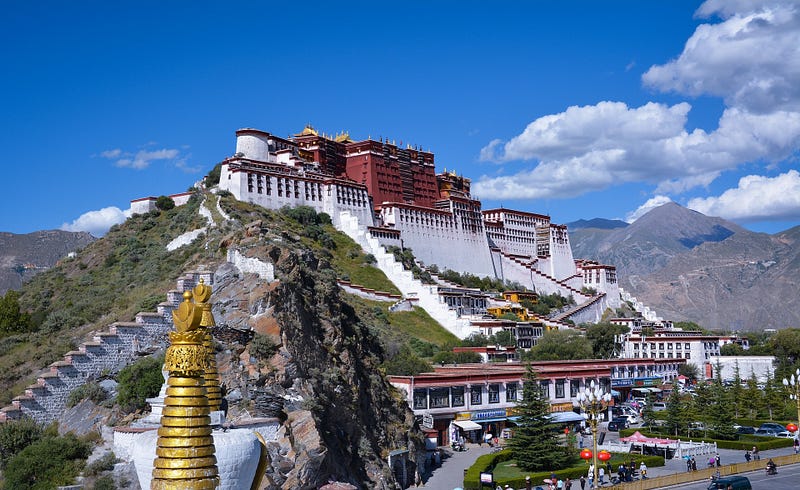
“Reincarnation” is popularly, but wrongfully, understood to be the transmigration of a soul to another body after death. Each successive Dalai Lama thus justifies his continual entitlement as the spiritual and political head of the Tibetans residing in the posh and luxurious Potala Palace overlooking the world’s highest plateau.
There is no such teaching as Tibetan “reincarnation” in Buddhism.
The term “Reincarnation” is uniquely a Tibetan conceptualization and emerged only from the 14th century to explain, justify and legitimise political succession in perpetuity by attesting to the continuity of impersonal charisma inherent in repetitive reincarnation. Herein is the point of departure for Tibetan Buddhism from its original Mahayana Buddhism roots.
In Buddhism, there is only the concept of “incarnation”. Outside Tibet, Buddhists globally understand the key fundamental doctrine of “incarnation” in the original Buddha’s Buddhism as “anatta” — simply means “no soul or no self”. There is no permanent essence of an individual self that survives death. Since there is no soul or permanent self, what is it that is “reborn” or “reincarnated” at “rebirth”?
According to Buddha’s teachings, the “self” — ego, self-consciousness, and personality — is a creation of the “skandhas”. Very simply, our bodies, physical and emotional sensations, conceptualizations, ideas and beliefs, and consciousness work together or to create the illusion of a permanent, distinctive “me.”
In other words, the self is merely an idea or a mental construct in Buddhism.
The Buddha taught that all phenomena, including beings, are in a constant state of flux — always changing, always becoming, and always dying. For him, “every moment one is born, decay, and die.” That is, the illusion of “me” renews itself every moment. Not only is nothing carried over from one life to the next, nothing is also ever carried over from one moment to the next.
At the final enlightenment or “Nirvana” stage, all the causes for future rebirth would have been resolved and the “Buddha” now abides in a state of being called “deathlessness”. A Buddha (“arahant”) — defined as one who has reached that ultimate wisdom stage of “Nirvana” — no longer reincarnates after death.
Quite contrary to Buddha’s teachings, the concept of “reincarnation” was a political innovation in Tibetan Buddhism. It developed rapidly from the 17th Century for political reasons to provide Tibetan religious elites with a metaphysical lineage instead of patrimonial connections which are unavailable to celibate monks. The theocratic elites thus wrestled power from the lay and non-clergy aristocratic elites effectively to establish the Dalai Lamas reincarnation lineage as Tibetan rulers for over 500 years.
It is laughable therefore for the 14th Dalai Lama to suggest that the “succession (of Dalai Lama) should not be used for political ends” when his predecessors have been doing so for centuries.
Further, as if admitting the conceptual flaw in his Tibetan Buddhism’s “reincarnation”, he added that “If a weak (15th) Dalai Lama comes along, then it will just disgrace the Dalai Lama”. He, therefore, wanted to prevent this by ceasing his own “reincarnation”. But, isn’t ALL the Dalai Lamas the “SAME” guy, or “SAME” person in different bodies?
The Dalai Lamas had ruled over Tibet like the “human Deities” which they had apparently emulated from the ancient Asokan “God-King” of India. They ascribed to the Ashokan idea of the Buddhist king (“dharma-raja”) as a virtuous king, one who rules in the service of dharmic goodness according to the universal dharma. And as a divine Buddhist bodhisattva (“enlightened being” who has achieved Nirvana), the Dalai Lama’s rule over Tibetans is therefore perceived as that of a “celestial” bodhisattva beyond the reach of rational inquiry and reproach. He is after all, literally and politically, a “living Buddha”. From the 17th century, the institution of reincarnation considerably left its mark on the whole political and economic system of Tibet.
The passing of the 14th Dalai Lama without the “reincarnation” of the 15th Dalai Lama means that Tibetans can finally look among themselves for suitable political leaders based on other normal leadership criteria precluding religion. A better educated Tibetan population can be expected to form political parties to enhance their expressions for self-determination and political purpose. They would, like what the Europeans did to the Church, relegate the Potala Palace and their monasteries to the domain of personal religious beliefs.
The separation of religion and politics is critical for Tibet’s future. A secular Tibet that respects the inherent right of Tibetans to their personal freedom of religion would emerge to regain its place among equals with other Chinese Provinces. Just as the Church no longer played a significant political role in the former countries of Christendom, there should also be no political role for Tibetan monasteries other than a purer, revised Tibetan Buddhism on equal footing with Buddhism and other religious beliefs systems.
Acknowledgment and gratitude to my Bhutanese friend Jigme Thinley who in 1983 first shared with me the Tibetan slavery conditions. They were subsequently validated by many other friends and sources in the region who also confirmed my research and empowered here a true picture of Tibetan struggles with serf slavery.
Please enjoy my recent Articles.
You can also subscribe to my stories and social media posts via your email.
Enjoy more interesting Articles by signing up to Medium here: https://thefuturistoracle.medium.com/membership


