

How Ramadan Fasting Shapes Our Understanding of Time-Restricted Eating?
Ramadan fasting is a style of diurnal intermittent dry fasting diet that challenges the biological clock.
Ramadan fasting is a style of diurnal intermittent dry fasting diet. This is complicated, so let me break them down into:
- Diurnal — During the daytime. The opposite term is nocturnal.
- Intermittent — Strict fasting is interrupted with a specified window of eating period.
- Dry —Liquid consumption is not allowed.
- Fasting — Prolonged period of not eating that leads to the depletion of the body’s glucose storage and turn into fat-burning phase.
- Diet — An eating pattern.
To put them together, Muslims abstain from all food and drink during daytime when they practice Ramadan fasting. Refuelling the body with food happens after the dawn and before the dusk. Hence, nocturnal eating switches the body from resting to storing energy over the night.
There has been an increased interest in time-restricted eating, whereby many people resort to skipping a daily meal. Many believe that we should eat according to our biological clock, presuming that the digestive system should be allowed to rest at night. However, Ramadan fasting practices the opposite. Hence, Radaman fasting sparks the interest of scientists to study the impact of this unique diet on biological clock and metabolism. With Ramadan just about a week away from the time of writing, I believe this is a timely article to write and share.
Making sense of time-restricted feeding
“Eat breakfast like a king, lunch like a prince, and dinner like a pauper.”
This is perhaps a well-known saying to me. Anybody with me? If you have heard this saying before, then it is very likely that you were educated not to eat at night because it might lead to weight gain.
Furthermore, most if not all animals practice time-restricted feeding in their natural environment. For example, mice eat 80% of their calories when they are active at night and eat only 20% of their calories when they are inactive in the morning. Therefore, it makes sense that human too should not eat when we are inactive (at night).
Time-restricted feeding itself does not make us healthier. It is what we eat during the eating period that makes us healthier. Nutrients are nourishment!
Calories intake during Ramadan fasting
According to the Islamic holy text, Muslims are only allowed to eat when there is no sunlight. This definition is fixed, but the length of day and night time is changing depending on where you live on Earth. If you have a longer daytime, you only have a very small amount of eating window to consume 100% of your calories. For example, Muslims in Russia experience 20 hours 45 minutes of fasting time in a day in 2019. In contrast, Muslims who live in countries located in the Southern hemispheres like Argentina and New Zealand have more privileged to experience about 11 hours of fasting time only.

So, how do Muslims consume their calories during Ramadan fasting? Well, there is a vast variation on how they consume their calories. Dr Nader Lessan from the Imperial College of London at UAE agreed that most of the calories are consumed at dusk and some calories are consumed at before dawn. He also noted that while the nature of time-restricted feeding is to limit one’s calories intake, some Muslims increased their calories intake from 2270 kcal pre-Ramadan to 3000 kcal during Ramadan. It is not uncommon for Muslims to overeat when they break the fast, causing them to gain weight during Ramadan. This is not surprising.
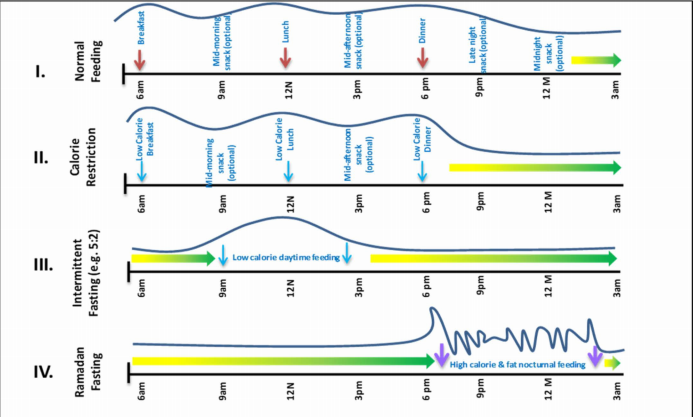
This picture below was shared by Dr Lessan, showing the generic glycaemic pattern (the glucose level) during Ramadan compared with other eating patterns. The up-and-downs of glucose level illustrated in the Ramadan fasting curve represent people having multiple snack time between two larger meals (after dawn and before dusk).
Fasting presents a “challenge” to our body, it is how we respond to the challenge that dictates our health outcomes.
The inability to drink water demonstrates the importance of hydration
No health professionals will ever encourage you to stop drinking water. A good hydration status maintains healthy blood pressure and blood biochemistry. Radaman fasting may induce hyperosmolar stress. This means the concentration of fluid outside the cell is higher than the concentration of fluid inside the cell, causing the cell to lose water to its surrounding. This is a physical phenomenon known as osmosis.
One of the consequences is the development of dry eye symptom. Those who are already susceptible to dry eye is at risk of further eye inflammation. Certainly, dry eye is not only associated with hydration but a combination of other lifestyle factors such as sleep, stress and screen time. Nevertheless, this small prospective study showed that dry eye symptom is twice as prevalent during Ramadan. The inability to drink water also presents a health risk to those who have diabetes and kidney disease.
Are there any health benefits associated with Ramadan fasting?
Ramadan fasting, when practised in a healthy way can confer temporary health outcomes. Most of the research studies that investigate the health benefits of Ramadan fasting are observational studies, whereby minimal lifestyle advice is given to the participants. Therefore, people can have a variety of food and do anything they want except for eating during the daytime.
One obvious example is body fat loss. A meta-analysis involving 2947 participants found that overweight people can lose about 1.5 kg during the Ramadan. Other health benefits include the reduction in bad cholesterol, fasting blood glucose, and inflammatory markers.
However, these health benefits are just transient. It is not meaningful if the health benefit is not sustained.
Key takeaways from understanding a snapshot of Ramadan fasting
Ramadan fasting is under-researched since Ramadan fasting only happens once a year but provide us with a unique insight into the study of biological clock and metabolism.
With any time-restricted feeding diet, managing macronutrients and micronutrients are of utmost importance. Fasting neither makes us stronger nor makes us weaker. So does eating at night, as long as we have plentiful sleep and eat regularly. Fasting presents a “challenge” to our body, it is how we respond to the challenge that dictates our health outcomes. Still, we can have a healthy diet even without a fasting “challenge”.
Time-restricted feeding itself does not make us healthier. It is what we eat during the eating period that makes us healthier. Nutrients are nourishment! Of course, some people might argue that fasting can switch on our “survival genes” and increase our life span. This is probably right. However, before we try to fast, let’s learn how to eat properly.
Ramadan fasting is a very good example with some people successfully lose weight while some people gain weight. Although studies found many healthy benefits during Ramadan fasting, the benefits are small and transient. Those who lose weight certainly has weight-related improvements, such as the reduction in bad cholesterol, fasting glucose and inflammatory markers. These are probably not “magic” caused by fasting. If you lose weight without fasting, you certainly can reap these benefits too. If you can sustain your body weight, the improvements stay with you longer.
Thank you for reading.


