
EDUCATION
How One Good Teacher Changed My Life
Remembering my Fifth-Grade Teacher, Ms. MacFarland
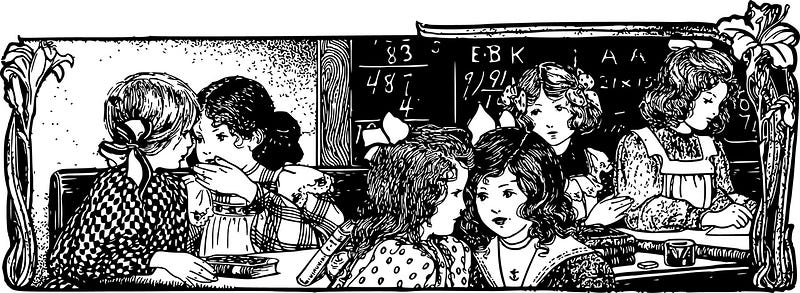
MaryBeth, 13 years old
She was a young teenager when the ship docked at Ellis Island in the late 1800s, her Scottish parents, being Mormon, seeking religious freedoms in the New World. One of 11 children, 7 of whom had survived, MaryBeth MacFarland was the eldest girl, and therefore the primary caretaker for her younger siblings while her mother attended to church duties of choir practice and the relief society.
So many children stuffed inside that tiny Brooklyn apartment! Keeping them fed and in clean diapers, making school lunches, helping with homework, keeping up with her studies — none were ever a challenge for a strong Mormon female of any age.
But her mother had not been strong for a long time, growing thinner, less mobile, eventually becoming bedridden, gray, and tired. It was pneumonia, they said, and in the days before antibiotics, there was not much hope for her survival.
The last time the doctor came, passing his hand over her mother’s face to close her eyes forever, he suggested to MaryBeth’s father that city life was not healthful—not for him, not for the kids. And because a good Mormon man needed at least one wife to help raise all those children, MaryBeth’s dad decided to relocate to Ogden, Utah, where the prospects of finding a new wife and raising his family among like-minded people were more promising.
MaryBeth became one of the first young women to graduate from Brigham Young University, securing her dream of becoming an elementary school teacher.
Adelia, 9 years old
Melbourne, Florida, in the 50’s was a sandy little town with rows of small bungalows on parallel streets, sprinklers in every front yard, each failing to keep the lawns green in the intense summer heat. I was nine years old when we moved there from the farm in Virginia, my dad having accepted a position at nearby Cape Canaveral. Every day when he came home from work I would ask him, “Did you see Dr. Werner von Braun today, Daddy?”
Being nine in the fifth grade was no problem for me, even though I was a year younger and smaller than all the other kids in my class. I believed my dad when he told me I was smarter than the other kids. And I loved school. As a six-year-old, I had told my dad that someday I was going to know everything in the world, starting with the aging set of Funk & Wagnalls Encyclopedia on the bookshelf in the living room. (Still working on that!)
The previous year, at the start of third grade in the antebellum brick schoolhouse in Stafford, Virginia, my teacher realized that four too many children showed up for her class than there were desks for all those kids. Soon, the principal arrived to sort this out, and four of us (all girls) were removed from the classroom and taken to the fourth-grade class in the adjacent brick building.
I guess someone thought the four of us were advanced enough that we could easily catch up with the older kids. Or maybe they made us draw straws. Who can say? I slid into learning at a new level and loved it.
However, the next year, after we moved to Florida, where the school system at that time was one of the most advanced in the nation, my fifth-grade teacher, Ms. MaryBeth MacFarland, began to worry that my vocabulary was lacking. I was able to read the words, to pronounce them correctly, but I wasn’t clear on their meaning. I wasn’t comprehending what I was reading.
A large woman with crooked teeth and ample bosom, Ms. MacFarland invited me to stay after school every day for many weeks, at no charge to my parents, so that she could teach me the vocabulary words I had missed by skipping third grade.
She was kind and patient, and each day I was eager to sit with her for the after-school hour of new words and meanings. She made learning fun and fascinating.
To this day she holds the top position on my list of the best, most generous, and caring teachers I had ever known. It was because of Ms. MaryBeth MacFarland, and caring educators like her, that I went on to become a science teacher and ultimately a chemistry professor.
Today
There is no more fundamentally important profession — not doctors, not lawyers, cooks, writers, engineers. Teachers touch the lives of every person, they are remembered, and they have a deep impact.
Politics and religion are creeping into our schools, our school boards, school libraries, and our entire K-12 educational system, even affecting the student admission policies at colleges and universities.
It should go without saying that the first question we should be asking our politicians at every level is How are you going to improve and protect our educational system? Attract qualified teachers? Raise the pay of educators? Keep politics and religion out of classrooms?
Nothing, except dealing with the climate change crisis, is more important, more urgent, and more crucial to the survival of this country. It’s up to every single one of us.


