
How Much Does That Extra 10 Pounds Of Flab Slow My Running Down?
It’s not just the weight
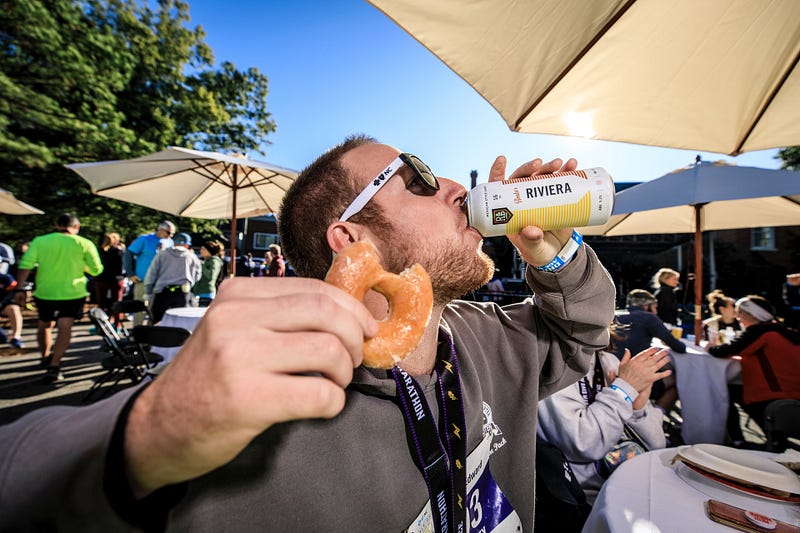
Ok, you got me. I’m guilty of enjoying food. I have a serious buttered toast habit and I like my potato chips. Fries are on my agenda when I go to town.
I know I’m not the only one eating more due to stress over world issues right now. Many people are worried about a few extra pounds. Anxiety eating is a big challenge. And a lot of us are spending more time than ever inside at home.
Since I’ve been laid off again I have been doing as much work from home as I can. Without the office schedule to keep me on the straight and narrow, my food choices changed. I have access to my own fridge 24–7, so I can snack like never before. I always found it hard not to have seconds at supper. Maybe some 9:00 PM popcorn too.
The result is that my weight is 10 pounds more than it was this spring. That’s equal to two regular-sized concrete bricks. Or 10 blocks of salted butter. The same weight as 19 cups of water.
That’s a three-month-old baby! Since I’m not giving birth anytime soon, I need to nip this in the bud. That’s why I want to face facts. I want to know how this is affecting my life. How does this flab really change me?
And how is it affecting my running?
Not cut and dry
It seems obvious to everyone that it takes more energy to move a fat bulldog slob than a sleek greyhound racer. But what isn’t so obvious is all of the effects on the body when we gain weight but aren’t actually obese.
The CDC’s adult BMI calculator tells me that a man of my height, 5'7" and 169 pounds has a BMI of 26.5. Overweight is considered 25 to 29.9 BMI, while over 30 BMI is shown as obese. I’m definitely overweight, then. If I lost my extra 10 pounds of flab, I would just barely squeak back into the normal range. So how much slower am I right now?
Most of the time, everyone only seems to be concerned about how much speed you lose. Like this article in Runner’s World, called “How Much Does an Extra Pound Slow You Down.” They talk about “a race time improvement of 0.64 percent per pound lost — or, for these runners (who were running at about 6:00/mile), 2.4 seconds per mile per pound.”
This is due to the extra energy it takes to accelerate your mass forward. It also costs energy to fight gravity and push off the earth with every step. The more you weigh, the more juice and oxygen that costs you.
At my current weight, that would mean I’m 24 seconds slower per mile than I was 4 months ago. That’s nothing when you’re running super slow to start with. Just a few seconds, what’s the big deal? If that was all there was to the picture, then nothing to worry about.
But what I’m more concerned with is inflammation. In the weight argument online, no one seems to consider what that’s doing to a runner’s body.
Flab equals inflammation
Having a few pounds of fat packed in my middle, around my liver, and in my arteries does daily damage through inflammatory processes. Recovery is slower because body parts like knees and ankles don’t heal up as fast. I think I can already feel this happening to me, even though I still get the same amount of exercise as ever. It’s noticeable in just a few months.
Here’s a study called “Obesity and inflammation: the linking mechanism and the complications,” by Mohammed S. Ellulu, Ismail Patimah, Huzwah Khaza’ai, Asmah Rahmat, and Yehia Abed. They took a detailed look at how extra adipose tissue, or body fat accumulations, creates big problems. One of the conclusions of this study states that “the inflammatory state followed by vascular and endothelial dysfunction is characterized by decreased nitric oxide and elevated reactive oxygen species leading to oxidative stress.”
Oxidative stress is an excess of free radicals. Everything basically starts rusting inside you if you have oxidative stress. This can mean hardening of the arteries, high blood pressure, and heart disease.
Oh yeah, and getting old faster. That’s exactly what we want, right? Short-term pleasure of eating fries at the cost of long-term health.
Time to cut the toast, fries, and second helpings
It seems pretty clear. That extra 10 pounds of flab makes me a few seconds slower right now. I can feel myself losing speed, too. It’s taking just a little more effort to get going. And my times have been increasing instead of decreasing, for the same runs. I can’t ignore it any longer. It’s a problem.
Long-term effects are it’s making me get old faster. Maybe this will lead to some serious problems, like high blood pressure, or even cancer. No one wants that. I need to take some steps now. I don’t have to have an emergency room wake-up call to tell me I’m headed in the wrong direction.
After free radicals rust away your insides, it’s probably too late to do a darn thing about it. Preventative measures are the way to go. Time to sit down and come up with a game plan, get my weight back on track.
And I definitely better keep running.