
How Meditation Affects Your Physical Body and Brain
Leaving the spiritual aspect aside, meditation may be a really good way to keep your body and brain healthy

David told me that he initially started meditating in order to calm down his nerves and to better deal with his anxiety and addiction. He had been working two jobs, for 12 hours each day, whilst trying to navigate a life torn between his family struggles and an anxiety-driven mind. Unfortunately, all this had pushed him to the edge and he eventually gave in to the pressure — cocaine and cannabis had become his best friends when dealing with stress…and life in general. After a lengthy period of self-destruction, David explained, he stumbled upon аn old family friend who had become a mindfulness teacher. This was when his recovery journey began.
David had been meditating for 3 years when I first spoke to him. I was really interested in knowing how he managed to keep his habit for such a long period and also whether the practice had any actual effect on his body and mind. “It really helped me in recognizing my emotions more clearly and also be more in touch with my body in the present moment,” he said. He also learned to be more grateful for what he had and be more kind to himself and the others around him. “I am now able to recognize the thoughts going through my head, to see them as nothing but thoughts. This has since helped me immensely in not getting identified by my anxiety and anger. I’m not them!”
Although there were some obvious benefits as far as his mental health was concerned — he knew the practice aided his brain function and overall physical body in some way, simply because he never felt better. However, he wasn’t sure how exactly and to what extend he had changed.
At that time I had read a couple of articles that claimed that meditation altered your brain, but I never really researched it properly…until I started meditating myself. Here’s what I found:

Age-Related Grey Matter in the Brain
Usually, the human brain decreases in weight and volume as soon as we hit our mid-twenties, which is associated with progressive functional impairments that result in an increased risk of neurodegenerative diseases and various mental illnesses. That’s where meditation may be of great help.
A study conducted by researchers at the University of California and the Centre for Research on Ageing Health and Wellbeing at the Australian National University argued that a long-term habit of meditation (years of meditation experience ranged between 4 and 46 years) better preserved the brain compared to a lack of such habit. They also had found that long-term meditators had more brain grey matter volume, throughout the whole brain area, as compared to the control group of non-meditators that were of as similar as possible sex and age.
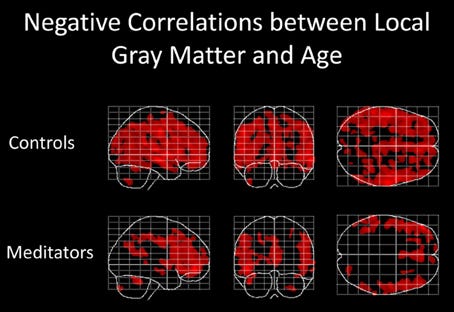
Age-related gray matter does generally decline as age advances, however, the age-related loss within the practitioners was less significant, suggesting that there was a widespread effect of meditation that encompassed regions throughout the brain. As a conclusion, the authors stated:
“The findings seem to add further support to the hypothesis that meditation is brain-protective and associated with a reduced age-related tissue decline.”
However, it’s important to note here that these effects might not be a direct result of meditation alone, but of other (either stand-alone or partnering) factors.
Immune System
A comprehensive review was conducted, jointly by researchers at USC and UCLA, reviewing randomized controlled trials, that examined the effects of meditation on various immune system parameters, such as inflammation, cell-mediated immunity, and biological aging. This review found “tentative evidence that the practice of meditation modulates some select immune parameters.” However, although the study did cover 20 RCTs (randomized control trials) and more than 1600 participants, the findings, although presented in a clear way, hardly mean anything to the normal reader who has no scientific background.
Another study from 20 years ago assessed the influence of long-term meditation on marathon runners’ immune status at rest, after half a marathon, and after two hours of the recovery period. Ten males, who had been practicing meditation for a long time (not specified how long) were compared to a control group that had been drawn from a pool of applicants in the race who didn’t practice meditation. Each of the participants gave a blood sample, before, right after, and 2 hours after the half-marathon. The primary marker observed was lymphocyte count — a measure of one’s white blood cells, which help fight off diseases. Here are the findings:
“Runners practicing meditation had lower lymphocyte counts at rest before the race. Just after the race, both groups more than doubled their white blood cell counts; however, no significant effects were observed on the immune cells, neither was any difference between groups seen in the post-exercise period. Long term practice of meditation may influence absolute lymphocyte counts at rest.”
A more thorough and comprehensive large-scale genomic study from this year studied participants in an advanced 8-D Samyama Inner Engineering meditation program, where members of the group spent 8 days in complete silence with more than 10 hours of meditation per day. The participants had at least one year of meditation experience and meditation practice of one to two hours a day prior to the retreat and study. Also, blood samples were taken at four-time points throughout the study period.
The main point of argument in the study is that meditation, as far as the immune system is concerned, as behavioral intervention, could “voluntarily and non-pharmacologically” aid the immune responses that treat different conditions related to excessive and persistent inflammation with a “dampened immune system profile.” Immune function is probably one of the processes in the body that is implicated in several major health conditions, such as depression, cardiovascular disease, obesity, asthma, certain types of cancer, and so on. The immune system was of primary importance to the study, as the researchers argued the following:
“We found several immune-related and other fundamental cellular pathways were altered after the meditation retreat. This work provides a key proof of principle for the power of the systems genomic approaches in tackling complex problems by demonstrating that meditation practices enhance gene networks associated with distinct pathways.”
However, although the large-scale genomic study might be the first one of its size to explore the benefits of meditation on the human immune system, there’s more to meditation than this.
Depression & Anxiety
Although most people that meditate have reported decreased levels of depression and anxiety, it is worth researching it scientifically in order to see what studies and meta-analyses have to say about it. Although such studies are scarce and their findings are often limited, they still could provide an overall framework to work with.
One such study that explored the effects of mindfulness-based therapy on anxiety and depression, conducted literature research based on 39 studies, totaling 1140 participants that had been receiving mindfulness-based therapy for a range of conditions, including cancer, anxiety disorder, and depression. The results suggested that the therapy was “moderately effective” for improving anxiety and mood symptoms from pre- to post-treatment.
Another, older study, examined the effects of a short-term yoga course on mood in 28 mildly depressed young adults, aged from 18 to 29. None of the participants had been diagnosed or received any kind of psychiatric treatment, nor did they have any significant yoga experience. The participants attended two 1-hour long classes, each week, for 5 consecutive weeks.
The results? The young adults demonstrated “significant decreases in self-reported symptoms of depression and trait anxiety.” Changes were also notable in acute mood, as the participants reported lower levels of negative mood.
In 2014, a study at Johns Hopkins explored the relationship between mindfulness meditation and its implication for alleviating symptoms of anxiety and depression. The meditation programs, according to the authors, had moderate evidence of improved anxiety and depression, with an effect size of 0.23 and 0.23 after 3–6 months of practice, respectively. In order to better understand the numbers behind this, the effect size of some modern antidepressants is of about 0.31 to 0.32.
There are a dozen more worthy-of-reading studies on other important aspects of meditation, such as its positive effects on chronic pains, cardiovascular diseases, peristaltic (IBD in particular), fatigue, and stress. However, this article would’ve become way too lengthy, so I’ll explore these aspects in another piece :)
CONCLUSION
Although the interest in meditation and its implications on our health has started to receive more and more attention from the general public and the science community, the mechanics of its benefits and negatives are still poorly understood. Most of the parameters in relation to mood, anxiety, and depression are typically measured by self-reported questionnaires, which are ultimately prone to subjectivity and bias. The findings on the practices’ effects on the brain and immune system, although growing in size, are still to come up with definitive and conclusive answers, such that wouldn’t require “further research.”
Nevertheless, the studies on the practice of meditation do offer insight on how people could benefit physiologically at the most fundamental level. At the end of the day, one probably doesn’t need scientific proof that meditation works, if one already feels good from practicing it.
Thank you for taking some time to read my article.
If you wish to read more written by me, check my Medium page:
If you are further interested in psychedelics and mental health, I recently wrote about whether smoking can damage your brain cells, and the harmful and beneficial effects cannabis has on your body.


