
How MDMA Works in Your Brain
Massive empathy and Serotonin
**Join Medium here if you aren’t already a member to get access to 1,000s more articles**
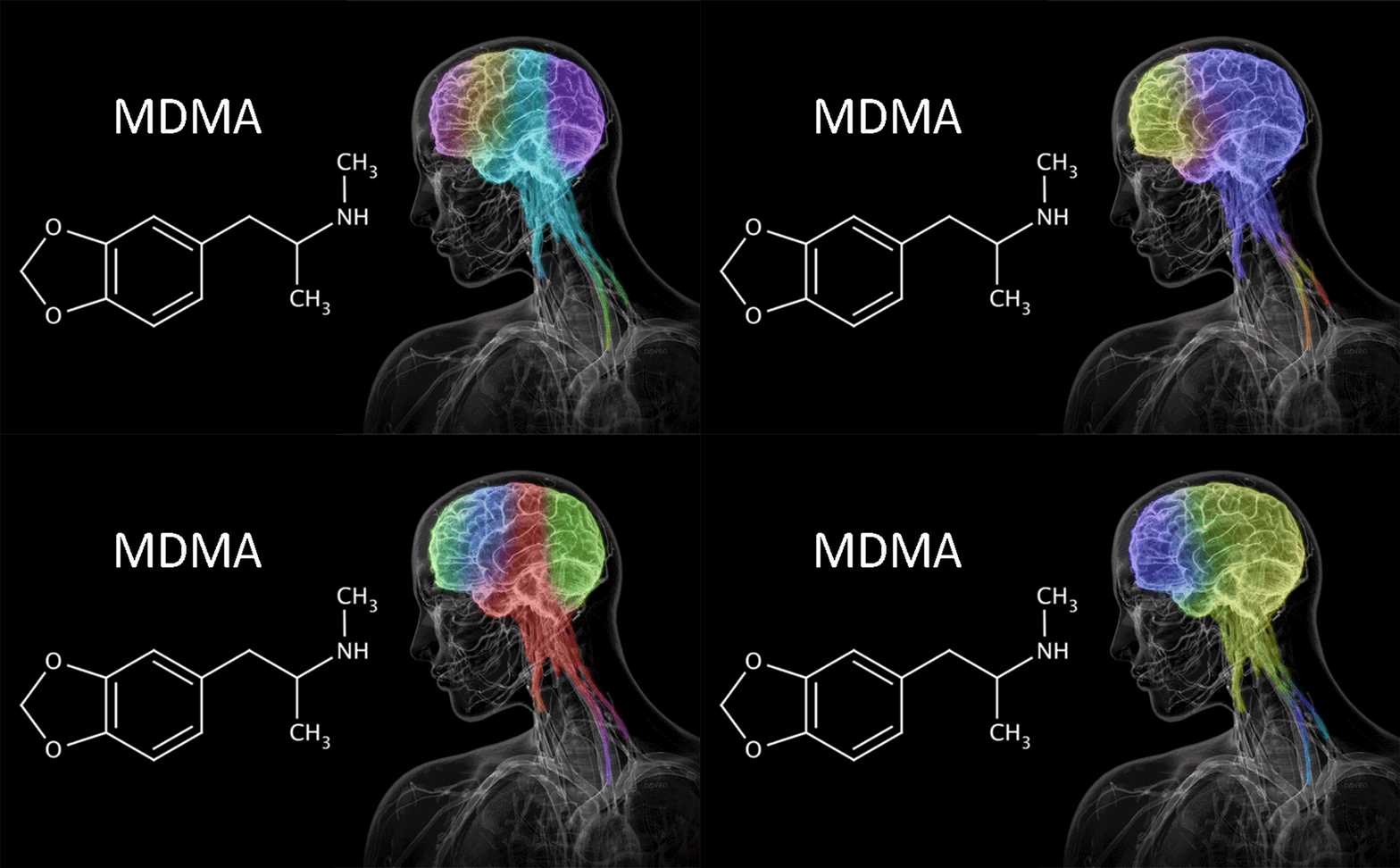
Classed somewhere between a stimulant and a hallucinogen, MDMA’s main effect is a massively heightened feeling of empathy. For this reason it’s classified as an empathogen.
MDMA (mandy/molly/ecstasy) is known as a rave drug, but there’s so much more to this substance other than it’s ability to make you dance. The feelings of empathy and emotional connectedness really cannot be rivalled.
However, it’s a controlled and potentially dangerous substance, look here for safety information and best practices.
MDMA brings about it’s characteristic empathy and emotional openness by stimulating a neurotransmitter called serotonin. It does this in a region called the hypothalamus.
Just to forewarn you, we’re going to go into the mechanics of how the substance works in the brain, but in order to understand it, we must first understand a bit about how the brain functions and how its cells communicate.
OK, ready…
The Hypothalamus
The hypothalamus sits between the pituitary gland and the thalamus in the brain. It’s about the size of an almond and its main function is homeostasis.
This means maintaining the balance between the body’s systems. The hypothalamus tells you if you’re thirsty, hungry, hot, cold etc.
MDMA mostly overstimulates cells within this region and throws it out of whack for a few hours. As a result, balance in body temperature, hunger and thirst systems are affected.
It dials feelings of hunger back, cranks thirst up and throws the body’s internal temperature-regulation system out of sync. Users report feeling hot and cold, especially when coming up, and body temp can be very sensitive throughout the trip.
This is where one of the main dangers of MDMA comes from. The more a user takes, the more out-of-sync the hypothalamus is thrown. Take dancing for hours in a hot club, for example. The hypothalamus has far less control over the body’s internal temperature when on MDMA, so it’ll have a much harder time keeping you cool while you rave away in a sweaty club basement. That, coupled with the fact it makes a user much thirstier than they actually are can make for a dangerous combination.
It can cause a user to drink too much fluid which can lead to water intoxication (yes there is such a thing), or worse still, lead to body-temp rising too high, which can result in organ failure. Again, have a read here for a far expanded safety explanation.

Neurons
The brain (and therefore the hypothalamus) is full of cells called neurons. These are thin and ling and have two distinct ends; one that sends signals and one that receives them. Neurons communicate by sending and receiving electrical signals down the length of their bodies via electrical impulses.
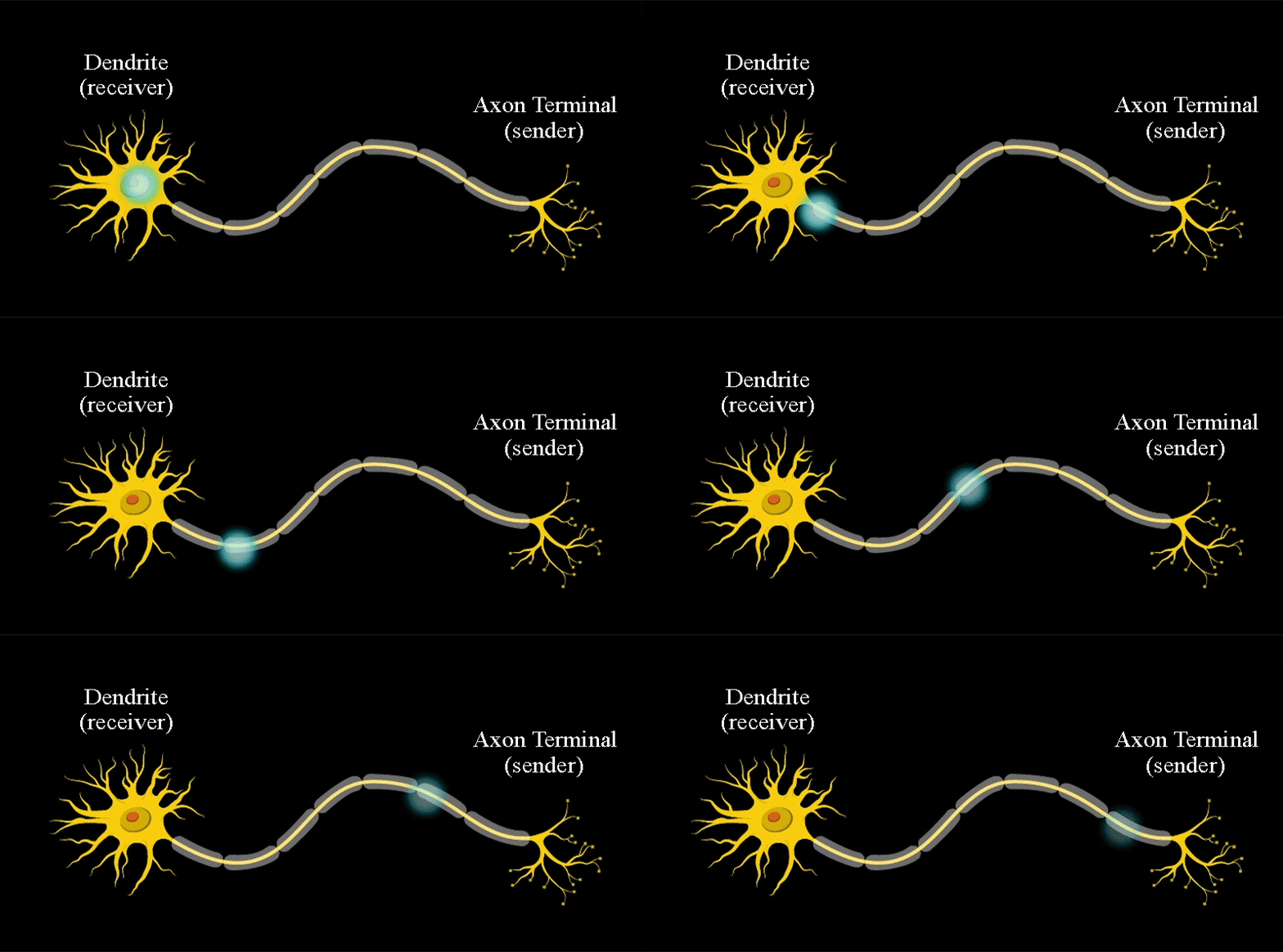
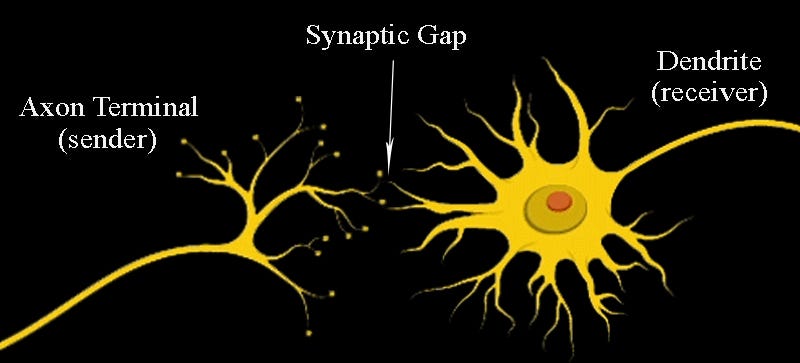
The sending ends of one cell will face the receiving ends of another, but they won’t touch. Instead, there’s a tiny, tiny space between the cells called the synaptic gap. The electrical impulses jump across the gap via chemical messengers called neurotransmitters.
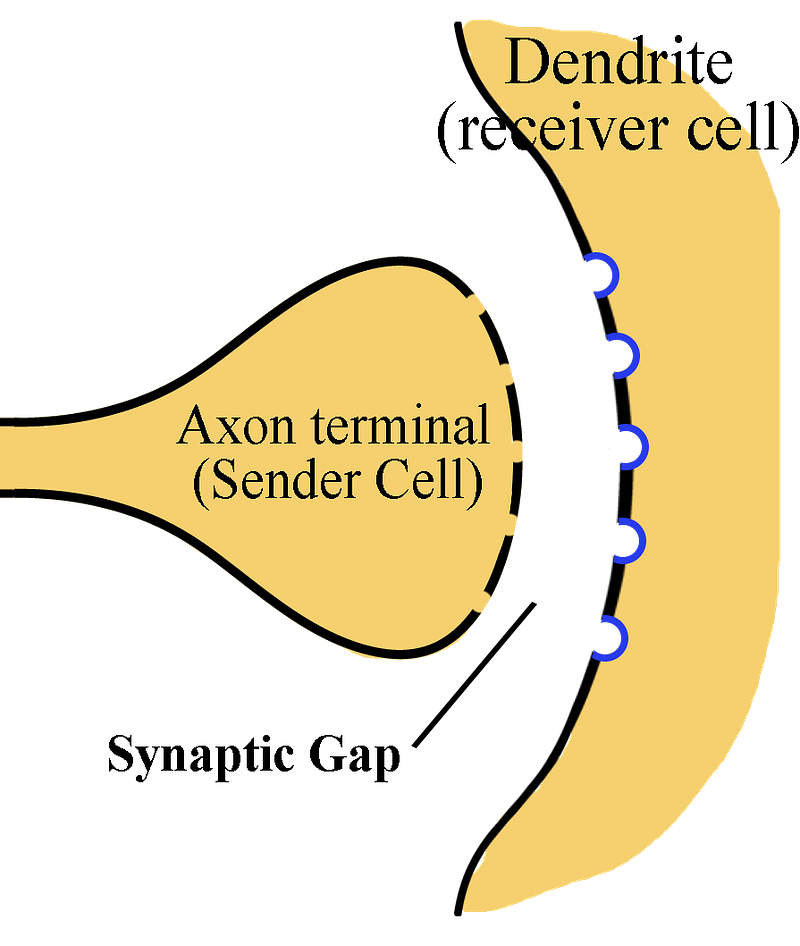
A neurotransmitter is a chemical which fires from the body of the sending neuron and fits into receptors in the receiving neuron, thereby activating them.
There are many different types neurotransmitters and they’re responsible for all kinds of different functions and feelings.
Dopamine, for example, is the neurotransmitter responsible for pleasure. The more there is of it swimming around in the synaptic gap, the more pleasure you’ll feel. It’s a motivator — we get a hit of pleasure when we do something good for our survival, for example eating or having sex. This is also the neurotransmitter which cocaine mainly stimulates.
Another one is cortisol, responsible for stress but also concentration. Just enough cortisol in the brain allows you to concentrate, too much leads to high stress levels and generally negatively impacts health due to immune system suppression.
So, back to how neurotransmitters work within their neurons. Each neuron will send impulses through a specific type of chemical, depending on what type of cell it is, what it does and where it is in the brain. The neurotransmitter released from the sending side of one neuron is received via receptors in the ends of the receiving neuron, just across the synaptic gap.
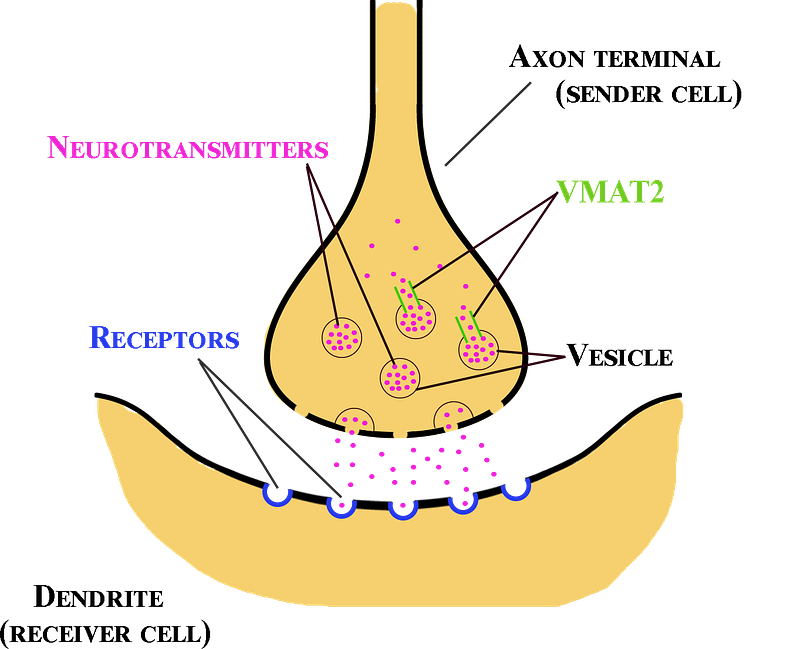
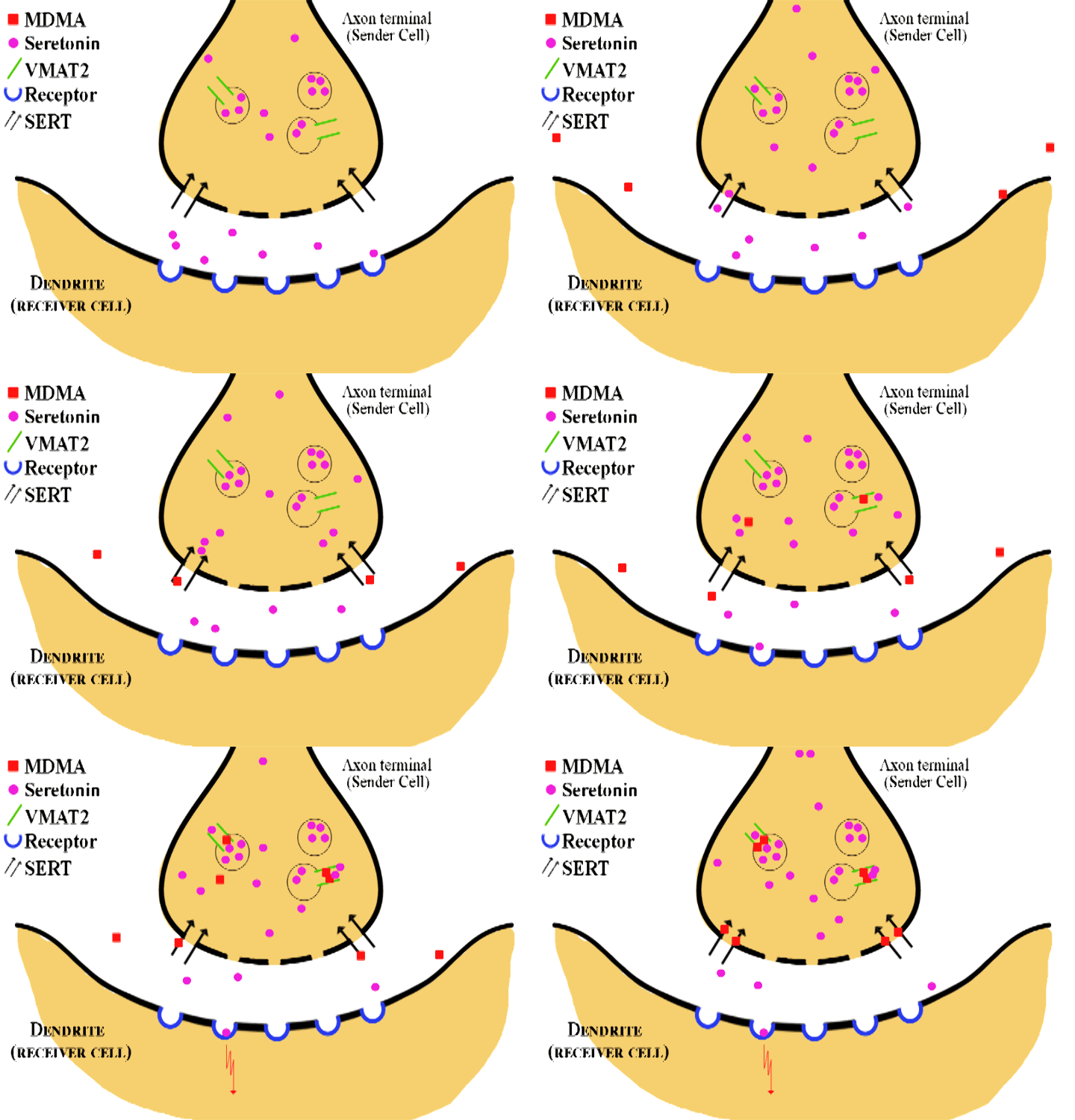
The image above is the normal function of a neuron. The space betweeen the two cells is the synaptic gap. In the sending cell, serotonin molecules, which are made within the cell, gather and are sorted into small groups (within the little bubbles, called vesicles) by a protein called VMAT2. The vesicles then bond with the cell wall and release serotonin into the synapse. The serotonin molecules float across the gap and sit into the receptors in the receiving cell, thereby activating them. The activation of these receptors sends a signal to the receiving cell to either light up or quiet down.
Receptors are very specific and can only be activated by a specific transmitter. This is because each neurotransmitter has a specific shape (which is the shape of it’s molecular structure) and the receptor can only accommodate that shape.
It’s like a lock and key. A specific receptor can only be activated by a specific neurotransmitter, like the lock on your front door can only be opened by the shape of your key. Dopamine, for example, cannot activate serotonin receptors because dopamine molecules don’t fit into them —theyre the wrong size for the receptor and therefore the wrong type of key.
Serotonin
MDMA stimulates the flow of serotonin. It does this much more so than its cousins amphetamine and methamphetamine. This is because of the ‘methylenedioxy’ part (the ‘MD’ in MDMA). This makes the substance dial down its stimulation of dopamine and norepinephrine receptors — which its cousins stimulate in larges amounts — and ramp up its stimulation of serotonin receptors.
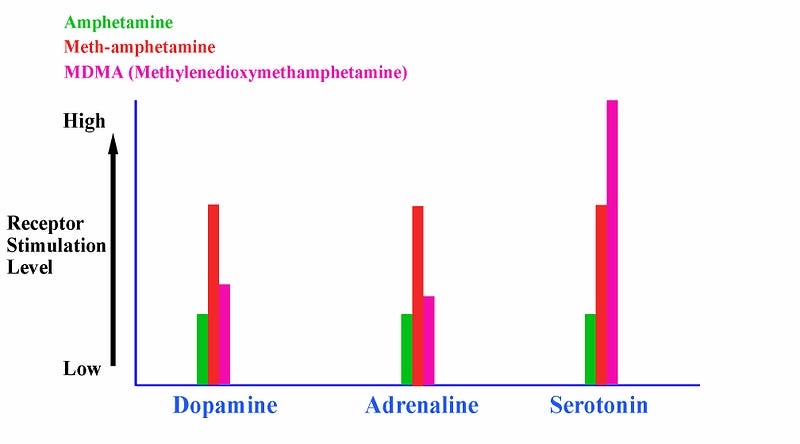
But what does that actually mean?
Serotonin has many, many different functions. These include regulating mood, circadian rhythm, muscle control, vasoconstriction, to name just a few. Which function is used depends on which receptor is activated. Serotonin has many different receptors, though serotonin itself is only one type of neurotransmitter.
This means serotonin is one key which unlocks many different types of doors. Behind each door lies a specific set of mechanisms for different brain and bodily functions. Putting the key into the lock opens the door and activates those functions. Serotonin has a total of 15 different receptors, meaning it’s one key which activates 15 different types of lock. MDMA focuses on one of these receptors, known as 5HT2A, and we’ll see shortly what effect that has on the individual.
The physical process is as follows. Serotonin molecules gather within the body of the sending neuron. A little protein called VMAT2 group the serotonin molecules together within the sending cell in little round bubbles called vesicles. They then transport them out of the neuron in their groups into the synaptic gap. It’s like if you’re crossing the road with 80 school children, you separate them into 10 groups of 8 and then cross with one group at a time.
The serotonin molecules bounce around in the synaptic gap and snuggle into the receptors in the receiving neuron. They don’t stay there for long at all though, as soon as the receptors are activated the molecules slip out and back into the synaptic gap. Like putting a key in a lock, turning it once and then swiftly removing it.
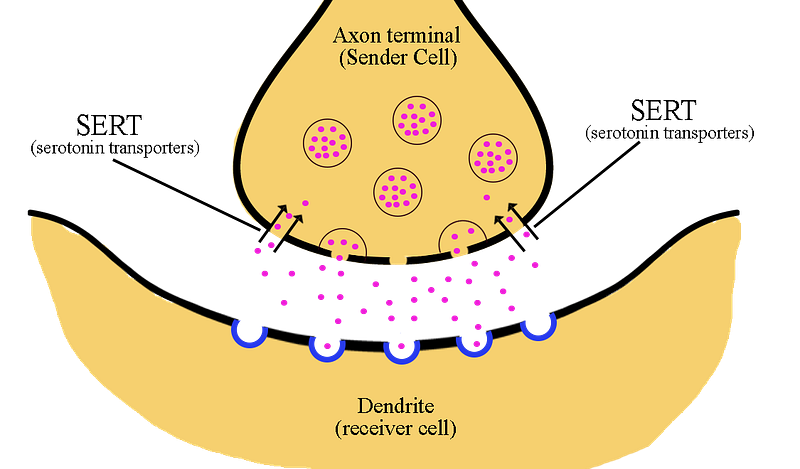
In normal brain function, the excess serotonin is then taken back up into the sending cell, in a process aptly named ‘reuptake’.
In the reuptake process, serotonin is called back into the sending cell via SERT (simply short for ‘serotonin transporters’). The SERTs are like bouncers operating a one way door. They allow serotonin back into the cell but do not allow serotonin out of the cell. The VMAT2 proteins mentioned before, which group the serotonin molecules together, let them out of the cell. Like at a music festival when there’s one gate in and one out, and absolutely no crossing between the two.
So What About MDMA?
If you’ve read this far, I thank you. We’ve gone through some fairly complex brain mechanics pretty quickly, and I’m happy you’re still with me.
As mentioned, MDMA acts mostly on serotonin.
Whereas it does stimulate your serotonin, it doesn’t actually increase its production or give your brain more than it’s already got. MDMA is much sneakier than that. Remember those VMAT2 proteins I mentioned, the ones which group serotonin together in the sending cell? And those one-way SERT bouncers which take serotonin back into the cell, but don’t let it out into the synaptic gap?
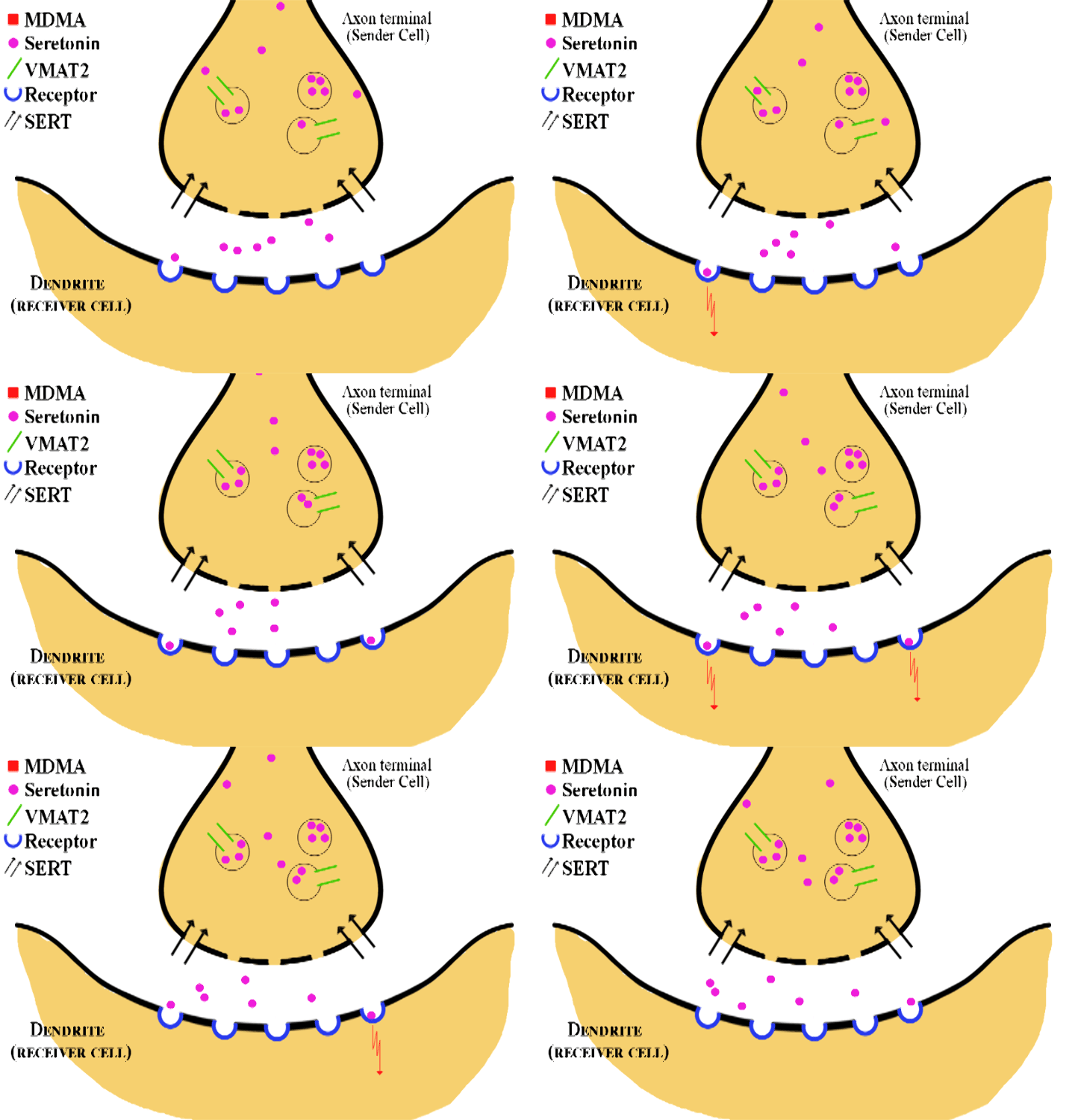
Well, MDMA grabs hold of both of them.
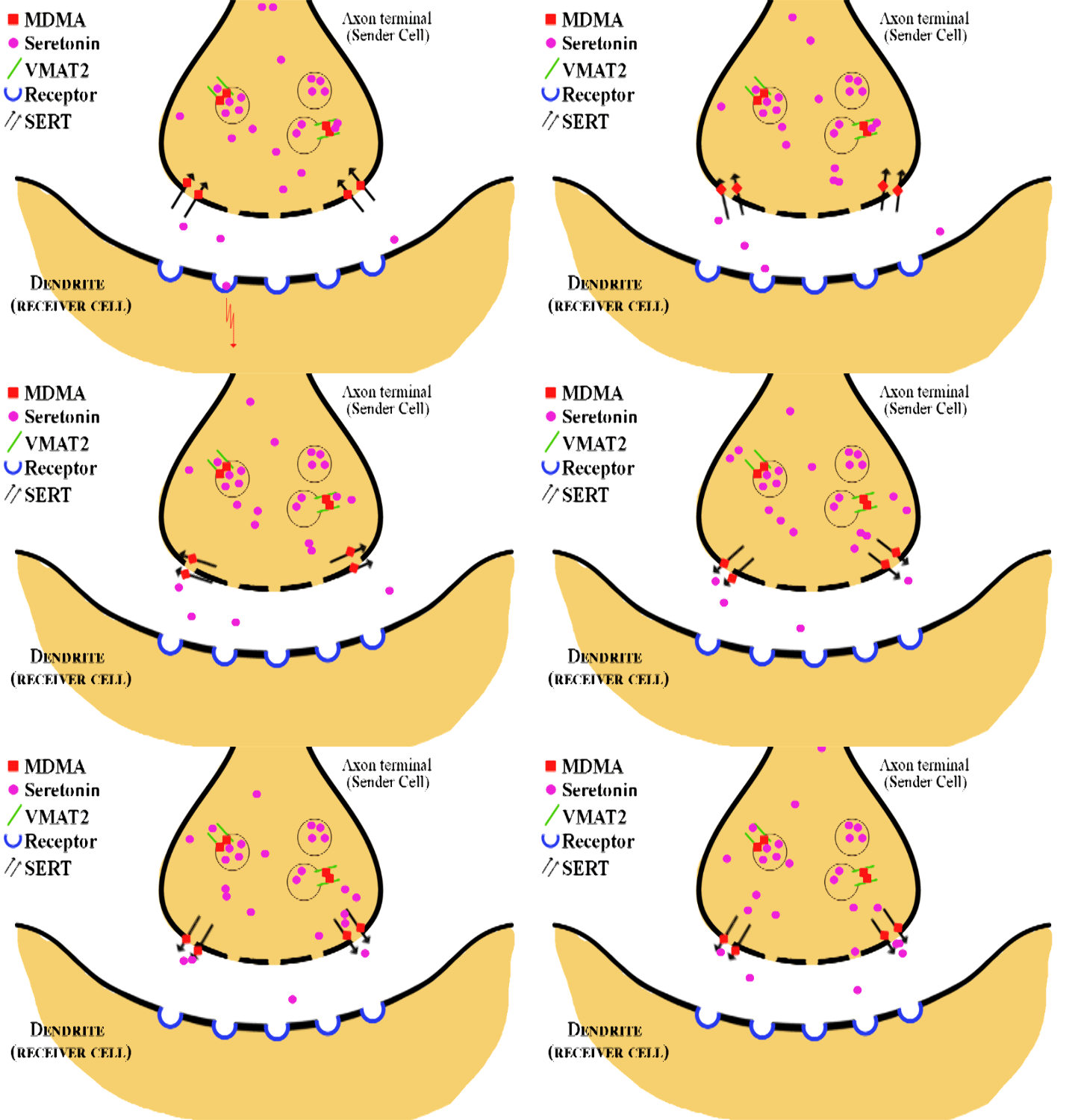
First, it stops the VMAT2 from grouping the serotonin molecules neatly within those little bubbles in the sending cell, so serotonin just ends up swimming around in there freely, unordered and unchecked, as if your 80 kids trying to cross the road were just rampantly running round on the sidewalk.
Secondly, MDMA grabs hold of those SERT bouncers and turns them around, so they don’t let serotonin molecules back into the cell after they’ve activated the receptors. Instead, those SERT bouncers start letting them out of the cell into the synaptic gap.
The result is a whole load of serotonin trapped in the synaptic gap, swimming around and constantly activating the receptors, sending the system crazy for 3–6 hours, until the MDMA molecules themselves are metabolised and flushed out of the cells by the brain.
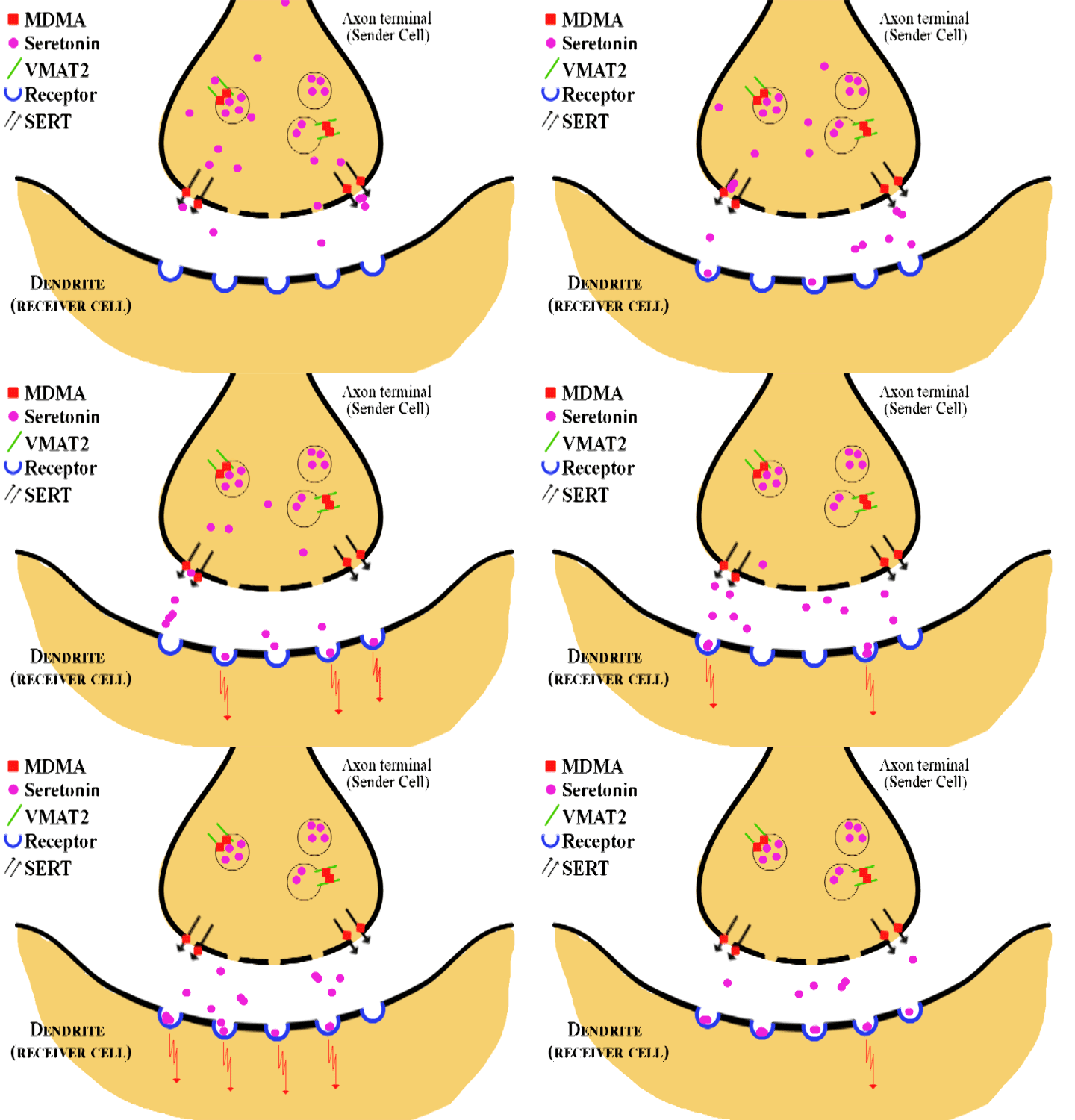
After the invasion, all of that serotonin which the MDMA hijacked is then metabolised. It doesn’t go through the reuptake prcocess and isn’t brought back up into the cell. This means all of that serotonin is broken down, which depletes that particular supply of the brains serotonin.
How Does It Feel?
Serotonin is responsible for many things and this specific receptor (5HT2A) deals with a variety of functions — psychedelia, anxiety, consciousness, vasoconstriction, to name just a few.
The practical effect of MDMA is a hugely heightened sense of empathy, which comes only from the over-activation of just serotonin. Amazing how changing the activation level of just one receptor drastically changes one’s perception.
I’ve gone into much more detail here, including how it feels, the stages of the trip, how and why there’s a comedown and why having one at all is optional.
MDMA is a controlled substance in many countries and this piece does not encourage, authorise or condone use, purchase, distribution or otherwise of MDMA or any illicit substance. This piece is meant for the purposes of information only.
Twitter: @rajeet_s
**If you enjoyed this article please consider Joining Medium to get access to all of Rajeet’s articles plus 1000’s more from other authors.**