
MDMA: A Harm-Reduction Guide
How MDMA works in your brain, how it feels and how to stay safe
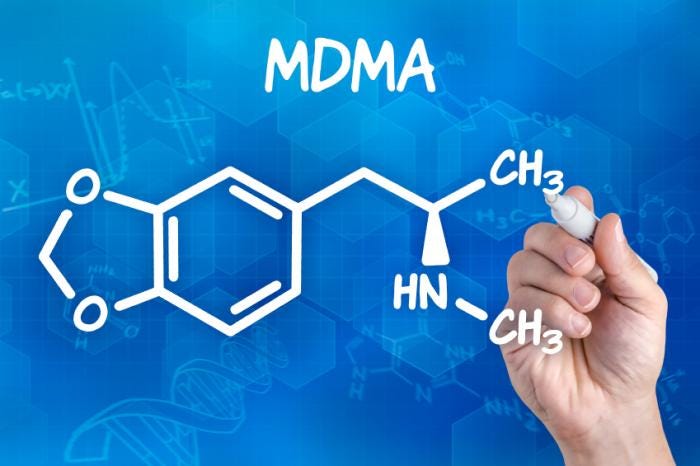
MDMA (aka molly, mandy, ecstasy) is known mostly as a party drug, the go-to of ravers and festival-goers the world over. However, there is much more to this substance, both in its potential benefits and dangers.
Contents
(Yes, this guide turned out so long we had to write a contents section)
1 Substances 1.1 Substances in general 1.2 Legality
2 MDMA 2.1 What is MDMA? 2.2 What Forms Does MDMA Come In? 2.3 Are There Any Differences in Crystals or Pills? 2.4 What About Safety? How Do I Know What I’ve Bought is What it’s Supposed to be?
3 The Brain and MDMA 3.1 Neurons 3.2 Serotonin 3.3 So What About MDMA?
4 The MDMA Experience 4.1 What does MDMA feel like? 4.2 Set & Setting 4.2.1 Set 4.2.2 Setting
5 Safety 5.1 Testing 5.2 Dosage 5.3 Frequency
6 Dangers and How To Avoid Them 6.1 Not Getting What You Think You’re Getting 6.2 General Health 6.3 Too High of a Dose 6.4 Overheating 6.5 Dehydration and Overhydration 6.6 Neurotoxicity 6.7 The MDMA Jaw Clench
8 The MDMA Experience — Come Up and Come Down 8.1 The Come-Up 8.2 The MDMA Trip 8.3 The Come Down and Aftermath 8.4 After the MDMA trip 8.5 Avoiding the Come Down 8.6 The MDMA Afterglow
9 The Benefit Potential of MDMA 9.1 MDMA and PTSD 9.2 MDMA and Couples Therapy 9.3 MDMA & Sex, and Cuddling too 9.4 Comfortable Setting vs Rave Setting
11 Resources, References and Further Reading
Disclaimer: MDMA is a controlled substance in many countries, including the USA and UK. This piece does not condone, endorse or encourage the purchase or use of MDMA or any other illicit substances and is meant for the purposes of information only. MDMA is a dangerous and potentially lethal substance and the author does not accept any responsibility, liability, or otherwise for any person purchasing, consuming or using MDMA or any other illicit substance in any way, or any damage, injury, death or otherwise sustained from purchase, use or consumption of MDMA or any other substance. This piece is not intended to be used in an advisory capacity and is for the purposes of information and education only.
1.1 Substances In General
Drugs are categorised broadly under 3 headings according to what they do to the brain. These headings are Stimulants, Depressants and Hallucinogens.
Stimulants increases brain activity, Depressants inhibit brain activity (they don’t make you depressed, as the name might suggest) and Hallucinogens, unsurprisingly, encourage the brain to hallucinate.
Stimulants include cocaine, amphetamines and caffeine, depressants include alcohol and ketamine and hallucinogens include psychedelic mushrooms and LSD.
1.2 Legality
As we’ll all know, MDMA is an illegal substance almost the world over. In most countries it is illegal to purchase, possess, consume or produce MDMA. This goes for other substances like psilocybin, LSD, cocaine, ketamine etc.
We do not suggest, recommend or encourage anyone to purchase, consume, possess, produce or otherwise have anything to do with MDMA or any illicit substances. This piece is meant for the purposes of information only.

2.1 What is MDMA?
MDMA, or 3,4-Methylenedioxymethamphetamine, does not fall neatly into one of the general 3 drug categories. It has stimulant and mild hallucinogenic properties, so it can’t strictly be classed as a pure stimulant or pure hallucinogen.
It’s an amphetamine, like speed or crystal meth, but has differing effects. Speed and crystal meth are very similar to each other in molecular structure—meth simply has an additional carbon molecule on the end of it, but this small change makes methamphetamine so much more potent than amphetamine.
MDMA, on the other hand, is far less addictive, at least from a chemical standpoint, although it does stimulate the same chemicals in the brain as other amphetamines (serotonin, dopamine and norepinephrine), just in different quantities.
As far as its effects go, MDMA is classed as an empathogen. As the name suggests, users feel vastly heightened levels of empathy, as well as euphoria, greater understanding of others and a general sense of well being.
And, the urge to dance, given the right setting (that one comes from the norepinephrine triggering).
The 'MD' in MDMA (the methylenedioxy part) changes the molecular structure of the amphetamine, making it chemically similar to mescaline, which is where its mild hallucinogenic properties come from.

Mescaline, a natural hallucinogen, is found in the San Pedro and Peyote cacti. Used in Peruvian healing rituals for hundreds of years, it almost strikes a balance between the effects of magic mushrooms and MDMA (obviously mescaline, being natural, existed before MDMA, which is synthetic, and MDMA can actually be classed as a mescaline derivative).
2.2 What Forms Does MDMA Come In?
Crystals or pills. The crystals can be crushed into a powder to be swallowed or insufflated (snorted) and the pills are known by the name ecstasy, so called because of the feeling of euphoria the user experiences.
2.3 Are There Any Differences in Crystals or Pills?
Yes. Huge potential differences.
One of the issues with any illicit substance is that they’re not regulated, meaning there’s no guarantee you get what you think you’re getting. The ecstasy pills you pick up at a rave may contain only small amounts of MDMA or may have none at all. Pills may contain other stimulants like caffeine, or worse still, have other dangerous compounds in them. With a pill you never quite know what you’re getting, or how much pure substance is even in it. Some ecstasy pills have been found to have as little as 3% MDMA in them and some with none at all.
The same goes with crystals. They’re more likely to be MDMA, but just by looking or even tasting, you won’t be able to tell whether what you have is what you think it is.
There’s a particularly nasty compound called PMMA. Similar in look and taste, it has none of the effects of MDMA and can be fatal in high doses.
2.4. What About Safety? How Do I Know What I’ve Bought is What it’s Supposed to be?
To put it simply, without testing it, you don’t know if it’s actually MDMA.
It is absolutely essential to test whatever substance you buy before you or anyone else consumes it. Otherwise you’ll have no idea if what you’re taking is what it’s supposed to be or something entirely different and potentially very dangerous.
There are things called reagent tests — chemicals which are perfectly legal to purchase which you can use yourself to test whether a substance is actually what you think it is.
A quick internet search for ‘reagent tests’ will bring up a load of options, or start here.
I cannot stress enough how important it is to test any substance first. If you don’t, it’s akin to sticking your hand into the biological waste bin behind a hospital and hoping you’ll be ok afterwards.
We’ll cover safety in far more detail later in this piece.
3. How Does MDMA Work in the Brain?
MDMA stimulates the flow of a particular neurotransmitter called serotonin. It does this in a region of the brain called the hypothalamus.
Just to forewarn you, we’re going to go into the mechanics of how MDMA works in the brain, but in order to understand it, we must first understand the mechanics of the brain and how its cells communicate. OK, ready…
3.1. Neurons
The brain is full of cells called neurons. These are thin, long cells which have two distinct ends; one that sends signals and one that receives them. Neurons communicate by sending and receiving signals down the length of their bodies via electrical impulses.
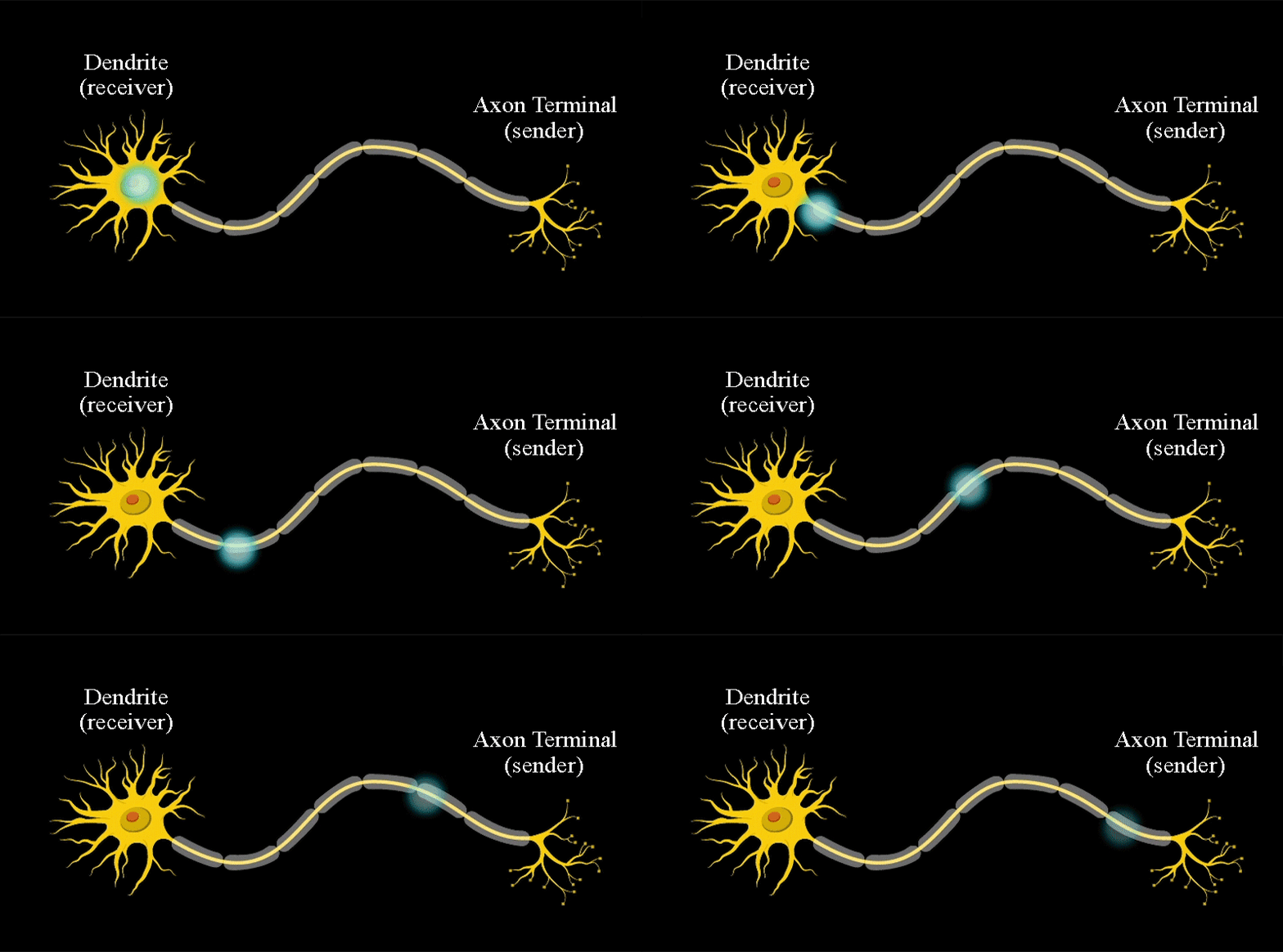
The sending ends of one cell will face the receiving ends of another, but they won’t touch. Instead, there’s a tiny, tiny space between the cells called the synaptic gap. The electrical impulses jump across the synaptic gap through the vehicle of neurotransmitters.
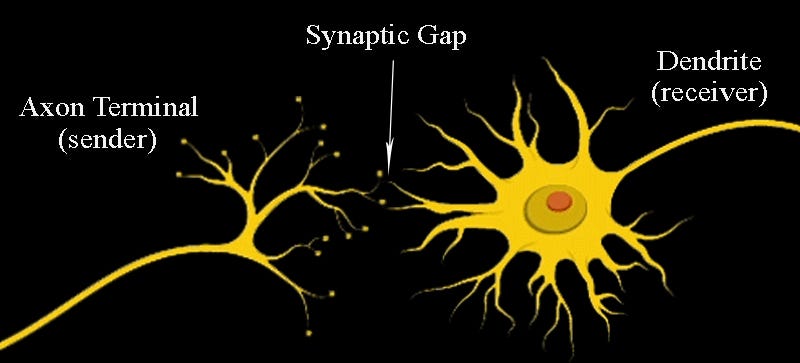
A neurotransmitter is a chemical which fires from the body of a sending neuron and activates receptors in the receiving neuron.
There are many different types neurotransmitters and they’re responsible for all kinds of different functions and feelings all over the body and in the brain.
Dopamine, for example, is the transmitter responsible for pleasure. The more there is of it swimming around in the synaptic gap activating the receptors, the more pleasure you’ll feel. It’s a motivator — we get a hit of pleasure when we do something good for our survival/reproduction, for example eating or having sex. This is also the neurotransmitter which cocaine mainly stimulates.
Another one is cortisol, responsible for stress but also concentration. Just enough cortisol in the brain allows you to concentrate, too much leads to high stress levels and generally negatively impacts health. Especially when cortisol is present over long periods of time (which is why constant stress, literally, slowly kills you).
So, back to how neurotransmitters work within their neurons. Each neuron will send impulses through a specific type of chemical, depending on what type of cell it is, what it does and where it is in the brain. The chemical released from the sending side of one neuron is then received via specific receptors embedded in the ends of the receiving neuron, just across that little synaptic gap.
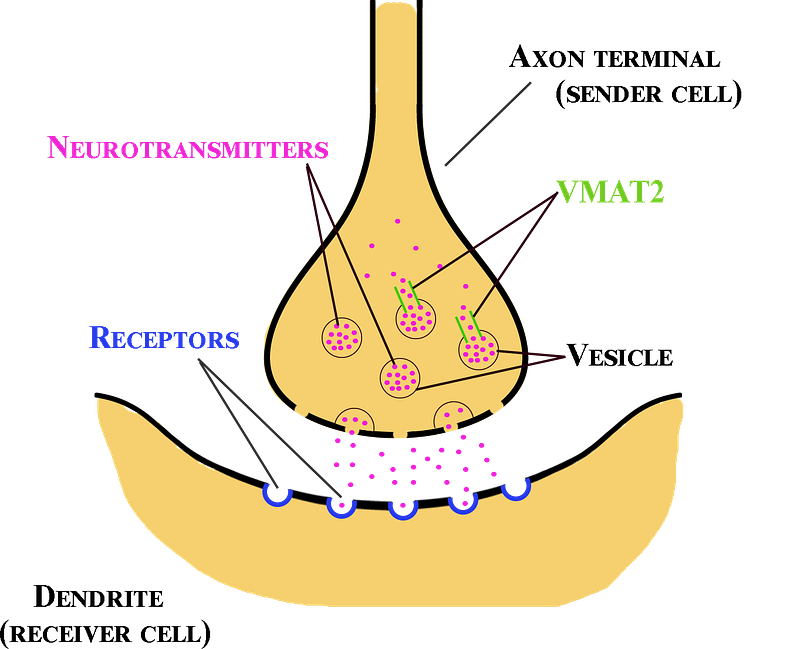
Receptors in the receiving ends of neurons are very specific and can only be activated by a specific transmitter. This is because each neurotransmitter has a specific shape (which is the shape of it’s molecular structure) and the receptor can only accommodate that shape.
It’s like a lock and key. A specific receptor can only be activated by a specific neurotransmitter, like one type of lock can only be opened by one type of key. Dopamine, for example, cannot activate serotonin receptors because dopamine molecules don’t fit into them — it’s the wrong type of key.
3.2. Serotonin
So let’s talk about what we’re here to talk about.
MDMA stimulates the flow of a neurotransmitter called serotonin. It does this much more so than its cousins amphetamines and methamphetamine. This is because of the ‘methylenedioxy’ part (the ‘MD’ in MDMA). This makes the substance dial down its stimulation of dopamine and norepinephrine receptors — which its cousins stimulate in larges amounts — and ramp up its stimulation of serotonin receptors.
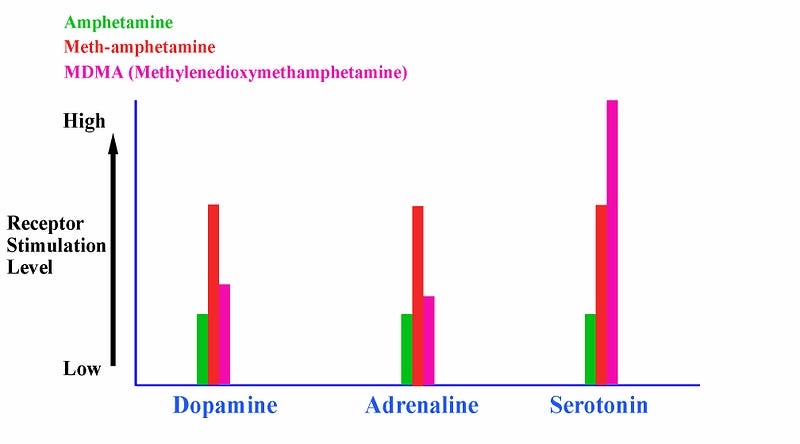
But what does that actually mean?
Serotonin has many, many different functions. These include regulating mood, circadian rhythms, muscle control, vasoconstriction, to name just a few. Which function is used depends on which receptor is activated. Serotonin has many different receptors, though serotonin itself is only one type of neurotransmitter.
This means one key unlocks many different types of doors, and behind each door lie a specific set of mechanisms for different brain and bodily functions. Serotonin has a total of 15 different receptors, meaning it’s one key which activates 15 different types of receptor. MDMA focuses on one of these receptors, known as 5HT2A, and we’ll see shortly what effect that has on the individual.
Serotonin molecules gather within the body of the sending neuron. A little protein called VMAT2 group the serotonin molecules together within the sending cell in little round bubbles called vesicles. They then transport them out of the neuron in their groups into the synaptic gap. It’s like if you’re crossing the road with 100 school children, you separate them into 10 groups of 10 and then cross with one group at a time.
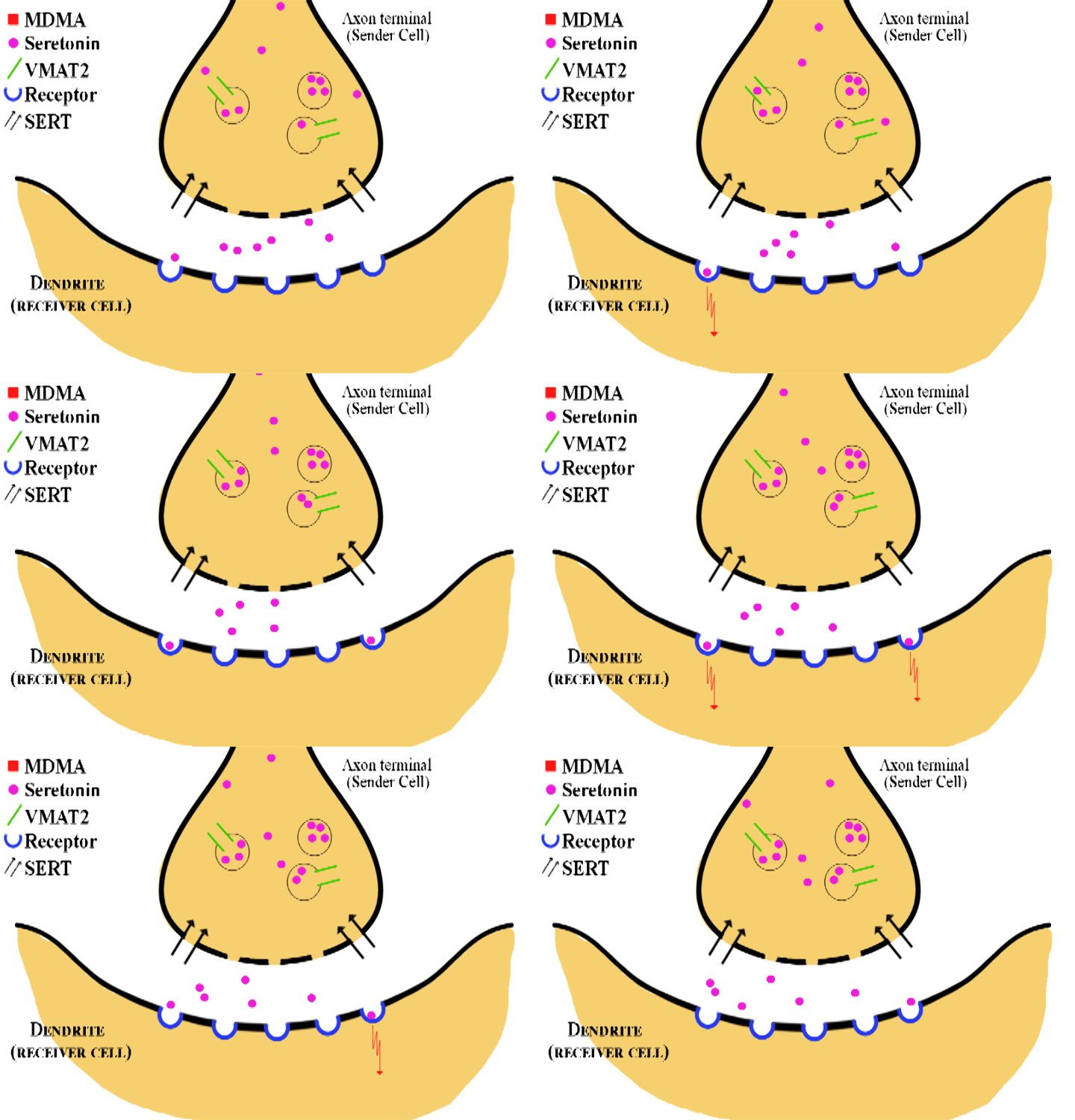
The serotonin molecules bounce around in the synaptic gap and snuggle into the receptors in the receiving neuron. They don’t stay there for long at all though, as soon as the receptors are activated the molecules slip out and back into the synaptic gap. Like putting a key in a lock, turning it once and then swiftly removing it.
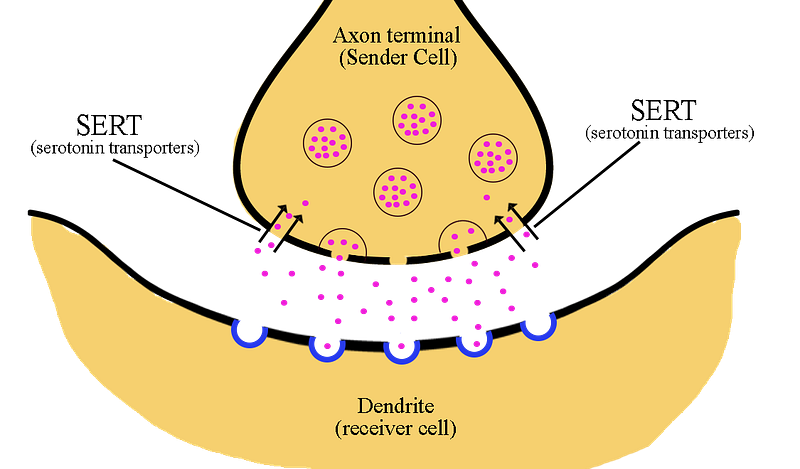
In normal brain function, the excess serotonin is then taken back up into the sending cell, in a process aptly named 'reuptake’.
In the reuptake process, serotonin is called back into the sending cell via SERT (simply short for ‘serotonin transporters’). The SERTs are like bouncers operating a one way door. They allow serotonin back into the cell but they do not allow serotonin out of the cell. The VMAT2 proteins mentioned before, which group the serotonin molecules together, let them out of the cell. Like at a music festival when there’s one gate in and one out, and absolutely no crossing between the two.
3.3. Okay, So What About MDMA?
If you’ve read this far, I thank you. We’ve gone through some fairly complex brain mechanics pretty quickly, and I’m happy you’re still with me.
So back to it. As mentioned, MDMA acts mostly on serotonin.
Whereas it does stimulate your serotonin, it doesn’t actually increase production of it or give your brain more than it’s already got. MDMA is much sneakier than that. Remember those VMAT2 proteins I mentioned, the ones which group serotonin together in the little bubbles in the sending cell? And those SERTs (serotonin transporters), those one-way bouncers which take serotonin back into the cell, but don’t let it out into the synaptic gap?
Well, MDMA grabs hold of both of them.
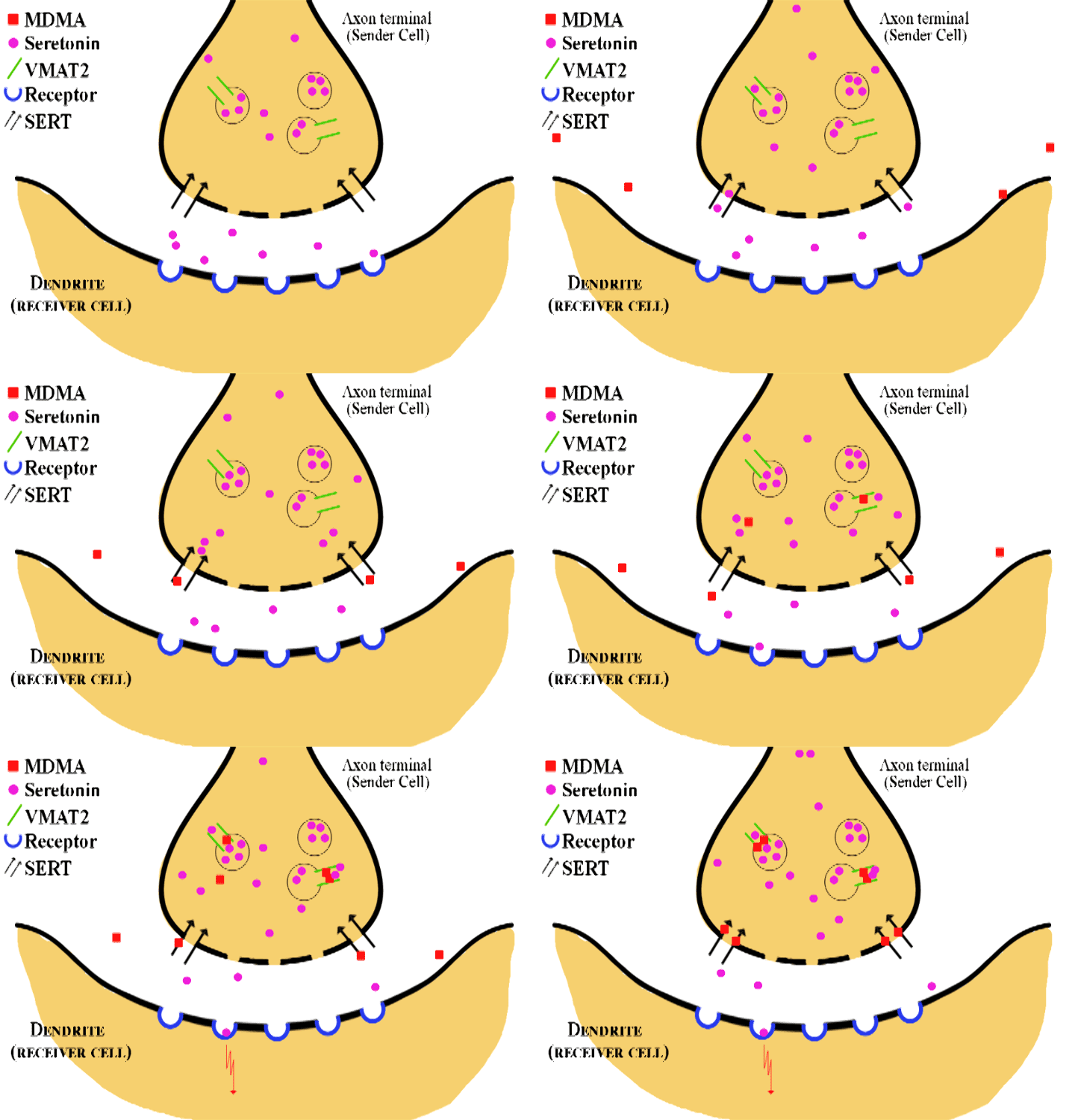
First, it stops the VMAT2 from grouping the serotonin molecules neatly within those little bubbles in the sending cell, so serotonin just ends up swimming around in there freely, unordered and unchecked, as if your 100 kids trying to cross the road were just rampantly running around on the pavement.
Secondly, it grabs hold of those SERT bouncers and turns them around, so they don’t let serotonin molecules back into the cell after they’ve activated the receptors and instead start letting them out of the cell.
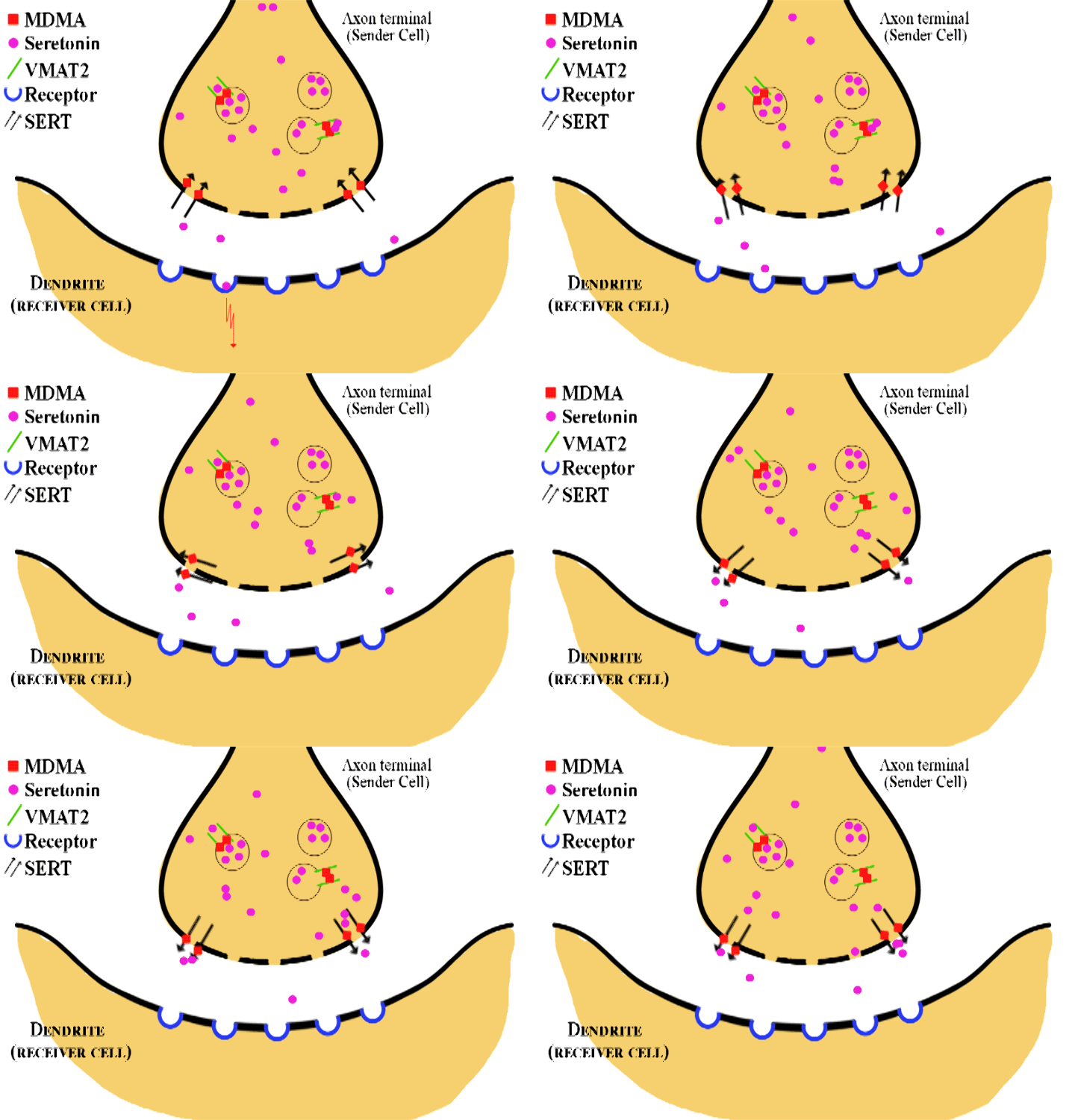
The result is a whole load of serotonin trapped in the synaptic gap, swimming around and constantly activating the receptors, sending the system crazy for 3–6 hours, until the MDMA molecules themselves are metabolised and flushed out of the cells by the brain.
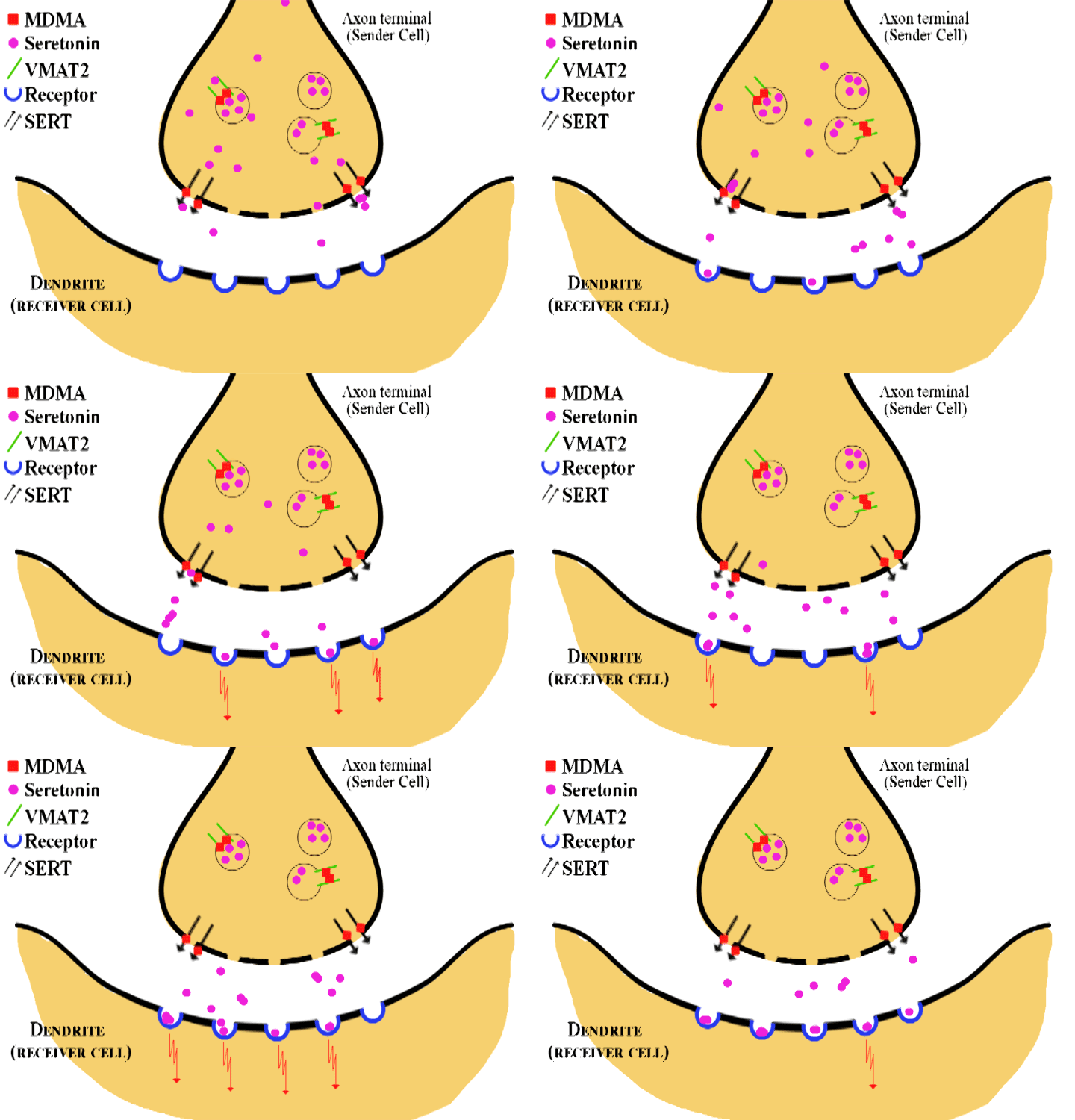
After the invasion, all that serotonin which the MDMA hijacked is then metabolised, meaning it’s all broken down, depleting that particular supply of the brains serotonin.
4.1. What Does MDMA Feel Like?
The serotonin receptor targeted by MDMA is known as 5HT2A. It’s associated with mood regulation, anxiety, perception, sexual behaviour and a few other things. It’s the same receptor targeted by pretty much all hallucinogens; LSD, psilocybin, mescaline, DMT. Have a look at Wikipedia for an extensive guide to serotonin, its many receptors and what functions they’re responsible for.
Practically speaking, the over-activation of the 5HT2A receptor, particularly by MDMA, pushes mood all the way up, anxiety all the way down and mildly alters sensory perception, but the staple effects are the massively heightened feelings of empathy and euphoria.
Every individual will have their own personal experience, but, as numerous online post-use blog posts and journal entries will attest, it’s akin to feeling like you have ‘become love’.
Hugely heightened feelings of empathy will abound for almost anyone and everyone around you, along with heightened energy levels, feelings of well-being and feelings of softness.
4.2. Set & Setting
Given that all the necessary safety, testing and dosage procedures have been followed (all of this is detailed further on in this piece), and safety is the MOST important thing, set and setting are the next two most important factors.
With any consciousness-altering substance, be it MDMA, psilocybin, marijuana or even alcohol (or all the rest), set and setting will dictate whether you have a good or bad experience.
‘Set’ refers to your mindset and ‘setting’ refers to your environment.
On classic hallucinogens, like magic mushrooms or LSD, a negative mindset, an uncomfortable environment or the combination of the two can lead to a bad trip. For example, if you’re going through a break-up and you try LSD in an environment in which you feel uneasy and uncomfortable, you may have a fabled ‘bad trip’, and these can be absolutely terrifying for the user.
Even if you’re going through a bad time and you decide to get blind drunk, there’s a huge difference in doing it whilst you’re out with friends or if you’re sitting at home alone in front of the TV. The latter is obviously more likely to push you deeper into negativity and this is the ‘setting’ part of set and setting, that being a factor alone can define your experience of a substance.
Luckily, whereas an MDMA trip is definitely influenced by set and setting, these two factors play a smaller role in the experience as they do when using classic hallucinogens or depressants.
4.2.1. Set
MDMA’s main effects are empathogenic, these empathetic feelings tend to come out no matter what mindset the user is initially in. From this sense, the mindset essentially determines how much empathy the user feels.
If you’re fine, happy and dandy within yourself and your mind, you’ll likely feel large amounts of euphoria and empathy. If you’re going through hard times, the serotonin bouncing around in your brain may help you to bring internal issues to the surface and talk about them, given you’re in a setting which is conducive to talking, of course. You’ll feel empathy and euphoria, but in a different and maybe more reflective way with an initial negative mindset.
4.2.2. Setting
On MDMA, If you’re madly dancing away in a hot, sweaty rave you’ll have a far different experience from if you were at home wrapped in blankets cuddled up with your partner. The substance you’ve taken is exactly the same and has the same effects on your brain, but the experience will be far different depending on where you are and what you’re doing.
In a rave you’ll feel more energetic, enjoy the sound of music far more and feel more inclined to keep moving and get closer to other people, no matter who they may be. At home you’ll feel more empathetic, cuddlier, softer and more willing to say whatever is on your mind and be willing to listen to what others say as well.
It’s not that one environment is correct and another is not. It depends what type of experience you want to have.
The people you’re with at the time also have a huge impact on your experience, which is part of your setting.
If you’re out at that rave with a bunch of strangers you don’t know too well, you may bond with them closer than you would’ve done sober and dance all night long. If you’re in a comfortable place with someone you’re close to you may communicate more deeply than you have ever done before.
5. Safety
Safety is the most important thing and should always come first.
This goes for any substance; MDMA, Ketamine, LSD, even alcohol, whatever it may be. Even in everything non-substance related safety is the number one concern. You wouldn’t cross the road without looking, would you?
There is risk in everything and anything in life.
You could buy what you think is MDMA which actually turns out to be PMMA, which can really damage your organs and even lead to death. You can enjoy a few pints of 4% alcohol beer in an evening and be fine the next day, but if you drank a pint of 100% ethyl alcohol you would die. You can drink 8 glasses of water in a day to stay healthy and hydrated but if you drank 4 gallons within 15 minutes you would down your organs and your brain, and again, die.
Risk exists everywhere; knowledge mitigates risk.
You know downing a pint of pure alcohol would put you in a morgue. You know drinking 4 gallons of water in one go wouldn’t be good for you. Knowledge of any endeavour will lessen risk, therefore knowing what’s safe and what’s not is key.
5.1. Testing
As mentioned earlier, it imperative to always test any substance. There is no guarantee what you buy is what you think it is, so it must be tested before you or anyone else consumes it.
As mentioned above, this can be done with reagent tests. These are inexpensive, perfectly legal-to-purchase chemicals which will tell you what kind of substance you really have in front of you. Google it or have a look here.
No one should consume anything without testing it first. The price of £15/$20 is well worth a life.
5.2. Dosage
A big difference between consuming alcohol and MDMA is that with alcohol we have much more of an intuitive sense of how much is too much. This is pretty much because small amounts of alcohol are diluted in fluid and we have an idea of how much fluid we can intake.
MDMA, on the other hand, comes in the form of tiny crystals. We have no natural, intuitive sense of how much is too much. This is probably because it’s synthetic.
MDMA has to be measured by the milligram (a thousandth of a gram). How much is in your system has a direct result on the amount it affects your brain.
Dosage and effect depend on a number of factors.
Firstly, neural composition. There are accepted approximate ‘normal’ levels of serotonin. This is mainly because low levels have been strongly linked to depression and anxiety. Those with lower levels of serotonin should stay away from MDMA altogether, because MDMA depletes the supply of serotonin it hijacks (although being able to tell whether you have low serotonin in advance would be very difficult).
A person like this wouldn’t experience much in the way of effects anyway (because there wouldn’t be enough serotonin to continually activate the receptors enough to bring on the higher effects) and that supply of the serotonin would be depleted afterwards, taken away from the already-low supply, which could lead to very, very pronounced symptoms of depression.
While we’re on the subject, anyone on SSRI’s (selective serotonin reuptake inhibitors — like Prozac, Zoloft, Celexa etc) or MAOI’s (mono-amine oxidase inhibitors like Marplan, Nardil etc) should steer well clear of MDMA. Mixing substances which interact with the same parts of the brain and the same neurotransmitters/receptors is a recipe for disaster and can be very dangerous.
Secondly, weight and physical composition affect dosage levels i.e. the larger a person, the slight bit more they may need.
Generally speaking, a small dose is 1mg per 1kg of body weight, medium is 2mg/kg and large is 3mg/kg. So for a person weighing around 60kg a small dose would be 60–70mg, a medium dose around 120–130mg, and a large dose around 170–180mg.
Bear in mind, we are talking in milligrams (a thousandth of a gram), NOT grams. It is very, very important NOT to take too much and to measure amounts, not just estimate by eye.
Taking too much carries a very real risk of death, mental health problems and serious health issues.
5.3. Frequency
There should be an absolute minimum period of at least 4–5 weeks between MDMA consumption.
MDMA depletes the supply of serotonin it hijacks which leaves the user with lower serotonin after consumption. Serotonin is made in the neurons from tryptophan, which we get through various foods (soya, nuts, seeds, meat, marmite) and it takes the neurons between 3–5 weeks to replenish the supply of serotonin lost from MDMA use, depending on how much the user took.
Not leaving a 3–5 week gap and taking MDMA more frequently will deplete serotonin levels faster than they can be replenished, which can lead to low mood, insomnia, depression and other highly undesirable consequences. MDMA has a similar effect on dopamine and norepinephrine, albeit in smaller amounts, but the compound effect can exacerbate issues if a user ingests the substance too frequently.
6. Dangers and How To Avoid Them
MDMA is a powerful drug, the dangers of which are very real and should not be taken lightly.
6.1. Not Getting What You Think You’re Getting
I know we’ve mentioned this twice before, but it cannot be stressed just how important this is.
ALWAYS test whatever substance you have (with reagent tests or some festivals even have drug testing facilities). Many bad trips, hospital visits and many deaths have been attributed to users taking what they thought was something but was actually something completely different.
Always test, otherwise you could be putting poison into your body.
6.2 General Health
MDMA raises heart-rate, blood pressure and body temperature (the temperature part we’ll go into in much more detail below). If a person has any heart conditions or blood pressure issues, MDMA should be steered well clear of.
It also goes without saying, anyone pregnant, anyone with heart issues, anyone underage or otherwise frail or fragile in their health should not use MDMA. It won’t to any favours for developing brains, bodies and general health.
6.3 Too High of a Dose
We’ve mentioned this above - taking too much can spell huge trouble and can have highly undesirable effects like the ones detailed below. Have a look above for the dosage averages.
6.4 Overheating
After not getting what you think you’re getting, overheating is the biggest danger.
MDMA acts on serotonin receptors within a region of the brain called the hypothalamus. The hypothalamus deals with a lot of functions, among them are thermoregulation, which means it’s in charge of controlling your body’s internal temperature.
Now, if you’ve ever had a fever, you know having a high body temperature isn’t good for your health. MDMA affects the hypothalamus’ ability to regulate the body’s internal temperature. The more MDMA a person consumes, the more it affects the hypothalamus, and the less the brain can effectively control the body’s temperature whilst under the influence of the drug.
Over-stimulation of the hypothalamus leads to overheating of the body. The more MDMA in the system, the more the hypothalamus is stimulated, the less control it has over the body’s internal temperature and the higher the body’s temperature can go.
Lets go back to set and setting. If someone is in a hot club dancing away but they’ve taken double the amount of MDMA they should’ve taken, their hypothalamus is having a very hard time controlling their internal temperature. The combination of being in a hot club coupled with the aerobic activity raises the body’s temperature even more.
This poses a very real risk. The body’s natural, optimum internal temperature is 37 degrees celsius. If the temperature raises to even 38C, it’s classed as a fever. 39C puts more strain on internal processes and at 40C and above organs start to struggle and can even start shutting down (41–42C and above).
This is how some users have died from consumption of MDMA; taking too much and causing their bodies to overheat, leading to their organs shutting down.
6.5 Dehydration and Overhydration
The hypothalamus also regulates thirst and hunger. MDMA ramps up thirst and pretty much cuts out hunger.
Now for those of you thinking MD will help you go on a diet; it will cut out your hunger for anywhere between 6–24 hours, but as we said above it’s not a good idea at all to take MDMA frequently.
When in a hot environment or doing aerobic exercise, or both, the body sweats to try and cool down. With the hypothalamus ramping up thirst levels while under MDMA’s influence, the user is a lot thirstier than they would normally be.
MDMA makes you feel thirsty whereas your body might not actually need anymore fluid. It’s like if you were stuffed from a big meal but your body kept telling you you’re hungry. This can cause potential issues in both dehydration and overhydration, and lets be straight here, overhydration (drinking too much water) can cause serious problems.
Lets go back to the hot, sweaty rave. If a user has taken a large dose and is dancing and feeling the higher ends of empathy, energy and connection, it means their sense of thirst is also out of whack from MDMA’s stimulation of their hypothalamus.
They could potentially either dehydrate themselves with the combination of the hot environment and aerobic exercise, making them lose water through sweat and perhaps not being able to get enough water in time. Coupled with MDMA’s overheating effect, being dehydrated and too hot internally becomes a potentially deadly combination.
On the flip side, one could ingest too much fluid because your body keeps telling you you’re thirsty even when you may not be. This can lead to overhydration; drowning your kidneys in more fluid than they can process.
Generally speaking, half a pint of fluid every hour is a good rule of thumb if one is in a normal environment. That raises a bit if one is in a hot environment, but not by much. Water is good to drink, of course, but especially good are particularly thirst quenching drinks like isotonic sports drinks or coconut water (sports drinks are better, coconut water is pretty much just water but somehow it’s quenching).
6.6 Neurotoxicity
There have been various studies performed in attempts to ascertain MDMA’s neurotoxicity — how dangerous the substance is to the health of the brain in the long term.
This is an excellent video which outlines some of the studies and their findings.
In short, MDMA’s level of neurotoxicity has not been conclusively ascertained, but various studies using mice and monkeys have shown that repeated and very frequent use has been linked to degeneration of the serotonergic system, brain cells, the ability of the brain to create serotonin, cell fibres and general issues with cell communication in the parts of the brain the drug affects. Studies have also been performed on humans which found that regular MDMA users had less capacity for memory and remembering words than non-MDMA users.
Again, these effects have been shown to occur with very high and frequent use, in a similar way that drinking 4 bottles of wine everyday will slowly (or not so slowly) destroy your liver and kill you. MDMA is a powerful substance and must not be taken too frequently (no more than once every 4–5 weeks at the most frequent) and in moderate doses. Heavy and frequent use over the longer term carries a real risk of brain degeneration and damage.
6.7 The MDMA Jaw Clench
This is a real thing. Many users find themselves jaw clenching and unknowingly grinding their teeth while they’re in the throes of the high.
This is because of MDMA’s stimulation of norepinephrine/adrenaline. This is the transmitter which kicks muscles into gear, specifically during the evolutionary fight or flight response, allowing us to run faster or fight harder, and this where is the energetic part of the MDMA high comes from.
A side effect of this response is the unwitting stimulation of the jaw muscles which press together. Many users don’t realise they’re doing this while under the influence and realise from the lacerations on the inside of their cheeks after they’ve come down.
It is important to be mindful of how hard one is clenching their jaw whilst under the influence. This allows one to consciously ease off clenching.
7. Is MDMA Addictive?
This is an interesting question.
From a chemical standpoint, no, MDMA is not addictive. This is because MDMA uses a portion of the serotonin supply which already exists in the brain. The supply it hijacks is then depleted, meaning the brain has to make more serotonin.
Due to the fact MDMA does not give the user any more serotonin and its levels are not spiked by the drug, the brain does not respond by changing its own production of serotonin. Because MDMA uses already existing serotonin which is then depleted, any further, frequent use will use serotonin from that already partially depleted supply.
The practical result is that frequent use will have lesser effects everytime because of lower levels of serotonin and therefore lower activation of the 5HT2A receptor, all the while making the user feel worse and worse after every roll (I forgot to say earlier MDMA trips are colloquially known as ‘rolls’) due to the ever-dropping levels of serotonin, the chemical which literally makes you happy.
From a psychological perspective, MDMA is potentially as addictive as any other drug, but this has a lot of varying factors around it.
First of all, it depends on a persons psychological constitution and their character. Some people have addictive personalities — the type who’ll overdo every new thing they like. This type of personality, of course, lends itself to addiction, albeit usually short term.
Psychological addiction comes largely from expectations. For example, if a person has never done any kind of drug before, they have no idea how it’ll feel. They may be nervous about taking drugs for the first time, have high expectations of what it’s going to feel like, or they might be very anxious of giving up control of their minds and bodies to a foreign substance, especially if they have no idea what it could do to them.
Quite often, those psychologically addicted to any drug do so because they’re chasing the first ever high they had.
Candidly speaking, there is no way of describing an MDMA high to someone who’s never had it. Or a magic mushroom trip to someone who’s never experienced it or being drunk to someone who’s never tried it. Even trying to explain the colour red to someone who’s never seen it would be impossible. They have to see it with their own eyes to know what it is.
So those people who had zero, negative or low expectations when first trying a substance, only to be then blown away by the experience will often chase that first ever high. However, they won’t get that first high ever again because they now have expectations of how it’s going to be. This is the same with many substances which drastically change ones perception; cocaine, mushrooms, LSD to name just a few.
Expectation is the root of all frustration. When expectations are high it is very difficult to meet them, especially if you’re doing something you’ve done before and are expecting things to be as amazing as a previous time. With the first high, for example, it wasn’t just the substance which made the experience amazing. It was the persons mindset, the setting they were in and their (low of complete lack of ) expectations.
8.1 The Come-Up
Come-up times will depend on the method of administration. Insufflation (snorting) will have a shorter come-up than ingesting the substance orally. This is because substances gets absorbed into the blood stream quicker through insufflation, where it’s then carried to the brain, whereas it takes longer to get to the bloodstream through the digestive system. Blowing anything solid through nasal cavities though will damage the lining of the nostrils.
Come up via insufflation can take around 5–15 minutes and orally around 30–60 minutes. If taken orally it’s best not to have eaten 2–3 hours before, otherwise the substance can get broken down with stomach contents and less of it will enter the bloodstream.
Due to the stimulation of the hypothalamus, on the come-up a person can feel hot and cold, stretchy, yawny and have a need to find a comfortable position.
If taking a substance for the first time, any substance, anxiousness can be common. This is less to do with the effect of a specific drug and more to do with expectations and psychology. Fear of the unknown can cause anxiousness, especially when ingesting a new and potentially dangerous substance.
8.2 The MDMA Trip
We’ve discussed what MDMA feels like at great length in sections 3 and 4 above, and we’ll go into it in far more detail in the next section (9), but we’ll have a quick rundown here.
MDMA makes one feel open, empathetic, euphoric and energetic. These effects all ensue provided, once again, the dose is correct and the substance is actually pure MDMA. Dosing too high and/or not testing the substance carries real danger of illness or death.
The quality of the trip itself will depend on set and setting (detailed above in section 4) but the effects don’t tend to veer far off openness/empathy/euphoria/energeticness.
8.3 The Come Down & Aftermath
You’ve probably heard of the notorious MDMA comedown. Stories of people being depressed or even suicidal for 1–2 weeks after a heavy session.
The risk of having this type of comedown is very real, but, only a strong possibility if one takes a high or very high dose. Which, as we’ve mentioned a couple of times already, also carries risk of death.
The horrible comedown is due to MDMA’s depletion of the serotonin supply it hijacks in the brain. Serotonin is the ‘happy chemical’, thought to control mood.
The 5HT2A receptor (the one which MDMA targets) has the function of regulating mood — not enough serotonin in the brain cells leads to the receptors not getting activated enough which can lead to low mood. This can last until the brain replenishes its supply of serotonin, which it does within 2–5 weeks. But that’s a long time to have a low mood, depressive mood, or suicidal feelings.
One of the potential causes for depression is a lack of serotonin. As such, SSRI’s (selective serotonin reuptake inhibitors) are prescribed to patients suffering from depression. These block the reuptake of seronin back into their sending cells (see above in the ‘serotonin’ section for the full description) so they can activate the receptors a few more times before being metabolised, hopefully increasing mood. Just to reiterate, a person should never take MDMA if they’re already taking any kind of SSRI, MAOI or anything else which has an effect on the brains neurochemicals. The mix of chemicals can be very dangerous.
It’s also been reported by users that in the aftermath of a MDMA trip sensitivity is heightened. These effects don’t happen to everyone and can be very broad when they do happen. For example, heightened sensitivity on the tongue (tasting flavours with more intensity, even upto the point of over-sensitive taste buds) or heightened sensibilities in other senses. These effects tend to wear off after a few days.
8.4 After the MDMA Trip
It’s very important for a person to get a good nights sleep after a trip. The body and especially the brain need rest after the invasion of a foreign substance. The brain needs to make sure it flushes it out as much as it can otherwise the after-effects of heightened sensitivity can be more pronounced.
It’s also an idea to have the next day off to relax, again to ensure the body and brain get enough rest.
8.5 Avoiding The Comedown
The simplest and only way to avoid the MDMA comedown is to not take too much in the first place (see ‘dosage’ above. Or not to take it at all). Taking too much can have massively undesirable consequences all round, for overall health, organs and psychological health.
Even if a person is lucky enough to feel the full flow of empathy and euphoria on a dose of MDMA which is too high, they will not come out of it without having a long, drawn out comedown which can last upto 2 weeks. Are 6 hours worth of empathy and heightened happiness worth 2 weeks of low mood or temporary depression?
8.6 The MDMA Afterglow
It is entirely possible to get an MDMA afterglow.
This happens when one doesn’t dose too highly (as we’ve discussed in great detail), has a positive experience — based on good mindset and setting, and gets enough rest afterwards.
The afterglow can feel like some of the MDMA-heightened-empathy feelings stick around afterwards. Some of the euphoria can also stay in a more mild form. These effects are largely based on the psychology of the individual, how they experienced the trip, who they were with, where they were and what they were doing.
Next we’ll go into what the best things to do are whilst on MDMA and where its merits truly lie.
9 The Benefit Potential of MDMA
We’ve spoken a lot about safety, potential dangers, harm reduction and brain mechanics of MDMA, but why would we even consider it suitable for human consumption in the first place?
Well, this rather long post hasn’t been written because MDMA is all bad. It has its potentials, and these potentials are significant enough that they warrant much more study.
9.1 MDMA & PTSD
MDMA has been shown to have a positive effect in the treatment of post-traumatic stress disorder.
John Hopkins university, for example, found that MDMA reactivates a learning period which often becomes inactive in PTSD sufferers, which allows positive associations to form in the brain where there were none before.
MAPS (Multidisciplinary Association for Psychedelic Studies) have also been granted permission by the FDA to advance their research into MDMA-assisted therapy to treat PTSD. A substance as globally illegal as the subject of this post receiving the go-ahead for above-board, government mandated testing is a big deal and shows how real the benefit potentials for MDMA are.
Looking from an individualistic, experiential viewpoint, rather than a scientific one, MDMA can treat PTSD due to its heightened empathy levels.
Empathy is the skill of being able to put yourself in someone elses shoes, to see things from someone elses perspective, but, counter-intuitive as it may sound, this skill can also be pointed inside, to see things from your own perspective.
Those with PTSD struggle to accept the reality of what has happened to them, whatever events may have caused their disorder. The brain will repress memories of trauma in an attempt to protect itself from further damage.
Bringing up traumatic memories can cause the brain to release the same neurochemicals, albeit in smaller amounts, as if the brain was experiencing the event itself. The practical result can be hyperventilating, irrational fear, panic attacks, unnecessary fight or flight response etc.
MDMA’s staple feelings of empathy come with a hugely diminished perception of negativity. It’s quite difficult to feel anger or fear whilst under its influence. This lack of negative perception can help one bring up difficult memories and look at them from a new perspective, from a completely different, self-empathetic viewpoint.
We look at ourselves from a subjective perspective; from our own frame of reference. It sometimes takes someone else, an objective observer, to tell us things we had not realised because we’re in the thick of it.
It’s the difference in not being to see the wood from the trees, because you are in the woods. It’s like being the captain in a battle and being the general overseeing the battlefield. The captain can only see what’s in front of them, who’s firing at them and who they’re firing at. The general can see the whole battleground, from an outside perspective.
Self-empathy can allow an individual to look at themselves from a different perspective, to see things they couldn’t see before from their own reference point. MDMA has the potential to facilitate this, by dramatically increasing empathy and cutting negative perception all the way down.
9.2 MDMA and Couples Therapy
For years many have seen the therapeutic potentials of the substance, firstly by its modern resynthesizer Alexander Shulgin.
Shulgin and his wife experimented with many compounds (being a chemist he had a far better idea than most as to what was safe and what wasn’t) and found that MDMA helped them connect closer to each other than they ever thought possible. And, in fact, for a decade after its first synthesis MDMA was used in individual and couples therapy before it was banned, the world over, and labelled as a schedule 1 controlled substance.
Since then the interest for its use as a therapy facilitator has been widespread among select scientific communities and open-minded couples.
Katie Anderson, in the psychology department at South Bank University, London, England, headed up a study in 2016 for her PhD named ‘MDMA: The Love Drug’. In it, she recruited 10 couples who took MDMA together a total of 5 times over the course of a year.
Every couple reported back the same thing. They felt so close to each other, so connected, they felt they could express almost any emotion, to each other and tthemselves, emotions both positive and negative. Along with its strong empathetic effects, MDMA also has the effect of knocking out negative emotions.
It’s very difficult to feel anger, fear or judgement whilst under the sway of the substance. The practical effect is one being left with feelings of warmth, empathy, happiness and understanding, which of course are the most conducive for having a deep or even difficult conversation with a loved one.
In The Love Drug study one half of one couple admitted infidelity. The couple reported having an honest, close and understanding conversation and amicably broke up, but then got back together some time later, citing their MDMA experiences as having given them a far greater closeness and a much higher level of understanding between each other.
Another couple reported how they took a bath together and felt so close that the lines between their individual persons blurred and they felt like one entity. Katie Anderson describes this state as the ‘MDMA Bubble’. A space in which two people can express anything they feel openly, without fear, anger or fear of judgement.
These experiences had residual, and sometimes permanent effects. Just to be clear, these lingering effects were not physiological ones from the actual consumption of the substance. They were effects resulting from the experience facilitated by the substance.
An MDMA trip typically lasts 3–6 hours. If you were to have a sober DMC (deep and meaningful conversation) with the person you love most in the world for 5 hours, you would end up feeling very close to the person. If you’d spoken about things that were close to both of your hearts, especially about your relationship, you may feel even closer to them.
If, on your 5 hour DMC, your empathy was heightened to stratospheric levels, your openness was dialled all the way up and your ability to feel anger, fear or judgement was knocked out, how close would you feel to the one you loved afterwards?
MDMA doesn’t have an effect on memory. It’s not like alcohol where patches of memory can be missing afterwards. After coming down, all the memories of connecting with someone, feeling your emotions and theirs, empathising, being closer than ever before, will stay with you. The memories of even being able to be that open have the potential to have a positive effect on the level of empathy and openness a person can feel after the experience.
9.3 MDMA and Sex, and Cuddling too.
With all those feelings of empathy, warmth, euphoria and closeness, sex is a natural curiosity.
MDMA is known to make sexual activities feel closer and more connected emotionally, but the actual physical pleasure of sex is diminished. This is because the 5HT2A serotonin receptor, the one which MDMA helps stimulate, is also responsible for vasoconstriction, which mean the tightening of blood vessels so less blood flows through veins.
In a very loose way, the more MDMA stimulates the serotonin receptors, the more empathy, warmth and euphoria the user will feel, but the more their veins will constrict as well.
The practical effect of the tightening of blood vessels is it restricts blood flow to the genitals. Our fun parts require a lot of blood to become aroused and even more to orgasm. Men have reported not being able to finish whilst on MDMA and some not being able to reach erection at all. Women have also reported an inability to orgasm where they’d usually be able to.
Feeling soft and cuddly is one of the staple effects of the substance. Particularly feeling one’s skin is much softer to the touch than usual (and other peoples skin too) and cuddling can become one of the most pleasurable experiences.
Normally, in a sober state, cuddling releases natural feel-good neurotransmitters in abundance anyway, like dopamine (pleasure chemical), oxytocin (‘love’ chemical) and serotonin itself (‘happy’ chemical).
Dopamine is released every time we do something our instinct deems good for our survival, like eating or having sex, in order to motivate us to do more of it. It’s released in cuddling because peer-bonding is good for survival. Oxytocin is released to create and strengthen bonds with others. Its released in mothers and babies brains’ on skin-to-skin contact and is released in cuddling after 20–30 seconds or so. A lot more of it’s released in cuddling than in sex.
Add a load of serotonin (the ‘happy’ chemical, stimulated by MDMA) to the mix of those two which are naturally released anyway during a cuddle and you have an extremely potent combination for bonding, love, pleasure and almost complete euphoria.
9.4 MDMA: Comfortable Setting vs Rave Setting
MDMA is known as a club/festival drug, the world over. It does make music sound better and because of the norepinephrine release it makes dancing for hours a bit nicer and easier, but the staple effects of empathy and euphoria are almost wasted in such an environment.
At festivals and raves, many users report having deep, connective conversations with their friends or strangers for hours. This is probably due to the fact that with such heightened empathy, one can find themselves just wanting to talk and connect with someone else. In a comfortable setting this is easy.
Going back to how closeness to another human being naturally releases feel-good chemicals like dopamine, oxytocin and serotonin anyway, being in a comfortable environment would actually require less of a dose to get a suitably significant effect than would be needed outside/at a rave/at a festival. In outside settings there generally isn’t natural, prolonged closeness with another human (unless you’re dancing closely with someone for a long time), and so one may need more of the substance to have a significant effect, which isn’t always a good thing (see above, in the Safety chapter).
MDMA definitely helps keep a person happy, energetic and dancing, but it’s main effects are mostly wasted with just dancing and raving. The true value of MDMA lies in its potential to massively increase emotional connectivity within oneself and with others.
10 Conclusion
MDMA is a powerful substance. It has a reservoir of potentially incredible benefits. These include highly significant facilitation of individual and couples therapy, treatment of PTSD and a general tool for heightened empathy and closeness with others.
It also has very real dangers, including psychological problems, depression, neurotransmitter imbalance, brain degeneration, organ damage and even death.
It’s a controlled substance in almost every country and much more research needs to be done in a controlled manner to ascertain long term dangers and benefits.
It’s a substance which needs to be treated with respect. Safety procedures must be followed and individual research must be performed.
We have a lot more to learn and a long way to go, but the benefits of these little crystals warrant far further research and cannot be ignored for their therapeutic potential.
**If you enjoyed this article please consider Joining Medium to get access to all of Rajeet’s articles plus 1000’s more from other authors.**
References and further reading
https://sapiensoup.com/serotonin
https://www.youtube.com/watch?v=OOa5n-DsnDw&t
https://www.uni-frankfurt.de/64645210/Anderson_MDMA_Research.pdf
https://psycnet.apa.org/record/1996-30953-001
https://www.sciencedirect.com/science/article/abs/pii/0006899388913091
https://jamanetwork.com/journals/jama/article-abstract/365202
https://www.pnas.org/content/89/5/1817.short
https://maps.org/news/media/6659-refinery29-the-couples-that-take-mdma-to-stay-together-2
https://www.callforparticipants.com/study/MMCV6/mdma-the-love-drug-a-qualitative-study
https://bigthink.com/sex-relationships/decades-ago-mdma-was-used-in-marriage-counseling
https://www.youtube.com/watch?v=dF3RZM3adR8
https://maps.org/research/mdma
https://hub.jhu.edu/2019/04/04/mdma-opens-critical-period-for-social-behavior/
Disclaimer: MDMA is a controlled substance in many countries, including the USA and UK. This piece does not condone, endorse or encourage the purchase or use of MDMA or any other illicit substances and is meant for the purposes of information only. MDMA is a dangerous and potentially lethal substance and the author does not accept any responsibility, liability, or otherwise for any person purchasing, consuming or using MDMA or any other illicit substance in any way, or any damage, injury, death or otherwise sustained from purchase, use or consumption of MDMA or any other substance. This piece is not intended to be used in an advisory capacity and is for the purposes of information and education only.
**If you enjoyed this article please consider Joining Medium to get access to all of Rajeet’s articles plus 1000’s more from other authors.**


