
How to Make Money in Stocks
17 proven ways to invest in the stock market

If you’re new to investing, you’re probably wondering, “How do I make money in stocks?”
There are many different investing styles. While some are better than others, I believe each can work if implemented correctly.
Below are 17 investing styles and strategies you can use to make money in stocks. I’ve divided them into three main categories:
- Fundamental Analysis: Strategies that use company and economic data to pick stocks that appear poised to deliver market-beating profit.
- Technical Analysis: Technical analysis uses stock price data to pick which stocks are the best to buy.
- Other Strategies: Other common investing strategies that don’t fall cleanly into either the fundamental analysis or technical analysis buckets.
Let’s start off with the most common category of how to make money in stocks: fundamental analysis.
How to Make Money in Stocks Using Fundamental Analysis
Fundamental analysis isn’t really a specific stock-picking strategy, but an entire category that contains many styles and strategies within it.
Fundamental analysis uses company and economic data to pick stocks that appear poised to deliver market-beating profit.
A fundamental investor will often analyze a company’s income statement, cash flow statement, and balance sheet to understand its financial condition and performance.
In addition, you might also consider some economic data such as where we are in the business cycle, interest rates, and unemployment rates when deciding which stocks to buy.
Common questions that fundamental analysis investors explore include:
- Is the stock undervalued or overvalued?
- How strong are the company’s growth prospects?
- How much debt has the company taken on?
- Will the company become more or less profitable in the future?
- And many more.
A good fundamental investor tries to find as much useful data as possible to analyze the characteristics they believe matter most to long-term stock profits.
As you’ll see below, each of the many fundamental investing styles focus on different types of data to execute their strategy.
Value Investing
Value investors seek to buy companies that are currently trading below what they’re truly worth in hopes their price will move up towards fair value.
Using a value strategy, investors try to determine a “fair value” or “intrinsic value” for a stock and then look at how deep of a discount the shares are currently trading at.
For example, if you analyze a stock and believe its fair value is $100 per share, but it’s currently trading at just $70 per share, you’d say the stock is undervalued and trading at a 30% discount to fair value.
One of the reasons value investing is so powerful is because it offers investors both offense and defense.
The goal of value investing is to make money when the stock’s price moves up towards its fair value. But in the case this doesn’t happen (or it takes some time to unfold) the stock has downside protection because it’s already undervalued and therefore less likely to decline further.
This is why some investors believe value investing is a good strategy for all market environments, as it will provide upside offense during good times and downside defense during bad times.
The exception is what investors call a “value trap,” which is when a stock appears undervalued but is likely to stay that way or decline further because the underlying business is struggling.
Value investing is one of the most famous and commonly-practiced investing styles, and it has extensive historical research showing that it works well.
You can learn more about it in my value investing deep-dive here:
Growth Investing
Growth investors look for stocks with strong historical and projected future sales and earnings growth because they believe these companies will continue to deliver strong financial results far in the future.
In my experience, there are actually two different types of growth stocks: story growth stocks and steady growth stocks.
Story growth stocks appear poised to grow very rapidly over the next 5–10 years and somehow substantially disrupt or take over an industry.
Their price is often tied more closely to the belief that the company will have an incredible future than to the fundamental reality of the company today.
On the other hand, steady growth stocks seem to deliver steady above-average sales and earnings growth year after year.
They usually don’t have an incredible future upside like story growth stocks, but they have found a formula for steady profitable growth and can often deliver strong results through good times and bad.
When it comes to growth investing, both story growth stocks and steady growth stocks can provide investors with good long-term profits.
Based on my research and experience, story growth stocks are more exciting, but steady growth stocks tend to deliver more consistently.
When looking at value vs. growth stocks, value stocks have historically outperformed growth stocks, as we can see in this chart from Raymond James:
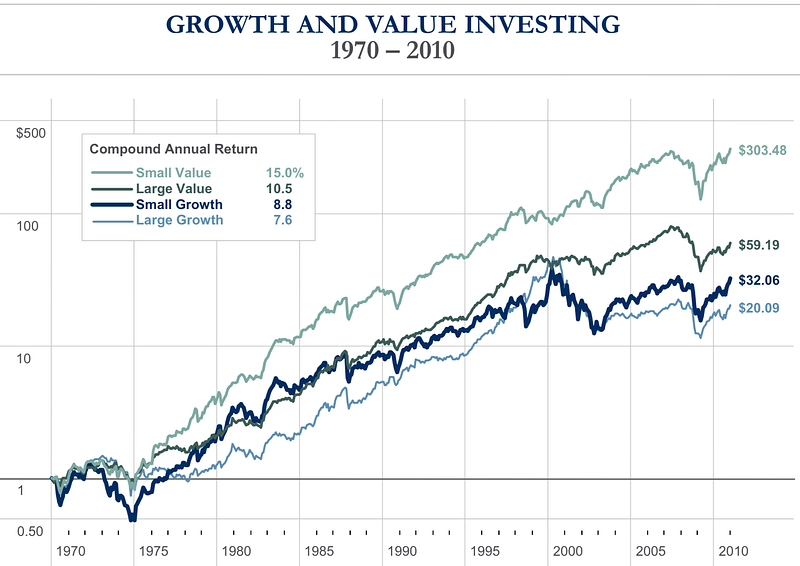
Both small cap and large cap value investing strategies have beat out small cap and large cap growth strategies since 1970.
Also of note, small cap value investing seems to be a powerful strategy, beating large cap value stocks by nearly 5% per year. You can read why here:
While value stocks have historically had an edge over growth stocks, the best option may be a strategy, like our next example, that combines both together.
Growth at a Reasonable Price (GARP)
GARP (Growth at a Reasonable Price) investors combine the philosophies of value investing and growth investing into a single strategy. They look for stocks that have healthy growth but also appear to be undervalued.
With GARP investing, the value component is often focused more on asking, “Is the stock undervalued given its strong growth prospects?” rather than, “Is the stock deeply undervalued?”
A healthy growth stock is unlikely to be deeply undervalued. However, investors could under-appreciate how strong and steady the stock’s growth prospects really are.
In that case, while it may not be the most undervalued stock on the market, a GARP investor would feel they’re getting a healthy growth company at discount value prices.
GARP investing seeks to find stocks that are BOTH undervalued and delivering steady growth at the same time.
GARP investors wouldn’t just buy a portfolio of five undervalued stocks and five growth stocks. Instead, they investor would look for 10 stocks with healthy growth that ALSO appear undervalued.
Dividend Investing / Income Investing
Dividend investors look for stocks that pay generous and sustainable dividends so they can collect steady income.
Dividend investors tend to focus a lot on dividend yield (explained in detail in our next lesson), which helps them find stocks that provide the most dividend income relative to the cost of buying shares.
There are many different reasons dividend investors seek out dividend stocks, including:
- Dividend stocks tend to be defensive against market pullbacks, downturns, and crashes. Highly steady businesses in defensive sectors often pay dividends, which means they’re less likely to be impacted by an economic downturn or market pullback.
- In the event of a market pullback, dividend income provides investors with a steady return during hard times. For example, if your dividend portfolio declines 10% but it has a dividend yield of 5%, you’ve greatly reduced your losses compared to an investor who has no dividend stocks and is stuck with a simple 10% portfolio decline.
- Historically, dividends have been responsible for about 40% of the return of the stock market while 60% of the return has come from price gains. Investors who ignore dividends may be missing out on a big portion of the market’s returns.
- Dividend stocks are often a favorite of retirees who like to use the steady dividend income to replace the income from the job they just gave up. For example, if a retiree invested $500,000 into dividend stocks and they earned a 5% dividend yield, they’d collect $25,000 in annual income with very high certainty and regularity.
Dividend Aristocrats
The Dividend Aristocrats is a dividend strategy that focuses on a specific group of 53 S&P 500 stocks that have delivered 25+ years of consecutive dividend increases.
Examples of the 53 Dividend Aristocrat stocks include: Walmart (WMT), Clorox (CLX), Procter & Gamble (PG), McDonald’s (MCD), Johnson & Johnson (JNJ), AT&T (T), Coca-Cola (KO), Exxon Mobil (XOM), and Walgreens Boots Alliance (WBA).
Over the last 10 years, the Dividend Aristocrats have outperformed the S&P 500 by a little more than 1% per year, as we can see in this chart from S&P Global:
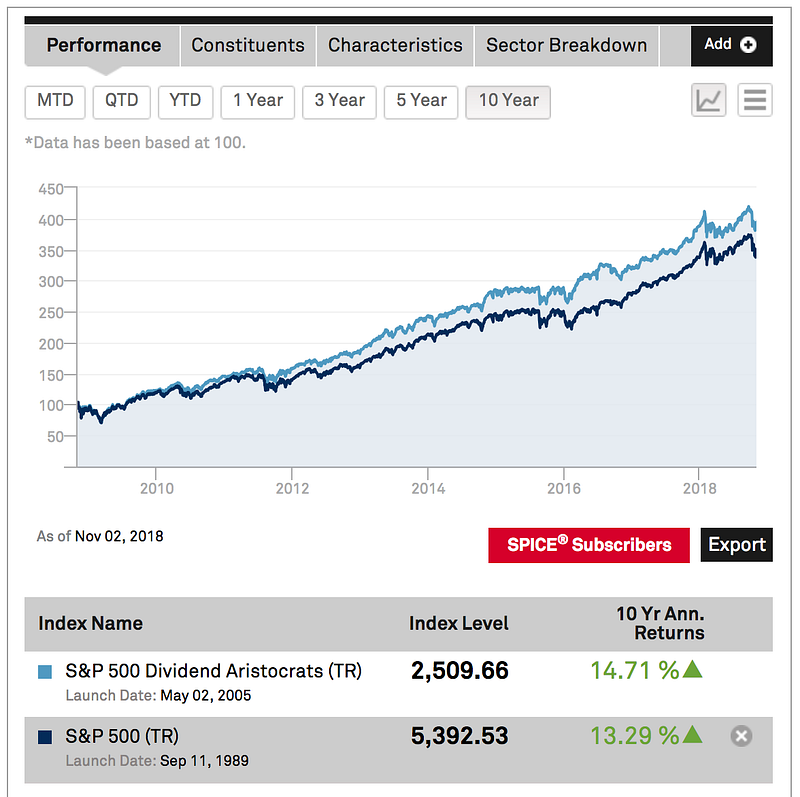
The Dividend Aristocrat stocks have not only outperformed the S&P 500, but they’ve done so with lower volatility, meaning they’re steadier and don’t react to market movements as much as other stocks.
The Dividend Aristocrats could be a good strategy for an investor looking for steady and predictable dividend income paid out by low volatility stocks.
Quality Investing
Quality investing looks for stocks that carry the attributes of high-quality companies and management.
It seems like every investor defines quality differently and they usually don’t focus on just a single metric or characteristic. Instead, they look for a handful of characteristics that suggest the underlying company is high quality.
For example, here are some of the common characteristics quality investors look for:
- Good management that makes smart decisions and is focused on delivering strong returns for shareholders.
- A healthy balance sheet that shows the company hasn’t relied too heavily on issuing debt or new shares to fund their growth.
- A profitable business with strong margins that appear sustainable for the long term.
- A historical pattern of stable earnings reports that suggest the business is operating on solid footing.
- An economic moat that suggests it would be difficult for competitors or new entrants to disrupt the company by stealing business.
These are just a few example. There are many more characteristics that indicate a quality company. We’ll cover them all and show which are best in a future lesson.
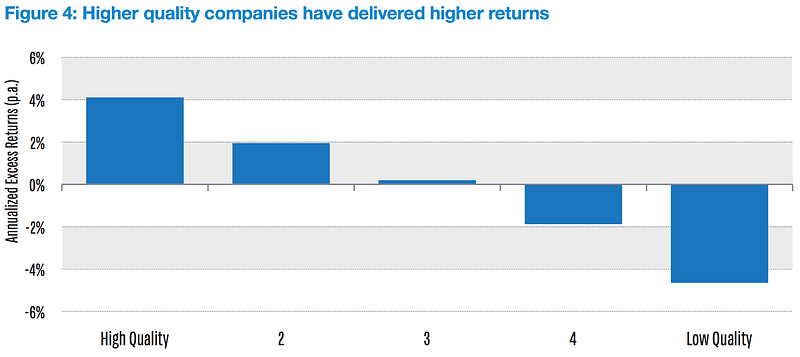
This table from Schroders shows that from 1988–2015 high-quality stocks have delivered higher returns than low or even mid-quality companies.
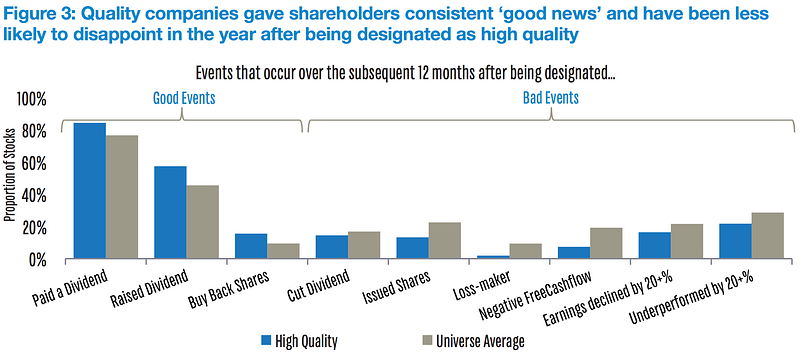
Schroders also shows that quality companies are more likely to give good news and less likely to give bad news than other stocks.
Wide-Moat Investing
Wide-moat investing aims to buy companies that have something about their business that acts as a defensive moat against competitors or new entrants to the market.
A moat is considered a sustainable competitive advantage that protects the company’s market share from competitors.
Like an ancient castle protected by a wide moat, these stocks have something that makes their business somewhat protected from competitors.
For example, one type of wide moat is the network effect, which is when each user of a good or service improves the value of that product for others. The more people that join Facebook, the better it is because you can find more friends, engage with more brands, see more interesting content, etc.
If I were to start a new competitor to Facebook today, people would likely say, “There’s no one on there. Why should I join?”
This illustrates why some people feel Facebook (FB) is a wide-moat stock; the company benefits from a network effect that makes it difficult for a competitor to disrupt their business.
Another type of a wide moat is high switching costs. If a customer who wants to leave a company for a competitor faces high switching costs (in terms of money, time, or effort), then the product becomes more “sticky,” which is a type of moat.
For example, electronic medical records companies like Cerner (CERN) are said to have strong economic moats because their records systems have high switching costs. It’s extremely costly and time intensive for a hospital to migrate over hundreds of thousands of patient medical records, remain compliant with healthcare regulatory laws, train tens of thousands of staff on the new programs, etc.
If a Cerner customer is considering switching to a competitor, they think long and hard about how difficult the process will be. This provides a wide defensive moat for Cerner.
Morningstar categorizes five types of economic moats:
- Network effect
- Intangible assets
- Cost advantage
- Switching costs
- Efficient scale
Dogs of the Dow
The Dogs of the Dow strategy buys the top 10 high dividend yield stocks of the Dow Jones Industrial Average (DJIA) each year.
The strategy was made popular by investor Michael O’Higgins in 1991 based on decades of historical testing.
Since 2000, the Dogs of the Dow strategy has returned an average of 8.6% per year, vs. 6.9% per year for the broader Dow Jones Industrial Average (DJIA) and 6.2% per year for the S&P 500.
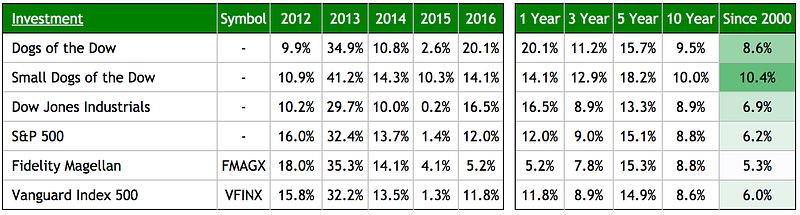
The Dogs of the Dow appears to be a good strategy with a lot of historical data suggesting it will outperform its benchmarks over the long term.
CANSLIM
CANSLIM is a growth investing strategy pioneered by Investors Business Daily which aims to buy high growth stocks that meet all seven of these key characteristics:
- Current quarterly earnings: Quarterly earnings that have grown 25% since last year.
- Annual earnings growth: Annual earnings that are up 25% or more over the last three years.
- New product or service: A company that is launching new products or services that can drive revenue growth.
- Supply and demand: Relatively high demand for shares that are in relatively short supply.
- Leader or laggard: Stocks with strong demand patterns in their trading price and volume.
- Institutional sponsorship: Stocks that large institutions such as mutual funds and hedge funds are buying.
- Market Direction: Buy these stocks when the overall market is headed upwards so it will act as a tailwind for the portfolio.
As you can see, “CANSLIM” is an acronym for the seven attributes described above.
CANSLIM performance based on historical testing seems to be strong. However, it’s a fairly difficult strategy for investors to implement and so real-world performance of CANSLIM hasn’t always lived up to the promise.
That wraps up all the strategies in our fundamental analysis section. Now, let’s look at the strategies that fall under technical analysis.
How to Make Money in Stocks Using Technical Analysis
Like fundamental analysis, technical analysis isn’t really a specific stock-picking strategy, but an entire category that contains many styles and strategies within it.
Technical analysis uses stock price data to pick which stocks are the best to buy.
Unlike fundamental analysis, which seeks to understand the company behind a stock, technical analysis focuses mostly on how the stock’s price is moving (both share price and volume).
Common questions that technical analysis investors examine include:
- How much has the stock’s price changed relative to similar stocks?
- How has trading volume in the stock changed?
- Where is the stock’s price relative to it’s recent history
- Does this stock appear oversold or undersold?
Technical analysts believe there are common patterns of trading and investor emotion which can be recognized and exploited for profit.
Momentum Investing
Momentum investing buys stocks that have gained the most over the last 3–12 months and avoids stocks that have declined the most during that same period.
The idea is that stocks that have gone up have “momentum” that will continue to fuel further gains, while stocks that have declined will continue to do so.
There’s debate around what exactly drives the momentum phenomena, with some investors arguing it’s simply a continuation of price trends while others arguing the price gains are a sign of something positive in the underlying business (i.e., a fundamental reason).
Regardless of the cause, there’s a healthy amount of research showing momentum investing can work well.
Historical analysis suggests that momentum investing is a powerful strategy that can deliver strong, but somewhat inconsistent, returns. Momentum tends to go through periods of strong performance and periods of poor performance.
Day Trading
Day trading involves buying and selling stocks within a single trading day.
Rather than buy and hold, day traders aim to quickly compound lots of small profits, adding up to a large profit over time.
Day trading is considered speculative and risky, especially since investors often use margin (borrowing money from a financial institution) to boost their returns.
It takes great expertise, discipline, and resources to consistently profit from day trading.
Swing Trading
Swing trading involves buying stocks that are seeing a positive movement in their price and selling them after just a few days or weeks for a small profit.
Swing trading is very similar to day trading since they both try to make money by quickly compounding lots of small gains which will add up to big profit over time.
However, day trades are bought and sold within a single day whereas swing trades can last longer (typically several days or a weeks).
Like day trading, swing trading is fairly speculative and high risk. It takes a meaningful time commitment, discipline, research, and tools to execute well.
How to Make Money in Stocks Using Other Strategies
These are other common investing strategies that don’t fall cleanly into either the fundamental analysis or technical analysis buckets.
Penny Stock Investing
Penny stock investing involves buying obscure stocks trading under $5 per share (and often under $1 per share) in hopes of a large and fast gain.
Penny stocks are usually highly speculative companies with little public information that may be trading on over-the-counter or “pink sheet” exchanges.
While their volatility, thin trading volume, and lack of information make them prime candidates for large price gains, it also makes them highly speculative and probably too risky for the average investor.
Sector & Industry Investing
Sector (or industry) investing involves buying stocks in a particular sector as a way to gain from the strong profit potential of that overall sector.
For example, many investors are excited about the potential of the emerging marijuana industry and are buying shares of companies that play various different roles within in the industry.
Or, investors that believe the U.S. healthcare sector will be a steady source of economic growth for years to come might buy shares in hospital, pharmaceutical, biotechnology, and medical device stocks to profit from the trend.
“Macro investing” or “trend investing” might also be considered sector and industry investing because investors buy stocks concentrated in a specific economic area to capitalize on a multi-year trend that will drive long-term profit.
For example, investors may buy healthcare sector stocks to capitalize on the aging baby boomer trend.
While buying several different kinds of stocks within a sector or industry can provide some diversity, a sector or industry-based strategy by its very nature risks being too highly concentrated in a single area of the market.
Emerging Markets
An emerging markets strategy aims to buy companies located in fast-growing overseas markets in order to capitalize on the emerging country’s rapid economic expansion.
For example, an emerging markets investor might buy stock in the largest banks in Africa due to their fast economic growth, or shares of all the telecom companies in South America due to the rapid spread of mobile phones.
Sometimes these companies are listed on U.S. exchanges such as the Nasdaq, whereas other times investors use their broker to buy shares listed on an overseas exchange.
Dividend Capture Strategy
Dividend capture strategy involves buying a dividend-paying stock right before the ex-dividend date and then selling it right on (or after) the ex-dividend date so that you’re eligible to receive the dividend.
The ex-dividend date is the day on which if you buy the stock, you’ll be too late to be eligible to collect the upcoming dividend payment. So, if you buy the day before the ex-dividend date, you are eligible to collect the dividend.
The goal of the dividend capture strategy is not to buy and hold the best dividend stocks, but to jump around and collect dividends by “getting on the books” as a shareholder at the last possible moment, earning the dividend, selling the stock, and moving on to another dividend stock.
The dividend capture strategy is somewhat complex to execute and is used mostly by day traders and professional money managers.
Popular Story Stocks
As discussed above, buying story growth stocks involves finding companies that appear poised to grow very rapidly in the near future and somehow completely disrupt or take over an industry.
An example of a story stock is Tesla (TSLA), which some investors believe may disrupt and take over the entire auto industry in the coming years.
Story stocks are often highly overvalued as their price reflects hopes that the company will have an incredible future rather than to the fundamental financial performance of the company today.
How to Make Money in Stocks: Summary
Each investing style has its pros and cons, and which is best depends a lot on your personal goals as an investor.
Some investors are naturally drawn to fundamental investing because it fits with their idea of understanding the value of a business. Others are drawn to technical analysis because they think prices are driven by trends in human psychology.
Some investors implement the strategies above in a “pure” way, meaning they focus exclusively on buying the best stocks based on that single strategy. For example, a pure value investor cares only about finding undervalued stocks and ignores everything else.
However, many investors blend these strategies together in some way. For example, they may buy high-quality companies that are currently undervalued or day trade penny stocks with strong momentum indicators.
There are many possible combinations that can work to make money in stocks. The best way approach is to jump in and see what works best for you.
Below I recommend a way to combine fundamental research (what to buy) with technical research (when to buy) to find the best stocks to buy now. It will help you learn both fundamental and technical investing, and then you can focus on which works best for you.
NOTE: I get a lot of reader emails asking how to invest, so I thought I’d post my answer here:
The best way to learn investing is to get real-life, hands-on experience. There’s simply no replacement for buying and selling your own stocks.
If you need a place to start, there are two tools I recommend to all new investors:
#1) The Motley Fool is a stock recommendation service. Every month they share their top stock picks, along with a detailed research report. They recommended mega-winners Disney, Netflix, and Amazon over 10 years ago. I learned how to invest from The Motley Fool. It’s a superb place to get quality stock ideas. Motley Fool offers a 30-day guarantee.
#2) TradingView is a charting tool. It’s an absolute must-have for deciding when to invest. I use it every single day and I never buy or sell anything without analyzing the chart first (for example, Apple). I’ve tried all the charting tools out there, and this is the best. Plus their community is overflowing with ideas. You can use TradingView 100% free.
Here’s what I recommend: Take stock picks from The Motley Fool and then research the best time to buy them using TradingView. That way you combine fundamental research (what to buy) with technical research (when to buy) to find the best stocks to buy now.
If you join either service, I may receive a commission for referring you.
Give Motley Fool and TradingView a try — I guarantee they’ll make you a better and more profitable investor.
Disclaimer: This article is provided for informational or educational purposes only and is not any form of individualized advice. All information is obtained from sources believed to be reliable but cannot be guaranteed for accuracy or completeness. Use this information at your own risk.


