
How to Combine Stock Factors and Boost Your Investing Profits
Use the “intersection” strategy to earn bigger (and more consistent) stock market returns

I love factor investing.
Why? Because it’s the most well-researched and consistently profitable approach to beating the market over time.
Factor investing involves buying stocks with specific characteristics that are proven to deliver market-beating profits over time.
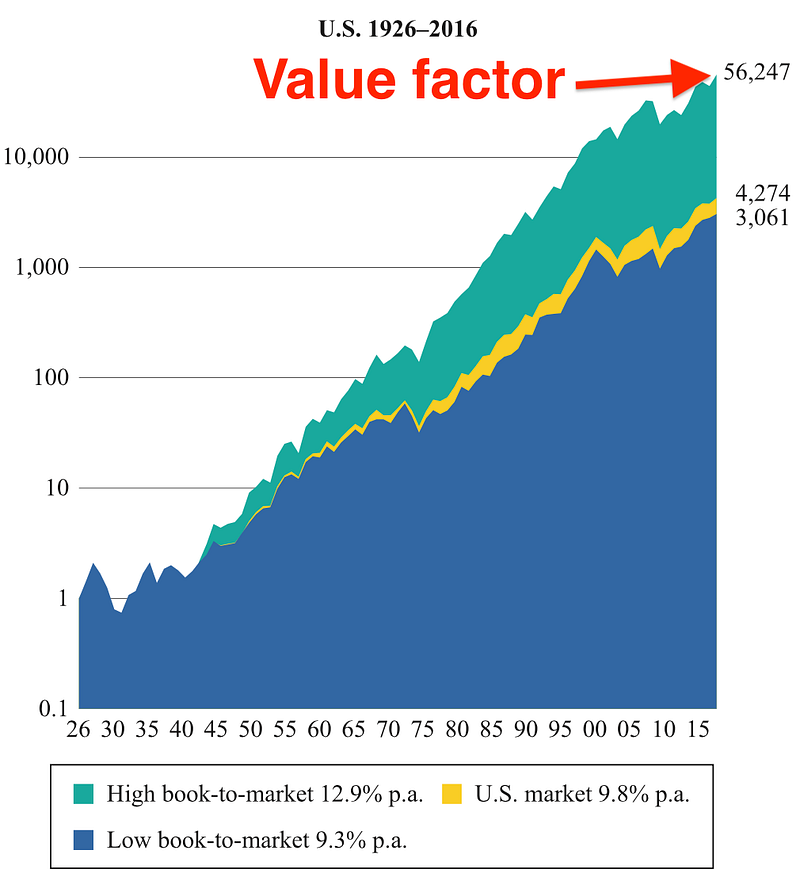
For example, buying undervalued stocks is one of the most well-known and long-standing factor strategies. The “value factor” has returned 13x the market since 1926:
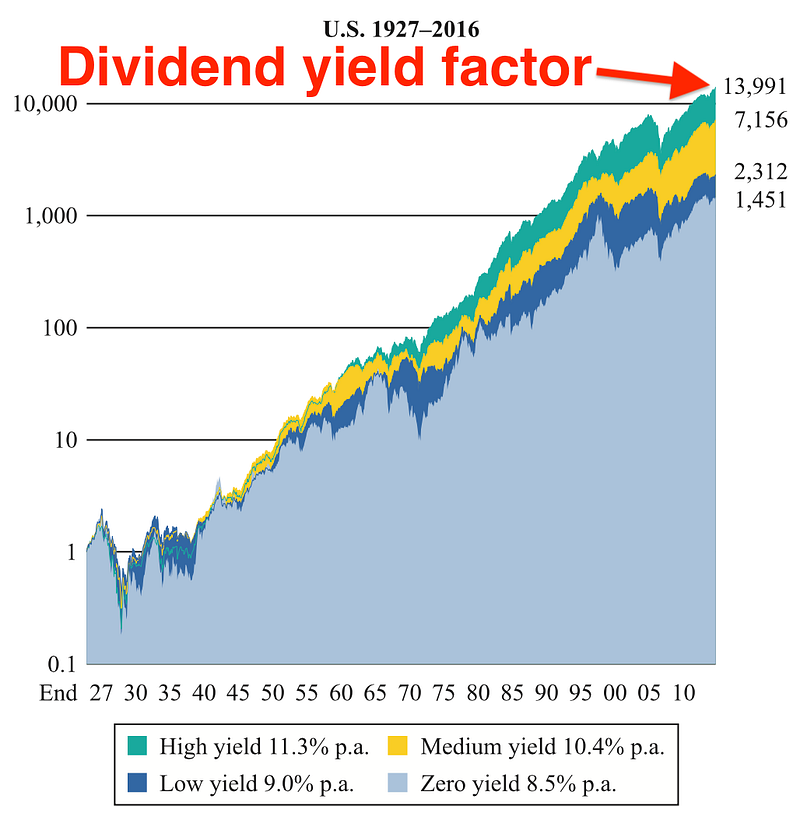
Other powerful factor strategies include buying low-risk stocks (27x better return than high-risk stocks since 1963) and high-yield dividend stocks (10x better return than zero-yield stocks since 1927):
While there are many factors that have beaten the market over the long-term, they all suffer from one big challenge:
Factors go through stretches of time where they don’t work.
For example, while buying undervalued stocks has beaten the market over the last 100 years, it hasn’t worked well for the last 10 years.
The dividend yield factor, low-risk factor, momentum factor, quality factor, and others all suffer from similar challenges.
The good news is there’s a clever solution to this problem:
Research suggests the best approach is to look for stocks that combine these winning criteria together into one company.
For example, rather than buy a few undervalued companies, plus a few high dividend stocks, plus a few high-quality companies, research suggests you’ll make more money over time by looking for high dividend stocks that are high quality and currently undervalued.
In other words, don’t look for the best value stocks and then separately look for the best growth stocks. Instead, look for the most undervalued stocks that are growing steadily, or the best growth stocks that are currently undervalued.
In my research, I’ve seen this combination strategy perform much better than any one individual factor. Plus, it makes intuitive sense:
- Value stocks are likely to perform better if you screen out companies with declining growth.
- Dividend stocks are likely to provide you with better long-term income if they’re profitable.
- Low risk, blue-chip stocks are much more likely to increase in price if they’re currently undervalued.
- High momentum stocks are less likely to crash if they’re not grossly overvalued.
Regardless of what type of stock you want to buy (value, growth, dividend, blue-chip, etc.) make sure to include at least a dash of other strategies as well.
The best stocks for your portfolio should focus on your core investment strategy while also scoring decently well on other proven investment strategies.
By combining these winning criteria all into one single stock, you get two big advantages:
- You’ve now placed a “bet” on multiple winning strategies (value, growth, dividends, etc.) with just a single stock. So that stock has a chance to earn you money because it’s undervalued OR growing OR paying a healthy dividend OR all of the above.
- A single stock that meets all the characteristics above is likely to be a high-performing company with a strong management team and a compelling set of products. Any company that’s profitable, growing, paying a healthy dividend, and carrying modest amounts of debt is likely a special stock.
Let’s look at an example based on data collected by Northern Trust.
Here we can see the annual returns for the Russell 3000 vs. the dividend yield factor and the quality factor from 1979–2013:
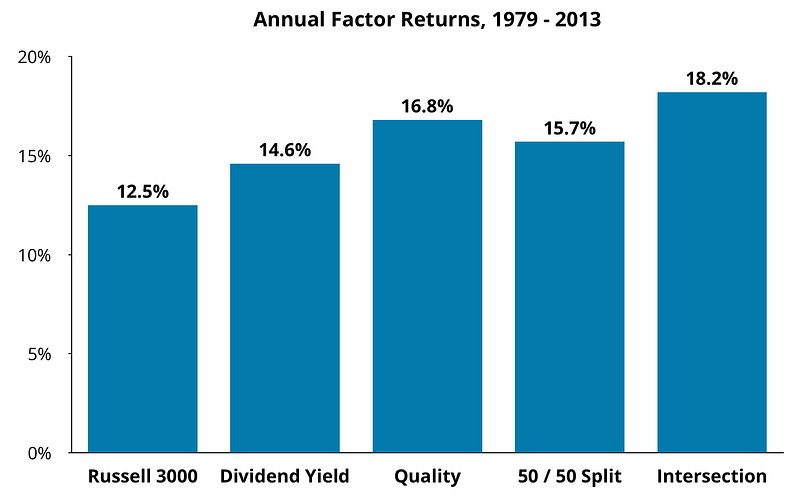
The first thing to note is that both strategies strongly beat the Russell 3000. Those extra 2–4 percentage points of annual market-beating performance will add up to an enormous difference in profit over the 34-year period.
The next column, labeled “50 / 50 split,” shows the returns for a portfolio of stocks made up of 50% quality stocks and 50% high dividend stocks. In other words, half the stocks are the best quality stocks on the market and the other half are the best dividend stocks on the market.
Because it’s a simple 50 / 50 mix, such a portfolio performs right in between the quality factor and the dividend factor.
Now, the last column is where it gets interesting.
Instead of a simple 50 / 50 blend, the “intersection” portfolio buys stocks that are BOTH high quality AND high dividend. It basically picks the stocks that reflect the “best of both worlds.”
For the intersection approach, the annual returns are 18.2%, which is higher than the quality factor or dividend factor earned on their own.
We can also look at the standard deviation of each strategy and see the same concept. Standard deviation is a measure of how widely dispersed a strategy’s returns are over time.
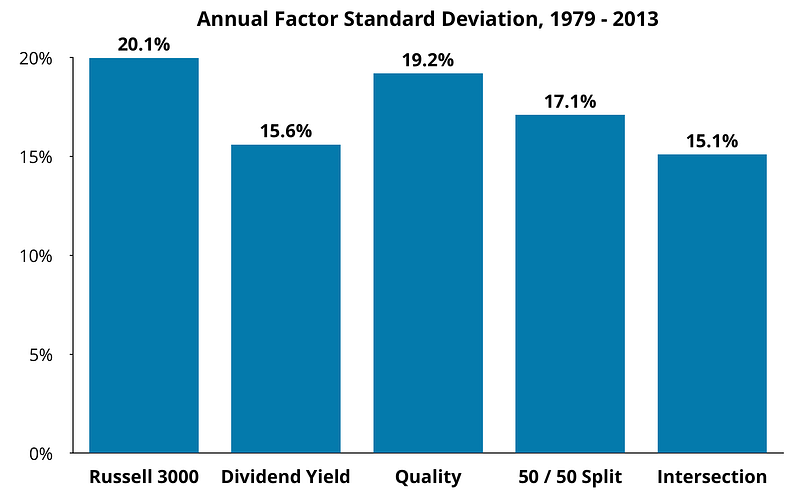
Again, we can see that both the dividend yield and quality factor beat the Russell 3000 with lower standard deviations (more consistent returns). And again, the “intersection” approach leads to a standard deviation that’s lower than either factor on its own.
Here’s the important takeaway:
While each factor on its own beat the market (as measured by higher returns and lower standard deviation), picking stocks that combined the two factors provided higher, more consistent returns than either strategy on its own.
When it comes to investing, the holy grail is high annual returns with low standard deviation. That would be a portfolio that makes a lot of money very consistently.
Here’s another way of looking at it. Here are the returns for the value factor combined with the quality factor in either a 50 / 50 blend approach or an intersection approach.
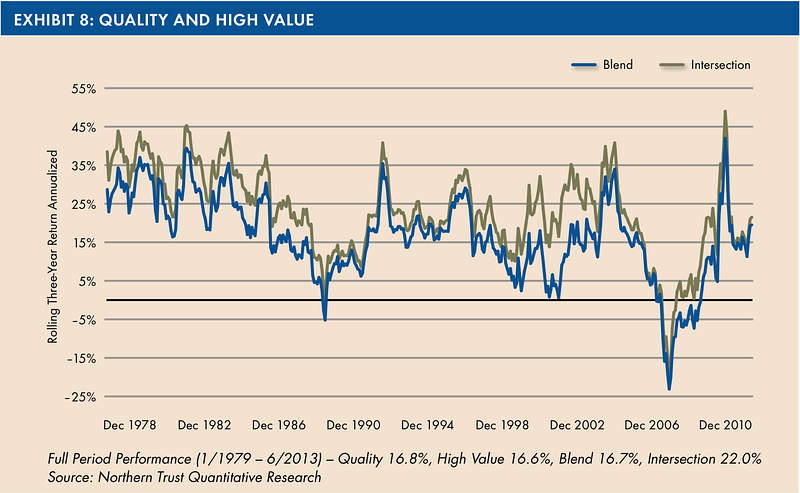
Although they move in parallel, the intersection approach consistently beats the blended approach.
While these charts have looked at combining just two factors together, the effect is even more dramatic when you combine many factors.
While anyone factor might outperform or underperform for a stretch, a multi-factor portfolio has a better chance of providing steady returns over time.
Disclaimer: This article is provided for informational or educational purposes only and is not any form of individualized advice. All information is obtained from sources believed to be reliable but cannot be guaranteed for accuracy or completeness. Use this information at your own risk.


