
How Living Life As A Soldier 20 Years Ago Taught Me To Appreciate School, Living Life On The Edge, The Washing Machine, And Black Market Economics.
The Army can be an interesting place. On hindsight.
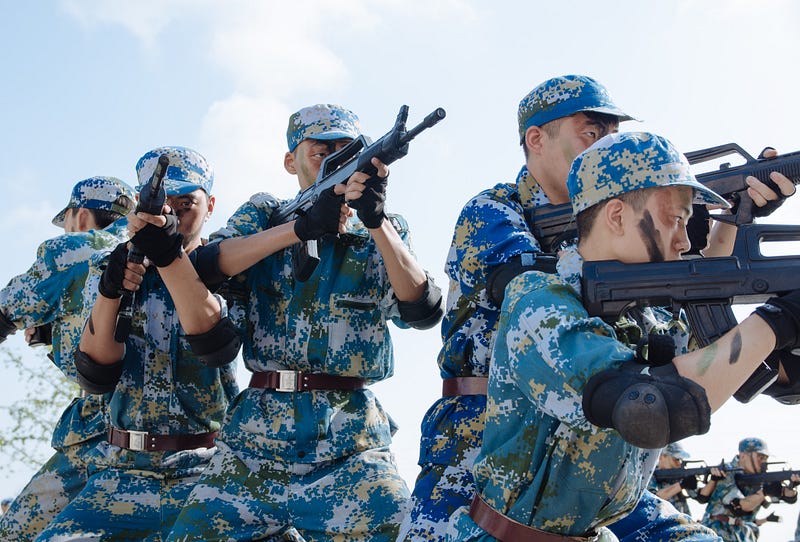
I was recently recalled to camp for National Education and health checks, which is an exercise Singaporean guys have to go through annually.
Military camps are notoriously hard to commute to, for obvious reasons. It was during the commute to the military compound that memories started popping into my head. A few prominent bubbles popped out, and a memory avalanche followed.
We Live Our Life On The Road. Actually, On Tarmac.
The Parade Square is an indispensable part of our military life. There is no way to bypass it daily.
Our morning briefings, fitness regimes, fitness tests, pre-operations equipment checks, punishments, flag-raising ceremonies, pre-meal pull-ups, and push-ups are all performed on the tarmac.
There is no way we can pass it without dripping beads of sweat on it.
This venue held plenty of memories for me, even though it was just a strip of a road made into the shape of a square demarcated by a line of trees.
- I clocked many marching hours here.
- I received my Best Trainee award here.
- I failed many fitness tests here.
Every inch of the Parade Square is covered with tears and sweat. Oh, and occasionally, blood.
As I walked past the Parade Square to the administration office to mark my attendance, I saw imageries of my past at different areas of the tarmac.
It is just humanly insane just how vivid memories can be.
The Push — Every Second Counts For A Good Life.
My memories reminded me how fit I was during my second year of service.
I have to be completely honest at this point. I was overweight when I was called for service. These were my devastating physical vitals: -
Height: 1.75 meters. Weight: 82 kilograms. Verdict: Courting death.
Not only that. I was bespeckled too. Exiting academic life and entering military service is a scary thing. The world I knew ceased to exist. In practical terms, it meant the following: -
- We stand more than we sit.
- We move more than we remained stationary.
- Compliance is valued over intelligence.
- And for the first time in my life, fitness does mean a damn thing.
This is different from what I am accustomed to in the academic environment. In Army, mobility is King.
In school, physical education takes a backseat. The top student with an F for physical education escapes from additional school hours.
The A student in physical education with F for Chemistry gets to romance with the laboratory assistant, learning how to combine Nitrogen and Hydrogen atoms to form Ammonia gas.
In the Army, fitness carries a premium. That premium is rest time.
When we clear our fitness test during the first attempt, we accumulate credits for additional breaks. When others attempt their second round, we can stay in our bunk and play testicular poker.
That was the biggest motivation for all fatsos. That is why we run for our lives, especially during fitness tests.
The 2.4-kilometer run is the final leg of the fitness test, and the last 400 meters leading towards the finishing line is within the Parade Square.
At the 2-kilometer mark, as we turn into the Parade Square, we know it is time to leave our lungs behind us.
We have to sprint as fast as possible so we can pass the wretched test that God-damned morning.
I flew under the radar by 1 second when I passed the fitness test for the first time. I needed to hit 8 minutes 50 seconds. I punched the clock at 8 minutes 49 seconds.
That 1 second determined the quality of my future mornings until 6 months later.
I sprinted, crossed the line, tumbled over, cursed my Sergeant with multiple F-Bombs, crawled to the water station, and dunked my head in ice.
I was in pain. And pain brought me, sweetness.
Not to mention a new source of confidence from fitness.
These were my physical vitals by the second year of service.
Height: 1.75 meters. Weight: 59 kilograms. Verdict: Escaped death.
Confidence From Clothes Is Rare — The Washing Machine Is My Real Friend.
We sweat a lot. Plus, the weather is hot.
As a result, we stink.
Now, you will think that is okay. Everyone sweats. We are good so long as we wash our clothes daily, am I right?
Washing our clothes is a privilege, not an obligation. I do not mean that only the top fitness hunk gets to use the washing machine.
There is only 1 washing machine at every level of our dormitories.
We are not allowed to go to other levels to use theirs.
And this is the statistical context.
- 1 military company occupies 1 level.
- 1 military company is made up of 4 platoons.
- Each platoon has 60 trainees.
- Each platoon has 8 instructors.
- There is a total of 272 living beings per level.
- We change in and out of 3 sets of clothes each day.
- 1 set of clothes comprises a top and a pair of shorts.
- Undergarments aside, there is a total of 272 * 3 * 2 = 1,632 units of apparel to be washed and spun by 1 washing machine every single damn day.
What unites us as fellow trainees is not tough training. It is the washing machine.
We prayed very hard every morning that it will not break down that day. I am confident that the washing machine received 50% of our daily prayers. We probably prayed more for the washing machine than for ourselves.
When the washing machine sneezes, the company catches flu. Our hearts skipped a beat when the cutting-edge machine refused to spin at our turn.
I swear my pants dropped (the ones I was wearing) when the machine refused to take my $1 coin.
Take my coin, buddy. I will give you 10 of them. Please. Take them. Spin my clothes!
There were times when we had to go topless. Of course, we were young, and we had abs. That is not the reason. The reason is, our precious asset has broken down, and we do not have enough tops to cover ourselves.
As tough as we are, defending the country by standing tall at the forefront of danger, we cannot bring ourselves to wear smelly and sweaty clothes for the 3rd time.
I learned something new about clothes too.
For some weird reason, tops stink faster compared to pants.
And I am bloody glad it was the case.
Otherwise, we would be strutting around in our natural state.
Weekends Can Be Traded Stealthily.
This is where the book-smarts are schooled by the street-smarts.
We live for the weekends. I suspect this is the origination of the 9 am — 6 pm mentality in Singapore. It started with National Service, and then we ported it over to our workplaces.
Weekends are treasured commodities. There is no guarantee that we will get to go home by Saturday afternoon. Many reasons could throw us off-course.
Guard duty is one.
Guard duty is one lottery system I hate because this system is built on penalties, not rewards. Those who got assigned weekday overnight duties pump their fists in the air as if they won a million bucks. Those who have to guard the camp compound over the weekends, are devastated.
When it happened to him, my buddy cried. He missed interacting with his girlfriend (read it in any manner appropriate, you are most likely correct), and he was dying to meet her.
And so, a black market was born out of undying, pent-up demand.
Weekend guard duties are listed in the black market for trading, and willing players can price their heroic sacrifice starting from $200 for Saturdays, $250 for Sundays, and up to $400 for Public Holidays.
Many people who watch television think there are only black markets for cigarettes and chocolates. They are boring trades.
The Weekend Trade is the real lucrative deal.
This is Capitalism at play. The invisible hand brings together willing sellers and willing buyers to solve a problem, allowing the market-clearing price to dictate competitive pricing.
If we want to understand Capitalism, start from black markets.
If we are to understand the mechanisms of a black market, start by serving the country.
We Have Blanket Parties While We Earn Too.
Blanket parties in the military context are not what we think it is.
This is a sophisticated tool deployed to crowd out recalcitrant behavior.
Sophisticated does not mean complicated.
This is how it works: -
- Identify a human target.
- Throw a blanket at him.
- Punch.
That is all there is to it. And then you might wonder, why assault a fellow platoon mate?
This is not intended to be a tool to establish a hierarchy within camp compounds. We are too tired for that.
This is a tool to get the delinquents to fall in line. It ensures that we do not get punished unnecessarily.
Some people have a knack for doing absolutely nothing. They do not clean the bunk, wash the toilets, report for morning assembly in time because they disregard the system. Often, the rest of the platoon suffers together with these folks.
When such recalcitrant behaviors keep repeating themselves, black market prices for weekend guard duties skyrocket just like Bitcoin today.
Fewer heroes are willing to stand up and absorb the market demand because they are too tired from unnecessary punishments throughout the week.
Thus, weeds have to be kept in check.
When people with an entitlement mindset get too carried away, the market will always find a way to bring them back to Earth.
That way is through blanket parties.
A Distant Memory.
It has been many years, and these memories never amaze me.
Pretty honestly, I never knew that I would survive past National Service. By a strange twist of fate, I did.
In hindsight, I totally enjoyed it.
Aldric
About the Author:
As a content contributor, I write my observations from daily life and my business exposure.
Because our life experience is the bedrock of our unique perspectives.


