
How Leveling Events shape Countries
A leveling event is a catastrophe that reshapes society by destroying or redistributing wealth and power. Historically, leveling events create equality and inequality.
A leveling event can be a war, a revolution, or a disaster. Leveling events shaped the histories of most nations and of history’s great empires.
For example, three great leveling events shaped the United States. Those events were the Revolution, the Civil War, and the Great Depression.
The First Leveling Event the Revolution
The Revolution redistributed wealth and power from British officials and colonial elites to middle-and upper classes in the colonies. For example, control of trade shifted from corporations in London to New York merchants. Similarly, political power shifted from parliament in London to the new federal and state governments.
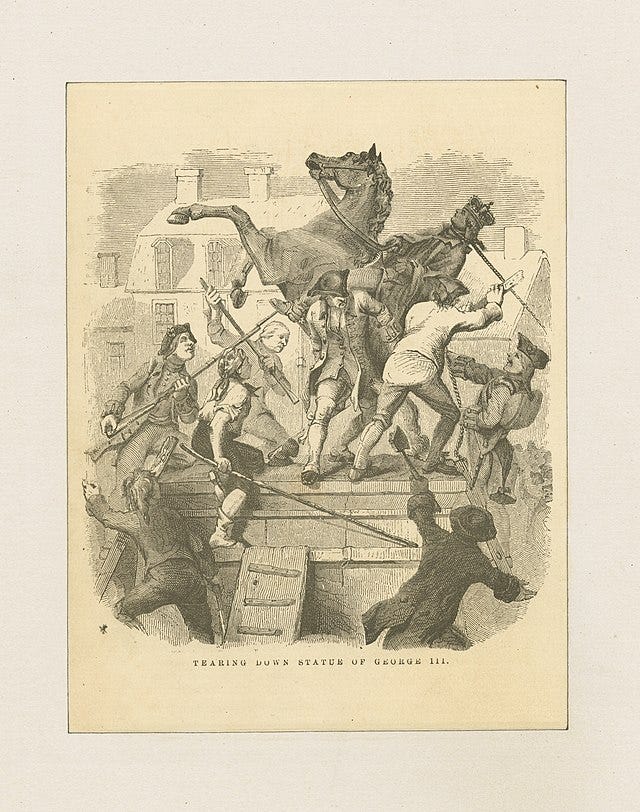
For example, before the Revolution large British corporations, the Hudson’s Bay Company and the Northwest Company dominated the North America Fur Trade. After the revolution, American merchants such as John Jacob Astor took control of the US fur trade.
One result of the Revolution was that the center of the fur trade moved from Montreal to New York City. Another was that American ships began trading directly with Chinese merchants in Guangzhou, bypassing the British East India Company.
The Civil War as a Leveling Event
The Civil War was a leveling event because it destroyed enormous amounts of wealth. Disgustingly, that wealth came from slaves.
In 1860, American slaves were worth $3 billion to $4 billion. Those slaves produced $250 million worth of cotton in 1861, the Brookings Institution estimates. Slavery and cotton made the South wealthy. For example, half of US millionaires lived in Natchez, Mississippi, in 1850.

Those millionaires got rich by exporting cotton to Britain. Around 80% of the cotton British textiles mills processed, came from the American South. Cotton goods comprised 38% of British exports and 12% of the United Kingdom’s national income. Slaves picked the cotton creating a wealthy elite of slave owners.
By the 1850s, many Northerners, including lawyer Abraham Lincoln (W-Illinois), were complaining about a slave power of wealthy southerners that controlled the federal governments. The US Supreme Court’s Dred Scott Decision, which found a right to slavery in the Constitution, drove such fears. The Justices behind the Dred Scott Decision were appointed by pro-slavery Democratic presidents. In particular, US Chief Justice Roger B. Taney who wrote Dred Scott. Taney came from an aristocratic slave-owning family.
When the Civil War broke out, Lincoln, now president, adopted a policy of destroying the Southern economy by emancipating slaves. To explain, Lincoln’s Emancipation Proclamation only freed slaves in Confederate states. Hence, Lincoln was depriving the South of its labor force and the basis of the Cotton industry.

Furthermore, the Union Navy began blockading the South and seizing ports to prevent cotton exports. Moreover, the Union Army launched a campaign to seize the Mississippi River, through which they exported most of the South’s Cotton. This was General Winfield Scott’s Anaconda Plan, a deliberate strategy to destroy the Southern economy.
Although Scott and Lincoln’s actions were military and political. One result of the war was to redistribute American wealth from the South to the North. Moreover, the war also destroyed enormous amounts of Southern wealth. For example, all the Plantations and railroads the Union Army destroyed.
Some Union generals, including William Tecumseh Sherman, adopted a policy of deliberate destruction. During the March to the Sea in 1864, Sherman ordered his troops to burn plantations, destroy cotton gins, and wreck railroad tracks.
Hence, for Lincoln and his generals, the Civil War was an economic conflict, and the enemy was the Slave Power. Interestingly, Lincoln and his generals viewed the South’s wealth as a more important target than Confederate Armies. For example, they diverted tens of thousands of troops from the principal front in Virginia to the West and Deep South to seize the South’s richest cotton lands.
The Slave Power’s Destruction made the Civil War a leveling event. For example, US cotton exports from $192 to $250 million in 1861 to under $7 million in 1865. Most of the South’s wealth was gone.

The devastation was so great some parts of the South never recovered from the Civil War. For example, Mississippi, once home to half the nation’s millionaires, was America’s poorest state, with an 18% poverty rate in 2021.
Notably, after the Civil War, New York City, the north’s financial center, become home to most of the Nation’s millionaires.
Although many Southern families recovered their wealth. Their new riches were a pale shadow of the Antebellum splendor. This created one of the enduring tropes of American culture, the penniless but proud Southern aristocrat. Think Gone with the Wind vs. the bankrupt Southern aristocrats in Tennessee Williams’ plays and movies. In particular, A Streetcar Named Desire.
Moreover, rich Southerners’ wealth was a tiny fraction of the fortunes of Northern Robber Barons like Andrew Carnegie and John D. Rockefeller Senior.
The Great Depression (or Great Destruction)
The Great Depression was actually a great destruction of wealth. For example, the number of US millionaires fell from 20,000 in 1929 to 13,000 in 1944.*
The number of millionaires collapsed because the value of stocks and other markets plummeted. For example, the Dow Jones Industrial Average fell from 6,143.86 in July 1929 to 998.28 in May 1932, Macrotrends estimates.* Thus, the Dow lost almost 85% of its value in under three years.
Overall, America’s real Gross Domestic Product fell from a high of $1.016 trillion in 1929 to $817.800 billion in 1933. The Depression destroyed $198.2 billion in wealth between 1929 and 1933.*
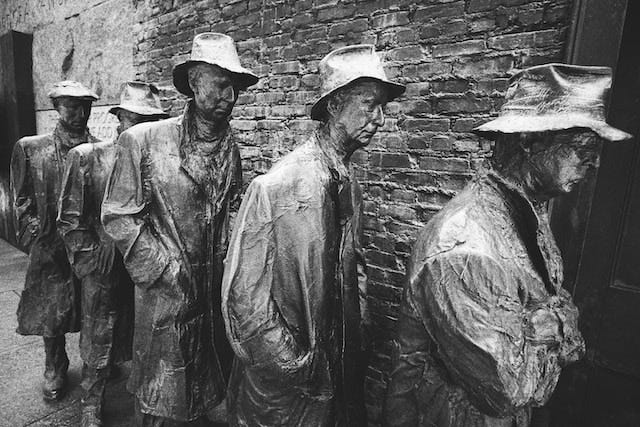
Hence, the Great Depression destroyed wealth like a war. This wealth destruction enabled the New Deal of the 1930s. Tellingly, the US economy did not recover until after World War II.
For example, the number of millionaires did not exceed the 1929 level until 1953, when America had 27,000 millionaires. Similarly, the Dow Jones did not rise to over 6,000 again until December 1958, when it reached 6,173.85. Hence, it took almost 30 years for the stock market to recover from the Crash of 1929.
The Great Depression was not a war or revolution. Indeed, there was more civil unrest in the early 1920s when America was prosperous. Instead, it was a total economic collapse.
Leveling Events and Prosperity
Strangely, leveling events often lead to prosperity. For example, the US real Gross Domestic Product (GDP) grew from $4.568 billion in 1790, just after the Revolution, to $16.352 billion in 1820.*
Notably, US GDP grew from $93.146 billion in 1860, just before the Civil War, to $217.601 billion in 1880.* This growth occurred for several reasons. First, the Civil War broke the power of Southern political elites, opening vast new markets for Northern business. Southern elites were too poor to keep Northern bankers, entrepreneurs, and railroads out after 1865.

Second, all the money tied up in slave capital and Southern wealth was free to flow into northern capital markets. Third, Northern Robber Barons had control of Congress and state governments after 1865. Hence, government policy benefited them and encouraged wealth creation and acquisition.
For example, the US Supreme Court ended the Civil War income tax. Plus, the federal government did not enforce anti-trust laws. The government benefited the rich because they owned it. Notably, journalists called the US Senate the “Millionaires’ Club” in the early 1900s.
Finally, the Civil War increased economic freedom. More people could participate in the economy. Black people were still poor, but they were free to start businesses, save money, and buy consumer goods. Sharecroppers, unlike slaves, had some income they could spend. Moreover, black people were free to migrate in search of jobs or freedom if they wanted.

The Civil War’s destruction of wealth led to prosperity. So did the Great Depression’s destruction of wealth.
For example, US real GDP grew from $817.800 billion in 1933 to $2.353 billion in 1944 and $2.291 billion in 1950. US real GDP more than doubled in 11 years because of leveling and World War II. By 1953, the number of US millionaires rose to 27,000, and by 1962 there were 80,000 millionaires in the United States.
Like the Civil War, the Great Depression freed enormous amounts of wealth. Plus, the Depression kept the wealthy and the Republican Party from blocking wealth redistribution policies. For example, President Franklin D. Roosevelt (D-New York) signed the Social Security Act in 1935. Social Security taxes incomes to finance a basic income for older people.
Similarly, the Revenue Act of 1935 imposed a wealth tax up of up to 75% on the richest Americans. The Revenue Act of 1942 created a withholding tax that deducted taxes from incomes.
The GI Bill of 1944 paid for college for 2.3 million World War II veterans and on-the-job training for another 3.4 million. Hence, millions of Americans increased their income with college degrees. Other GI Bill benefits included hundreds of thousands of low-cost mortgages.
These policies redistributed wealth, which drove economic growth, leading to prosperity. Interestingly, many economists thought economic collapse and a Second Depression could follow World War II. Instead, war’s end led to the greatest economic boom in American history.
Leveling Events led to similar prosperity elsewhere. For example, World War II increased poverty and equality in France by wrecking the economy. This led to aggressive investment and nationalization that drove what the French call the “Trente glorieuses” (“Thirty Glorious Years”) between 1945 and 1975.

West Germany and Japan enjoyed similar booms while Britain enjoyed an uncharacteristic two generations of economic equality thanks to the Supertax and the welfare state. For example, the British Supertax was 99% for top earners in the 1960s and 1970s.* Among other things, the Supertax inspired the Beatles’ Taxman.
One reason for the Glorious Years was that World War II had destroyed much of Europe’s and Japan’s infrastructure. For instance, France lost 50,000 factories in the war. Rebuilding and repairing infrastructure fueled an economic boom. Plus, it gave countries newer and more efficient factories than American competitors.
Thus, destruction could lead to prosperity. Perhaps, health economies need periodic leveling events for prosperity and equality.
Hence, people who hate income inequality should wish for a leveling event. However, I don’t want a Revolution, a Civil War, or a World War. Income inequality does not seem so bad when you examine the alternatives.
*https://www.csmonitor.com/1983/0322/032230.html
*https://finance.yahoo.com/news/25-poorest-states-america-130258343.html#:~:text=In%20terms%20of%20poverty%2C%20Mississippi,living%20below%20the%20poverty%20line.
*https://www.thoughtco.com/king-cotton-1773328
*https://liberalarts.oregonstate.edu/sites/liberalarts.oregonstate.edu/files/polisci/faculty-research/sahr/inflation-conversion/pdf/number-of-us-millionaires.pdf
*https://www.macrotrends.net/1319/dow-jones-100-year-historical-chart
*https://www.macrotrends.net/1319/dow-jones-100-year-historical-chart
*https://www.archives.gov/milestone-documents/servicemens-readjustment-act