
How Kudzu as an Invasive Species Affects Its Surroundings and Us
Four reasons why kudzu can thrive and harm ecosystems
In my previous article “How Do Lionfish As Invasive Species Affect Their Surroundings and Us”, I explained the large impact of lionfish on the environment. Their impact is large, especially in areas that don’t belong to their natural habitat. In these areas, they are intruders, also called exotic species. As they are harming the environment, they are not only called exotic but also invasive.
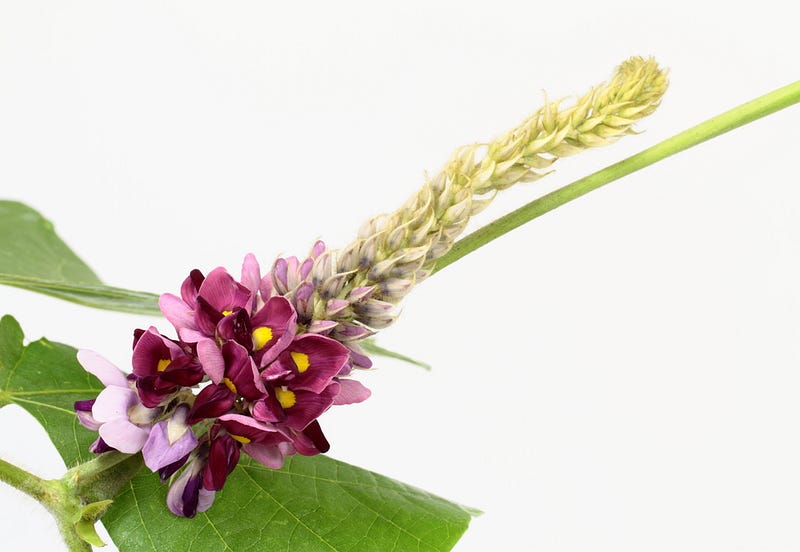
While animals can be invasive species that harm the environment, also plants can spread to new regions and harm their new environment. One of these plants is kudzu (Pueraria montana). Kudzu is a climbing vine that lives for several years. Their stems in early years are covered in bronze hairs; in later years, their stems become woody and grow very large, up to 30 cm (11.8 inches) thick. They grow upward, winding around a tree or other plants, and even walls or other man-made structures, all the way to the top. They also grow thick roots. The roots are used for medicines.
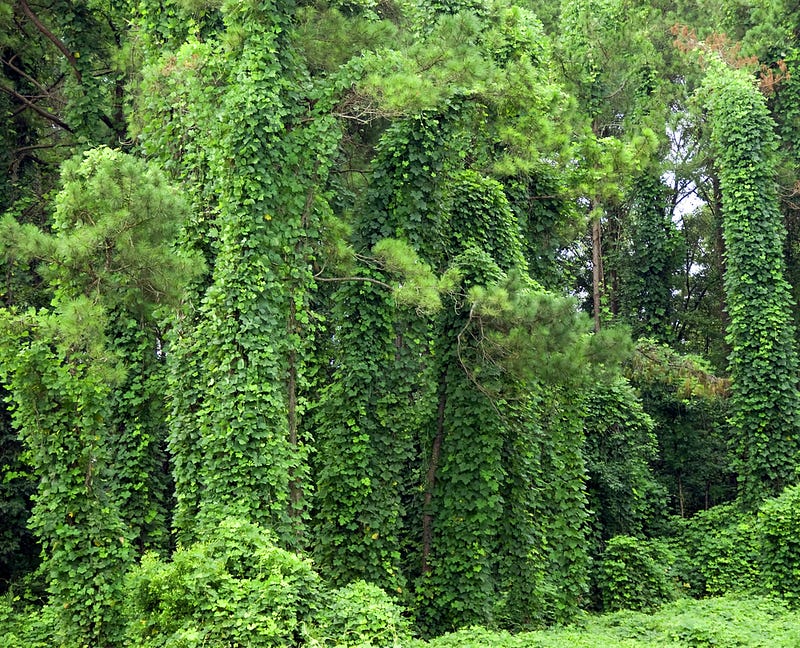
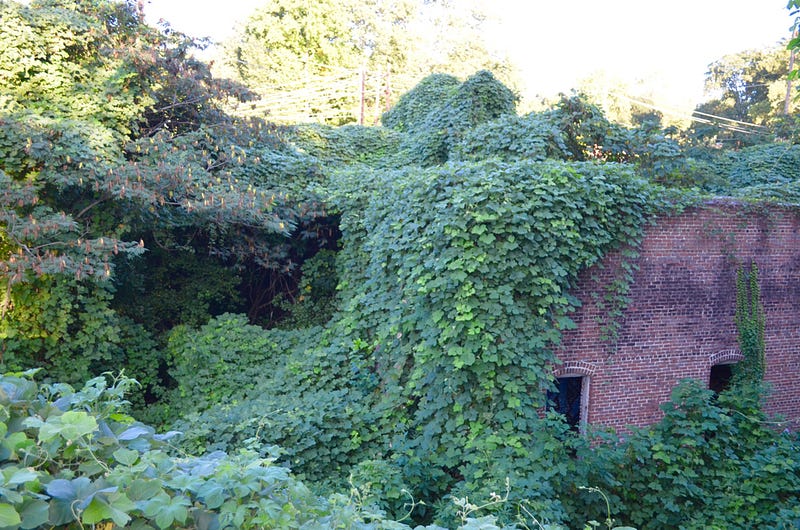
While kudzu naturally grows in East Asia, it was introduced in North America in 1876 and used as an ornamental plant, for food and medicines, to stop soil erosion, and to produce materials such as clothes and fishing nets. By 2001, it had covered 3 million hectares (7.4 million acres) in Eastern USA and was spreading with about 50,000 hectares (about 124,000 acres) per year. To compare, this was about 5.6 million soccer fields, with an additional about 93,000 soccer fields a year, which is about 256 additional soccer fields a day! Because of its rapid growth, it is now one of the most harmful plant species in the USA and has also spread to other countries in North and South America, Europe, Africa, Australia, and South Asia where it is affecting natural ecosystems and agriculture. An ecosystem is a biological community consisting of organisms that interact with their physical environment.
While kudzu is spreading, it harms ecosystems in many ways, including:
- kudzu causes complete shading because the plant occupies forest canopies once they have reached the top of trees and because they form mats on the ground. This permanent shadow disturbs photosynthesis of other plants. Photosynthesis is the natural process of turning water, sunlight, and CO2 in nutrients and oxygen. This causes native species to die and reduces the number and diversity of species in the area
- the plant functions as a fire ladder to the top of a tree, making it easier for wildfires to spread
- soil below kudzu contains less carbon, which can affect the growth of native plant species, plants that naturally grow in the area
- the composition of fungi below the ground changes, which can also negatively affect native plant species
- kudzu emits a lot of isoprene. Isoprene is a molecule consisting of carbon (C) and hydrogen (H) atoms. It forms together with nitrogen oxide smog, meaning it affects air quality
- kudzu is involved in transmitting several types of viruses that affect crops in farming
Apart from harming the ecosystem, it is also harmful to agriculture, with high financial consequences:
- timber production is affected, causing between 100 and 500 million USD per year in the USA
- costs arise to control the plant’s spreading. For example, to remove the plant from electric cables and to allow other plants to thrive again. It costs about 500 USD per hectare (268 USD per acre) per year
- kudzu is involved in transmitting several types of viruses that affect crops in farming. For example, the virus affecting soybeans caused a smaller yield, resulting in a loss of 240 million to 2 billion USD in the USA. In Brazil, the costs are between 500 million and 700 million USD per year due to yield loss and additional costs for chemicals.
Kudzu can have these negative impacts because it can spread freely. These are reasons why kudzu can spread freely and do harm to its surroundings:
Reproduction
The first reason kudzu can thrive as an invasive species and harm its surroundings is because of the way it reproduces.
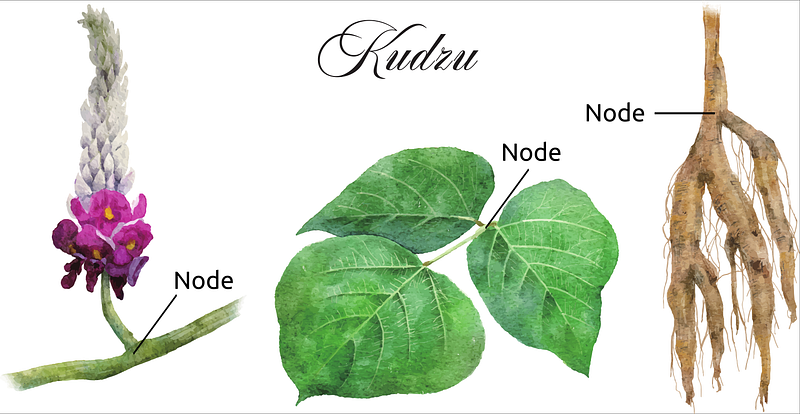
One way kudzu reproduces is through its root system. It grows a large root system, with many nodes from the stems and roots. A node is the location where a root or stem branches. After 1 to 3 years, the rooted nodes detach from the mother plants, which means that a clone is created. This clone can continue to grow as an independent plant. Because of the large number of nodes, such as 61 per m2 (5.7 per sq feet), the density of clones in an area can be very high. Also, rooted nodes can be spread by hurricanes or humans.
Another way kudzu reproduces is by producing seeds. Seeds spread usually within 6 m (19.7 feet) and up to 25 m (82 feet) from the mother plant and can even be carried further by streams or flood water. These seeds can lay dormant due to the seeds’ coats and only start to grow into a plant when this coat is damaged or by rising temperatures between spring and summer. As only a few seeds are produced and not all seeds can grow into a new plant, this means that producing clones from the roots is the most important way to reproduce.
Adaptation
The second reason kudzu can thrive as an invasive species and harm its surroundings is because of its adaptation. Adaption means that it can thrive under many different conditions. For example:
- it can grow in many different environments, including the outer boundaries of forests, on agricultural fields, in mountains up to 1500 m (4921 feet), and on small islands
- it can thrive on various types of soil, including sandy and clay soils
- it accepts soil of different acidity levels, ranging from 3 to 8, which is rather acidic to slightly alkaline
- it prefers nutrient-rich soil but can also grow in nutrient-poor soil as kudzu can obtain nitrogen from the air instead of soil
- kudzu can also survive relatively dry periods as it stores water in its roots
- it prefers hot summers (over 25 °C / 77 °F) and mild winters but also survives winters with extreme colds (down to -29 °C / -20.2 °F). This is because leaves die with cold temperatures which grow back in early spring and because snow protects under-ground stems from dying by functioning as insulation
- it has genetic diversity even though the plant clones itself because the plant was introduced to the USA multiple times from different origins
Allelopathy
The third reason kudzu can thrive as an invasive species and harm its surroundings is because of allelopathy. Allelopathy means that kudzu spreads chemicals that prevent or limit other plants’ growth. These chemicals are released into the environment, including soil and air, by both living kudzu plants and their remainders. They suppress native plants’ growth by for example preventing germination, limiting root growth, suppressing healing, and affecting the beneficial relationship between native plants and fungi. As these chemicals are new to native species, they have not yet developed a mechanism to deal with them or increase their tolerance, making invasion of kudzu easier.
Insecticidal and fungicidal activity
The fourth reason kudzu can thrive as an invasive species and harm its surroundings is because of limited insecticidal and fungicidal activity. Insecticidal and fungicidal activity involves plant-eating insects and harmful microorganisms that limit the growth of kudzu. For example:
- kudzu contains substances that cause the soybean looper moth to die sooner and their pupae to grow smaller when eating kudzu compared to soybean plants
- kudzu contains chemicals that limit tobacco mosaic virus activity
- some fungi that live in plants and benefit kudzu limit harmful fungi’s growth by secreting certain substances
- as they don’t have natural enemies or only in small numbers in non-native areas, kudzu is not or hardly limited by insects and fungi
Conclusion
So, kudzu is a thriving invasive species in some parts of the world because it effectively reproduces through the roots, adapts well to various types of environments and circumstances, limits the growth of native plants, and is hardly limited by natural enemies. This not only harms ecosystems, for example by suffocating other plants but also agriculture by affecting crop growth.
How we can take action
As kudzu has many harmful effects, it is important to limit its growth as much as possible. Here are practical ideas of what you and I can do to help control the spread of kudzu:
- Removing any kudzu on your land as early as possible including the roots
- Using kudzu root to obtain a nutritious starch
- Using kudzu to feed livestock or let them graze it
- Using vines as rope or to create objects such as chairs, baskets, and hammocks
- Using kudzu leaves as food or as an ingredient for edible products
Which one of these can you implement in your daily life? And do you have further ideas of what you and I could do? Thank you in advance for putting them into practice and sharing them in a comment to this question to inspire all of us.
Did you enjoy this article? Then I’m sure you’ll love my book “A Guide to A Healthier Planet” as well. Have a peek inside the book at:
About the author
Dr. Erlijn van Genuchten is a an internationally recognized environmental sustainability expert. She is a science communicator, helping scientists in the fields of nature and sustainability increase the outreach of their results and allowing us all to put scientific insights into practice and contribute to a sustainable future. Erlijn has inspired thousands of people around the world — for example — by supporting the United Nations with her expertise, her book “A Guide to A Healthier Planet” published by Springer Nature, her YouTube channel Xplore Nature, and her posts on social media.
- More about her book “A Guide to a Healthier Planet”
- Invite Dr. Erlijn van Genuchten as speaker
- Xplore Nature YouTube channel
- Science communication support
- Toward (a green) peace of mind community — resolving eco-anxiety
- Website
Credit
This article is based on: