
How is Partisanship Ever a Point of Pride?
A plea for unity over factionalism
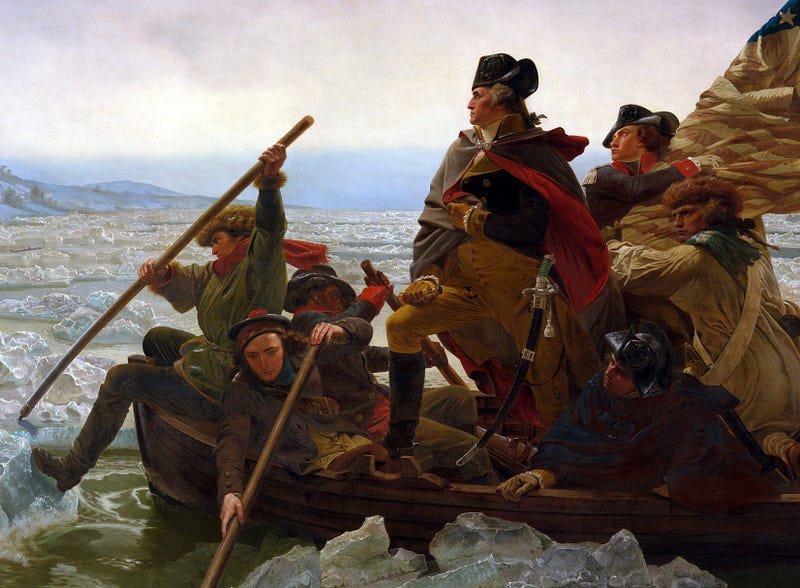
America today stands on a precipice. As unthinkable as the nation’s decline and fall still is to many, every day it feels more and more like the slightest of forces — whether a shifting of political winds or a nudge from a scheming ne’er-do-well— any such impetus could be enough to send the U.S. careening over the edge to be dashed to bloody pieces on the rocks below.
If you’d asked my 10-year-old self if I ever thought it possible I might live to see my country descend into a dictatorship, or be torn apart through Balkanization, or succumb to the madness of a second civil war, I’d have called you a scare-mongering lunatic and a fool. But no longer. Sadly, such dire outcomes no longer strike me as being outside the realm of possibility. In fact, they don’t even seem particularly unlikely.
How did we get to this point? What’s driving such madness?
Simply put, the driver of our woes is 40 years of ever-increasing political and cultural polarization spurred on by siloed-off, opinionized news sources that have slowly but surely carried the nation to its present dangerous and unsustainable summit.
But these problems are hardly novel to our era. For everything we’re now experiencing — all the petty factionalism, the mistrust and misinformation, the passionate anger and irrationality, the mindless echo chambers, as well as the opportunistic demagogues such conditions inevitably spawn — all of it was forewarned, almost prophetically, by the heroic general who helped guide our nation into existence, that familiar likeness found on quarters and one-dollar bills, our very first president, George Washington.
At the end of his second term as president, way back in 1796, he delivered a long parting speech to the nation in which he warned of so many of the forces that are now threatening to tear us asunder. It’s an illuminating read, one whose prescience is uncanny, and whose wisdom is sorely needed in these troubled times.
Unfortunately, however, few today still fancy the verbose, mellifluous stylings of 18th-century prose. Nor does there seem to be much lingering respect among much of the citizenry for the thoughts and the values of old, dead, white guys — especially ones who happened to own slaves (regardless of their individual views on that “particular” and atrocious institution).
But such obstacles in no way diminish the continuing power of Washington’s words, or the necessity of them being heeded. So I’ve taken it upon myself to whittle his speech down to just the choicest of morsels, and to present them in the context of current events to show just how far we as a people have gone astray. And lest you think your own side is somehow above the fray, be forewarned — no partisan shall be spared my pen’s wrath.
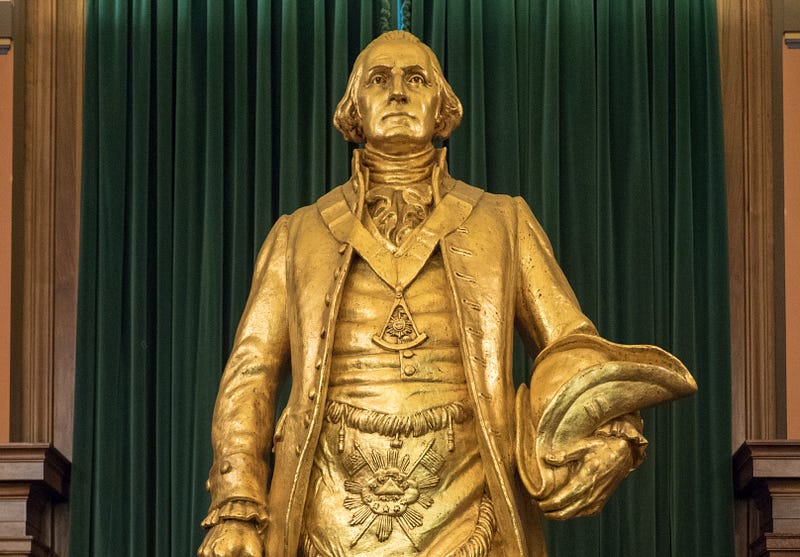
Washington’s farewell address focuses on three main themes that he envisioned as being the primary dangers that could derail the bold, hard-won experiment in representative government that he and his fellow Founding Fathers had worked so hard to achieve.
- The first of these (and the one most salient to this essay) is that the people’s unity would be shattered by infighting resulting from breaking into hostile factions, or as they’re known today, political parties.
- The second is that the Constitution would get frivolously altered by short-term interests, thus destroying its timeless power to bind the nation into a cohesive whole and preserve the liberty of all.
- The last was that we would find ourselves caught up in foreign entanglements which would saddle the nation with war and ruinous debt while opening us up to meddling by both friends and adversaries alike.
As we shall see, all three have come to pass to a greater or lesser extent. Yet it’s the first of the three that has largely led to the latter two.
Here, then, are Washington’s “disinterested warnings of a parting friend” offered to his fellow citizens as “the result of much reflection, of no inconsiderable observation” in his fervent hope:
…that your union and brotherly affection may be perpetual; that the free Constitution, which is the work of your hands, may be sacredly maintained; that its administration in every department may be stamped with wisdom and virtue; that, in fine, the happiness of the people of these States, under the auspices of liberty, may be made complete.
His guiding thesis in this endeavor was the notion that we as a nation derive not just our strength and our liberty, but our happiness itself, through unity. As he put it (with all bold-faced emphasis my own):
It is of infinite moment that you should properly estimate the immense value of your national union to your collective and individual happiness.
For as he further explained:
The unity of government which constitutes you one people is also now dear to you. It is justly so, for it is a main pillar in the edifice of your real independence, the support of your tranquility at home, your peace abroad; of your safety; of your prosperity; of that very liberty which you so highly prize.
In his opinion, the chief threat to unity was the pitting of one group of Americans against another. Thus, it is every citizen’s duty to refrain from falling into the all-too-human in-group/out-group dynamic (which he recognized as being “inseparable from our nature, having its root in the strongest passions of the human mind”). The price of failure at this task would be our own happiness and prosperity. As he advised:
You should cherish a cordial, habitual, and immovable attachment to [unity]… watching for its preservation with jealous anxiety… and indignantly frowning upon the first dawning of every attempt to alienate any portion of our country from the rest, or to enfeeble the sacred ties which now link together the various parts.
Recent polling has shown that Americans no longer merely disagree with the policies of the opposing party, they view their members as outright evil. Spend five minutes on social media and this quickly becomes self-evident, with one side disparaging the other as “snowflakes” and “libtards” while the other writes off their tormentors as nothing but “racist, ignorant hicks.” It’s disgusting. Is it any wonder our country is in such sorry shape?
Of course, it certainly doesn’t help when such divisiveness comes straight from our leaders. Like when Hillary Clinton dismisses half of our citizenry as “a basket of deplorables.” Or when wokeist identity politics all but ensures MLK’s dream of universal brotherhood will be impossible to achieve, subsumed to a race-based oppressor/oppressed power dynamic and a perpetual victim mentality. Or when Donald Trump slanders half our Latino population as “drug dealers, criminals, rapists” and tells duly elected women of color to “go back where you came from.”
Washington minced no words at such divisive name-calling, stating:
You cannot shield yourselves too much against the jealousies and heartburnings which spring from these misrepresentations; they tend to render alien to each other those who ought to be bound together by fraternal affection.
Being as he valued unity and fraternity above all else, he saved his most damning words for the very notion of political parties, viewing them as the institutionalizing of petty differences and hatred of the “other.” His goal was to “warn you in the most solemn manner against the baneful effects of the spirit of party generally.” As he put it:
The alternate domination of one faction over another, sharpened by the spirit of revenge, natural to party dissension, which in different ages and countries has perpetrated the most horrid enormities, is itself a frightful despotism.
We call this despotism “the two-party system.” It is a system where your ballot choice is between two nominally different groups who differ only in their outward trappings and culture war subject du jour, both being fully bought and sold by their corporate masters, while independents are left with a choice between “the lesser of two evils” or throwing away their vote on a hopeless third party.
Washington wanted nothing to do with such a system. As he said:
But this leads at length to a more formal and permanent despotism. The disorders and miseries which result gradually incline the minds of men to seek security and repose in the absolute power of an individual; and sooner or later the chief of some prevailing faction, more able or more fortunate than his competitors, turns this disposition to the purposes of his own elevation, on the ruins of public liberty.
His name is Donald J. Trump. Enough said.
Washington not only predicted the rise of MAGA populism, but he also foresaw the events of January 6th as its inevitable conclusion, stating:
However combinations or associations of the above description may now and then answer popular ends, they are likely, in the course of time and things, to become potent engines, by which cunning, ambitious, and unprincipled men will be enabled to subvert the power of the people and to usurp for themselves the reins of government, destroying afterwards the very engines which have lifted them to unjust dominion.
He knew firsthand the power of demagogues to unleash their mindless followers upon the forces of law and order. Again, he predicted:
All obstructions to the execution of the laws… with the real design to direct, control, counteract, or awe the regular deliberation and action of the constituted authorities, are destructive of this fundamental principle, and of fatal tendency.
The fact that among the American flags, among the Confederate banners and Nazi swastikas being carried through the halls of Congress could be found a staggering number of “Trump” flags says it all. It’s party before country and personality before party.
They serve to organize faction, to give it an artificial and extraordinary force; to put, in the place of the delegated will of the nation the will of a party, often a small but artful and enterprising minority of the community… to make the public administration the mirror of the ill-concerted and incongruous projects of faction, rather than the organ of consistent and wholesome plans digested by common counsels and modified by mutual interests.
As much as I have to choke back bile while saying it, thank goodness for Mike Pence. Thank goodness that despite his predilection towards being a character straight out of The Handmaid’s Tale, that at least at heart he’s a man of honor and principle, willing to stand up against a rioting mob chanting for his death.
But in addition to the obvious threat to our republic posed by a blatant coup attempt, Washington also foresaw the opportunity such unrest offered to foreign adversaries to meddle in our affairs to their advantage. Cue Putin’s army of propaganda bots. As he said of such happenings:
It serves always to distract the public councils and enfeeble the public administration. It agitates the community with ill-founded jealousies and false alarms, kindles the animosity of one part against another, foments occasionally riot and insurrection. It opens the door to foreign influence and corruption, which finds a facilitated access to the government itself through the channels of party passions. Thus the policy and the will of one country are subjected to the policy and will of another.
Or as he states later:
As avenues to foreign influence in innumerable ways, such attachments are particularly alarming to the truly enlightened and independent patriot. How many opportunities do they afford to tamper with domestic factions, to practice the arts of seduction, to mislead public opinion, to influence or awe the public councils?
It’s amazing how clearly he foresaw all of the above over two hundred years ago — long before radio and television, before the Internet, before jumbo jets and near-instantaneous global communications. How can we today, with the entirety of human knowledge at our fingertips, still be so ignorant, so stupid? It boggles the mind.
There’s so much additional sage advice to be found in Washington’s speech, it’s hard to wind down this essay within a reasonable amount of time. For as much as I’d like to continue, as much as I’d like to point out the Republicans’ dismal failure in:
…avoiding likewise the accumulation of debt, not only by shunning occasions of expense, but by vigorous exertion in time of peace to discharge the debts which unavoidable wars may have occasioned, not ungenerously throwing upon posterity the burden which we ourselves ought to bear.
Or point out the Democrats’ equal failure to:
…practically bear in mind that towards the payment of debts there must be revenue; that to have revenue there must be taxes; that no taxes can be devised which are not more or less inconvenient and unpleasant.
As our national debt now surpasses twenty-eight trillion dollars. As much as I’d like point out the reckless insanity of the Democrats’ current warmongering for intervention again Russia in Ukraine (following the Republicans’ disastrous adventures in the Middle East) and both parties’ utter failure to:
…avoid the necessity of those overgrown military establishments which, under any form of government, are inauspicious to liberty, and which are to be regarded as particularly hostile to republican liberty.
Or to mention their failure to “observe good faith and justice towards all nations; cultivate peace and harmony with all” and to exclude “inveterate antipathies against particular nations, and passionate attachments for others” as:
The nation which indulges towards another a habitual hatred or a habitual fondness is in some degree a slave. It is a slave to its animosity or to its affection, either of which is sufficient to lead it astray from its duty and its interest.
Or to note that:
Antipathy in one nation against another disposes each more readily to offer insult and injury, to lay hold of slight causes of umbrage, and to be haughty and intractable, when accidental or trifling occasions of dispute occur. Hence, frequent collisions, obstinate, envenomed, and bloody contests.
As much as I too would like to ask:
Why, by interweaving our destiny with that of any part of Europe, entangle our peace and prosperity in the toils of European ambition, rivalship, interest, humor or caprice?
In the interest of brevity (knowing that very few readers are willing to surpass the 10-minute mark), I’ll conclude. But I’ll let a far greater and more eloquent writer than myself do the honors. For in closing, Washington states:
In offering to you, my countrymen, these counsels of an old and affectionate friend, I dare not hope they will make the strong and lasting impression I could wish; that they will control the usual current of the passions, or prevent our nation from running the course which has hitherto marked the destiny of nations. But, if I may even flatter myself that they may be productive of some partial benefit, some occasional good; that they may now and then recur to moderate the fury of party spirit, to warn against the mischiefs of foreign intrigue, to guard against the impostures of pretended patriotism…
I likewise hope that my dusting off of this long-ago speech “may be productive of some partial benefit.” And I’d implore each and every one of you, that next time you’re slipping a quarter in a slot machine or showing your appreciation for a pole dancer as she artfully parts you from your dollar bills, take a moment to also appreciate the wisdom of the man whose stern visage graces both, and perhaps let go of some of the hatred for your countrymen engendered by vile politicians, cable news pundits, and social media trolls. And remember:
The name of American, which belongs to you in your national capacity, must always exalt the just pride of patriotism more than any appellation derived from local discriminations.
We are all Americans — not Democrats or Republicans, not liberals or conservatives — but Americans. And unless we remember that and prioritize it over party and faction, we may soon be mere footnotes in history, just another fallen empire among the countless who preceded us. Let’s try to do better than that.

Colby Hess is a freelance writer and photographer from Seattle, and author of the freethinker children’s book The Stranger of Wigglesworth.
If you’re just discovering Medium and you like what you see, please help support this author and others by subscribing here.


.jpg)