
[Technology] How induction motor works
The secret behind all electric motors
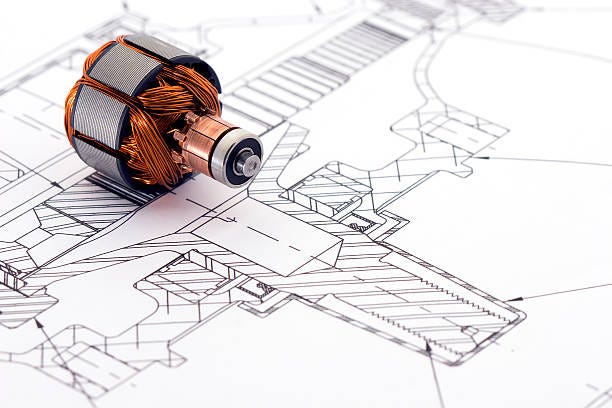
Do you know that a magnet creates a magnetic field? A magnetic field can either pull or push another magnetic field depending on the polarity. Thus we can say that a magnet can create a motion force. This force is called RMF (Rotating Magnetic Field).
In order to get a good RMF, its shape should be:
- Smooth
- Should not get distorted during rotation
- The central flux line should be perfectly linear
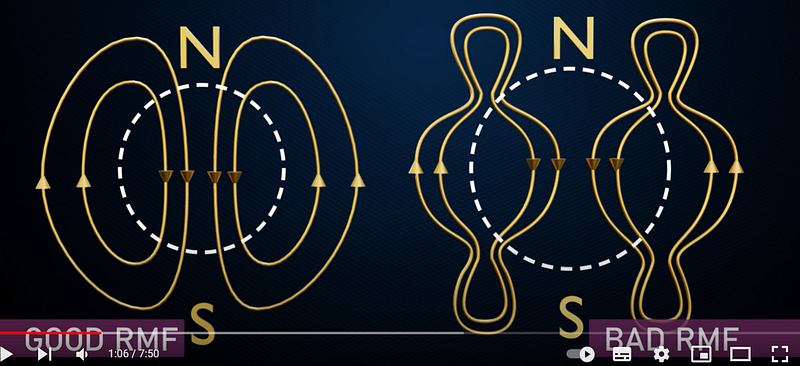
For years the RMF in induction motors was bad; till the Godfather of inductions motors Nikola Tesla came out with an explication of the problem:
“ They don’t rotate because all the fields experience the maximum or minimum at the same time.”
Knowing the problem is half the solution. Nikola Tesla knew the problem. His solution was to keep maximum values of the different fields at different instants (Phase shift concept).
But do we use huge magnets in the induction motor? The answer is no!
Back in 1831, a genius called Faraday discovered that a magnetic field generates electricity and electricity can also generate magnetic fields. This is called Faraday’s law of induction.
In this case, the magnet is just copper or aluminum wire coiled around an iron core. When electricity passes through the wire, magnetic fields are created.
To keep it simple, in an induction motor we find a :
- Stator: a fixed structure that makes a magnetic field.
- Rotor: a rotating structure that rotates inside this magnetic field.
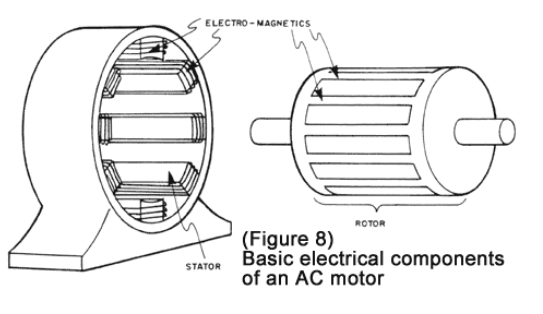
In order for the rotor to keep rotating, we must have a good RMF. In the end, the induction motor converts electrical power to mechanical power with the help of a magnetic field. But you should also know that it can also convert mechanical power into electrical power using magnetic fields. And this is how wind power generates electricity.