
How I Use Keyword Research To Generate Organic Search Traffic For My Medium Stories
Combine low competition keywords and Medium’s high Domain Score to get to Page One of Google Results

To give you the best information quickly, let’s start with the top takeaways from my experience in maximizing my organic search traffic. Screenshots of stats and articles, plus details about the process, will come afterwards.
Key Takeaways for Your Keyword Research:
- It matters 😃
- Medium has a high DS (Domain Score), meaning it is a great platform for ranking well in Google results
- Use a tool like Ubersuggest to identify low competition keywords in your niche. Don’t target broad topics, instead target specifically searched phrases
- After identifying a target phrase, check if there are other Medium articles that return as results for that phrase. If not, you are golden 👍
- Use the keyword phrase in the title so Google and potential readers know you are answering the target question
What I used to do vs. what actually works
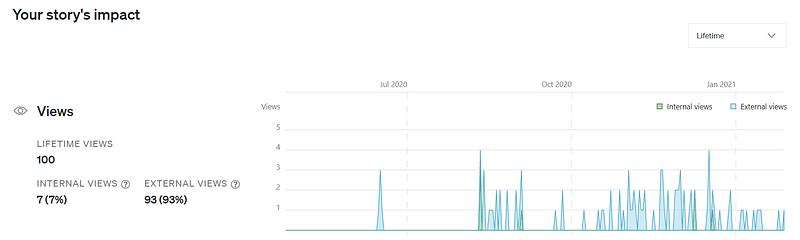
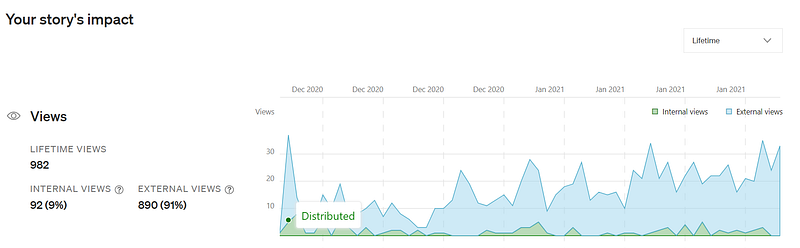
I first started writing on Medium in spring 2020 (anyone remember those days? 😐). I wanted to boost my software development skills in case I got laid off, and wanted to have my work easy to reference in an interview. Medium was a great fit. (And by the way, this article is not software-dev-blog specific)
I initially started writing answers to problems I had with code at work that I couldn’t find an answer to online. Truthfully, that’s not a bad place to start: if you need the answer to a question for work, probably others are searching for the same thing.
However, there simply weren’t enough people searching for the solutions I posted. They were too niche.
I did get the occasional lucky break with articles that had significant search traffic. This made me wonder: what sets these articles apart?
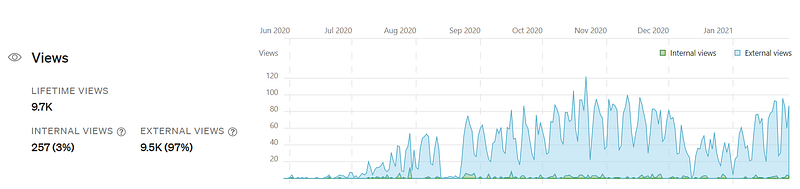
First I targeted similar topics (writing “Intro to” articles for different components in a JavaScript library called Material-UI). Then I stumbled into keyword research through laziness — I had already written an article about a topic; I knew quite a bit about that topic; what else are people looking for about the topic? I intended to reduce my time spent writing, and instead stumbled into learning what to write about.
My keyword research process with Ubersuggest
I enjoyed reading about online businesses so I was aware of the concept of keyword research and that there were freemium tools. I just hadn’t thought about applying my prior knowledge to my business.
I tried out Neil Patel’s Ubersuggest keyword research tool and found it very intuitive. Here’s a walkthrough of how I went about doing keyword research, using the example of the first time I went about it methodically:
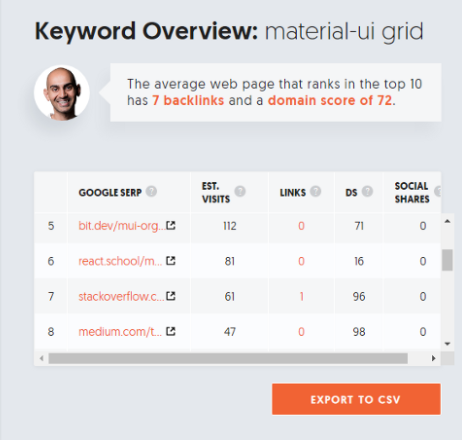
I plugged in a phrase I had (unintentionally) previously targeted and got a list of related potential keywords to target.
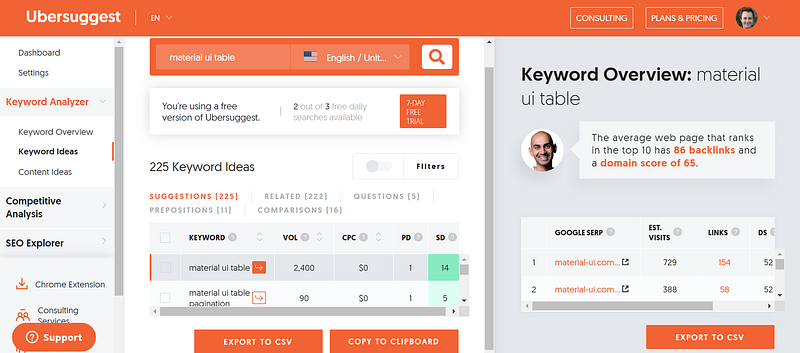
I exported the batch to CSV. The free version of Ubersuggest lets you perform three searches per day and export the top 30 keywords from the search results. I write about an article per week, so this is perfect for me. Someday when I am rolling in cash 💸 I will upgrade to the paid version, which costs $29/month.
I am a beginner with SEO, so I only look at the search volume in the exported results. As long as a keyword has at least 10 searches, I will target it. Supposedly, that means 10 searches per month for that phrase occur in Google. In my experience, that’s roughly the views my article will get per day. My guess as to why: Ubersuggest is underestimating, plus I rank for other keywords I am not specifically targeting.
The other column of interest in the exported data is the SEO Difficulty column. The lower the score, the less competition for that keyword or phrase. My niche (writing about React libraries) has little enough competition that I don’t worry too much about SEO Difficulty. More importantly, Medium has high Domain Score (Domain Authority), meaning it is more likely to rank well in search results.
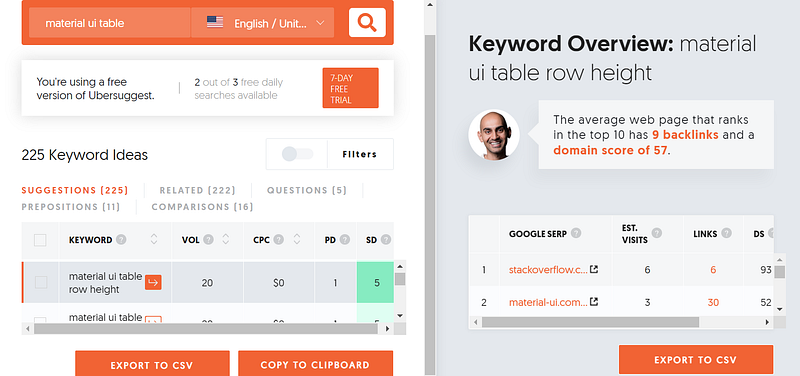
For my last step, I picked out a couple of keyword phrases. Let’s look at one in particular: “material ui table row height”. I selected it in Ubersuggest and checked the right hand results. Search volume of 20 and no Medium articles in the top 10? I’ll take it!
I dug a little deeper and did not see any article on the first page of Google directly answering this query. However, I did see a help thread where people were posting potential solutions. A lot of people needed this info, there were a lot of partial answers out there, but no one was truly providing a clear solution.
(A side note — I will write an article if there is another Medium post on the first or second page of Google if 1) the existing Medium story is poorly written, i.e. not informative enough or contains grammar mistakes, or 2) the returned Medium story is not really about the searched topic. Medium has strong domain authority and sometimes Medium articles that are only loosely related are returned for a search.)
I wrote this guide that solved the internet’s material-ui problem table row height problem 😉. Here are the views after about a month:
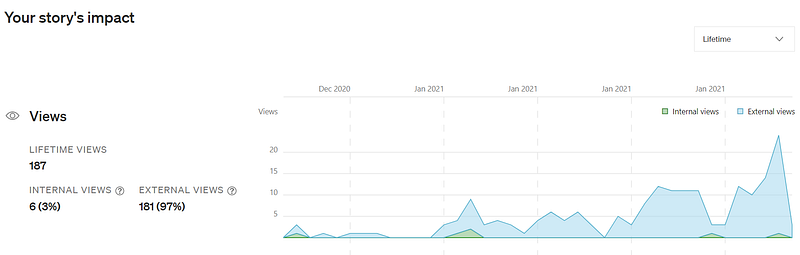
It takes time to gain traction in Google search results. Notice the upward trend. The search volume in Ubersuggest was listed at 20 for “material table row height”, so I expect about 20 views per weekday once Google really trusts the article.
Let’s see what happens when I search for the solution:
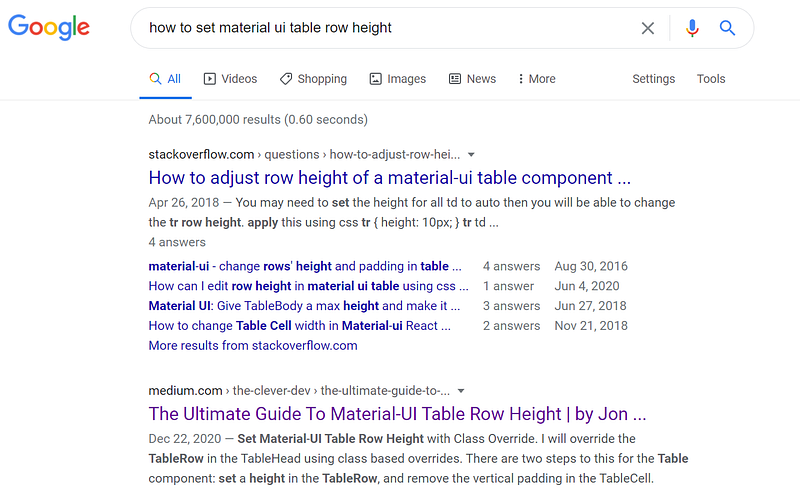
Beautiful! I’m on page one!
I included the keyword phrase in the article title so that Google and readers know what it is about. Most of the viewers are probably at work wanting a quick solution.
Pros and Cons
Let’s start with cons first, maybe I’m a pessimist 👊.
There’s really only one drawback: most readers of my articles are not Medium members. This means low earnings per view and low claps or followers per view.
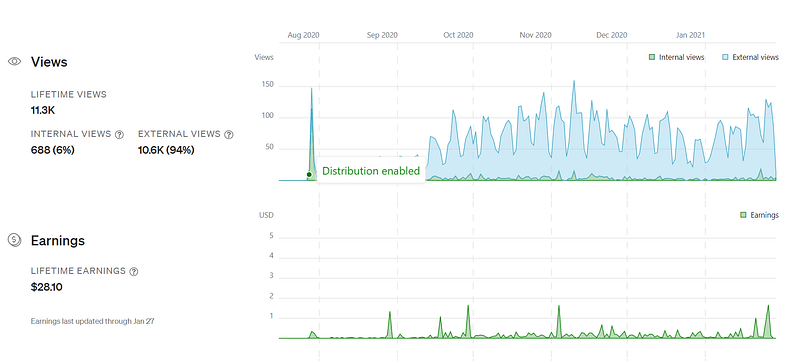
Here’s the earnings from the table row height article:
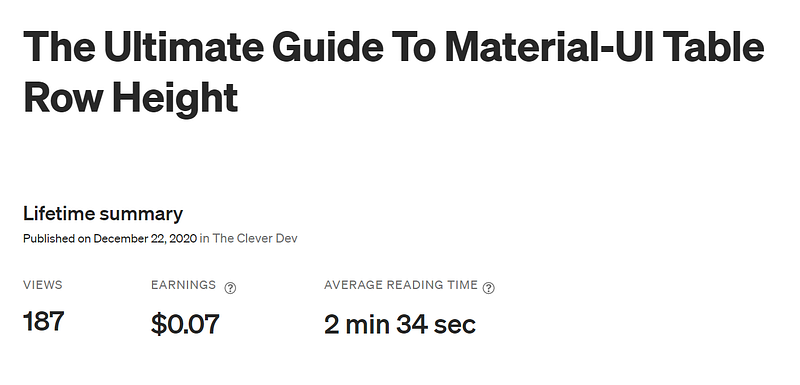
My earnings per article tend to be lumpy. Most articles that get 30–50 views per day might make $0.15 most days, but then I get bounties when a reader signs up for Medium.
However, there are other opportunities for monetizing (affiliate links for example). Read more here on how I monetize my articles beyond Medium earnings.
The Pros?
- I rarely have to touch an article again, except to keep the article up-to-date.
- I do almost zero promotion because Google handles my marketing, freeing me to create content.
- Each article that ranks well is a tiny asset with persistent cash flow.
- More software developers signing up for Medium should be an earnings tailwind for articles I wrote months ago
Finally…
Many writers on Medium are writing for their followers and for publications. They may not be interested in organic traffic.
If you are interested in capturing organic search traffic, keep in mind there are three pieces to the equation:
- A well-optimized platform (Medium solves this)
- Writing high-quality content (you solve this)
- Writing content that people are searching for (good keyword research helps solve this)
Even if you do good keyword research, not every article will rank or get the traffic you expect. Part of this business is having a high quantity of quality articles. The more articles you write, the more you will learn what gets views, earnings, and click-throughs to other earnings opportunities.
And by the way, I didn’t get laid off last spring😍.
Resources:
Special thanks to this story from Aigner Loren Wilson for giving great tips on formatting articles for publications.
This article describes why I think targeting 10, 20, and 30 monthly search keyword phrases is worthwhile.
For those interested, here are links to the articles for which I included stats screenshots: Topojson Demo, Framer Motion vs React-Spring, Material-UI Table Row Height, Intro to Material Table for React


