
How I Learned About “Second-Degree Fun”
Be careful what you sign up for
A few years ago, I took a basic climbing class from the Mountaineers Club. The name of the class is a bit misleading in that it sounds like you spend a Saturday morning with the instructor going over the “Ten Essentials” then go for a hike in a beautiful meadow in the afternoon and take pictures of wildflowers and maybe see a marmot.
It’s not that at all.
Rather, it is six months of every-other-Tuesday night lectures interspersed with one- or two-day weekend field trips each month to practice what you learn in the lecture series. The class then culminates with the student summiting three mountains, one of which needs to have a rock climb (ropes and carabiners) and one that needs to involve travel across a glacier. The third is the student’s choice.
It is very involved, and very expensive, to the tune of about $4,000 worth of gear needed.
It was at one of the early lectures where I first heard the term “second-degree fun.” By loose definition, this is when you set out on a fun (first-degree fun) outing, and something doesn’t quite go as expected. In reality, this often results in being more miserable (and often cold) than planned and in the moment, it doesn’t seem like fun at all.
But then, when you get home or regroup in a cozy restaurant afterward with a nice beverage, you tell yourself and your comrades that, actually when you think about it, it was pretty fun.
Scientifically this is referred to as the fading effect bias where the negative emotion associated with unpleasant events fades quicker than the positive feelings from it.
Or, as my Mountaineers Club likes to call it, second-degree fun.
As you may expect, they wouldn’t have mentioned it if we weren’t destined to experience a bit of this second-degree fun phenomena. I had one such experience during one of my graduation climbs that involved glacier navigation.
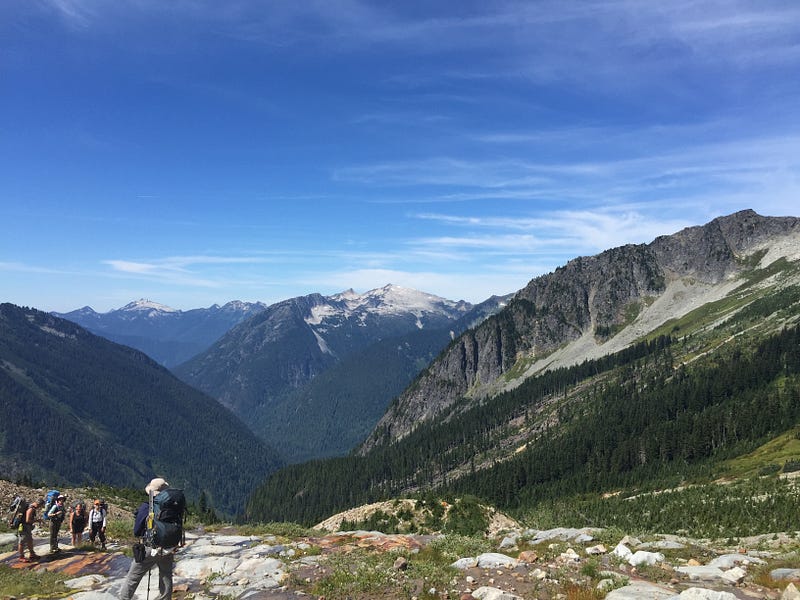
We set out to climb Sahale Peak across the Quien Sabe glacier in the North Cascades in Washington State on an extra-hot August weekend.
The plan was to hike in early on Saturday to beat the heat, set up camp at the foot of the glacier, and rest a bit. Then, early Sunday, set off, summit by 1000 and back to camp to pack up and hike out. Anticipated time back at the trailhead: around 1700.
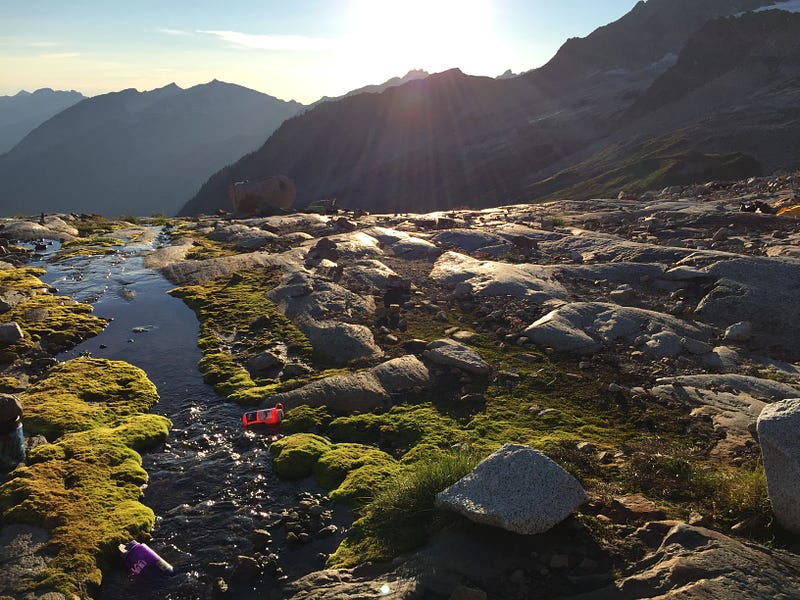
This year happened to have a lower-than-normal snowpack. So, when we arrived at the plateau where people normally camp, we were still significantly below the snow line. No problem, it was easy enough to find a nice area to set up tents, and we enjoyed the spectacular views and the pleasant August afternoon.
The next day slowly turned into a different story.
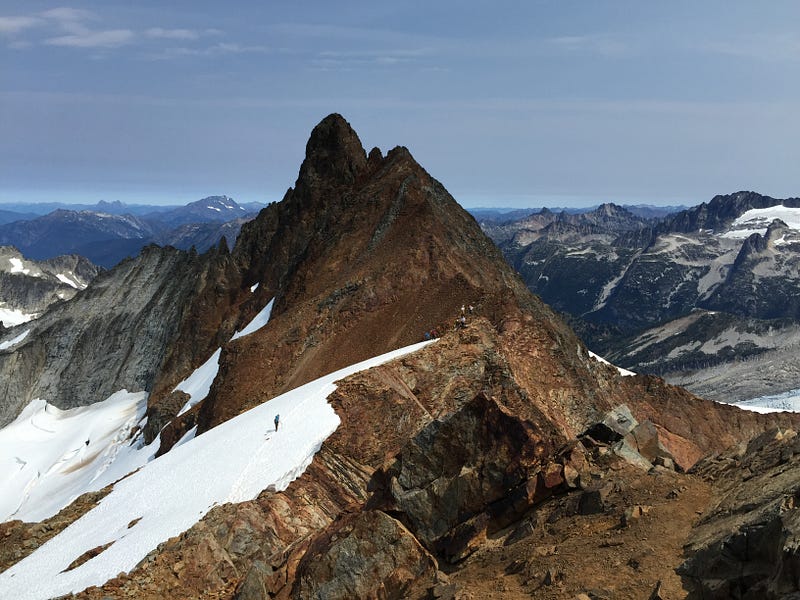
We set out at 0400 as planned, but it took us quite a while to get up to the edge of the glacier. We rested there and transitioned into crampons and roped up for travel on the glacier. Glacier travel is slow but went as expected. The twist came when we got to the top edge of the snow. Typically, the snow extended right up to the final steep pitch (technically a rock climb, but a very easy one). In this case, the snowpack was so low that we had to transition onto a thin ridge of rock and traverse quite a distance over to the final pitch.
That took a long time. We had to set up safety lines to negotiate areas where you wouldn’t normally travel with a typical snow level.
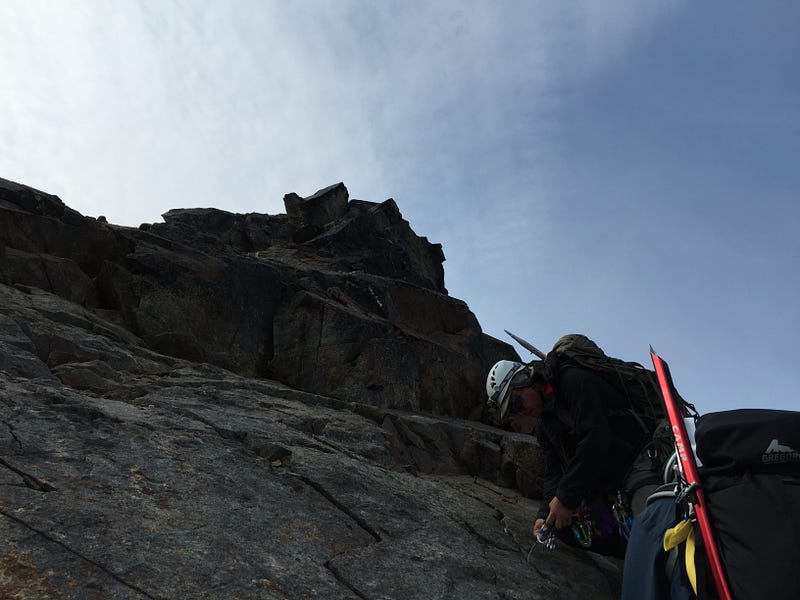
Our ‘Bingo’ point for the climb was 1300. That is if we had not summited by that time, we were to turn around and head back to avoid being caught on the mountain later than we wanted. In many cases, in mountaineering, that time is a hard measure because it means avoiding weather or conditions that could be life-threatening. In this case, it was a bit softer in that the weather risk was insignificant. It mostly represented us getting back to civilization and our lives at a decent time.
That being the case, we pushed it a little. We began the last pitch at about 1300, summited, had a bit of celebratory chocolate, took a selfie and began our descent at 1400.
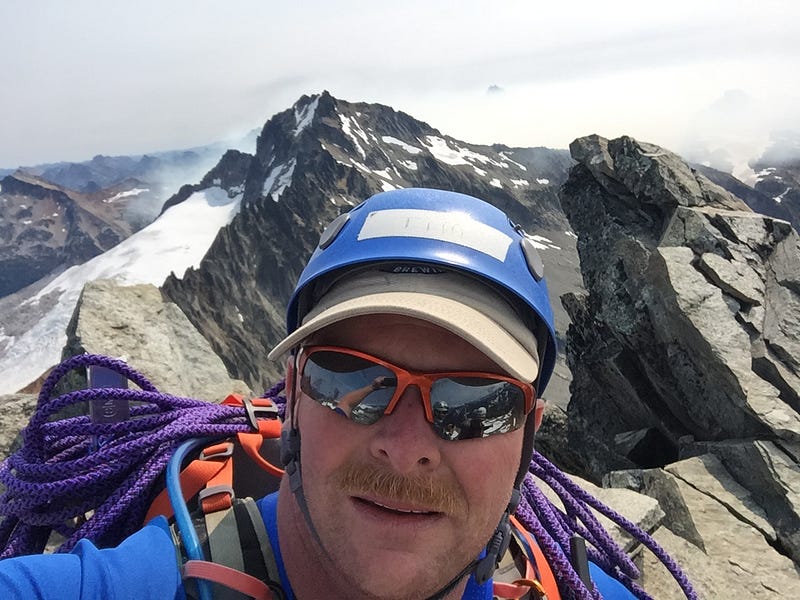
While glacier travel is inherently slow, traversing downward on rock scree fields is even slower; and significantly more challenging. Each step could mean a twisted ankle or knee if you mistakenly commit your full weight to a wobbly loose rock.
Since there was much more rock than snow, coming down took even longer than our approach. And, it was grueling. Painful physically and stressful mentally as you considered each step.
Once we reached camp, several people that didn’t need to be at work the next day opted to just stay there another night and rest. The balance of us that did have to show up somewhere in the morning trudged out.
The ‘climber trail’ that had been a fun and challenging hike in became a slippery menace to navigate, especially after dark set in. My legs were rubber, and each step was not only painful but an opportunity to stumble and possibly injure myself.
I have never been so happy to see my car before, and I now had a well-defined notion of second-degree fun.
That one is kind of an amusing story. Sore legs and mental exhaustion were the only real prices paid. Something you can spice up and tell the grandkids.
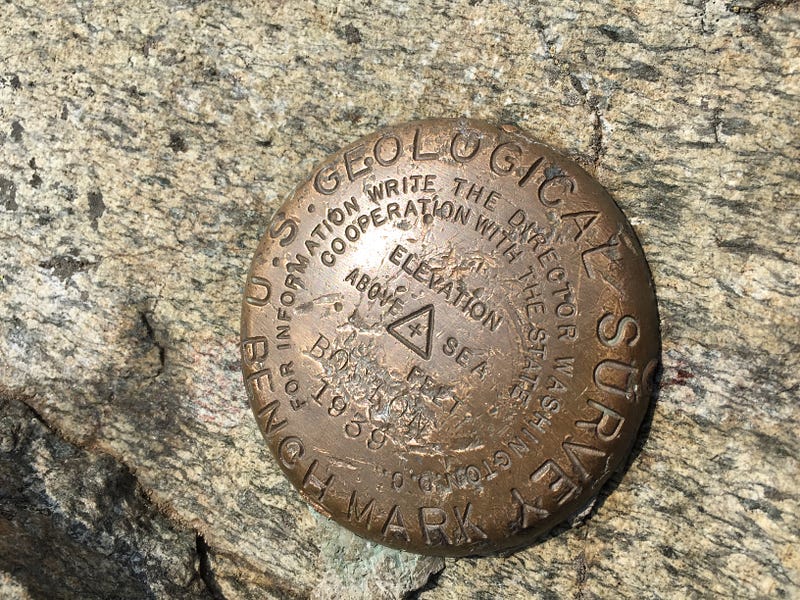
My next encounter with second-degree fun was brief but illustrates how second-degree fun can sometimes be a precursor to extreme danger.
It was on my last graduation climb, this time a three-pitch rock climb to the summit. Everything went great until we hit the top. We were a four-person climbing team and another four-person team was climbing a different face. The rappel off the peak was much more streamlined on the face we climbed, so we agreed to join forces (and ropes) with the other group and all rappel off in sequence together.
Then, literally out of nowhere, thick misty clouds rolled over us and it began to drizzle. The wind picked up and the temperature dropped precipitously. We had left our packs at the foot of the rock climb and only taken light jackets and gloves.
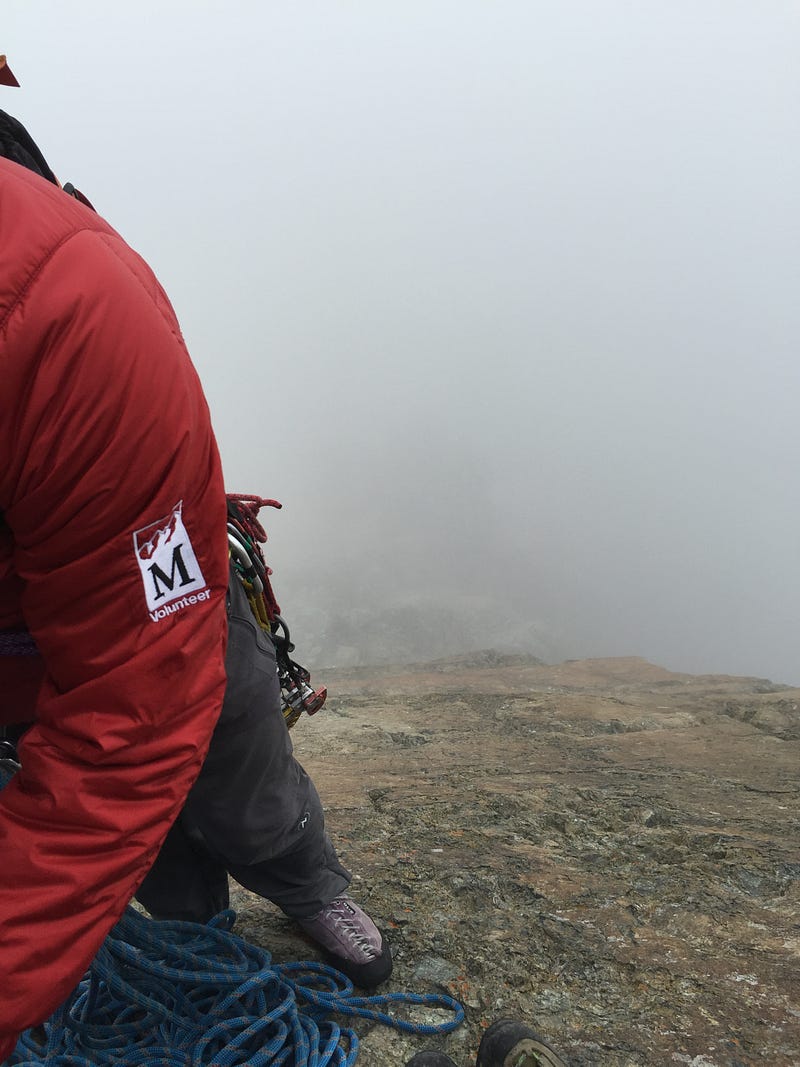
It got cold fast. We were exposed out on the peak and each second we stayed was miserable and agonizing.
Keep in mind that I was a firefighter at the time. I was literally a professional risk manager. I made life and death decisions as a matter of course in everyday existence. While the techniques and skills I learned in mountaineering were new, the concepts behind them were well ingrained. Safety factors, the importance of checklists, the significance of measured action, double- and triple-checking everything.
Yet, as I sat there on the edge of that mountain top, I was ready to skip through all the important safety checks just so I could get out of that wind and cold, and off that peak.
In the end, I won the mental battle with myself and safely — by the book — rappelled down to the first anchor point. From there we were out of the wind and everything went back to more of a first-degree fun version of mountain climbing.
But I never forgot that feeling of, “just get me off this peak.” That is where second-degree fun can quickly and easily become a story of tragedy.
So, my take-home points are these:
- Learn how to recognize situations of second-degree fun
- When you are in such situations, heighten your awareness of danger
- Don’t ever cut corners to get out of a second-degree fun situation — it could be deadly
- Know what you are getting into in the first place, and what your risk exposure might be
- Use your second-degree fun experiences to better prepare you for future outings
- Share your experiences with others, so they can benefit from your wisdom
Most of the time things don’t progress directly from fun to catastrophe. Generally, the road to disaster spends some time in a second-degree fun phase. Recognizing when and how things progress into this second-degree stage can help you avoid bad outcomes, and leave you safely recounting how much “fun” you had with your friends afterward.
If you liked this story, you may also like:
Timothy Key spent over 26 years in the fire service as a firefighter/paramedic and various fire chief management roles. He firmly believes that bad managers destroy more than companies, and good managers create a passion that is contagious. Compassion, grace, and gratitude drive the world; or at least they should. Follow me on Instagram, Facebook, and Twitter, and join the mail list.


