How I Landed 9 Interviews at Netflix in 2 Months
Here’s what I changed to be able to travel to Amsterdam to meet their team
Shortly after I obtained my Master’s degree from the Indiana University of Pennsylvania, I went back to the job hunt again. I am a seasoned Technical Sourcer, and I’ll land a job in no time — or so I thought.
However, when I stopped looking only inside my country and started applying for international jobs, magic happened & birds began singing.
When I changed the location of my search to become international, I had to change my approach as well. I couldn’t just dump my C.V. to any opening out there.
Preparation Process
My resolution for finding a new job was three central notions:
1. I am applying for the big and small companies alike.
2. I am applying for openings with at least 85% match to my profile.
3. I am applying with a customized C.V. per opening.
In a hope this may help someone out there, looking for a job and applying for openings, I’ll share the things I changed in my approach and how it helped me land interviews at one of my top companies to join.
If you need a more detailed, step by step guide on how to apply for jobs, check this 101 guide of how to apply and land jobs:
Application Process
My application to Netflix was the easiest, most straightforward approach. I didn’t even need to stalk recruiters on LinkedIn or via email. I applied, waited, and heard back in two weeks from the team, then joined them onsite in two months.
What significant changes did I apply to my approach? I:
1. Used the Job Description as my cheat sheet: I don’t use the same CV to apply to different jobs anymore. I have an open template with a basic layout, and each time I apply for a job, I change the vocabulary to use the same wording of the company. How can I know the terminology of the company? The job description is your ultimate friend. If they refer to ‘Customers’ as ‘Clients,’ then replace any ‘Customer’ word in your CV template to match the company’s vocabulary for that same word. Use terminologies used by the company in the required skills and qualifications sections.
Why do this? It will show that you already belong to the company and that you are familiar with their terminologies. This will make you sound more relatable.
2. Applied for the job that matched my skill set: I no longer apply for any job. I found a job that matched my skill set, and that’s when I applied. Thinking about it now, I never applied to Netflix before because I never found a matching opening.
Why do this? Eliminate wasted time and effort spent on doomed applications. This will save you from becoming a job search burned-out.
3. Connected with the seven hiring managers in advance: Before traveling to conduct my interviews, I sent a connection request over LinkedIn to the seven hiring managers I was meeting. I included a cover video of why I’ll be an excellent fit for the team, and I concluded with how enthused I was to meet them all shortly.
Why do this? Because most people don’t. It’s your chance to shine and stand out among the crowd.
4. Memorized the LinkedIn profiles of my interviewers: I knew whom I was meeting, so I visited the profiles of each of the seven of them. To be on the safe side, I took a screenshot of each profile. Before each interview, I would review the profile of my interviewers, understand the similarities, and decide the best opener line, and the ice breaker to throw if the interview went wrong.
Why do this? You always want to start strong in any interview. The best way to do so is to show your interviewer that you know about them and their career path. This will help you find a mutual ground, sound friendly, and look like a professional who did his/her homework in advance.
5. Memorized the Culture Memo: Since the culture memo seemed to be a big deal in the company, I revised it really well before traveling to meet the team and revised it again the night before the interviews.
Why do this? I used phrases from the culture memo in my answers. The target is, again, to sound relatable.
Interviewing Process
It’s worth mentioning that I interviewed for a different role than the one for which I applied. That’s the beauty of the Netflix team; even if your profile didn’t match the job you applied for, they would redirect you — if your profile is powerful enough to match another opening, they have.
This is the flow of how the Netflix interview process looked like:
1.First Screening call: a 45 minutes’ call with the Recruiter for the role. The call was direct behavioral questions from my real experience — no hypothetical scenarios of “what would you do if” questions existed at this point. This screening call made me fall in love with the culture immediately.
2.Written Assignment: I received a detailed scenario of a real task that I would do if selected for the role. The target was to assess the candidate’s way of thinking rather than the actual results. I was informed that I will need to discuss my assignment thought-process and results in the following screening call. The assignment complexity was Medium.
3.Second Screening Call: This call was conducted by a future-colleague who had the same title for which I was applying. An amiable discussion to explain how I tackled the assignment delivery, what was the thought-process, comparison of thoughts before and after the assignment delivery, and general findings. It was clear that the Netflix team was solely looking for how your brain handles tasks and what would ‘logic’ look like from your point of view rather than what certificates do you hold. The idea was that any skill could be taught if you have the right mindset.
4.Onsite Interviews In Amsterdam: I believe this part, for me, was the most surprising. Typically, the onsite interview phase comes later in the process, and full-honesty here: I never met any recruiter that was willing to sponsor a visa for a non-European applicant over the past year. Even for the remote roles, residing outside the European Union was always a deal breaker for the companies I applied for.
Netflix was the only company willing to invest in a foreign candidate generously.
And for that, they earned my respect and utter loyalty forever.
The Netflix Flavor
This is a taste of what the onsite interviews were like:
a) Beyond Thoughtful
When I was informed of my onsite interviews, I immediately received an email from the Pana team, a logistics facilitator dedicated to helping companies that are looking for superior travel and conferences’ logistics management. The company provides a hustle-free, strictly clear to navigate, and easy to follow up process.
Every little shred of detail was covered from travel to hotel reservations, including a note that was neatly left in my hotel room with sweet wishes for my anticipated interview:

b) Overly Welcoming
I had many interviews over the past two years. As a Sourcer myself, trust me when I tell you: there’s something different about Netflix people. I don’t know what it was, but they will make you feel like one of their own through the whole process. The only company culture that felt that welcoming to me was LinkedIn.
Normally, interviews at big corporations can be intimidating, especially for comers from startup culture. It went like a breeze!
c) Surprisingly Positive
When I walked to the Netflix office in Amsterdam, I was given clear directions on how the interviews would go and what to anticipate. It would be a sequence of consecutive seven interviews conducted by different seven interviewers. For me, this was an overwhelming realization that I would be locked in a chain of interrogations for an extended three hours an a half.
I was never happier to be proven wrong! Time went by like a charm, and Everyone was welcoming, kind, and sincere. It was more of a conversation rather than an interview. All interviews were conducted by employees onsite from the Amsterdam and London offices except for one Skype call towards the end of the day.
d) Culture Centric
If you have ever searched Netflix careers on LinkedIn or Glassdoor, you will always find a massive focus on the Netflix culture. The culture memo was always popping in my research in a way I haven’t witnessed before, even in companies that pride themselves for a diverse, inclusive culture. I was intrigued, and I read the whole memo, then I read it an extra two times.
The culture is unique in an intimidating yet intriguing way. To get a sense of what I’m talking about, read the company’s culture memo here.
e) A sense of Relief
You know how you usually feel after an intensive, exhausting interview: overwhelmed, tired, and drained. By the end of the Netflix interview marathon, I was feeling energized. It felt like visiting old friends in their new campus. The day before, I had a one hour interview with another company that felt like torture. Comparing the post-feeling of the two interviews was all I needed to realize that the overly preached Netflix Culture wasn’t a myth; it was in the air employees breathe.
What Can You Change NOW?
Each interview is a different project you need to prepare for well. Interviewing is both a consuming and draining process, so you need to strategize well for each interview you land. Use Glassdoor to collect data and revise interview questions. Refer to your interviewer website and social media for insight and knowledge. Do not enter the doors of your interviewing company unless you feel fully confident that you got this. What happens after is not your fault and non of your business, as long as you have done your homework thoroughly.
Goodspeed!
In Their Own Words
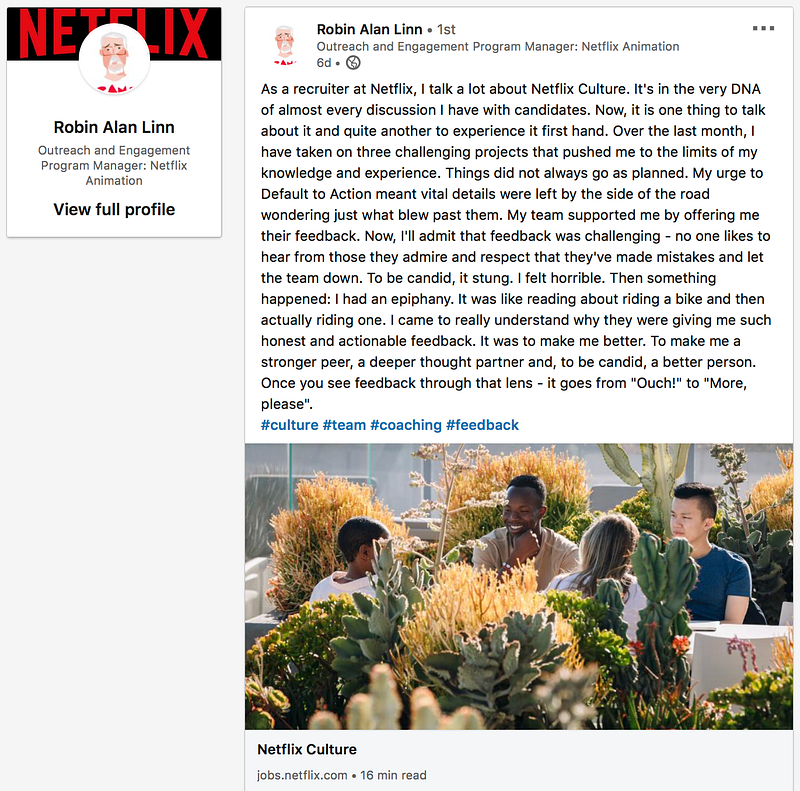
I am leaving you with words on Netflix culture from Robin Alan Lin, Outreach and Engagement Program Manager at Netflix: