
How I Keep a Commonplace Book Inspired by Ryan Holiday
The time-tested method for storing your notes and ideas.
Reading is the most knowledge-inducing and life-altering thing a human can do. In fact, reading is the only way a single human being can experience life many times over.
A voracious reader could in fact experience multiple lifetimes, fulfill endless goals, visit endless worlds, and get a first-hand business experience from moguls and tycoons like Phil Knight, Sam Walton, and John D. Rockefeller.
I remember reading a quote from Galileo that compared reading to time travel and telepathy:
“With what admiration the reading of excellent poets fills anyone who attentively studies the invention of interpretation of concepts! And what shall I say of architecture? What of the art of navigation? By surpassing all stupendous inventions, what sublimity of mind was his who dreamed of finding means to communicate his deepest thoughts to any other person, though distant by mighty intervals of place and time! Of talking with those who are in India; of speaking to those who are not yet born and will not be born for a thousand or ten thousand years; and with what facility, by the different arrangements of twenty characters upon a page! Let this be the seal of all the admirable inventions of mankind.” — Galileo
Eventually, an avid reader will aim to use all of this information in a more productive way. In today’s world, they may choose to write a book, start a blog, write on Medium, publish as a ghostwriter, become a publicist, or point their abilities toward a marketing/advertising career.
There are many options, but the struggle many people encounter is finding a way to capture, organize, and otherwise apply all the information they are reading about. Unfortunately, with an endless supply of software, systems, and apps, today’s knowledge environment has made the process harder, not easier.
As a fan of the hardcopy book, I prefer to write out my thoughts using the time-tested pen and paper method. I do this when I journal, update my daily planner, reaffirm my goals, and when using Robert Greene’s notecard system. Finally, I combine all of this information into a commonplace book, a place for storing and securing all of this valuable data.
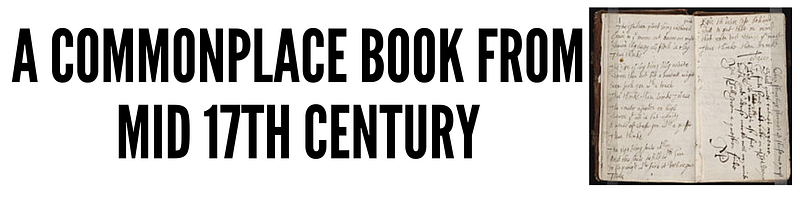
What is a Commonplace Book
I first heard of the idea from Ryan Holiday many years ago. However, a Google search would reveal a Wikipedia page that explains its use from times of antiquity and especially prevalent during the Renaissance period.
A commonplace book is exactly what it sounds like, a way (or place) to compile knowledge usually by writing information into notebooks. In essence, a commonplace book is used to store notes, ideas, maxims, quotes letters, and aphorisms, with the author’s ideas tying it all together. It can be organized by subject heading or by date, with the former being the preferred method for organizing main ideas.
It is the method that Ryan Holiday used to produce his 12 top-selling books. It is how Robert Greene writes one masterpiece after another. I prefer to give Holiday credit for the commonplace book because his article on how to create one inspired my use of the system. He is also a literary icon that I have admired for a long time, so it only made sense that I started to refer to it as “Ryan Holiday’s commonplace book.”
“A commonplace book is a central resource or depository for ideas, quotes, anecdotes, observations and information you come across during your life and didactic pursuits. The purpose of the book is to record and organize these gems for later use in your life, in your business, in your writing, speaking or whatever it is that you do.” — Ryan Holiday
It is also worthwhile to note that one of the most influential books of all time was most likely a commonplace book in its own right. Holiday mentions that Marcus Aurelius’ Meditations was a journal that he kept for himself. As the most powerful man in the world, he used this journal to retain lessons that kept him grounded in reality.
“When you arise in the morning think of what a privilege it is to be alive, to think, to enjoy, to love …” — Marcus Aurelius in Meditations
The opportunity to self-reflect also makes a commonplace book increasingly important in today’s fast-paced world and the reason I believe a good old-fashioned notebook is still the best way to start using one.
How to Create a Commonplace Book
- Gather information, notes, and ideas from as many sources as possible. The preferred method that has passed the test of time is to read books. You should aim to read a wide variety of books and genres, experiment with books outside your normal preferences, and explore as many book lists and recommendations as possible.
“We should hunt out the helpful pieces of teaching and the spirited and noble-minded sayings which are capable of immediate practical application–not far far-fetched or archaic expressions or extravagant metaphors and figures of speech–and learn them so well that words become works.” — Seneca
- Capture notes in the margins or keep a small journal for YouTube videos, courses, and podcasts. The goal of this step is to simply capture the information for later use. I use the Art of Marginalia to highlight important passages and to also note my thoughts and ideas while reading a book.
- Once you are done with the book or have accumulated some notes from other forms of media, transfer the notes into your commonplace book. Holiday uses the same notecard system that he learned from Robert Greene, which I also do with a slight twist. I prefer to transfer the notes onto a Google document and print it out. I use this printed document to produce the notecards and keep it all in a large binder that I use as my commonplace book.
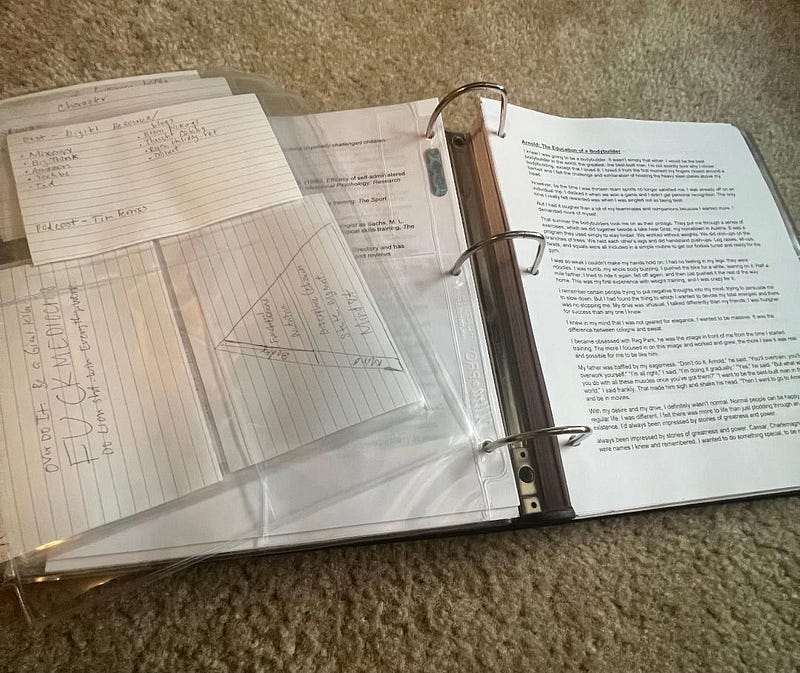
- I know the extra step may seem unnecessary, but I like the act of writing it down first, then transferring it onto a document. I like the document because it maintains a digital form of all of my notes and allows me to quickly search for something I read several years ago. The process of transferring it to notecards is the physical manifestation of making the information matter more.
- Lastly, stay on top of the process! If you let too much time pass, the books will pile up and the entire system will come to a screeching halt. Keep up with it, be consistent, and ensure that the task “transfer book notes” is part of your daily and weekly agendas. And don’t forget to apply the information in a positive way to push your life forward!
“Use them! Look, my commonplace book is easily justified. I write and speak about things for a living. I need this resource. But so do you. You write papers, memos, emails, notes to friends, birthday cards, give advice, have conversations at dinner, console loved ones, tell someone special how you feel about them. All these are opportunities to use the wisdom you have come across and recorded–to improve what you’re doing with knowledge passed down through history.” — Ryan Holiday
I reference Ryan Holiday’s piece that originally appeared on Thought Catalog here. If you are new to Medium, you can join using my referral link below. For just $5, you’ll get full access to all of my stories and publication on living a high-performance lifestyle.