
The Art of Marginalia
Marginalia is a simple concept, but if done correctly, it can become an expression of art for capturing information
The information for whatever you desire can be found in a book. Many of the most successful people in history have recorded their thoughts — they spent the time passing on their knowledge, successes, and failures, hoping others may learn from their example.
Books become instructional, philosophical, motivational, and inspirational.
Reading can be a catalyst for greatness only if you find a way to transfer the knowledge to action.
The process may seem simple, but simplicity is often the hardest thing to do consistently. We wander searching for novelty, thinking something more complicated will work better than reading, taking notes, and taking action.
However, committing to a simple, repeatable process will always trump an overly complicated system. This includes using technology, apps, or anything new and shiny.
“You have to make your own condensed notes. You learn from MAKING them. A lot of thinking goes into deciding what to include and exclude. You develop your own system of abbreviations and memory methods for the information.” ― Peter Rogers, Straight A at Stanford and on to Harvard
The process of taking notes, recording information, and taking action on that knowledge requires consistency. Simplicity promotes consistency. Thus, the decisive edge in how we take notes, read, and learn comes down to what is the most simple.
Mastery and Notetaking
The upward ascension to mastery, like notetaking, is an art.
It is a unique ability to turn knowledge into action. Not everyone can execute this simple task, making it a special gift. If it were easy, everyone would be taking action to accomplish their life’s goals.
To master the art of notetaking, you must become familiar with what prevents you from becoming better. You will be able to find what works best for you, what is simplest, and what you can do over and over again till you achieve mastery.
When you take action consistently, it becomes a part of how you approach your life. It is not an exact process and isn’t easy to test and measure.
The primary roadblocks with notetaking come in two forms:
- A system that is too difficult or complex.
- Constantly bouncing from system to system in search of the latest and greatest.
Ask yourself which of these are sabotaging your reading, note, and action-taking efforts. Commit to a simple system that you can repeat and stick with for the long term.
The Art of Marginalia
Marginalia, or the act of writing up the margins of a book, is a method of capturing the messages from the author and your thoughts.
It is the active process of reading, capturing, and then turning that information into action.
You can return to these markups to review what you have recorded. The best practice would be to transfer the markups to a commonplace book, which serves as an information hub for everything you read.
“But don’t just passively read. Make reading an active process. Make notes and comments to yourself as you read.” — Ryan Holiday
Robert Greene uses a very complex note card system that precludes every book he writes.
Ryan Holiday talks fondly of his commonplace book and how it enables him to capture overarching ideas. Many of these became the foundation for his books, including top sellers like The Obstacle is the Way, and Ego is the Enemy.
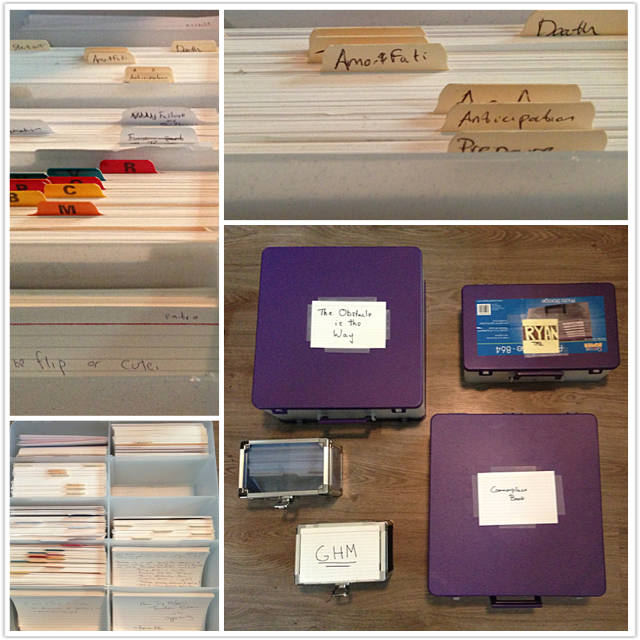
I adopted this principle but with a slight twist.
When reading, I circle central ideas and underline all of the supporting thoughts and ideas. I write other major ideas for a specific page on the top or bottom of the margins and use arrows to connect thoughts.
Once I finish a book, I transfer all of my notes onto a word document and print it out. I capture important ideas and concepts on 4 x 6 note cards, a practice I adopted from Greene and Holiday. I put the printed word document and the index cards into a binder that forms my commonplace book. It is different from Holiday’s and Greene’s shoebox full of note cards, but it is the method that resonates most with me.
The process allows me to transfer what I read into action — the only thing that really matters.
Before adopting this practice, I would completely forget everything I was reading. Instantly forgetting what you read makes the whole exercise pointless.
The main problem was jumping from system to system, hoping something new would excite me enough to take notes and take action. I now realize that I was just a pretender who read a lot but didn’t take action. I didn’t resemble any of the characters I was reading about. I wasn’t applying the information in any useful way.
Commit Ruthlessly
Robert Greene says that we should be ruthless. We should be relentless in our approach to life and deliberate with the actions that matter the most.
The art of marginalia requires a ruthless effort to ensure that every good idea and thought is captured for later use.
“We must create our own world or we will die from inaction.” — Robert Greene
Reading must become an active exercise. When reading a good book, I often stop and think about how I can alter my future actions and behaviors. I then start jotting down notes, marking up the margins of the book, and filling it with ideas, action, and things to do.
The process of change begins with a ruthless commitment to marginalia.
It doesn’t have to be a significant, life-altering change all at once. It can be something like the slight edge, where you make small daily changes that eventually lead to massive, noticeable gains. Start with a single book that captivates you and ruthlessly mark it up.
As you read the book, constantly look back and review the notes of the previous chapter and start to mentally connect the main ideas — work to mold those ideas into actionable steps.
When I read The Talent Code, I kept seeing a reoccurring theme of how people could build their skills and rise to the pinnacle of their field.
I used to think of talent as a genetic trait, a predisposed ability that we either have or don’t have. I was wrong, and talent, like greatness, can be built with consistent effort and a mastery of the process.
The Foundation for Greatness
“Not all readers are leaders, but all leaders are readers.” — Harry Truman
A quick look into history will reveal the reading habits of some of the most successful people. And most importantly, how their reading habits translated into enormous success.
Warren Buffet’s most important investment was a book called The Intelligent Investor.
George Washington didn’t receive formal education in leading an Army or starting up a government for a budding new nation, but he was a voracious reader.
Theodore Roosevelt was known for always having a book in hand and reading whenever he had a chance.
Napoleon’s meteoric rise to emperor is one of the most noteworthy in all of history. His secret was to out-read his competitors.
If you want to be great, then you have to read a lot. The art of marginalia gives you the decisive edge that turns that knowledge into action.
When you do it often enough, it becomes an art. This entire process, simple, powerful, and repeatable, leads to mastery.
This story contains affiliate links which means I get a portion of what you pay at no extra cost to you. If you are new to Medium, consider joining with my referral link below. For just $5 a month, you’ll get full access to all of my stories.
More from the author: