
How I Got Featured Next to Marketing Titans Like Amy Porterfield & Jenna Kutcher for $0
This is the smarter way to stand out on the internet.
I started my first business at 20 years old without knowing how to sell myself, develop attractive offers, or make a steady income. But I knew I didn't have much to lose, so I bet on myself, my discipline, and my willingness to learn.
For the first two years, I had no idea what I was doing or where I was going. I tried as many different paths as possible and failed at most. But I also celebrated unexpected wins like closing a 5-figure deal with a major client and publishing my first book.
After two years of trial and error, I had a clearer vision:
- I wanted to work online because I loved being time and location-independent. I love an empty calendar and working from home in my yoga pants. Plus, I like my own coffee best.
- I have always loved reading, learning, and teaching, so I wanted those to be my key activities.
- And I wanted to build smart systems to grow my business and income without constantly churning out new content or working harder.
So I started to learn from digital entrepreneurs who've built stunning communities and successful businesses, like Amy Porterfield and Jenna Kutcher.
I spent hundreds of hours with them by listening to their podcasts, observing their keynotes, and dissecting every word on their sales pages and emails.
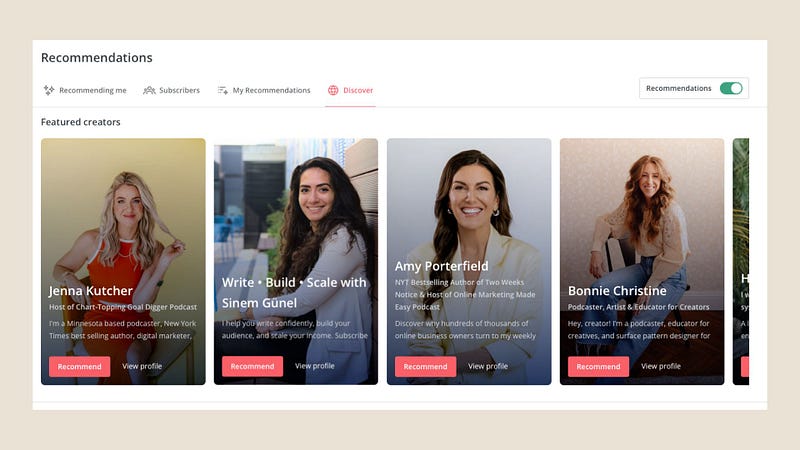
So when I saw my face featured next to them on Convertkit's recommendation page last week, my heart skipped a beat.
Granted, the feature itself was no surprise. It's been in the work for months, and I knew exactly when my profile would get promoted. But showing up next to Amy and Jenna was a pleasant surprise that made my younger self very happy.
Create what others can't.
I've been using Convertkit for email marketing since 2020, so when they announced a new recommendation system to help creators grow their audiences through free referrals, I immediately signed up.
A free and easy way to gain new email subscribers? Say no more!
Three months later, free recommendations were one of my strongest channels for subscriber growth. By now, I gained 5,000 subscribers through the referral system.
But I realized that most creators still don't know how to use referrals to their advantage. Many are even wondering if it's worth trying at all.
That's why I wrote an in-depth article about how I became one of the most recommended creators to share my experiences.
But I didn't just want to share my insights with my own community.
I wanted Convertkit to share it with their creators for two reasons:
A) I knew my insights were incredibly useful.
And B) I wanted to reach a new audience.
And I succeeded:
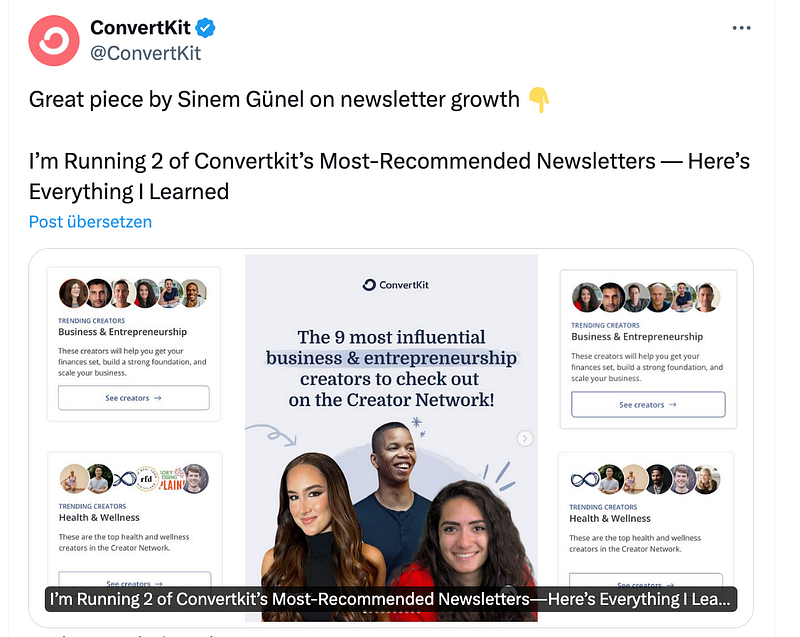
But that's not even the best part.
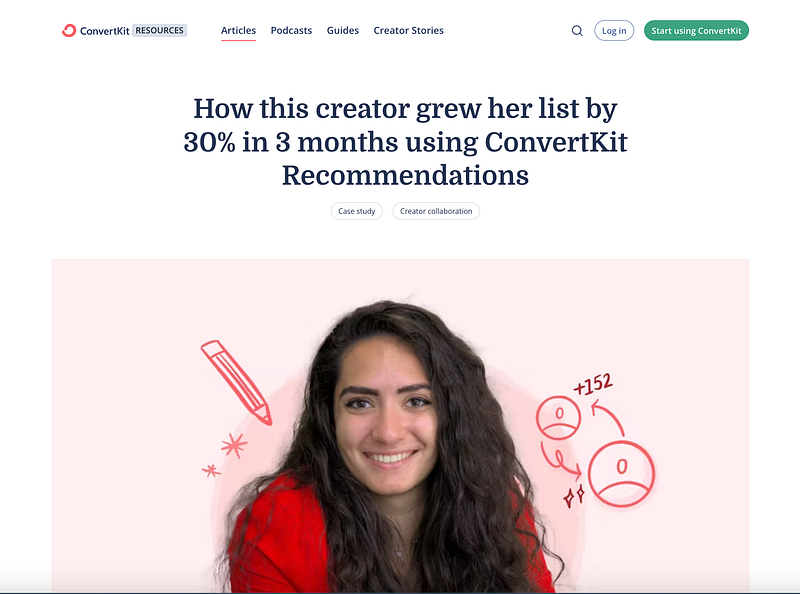
The best part is that my article led to a video interview and case study on Convertkit's blog:
Creating value isn't enough. You have to get in front of your target audience.
One of the most repeated and overrated pieces of advice for content marketers, creators, and experts is to provide value.
Easier said than done, right?!
The truth is, value looks different for different audiences.
A detailed technical guide can be as valuable as a funny video or a 5-line poem.
Value can be educational, inspirational, entertaining, emotional, and anything in between.
To create value, you first have to know who your ideal audience member is.
You need a specific niche and a clear value proposition so others know why they can trust you.
Next, you need to know how to get in front of your ideal audience.
I use various channels to grow my own audience and business:
- I write on Medium
- I run a huge Facebook group
- And I have an inconsistent YouTube channel
Despite covering several channels, there are millions of people who'll never come across my work. And I bet that's true for you as well.
That's why it makes sense to occasionally ask yourself where your ideal audience members are hanging out and how to put yourself in front of them.
Instead of writing about my experience with Convertkit's Creator Network and sharing it with my audience, I went the extra mile.
I pitched my piece to the Convertkit team, hoping they'd share it with their audience of thousands of creators:
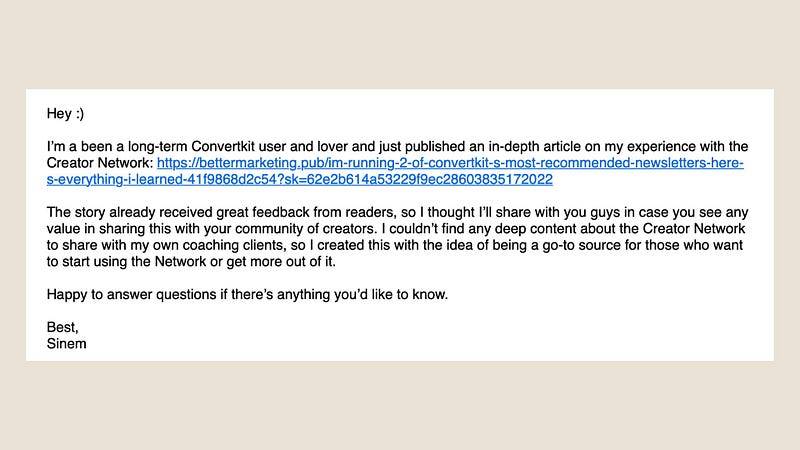
I was confident about this pitch for several reasons:
- I knew my article was valuable and relevant because I couldn't find any other deep-dives about the Creator Network and how to use it.
- By being one of the most recommended creators, I had proof that my strategy actually worked.
- The piece had already received positive comments from my audience, so I knew it was clear, engaging, and useful.
Why am I telling you these things again? Well, because those are the steps creators skip most often:
- They don't properly validate their content ideas.
- They judge their "success" based on vanity metrics.
- And they don't go the extra mile to put their work in front of the right audience.
When you're proud of what you created, you sometimes have to leave your comfort zone to promote yourself.
I totally understand creators who don't want to be too pushy, promotional, or salesy.
But the internet is loud and crowded. If you want your message to be seen and heard, you have to stand out.
And I'd much rather think about ten different ways to go the extra mile to share what I created than create ten more pieces of content and pray for the algorithm gods to make my content go viral.
Yes, you need to be consistent.
Yes, you need to provide value.
But that's what most creators do.
If you want to stand out or minimize your workload, you have to be intentional and smart about what you create.
To recap: I wrote about my experience with the Creator Network, but instead of stopping there, I contacted the Convertkit team through three different channels to get them to see my piece.
Not only did they end up sharing the piece with their audience and featuring me next to Amy Porterfield and Jenna Kutcher (YAY 🎉), but they also invited me for an interview.
And now, here I am, sharing the whole story through another article — very meta, I know.
There you go, that's creator flywheels 101.
Showing up is worthless if you constantly change how and where you show up.
The beauty of building an online business in 2024 is that you can grow fast.
I'm not saying you'll become a millionaire overnight, but you can come a long way within 6–12 months of showing up consistently.
Yet, showing up is worthless if you constantly change where you're showing up.
Most people are way too impatient and afraid of missing out on shiny objects. They start to create content on a platform but leave as soon as they hear someone saying that the algorithm has changed.
They spend a dozen hours creating a product but give up on it if nobody buys it within the first day.
Most podcasts never make it past three episodes.
And most newsletters die before reaching a hundred readers.
Building an audience and income online can be simple, but it's not easy.
For most, the biggest struggle is mental, not technical. They give up because they expect quick wins and magically growing paychecks.
In reality, being a writer/creator/expert requires you to show up for yourself for way longer than you want to.
I became the go-to expert in my niche within three years because I constantly showed up without changing platforms or paths.
My business model is stupidly simple:
- I write long-form content
- I invite my readers to join my newsletter
- I send weekly emails
- And I run 1–2 live launches per year to sell my paid offers
This simple framework allows me to make multiple 6-figure profits while working less than 30 hours per week.
I'm not creating content on Linkedin, Twitter, Instagram, TikTok, Pinterest, or any of the "next big things."
I stick to my core channels and focus on doing my job 1% better each time I publish, send, or launch.
You're constantly preparing for opportunities that don't even exist yet.
In the creator economy, every piece of content you publish, every email you send, and every connection you make can be a catalyst for massive opportunities.
You never know who's silently enjoying your work, preparing to offer you a massive opportunity.
And that's the tricky part: You have to keep going, even if you don't see those opportunities right now. But don't just go blindly.
Be intentional.
And don't be afraid to show what you create. As Austin Kleon writes in Show Your Work:
“Make stuff you love and talk about stuff you love and you’ll attract people who love that kind of stuff. It’s that simple.”
Granted, it's not always that simple. You might have to study platforms, distribution systems, and psychological biases to get your work in front of as many people as possible.
But Kleon is right: What matters most is that you talk about stuff you love. Or at least stuff that you genuinely care about.
Because if you don't care, why should your audience care?
AI tools can "generate content" within seconds. That's not what we're looking for anymore. There's an abundance of poor content being published every second of the day.
We're now looking for personality, community, and human connections more than ever. It's all about creating content that's not only worth consuming but worth sharing.
If you're not proud of sharing your work with your friends or family, your audience might not be proud of sharing it either.
But every share is a seed for future opportunities.
Do what you find exciting.
Do what you're good at.
I fell in love with writing because I found it to be the simplest way to share my thoughts with the world. Plus, I'm way too lazy to wear pants or makeup to shoot fancy photos or videos every day.
I found my thing by trying many things that didn't feel right. And so will you. Just make sure you don't get discouraged when things don't work out immediately.
Get out there and share your voice with those who need it — and do it until you get featured next to your heroes.
Hi. 👋 I teach you how to share your story with the world, build an audience, and make money online. Sign up for free & start now.