How I Got a French Visa as a Remote U.S. Worker (Part 2)
Here are the documents you will need to get this visa

So if you’ve read Part 1 of How I Got a French Visa as a Remote U.S. Worker then you know that even though the language on the website makes it sound like digital nomads/remote workers aren’t eligible for this visa, we are.
In Part 1 I go over all the initial prep you’ll need to do to start your application process and submit your French visa application. In this article I’ll cover what documents you need to get together for your interview, and what to expect at your appointment.
For starters, here’s the document list the French visa website provides when you submit your application:
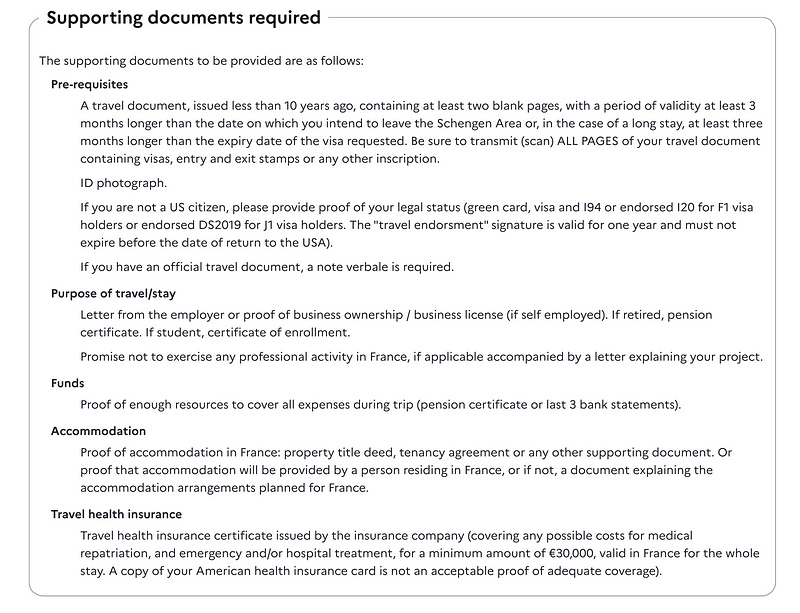
Then, separately, there’s another list they provide you at the end of your registration receipt:
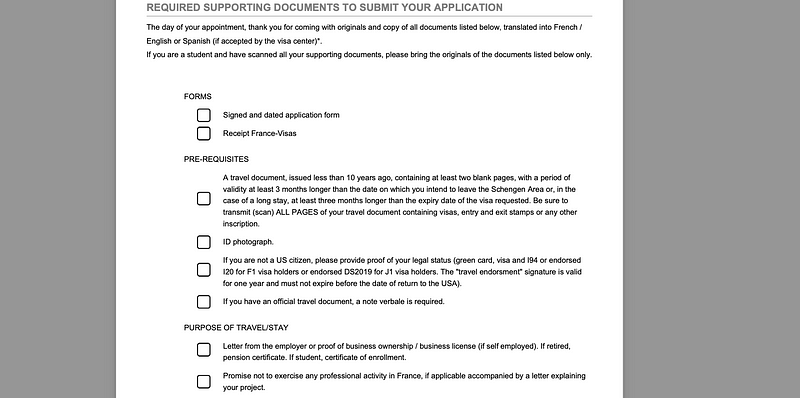
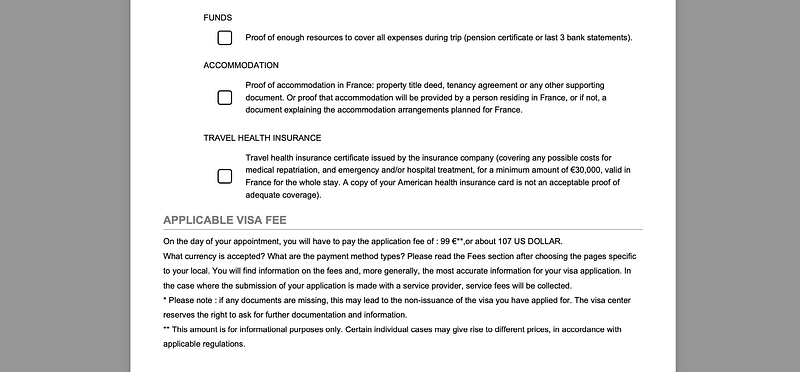
For some of these items, you will need more than one document.
Also, they will ask you to come with two copies of everything.
I did this, and then they took only one copy, told me to keep my other copy, and then photocopied my copies. *Shrug.* It’s probably still worth bringing the two copies they ask for.
Here’s the breakdown of what I brought for my French visa interview:
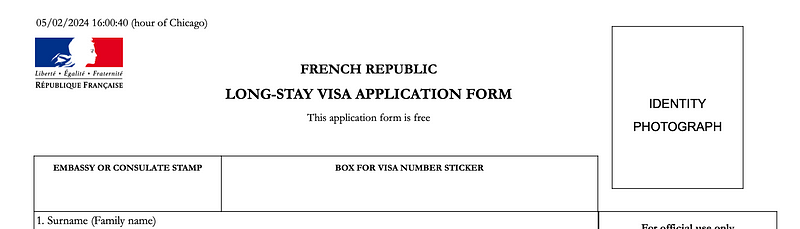
1. My signed and dated application form
That’s the document that looks like this at the top:
How do you get this? By logging into your visa application portal at https://application-form.france-visas.gouv.fr/ and clicking on the magnifying glass next to your application form.
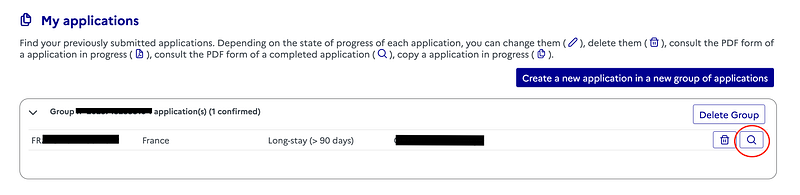
You’ll note that at the end of the .pdf that you receive when you click on the magnifying glass, you’ll also have your registration receipt. This satisfies the second checkbox (“Receipt France-Visas”) pictured in “Screenshot of page 1 of required documents” above.
2. My passport and copies of my passport
Note that the language here is:
“A travel document, issued less than 10 years ago, containing at least two blank pages, with a period of validity at least 3 months longer than the date on which you intend to leave the Schengen Area or, in the case of a long stay, at least three months longer than the expiry date of the visa requested. Be sure to transmit (scan) ALL PAGES of your travel document containing visas, entry and exit stamps or any other inscription.”
I had no other visas so I just copied the interior page of my passport with my photo image.
3. Passport photos
I actually did not bring these — I paid the extra fee for VFS to take them on site. But I’m mentioning them here because this is crucial if you didn’t sign up for this add-on during your VFS checkout process (explained in Part 1).
4. My signed and dated letter from my employer
This is key if you are funding your trip through your income — which most remote workers are! If you happen to be independently wealthy, you could leave it off your visa application, but in general, the more proof of funds the better.
Here’s the employer letter I used for my French visa application, screenshotted below:
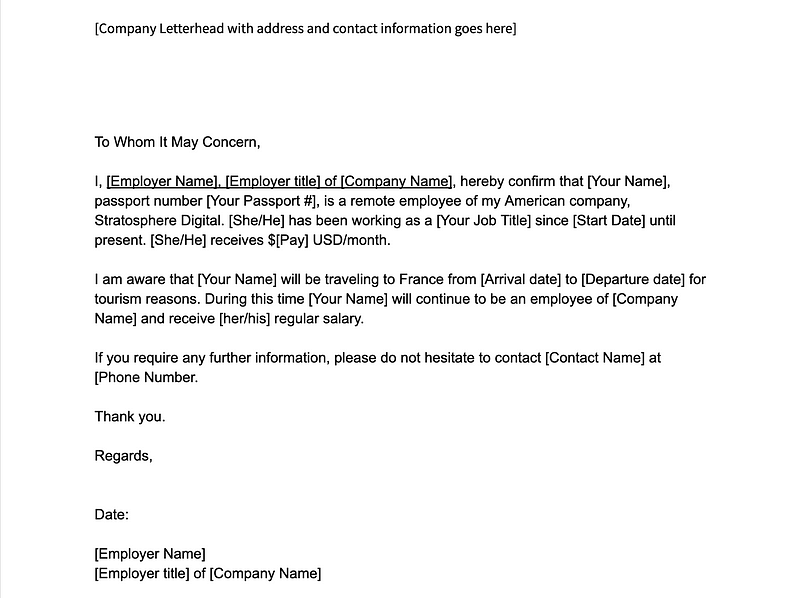
Remember that you must print this out, have your employer sign and date it, and make that obligatory second photocopy!
5. My signed and dated letter of promise not to exercise any professional activity in France
Totally contradicts my letter from my employer, right? Right. And yet, no problem!
Here’s the letter I used when applying for my French visa.
6. Proof of funds: bank account and brokerage account statements
I included three months of bank account statements as proof of funds, as well as one month of brokerage account statements.
Honestly, it might have been better if I’d included three months each for each brokerage account, but at this point I was tired of printing out paper, and between my job, my bank account, and my guarantor (see below), I felt I was covered.

7. More proof of funds: my guarantor’s letter
You’ll remember from section 1d of my Part 1 article that having additional funding sources is never a bad idea. In my case, I had a relative who was willing to sign a letter stating they’d provide me with up to at least $1050 USD per month if needed.
Here’s the guarantor letter template I used for my French visa application
8. Copies of my guarantor’s bank statements for the past 3 months
(I blacked out the account number)
9. Copies of my guarantor’s ID
I used my guarantor’s driver’s license for this — I provided a photocopy (well, two photocopies because I had two copies of everything) showing both the front and back.
10. Letter summarizing my funds and accommodation
This was not technically required for my French visa application process, but I wanted to summarize everything in a single document so that it was clear I more than satisfied the financial and accommodation requirements (for more details on the requirements, refer to section 1c. of Part 1)
Here’s the proof of funds and accommodation letter that I used.
11. My AirBnB receipts

I had booked one month with one AirBnB, but I noted in my Part 1 article, they ended up requiring me to book another 2 months of lodging in order to approve my visa application. This seemed to go against the requirements, but I wasn’t about to complain!
I booked a second AirBnB with a generous cancellation policy and just cancelled after receiving my visa, since I plan to rent somewhere more long-term after the first month, but want to see it in person first.
12. My travel insurance coverage receipt
I booked my travel insurance with Europ Assistance because it was the cheapest option I could find.
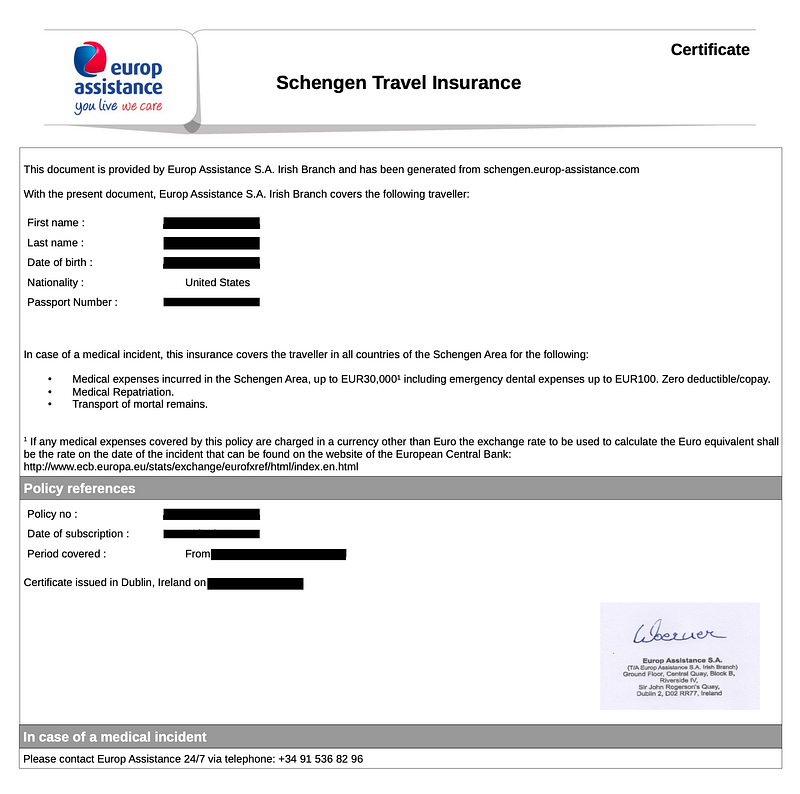
I paid 285.00€ for eight months. That’s 23.75€/month.
13. My French visa fee
This was 99€ or about 109 USD at the time of my visa application. I paid by credit card.
14. A final item
I had recently gotten divorced, and as a result, my name had not yet been updated on all my accounts. Because of this I also included a copy of my divorce decree showing my name change and a statment of explanation.
It’s very unlikely you will need to do this, but an example of the kind of additional documentation that may be necessary for unique circumstances.
What I did not need:
I had brought copies of my credit card statements. They didn’t want these. I’d brought copies of my flight receipts. Again, they did not want these.
And of course, they did not want my second copy of anything, even though I’d been told to come with two copies of every document. Still worth following that instruction, in my opinion, just in case.
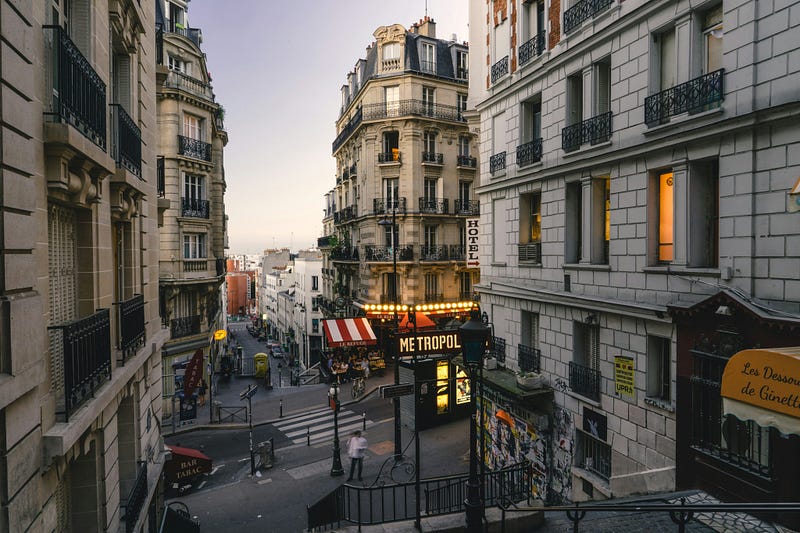
What to expect at the interview for your French Visa
Remember, the interview is conducted by a company called VFS, which takes your documents and submits them to the French embassy in Washington DC.
Arrive early, but not too early
Arrive early because you’ll need to find parking. (And when you do, pay for 2hrs to be safe.) Don’t arrive too early because they won’t let you into the waiting room if you arrive more than 15 minutes in advance.
I did my VFS interview in Chicago since it happened to be most convenient for me at the time. My appointment was at 12:30pm, and I was instructed by my appointment letter to arrive no earlier than 12:15pm. This turned out to be good advice since I ended up waiting in the waiting room until 1:45pm before I was even called up.
The actual interview
Once I was called up, the French visa interview went quickly. I shared all my documentation, answered a few questions that my documentation already answered, and then waited for the representative to make photocopies of all my documents.
After this I paid, and then was directed to a room where they took my photo.
I then waited some more, and then was directed to another room where they took my fingerprints and then took another photo.
Almost exactly two hours later I was free to go!
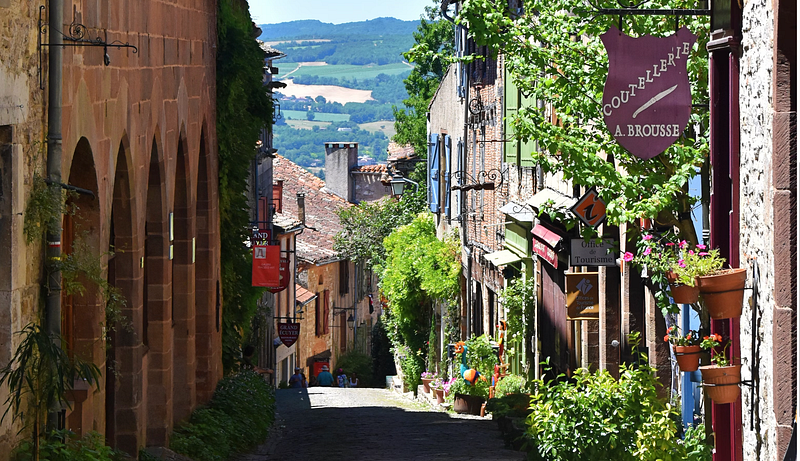
The waiting game
The VFS French visa representative told me their average turn around process was two weeks. Sure enough, almost exactly two weeks later I received my French visa in the mail!
Note that at the end of the first week I also received an email from the French consulate asking me to show proof of accommodation for each of the first three months of my visit. This is when I booked the AirBnB with the generous cancellation policy for months 2 and 3, and submitted that receipt along with the original receipt for month 1 that I’d already submitted prior. When I received my visa, I cancelled the second AirBnB.
What about when I get to France?
I received a year-long VLS-T visa. This means I do not need to do anything when I get to France — no validation, nothing. I’m free to remain in the country for a full year, after which I must depart. The downside is that I’m not on the path to French citizenship.
It may be possible for me to get a VLS-TS visa by applying for a longer-than-a-year stay, but that remains to be seen. Until then, I’m going to enjoy my time in France — from bakeries to beaches!