
How I Got a French Visa as a Remote U.S. Worker (Part 1)
Here’s what I did, step-by-step, with screenshots

Ok, so first off, the language on the official French visa website makes it sound like I — a remote American employee — should not have been able to get this visa:
“ You must also formally agree not to engage in any professional activity during your stay in France.”
(Source: France-visas.gouv.fr)
When I first read that I figured “Ah well, I guess I can’t do it then.” And I had also read a bunch of stuff online that seemed to corroborate this: “There’s no digital nomad visa for France,” “You can’t work remotely in France,” “You can’t get a long-stay visa as a remote American employee,” etc., etc.
But we can. How do I know?
Because I just did.
I just applied for and got the Tourism/Private Stay long-stay French visa as a U.S. remote worker. And yes, I was 100% transparent about my employment situation.
If you are a remote worker/digital nomad with an American company you are eligible for the long-stay tourism visa.
(If you are a remote contract worker this is likely true for you too!)
Additionally, every person I met in person who, like me, fulfilled all the visa requirements and who applied for this French visa as a remote worker has also gotten it.
Meanwhile, every accountant and lawyer I encountered said it shouldn’t/couldn’t be done. My guess as to why the bureaucracy and the reality don’t match?
1.) The law was written before remote work was a thing.

I guess that the intent behind the statement “not to engage in any professional activity during your stay in France” is that France doesn’t want you to engage in any professional activity with a French employer.
In other words, they don’t want you to in any way take work that might otherwise be given to a French person. (There’s a separate visa for that situation with a whole bunch of stringent requirements.) But they’re fine with you coming over and injecting their economy with your cash!
2.) It’s France.
They aren’t going to go out of their way to update an old law just to make things easier for tourists. After all, they have implemented laws to make places like Paris and some other areas less overrun with tourists!
So how did I get my French visa as a remote worker from the United States? Here’s what I did, and what you’ll need to do:
1. Line up everything you will need before applying for your French long-stay visitor’s visa
To fill out the visa application, you‘ll need to line some things up first.
a.) Figure out when you plan to go to France
This is key because you can only apply for your long-stay tourist visa between 2 weeks and 3 months before you depart for France.
I recommend erring on the earlier end of that window: the VFS office I went to for my interview told me it takes an average of two weeks, which means it can take longer. Also if you’re like me, you’ll want your visa sooner so you can use it to line up other things before you go, like a French bank account. I applied just under two months before my departure date.
b.) Get approval for your trip from your employer
If you are a remote employee, this is crucial because eventually you will need a letter from your employer (more on this in Part 2) stating that you have permission to be in France and that you will continue to be on their payroll and receive $x per month.
If you are a contract worker, I’’m less certain of the details, but I believe you would want to use your contracting agency in the same way as an employer here.
In theory, you can apply for the French long-stay visitor visa without this if you have enough funds in your bank account. (Details on the funds the French government wants to see are covered in the “accommodation” section below.)
c.) Figure out your accommodation plans in France: this determines your financial requirement
This is awkward, because how could you possibly line up accommodation for six months or a year when you don’t even know if you’ll get your visa?
Here’s the deal: you don’t need to book everything in advance, but for every month you do have accommodation, you are required to have fewer funds.
Here’s what the French visa website says:
“If you are staying in a hotel, you will need to provide a hotel booking as well as a minimum amount per day of stay that differs depending on the Schengen country visited.
For France, this amount is:
- 65 euros per day of stay in the case of presentation of a hotel booking;
- 120 euros per day in the case of non-presentation of a hotel booking;
- In the case of a partial hotel booking: 65 euros per day for the period covered by the booking and 120 euros per day for the remainder of the stay.
If you are hosted by an individual, you must provide a certificate of staying with a relative validated in the town hall at the request of the person who invited you (note: at the border crossing you must also prove that you have, in addition to this certificate, a minimum amount per day of stay — this minimum amount is €32.50 per day).”
(Source: France-visas.gouv.fr)

In other words, the French visa office will use your accommodation plans to determine how much money they need to see from you (in accounts or through regular income) in your application file.
So if you want to stay 8 months and have no accommodations booked, the French will want to see that you either have or will earn 244 days * €120/day = €29280 for 8 months.
I booked an AirBnB for the first month and then left the other months open. I had the necessary income to cover my trip with only the first month’s accommodation paid for, and, I wanted to wait to find a cheaper long-term apartment once I was in France (I didn’t want to try to rent an apartment sight unseen).
However, once I submitted my visa application, the French consulate emailed me asking to see proof of accommodation for the first three months. This wasn’t in line with the requirements, but there was no way I was going to complain. Instead, I immediately booked another two months with a different AirBnB with a generous cancellation policy and sent them the receipt. (I have since canceled the second AirBnB.)
d.) Line up additional funding if possible
It’s always good to show more funding than you need.
One way to do this is to see if there’s anyone who will sign a letter of financial support for you. I know one woman who used her American partner; I was able to use an American relative.
Your additional fund's person will eventually need to sign a letter stating that they will, if needed, support you with at least $1050 per month (more on this in Part 2).
This person will also eventually need to provide 3 months of bank statements and copies of their photo ID (driver’s license or passport), so you’ll want to make sure they are comfortable doing that.
On a different note, if you want to move more money into your bank account, you’ll ideally want to move it three months in advance so you can show a more stable balance over some time.
e.) Determine which VFS office you want to schedule your interview at and how you will get there
France, like many countries, has outsourced their visa interview process to a company called VFS Global.
In most cases, it will make sense to go to the VFS office nearest to you for your visa interview. However, there are exceptions.
Why? Not all VFS offices are made equal!
VFS has offices in Atlanta, Boston, Chicago, Houston, Los Angeles, Miami, New York, San Francisco, Seattle, and Washington.
And you can see here that Seattle has, for example, some of the most restrictive interview hours, which means they may not have an opening for you when you need it:
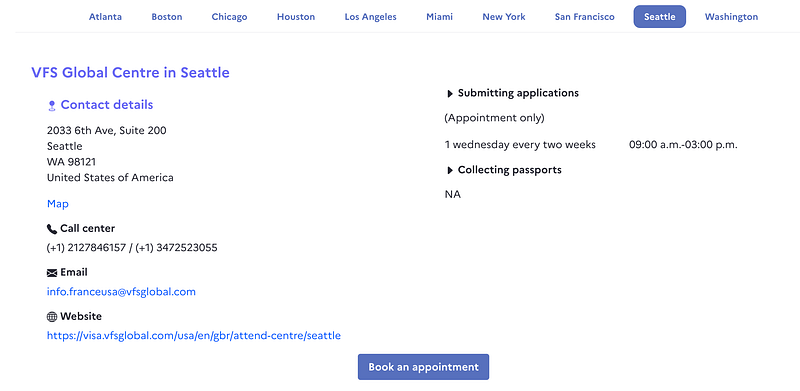
So what can you do? Pretend to start the VFS online application process by clicking “book an appointment” NEEEDS ATTENTION (but don’t actually finish it — you can’t) before you start your French visa application. This will allow you to see whether the center you want to use has appointment slots when you need them:
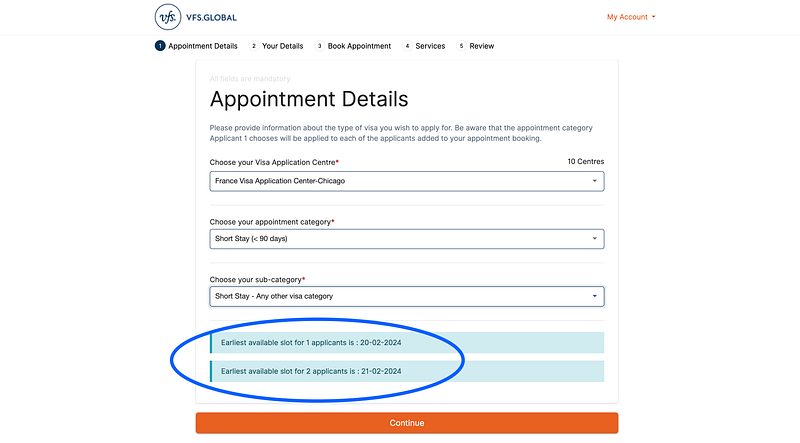
I used Chicago since it was easy for me to get to and they had openings within a week.
Note: VFS’s website is totally buggy and looks sketchy, but it’s legit. (The French Visa site explains how this process works here.)
2. Apply for Your French Visa Online
To do this, you’ll need to go to https://france-visas.gouv.fr/en/web/france-visas/online-application
Note that they have a list of things required in their sidebar:
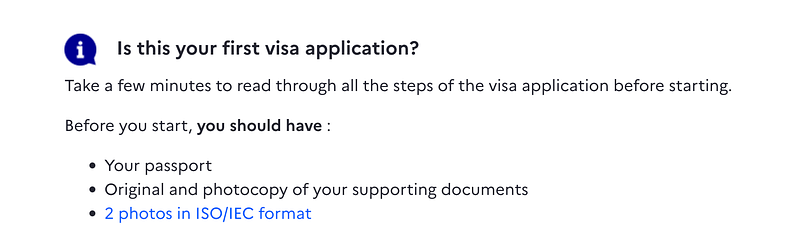
Aside from your passport, which you only need for your passport number, these are not actually required for the online application. However, you will need them (and more) eventually when you go to the VFS center for your interview in person.
a.) Create an account
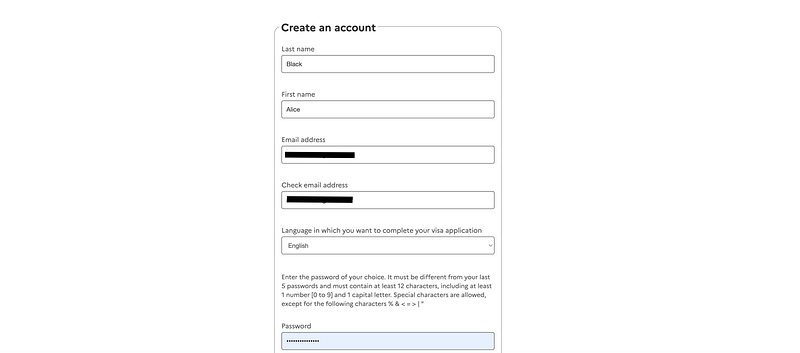
The site will then send you a verification email, and you’ll need to click “confirm mail.
b.) Create new application
Click “create a new application in a new group of applications.”

c). Fill out your plans, travel document information, and purpose of stay
This is where your VFS office location research from step 1e comes into play!
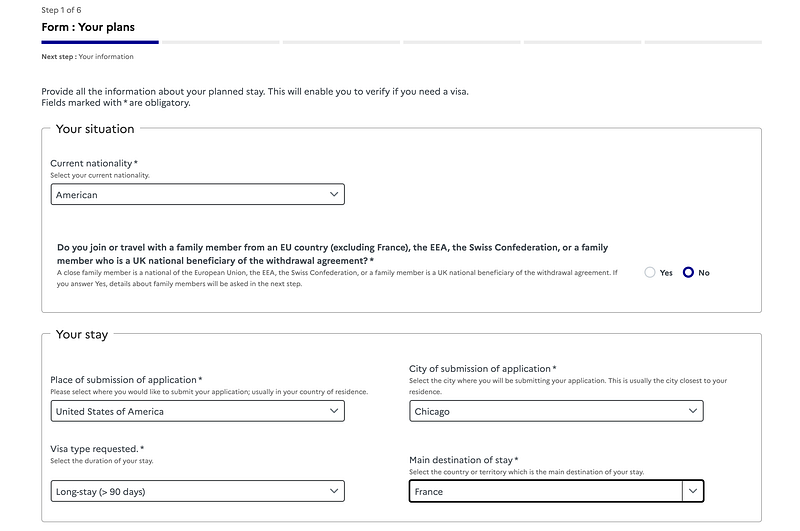
When filling out your plans, make sure to select “Visitor” and “Visitor (adult)” in order to apply to the French long-stay tourism visa.
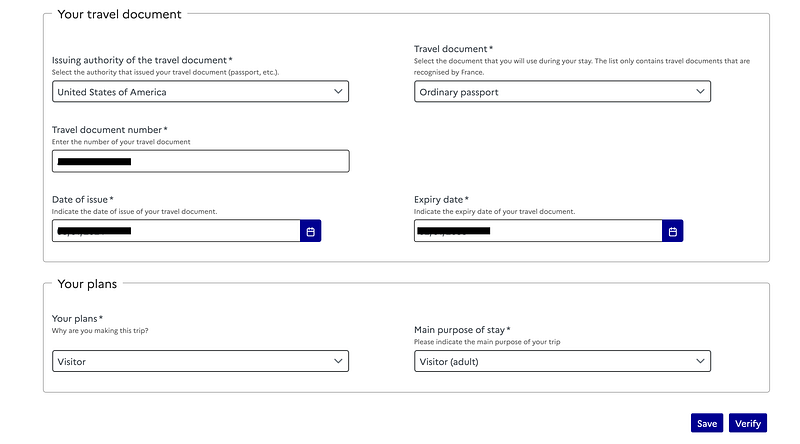
When you click “Verify” to move to the next step, you will be told (surprise!) that you need a visa:
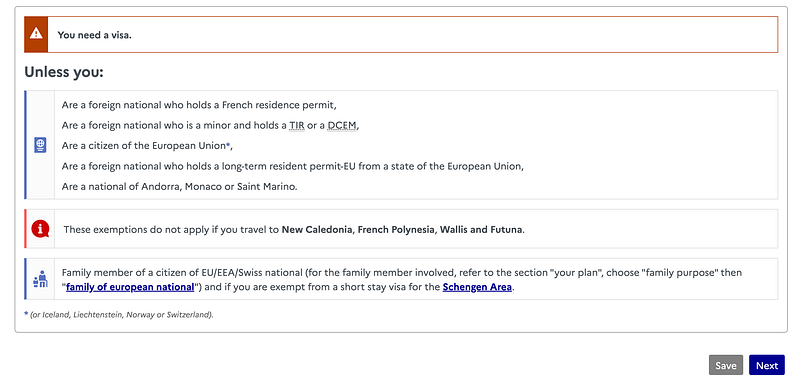
Very good, all is as it should be, carry on.
d.) Fill out your identity information, personal information, and family and employment information
Note that you will be asked to enter your “National identity no.” This is your social security number.
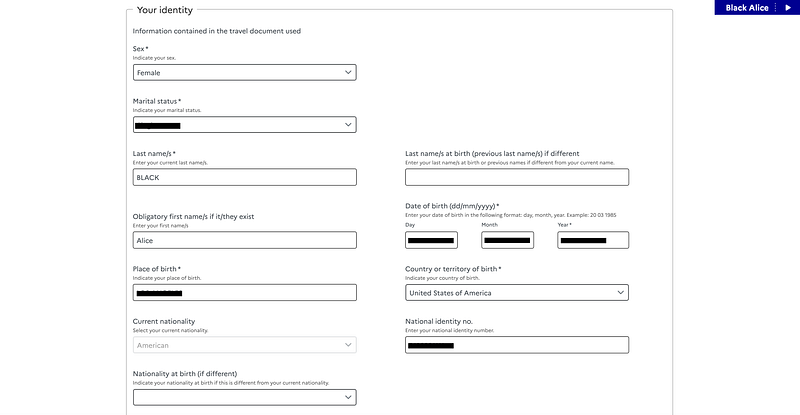
And I’ve left the below sections blank in my screenshots since that information is all personal:
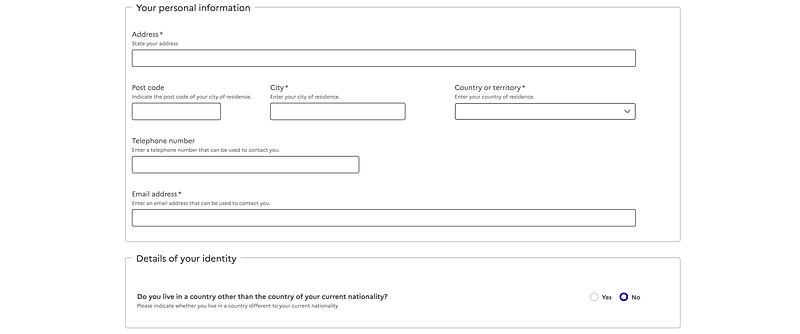
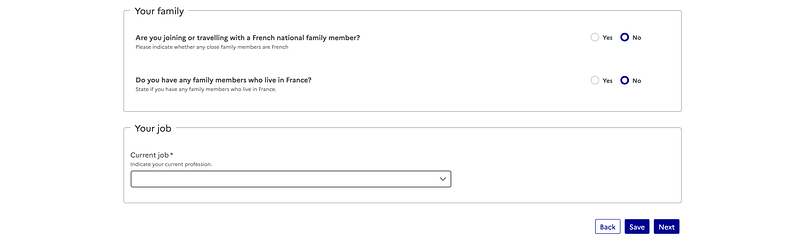
For the current job section, note that you’ll need to fill out your employer information (address, phone, email) as well.
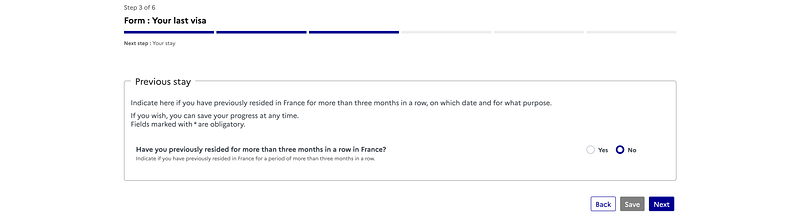
e.) Indicate if you’ve previously stayed in France on a visa
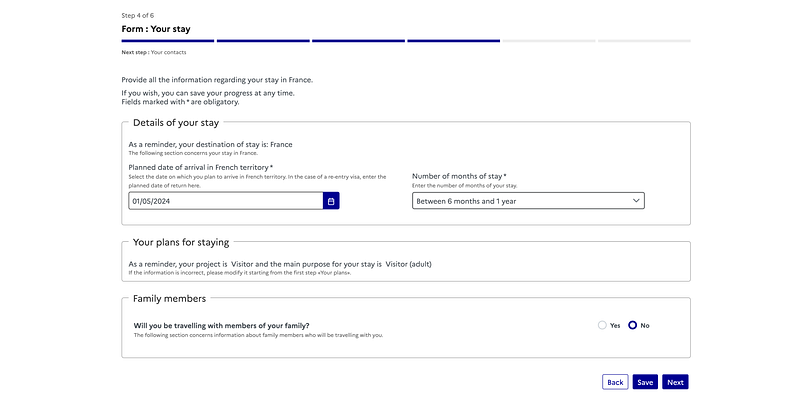
f.) Indicate your intended arrival date and length of stay
Here I would recommend putting “Between 6 months and 1 year” since the long stay visa is only issued in 6 months and 1 year intervals, and it gives you the chance to stay up to the full year if you’d like.
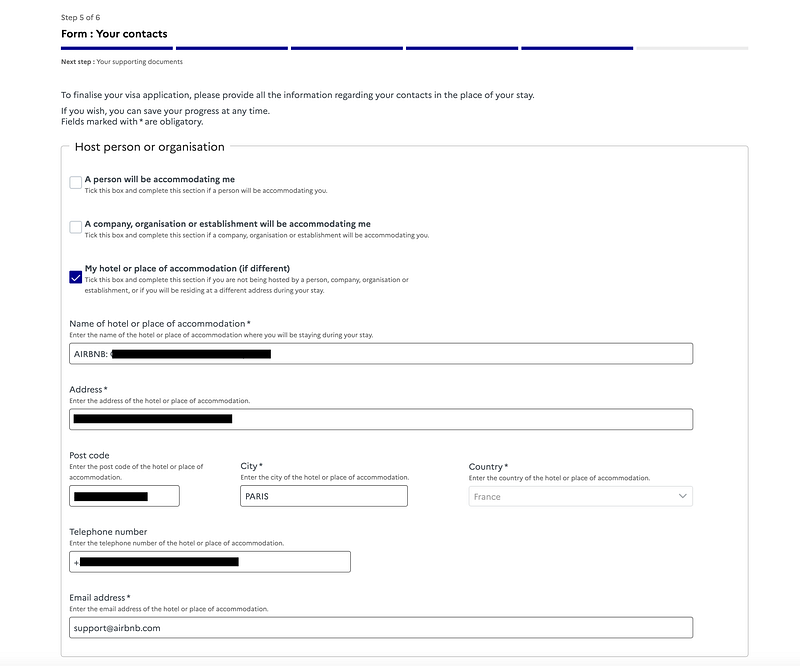
g.) Indicate your accommodation and your funding sources
For my “hotel name” I put AIRBNB and then the title of the listing. I also literally put [email protected] for the email since I did not have my host’s email, although I did have their correct phone number and address. I recommend using their actual email if possible.
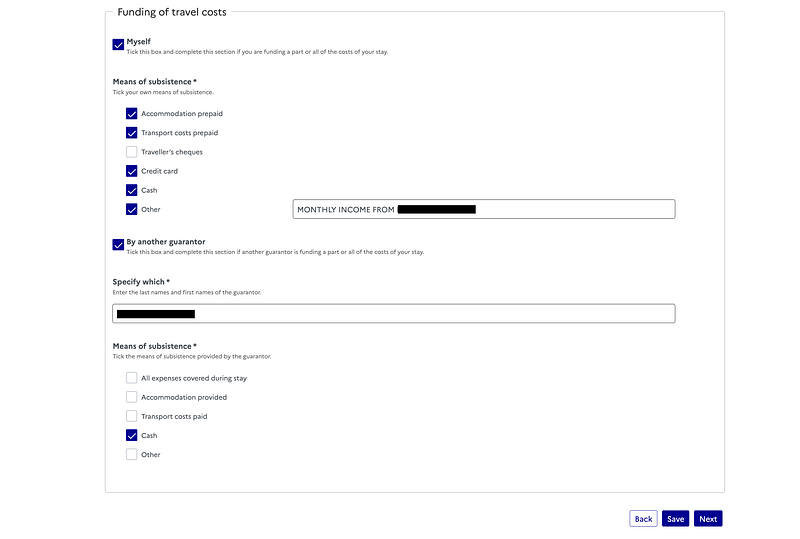
For my funding, I made sure to include note of my monthly income from my employer. This is also where I added the information about the relative who was willing to help support me if needed (see 1d).
e.) Make note of the supporting documents you will need
(More about these in Part 2)
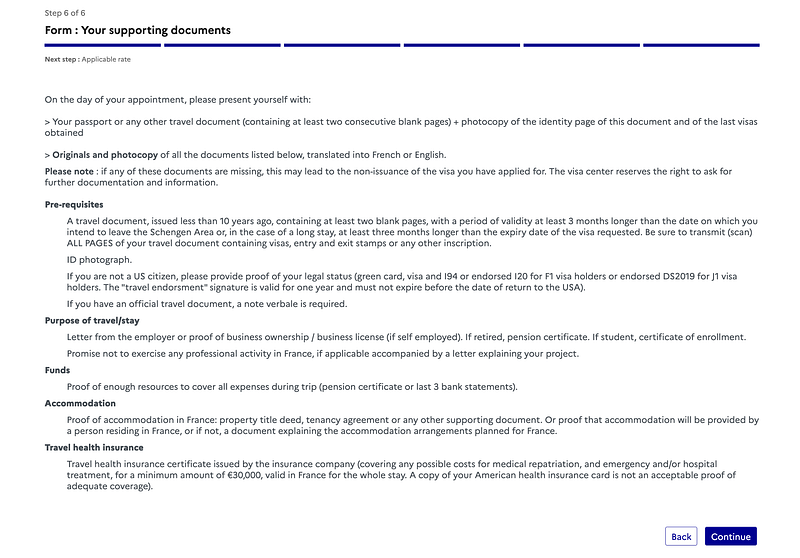
f.) Return to the applications main page, check the box, and hit “continue”
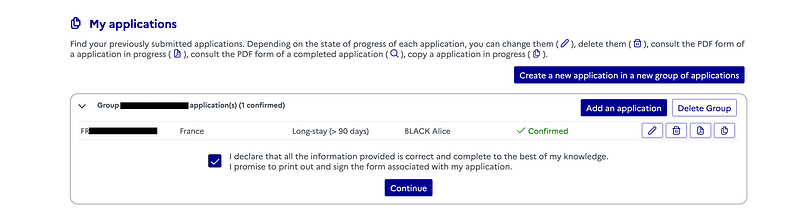
You will be asked to verify your information, and then you will be directed to the next steps for making your appointment.
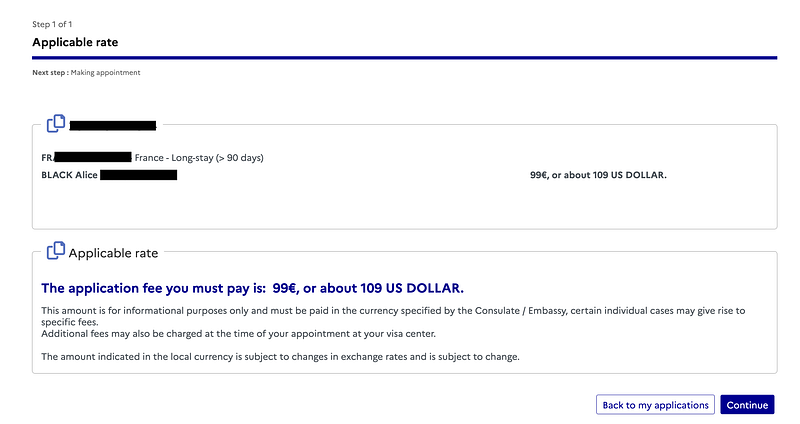
g.) Read the notice regarding the fee (you won’t pay this yet)
3. Go over to VFS and schedule your interview
At this point, the French visa website will direct you to make your appointment for your visa interview:
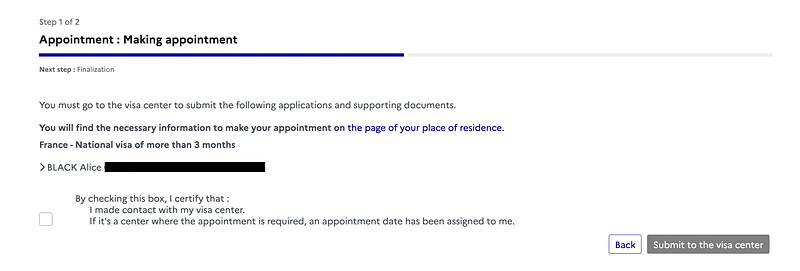
Here’s the link to use to select the VFS office at your desired location and book your interview: https://france-visas.gouv.fr/en/united-states-of-america
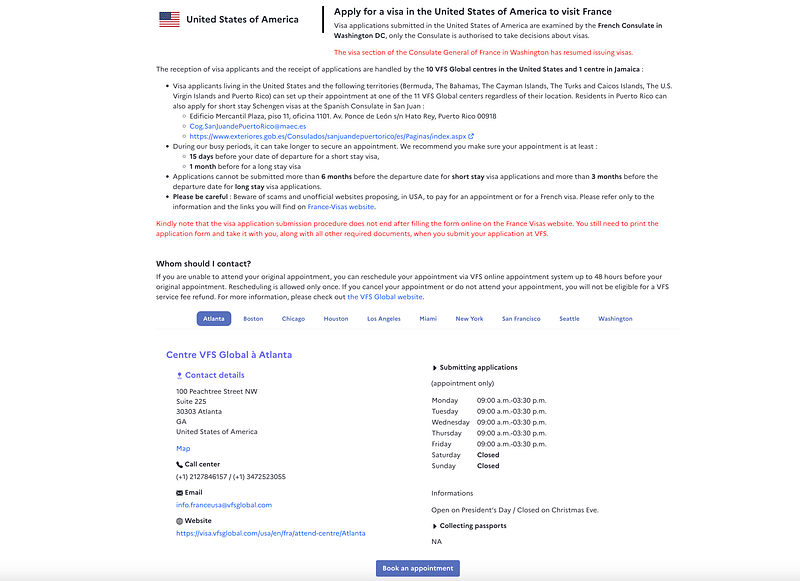
Remember to select the location you specified in your Visa application form (2c)!
a.) Complete the VFS interview application and pay
I’m not gonna lie: this is an subpar user experience.
Not only does the whole VFS site look and feel slightly like a scam, it tries to upsell you with additional (often unnecessary) services every step of the way. Furthermore, the VFS site actually timed out on me partway through (there was no way to save along the way), and I had to start over.
I’m not going to guide you through this one because I didn’t take screenshots the first time around and I hate this site so much I’m unwilling to dive back into it. :-P
But, once you’ve selected your location to book with, this is where you go to begin:
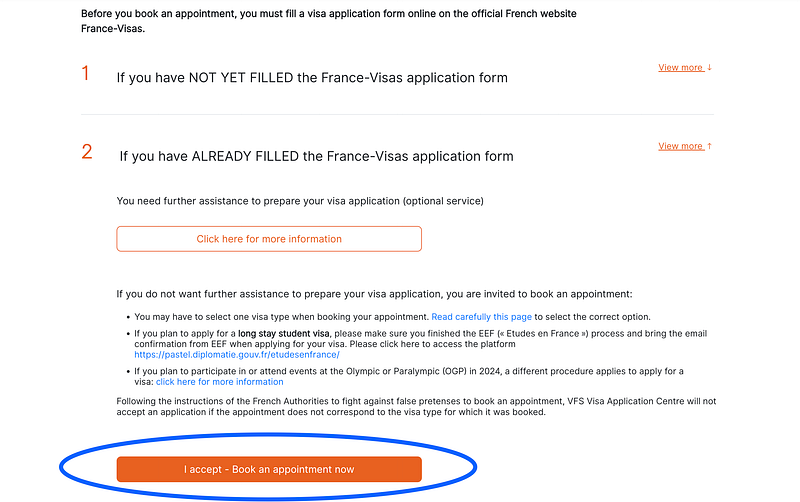
Some things to keep in mind throughout the process of booking your interview:
- The visa interview process will take longer than you think. I had a 12:30pm time slot. I sat in a waiting room and waited to be called for over an hour. The actual interview, biometric data process, etc. took about 40 minutes after that. Book your time slot accordingly.
- You will want to give yourself time before your interview to gather and print all the documens you need. I gave myself two weeks which felt like the right amount of time for me.
- You probably do want to pay the extra fee for your visa and all other documents to be returned to you by mail.
- You will need to pay VFS when scheduling your interview. This is a separate fee from the French visa fee that will be collected at your interview.
4. Return to the French Visa website and submit your visa application
Once you’ve booked with VFS, you’ll then return to this page:
Click the checkbox, and then click “Submit to the visa center.”
I’m not showing what happens after you click submit since these screenshots are from a dummy copy of my original submission, and I don’t want to submit for a second visa.
You’ll receive an email confirmation that looks like the following:
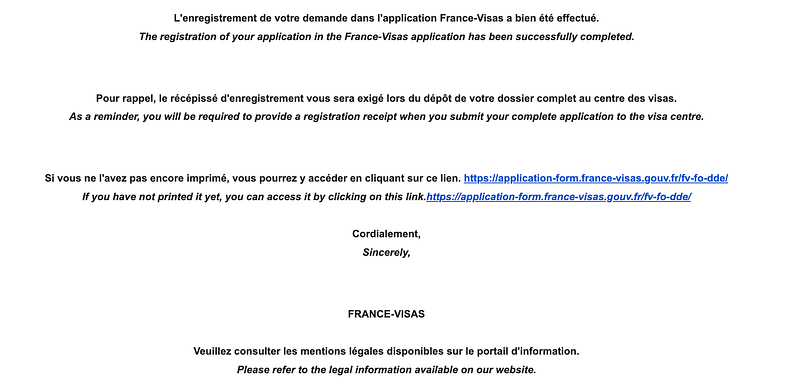
And clicking on either blue link will take you back to your application form, where you can click the magnifying glass to download your registration receipt.
In How I Got a French Visa as a Remote U.S. Worker (Part 2) I cover all the documents you need, as well as providing example templates that you can use!