
How I Forced Myself to Be Curated on Medium
Learn how curation works and how to motivate yourself when your articles are not getting reviewed for curation.

In the first seven days of writing on Medium, three of my articles got curated. As a beginner writer, I was overjoyed. I thought my writing clicks with Medium editors. A publication initially rejected even one of the stories which got curated later.
I was new to the writing world and had never published an article before. The initial success made me super motivated. I believed I could repeat the feat easily week over week.
Getting curated thrice in the first week of writing was amazing, to say the least.
However, my motivation did not last for long. The next two week’s outcome was utterly the opposite. I kept writing new articles but without any curation success. All the latest articles got stuck in the ‘We are processing this story. Hang tight!’ message.
With days passing by without a single article getting picked up for curation — it became increasingly difficult to keep me motivated. I started thinking the first week’s success might be just beginner’s luck. However, I kept doing what I thought is the right thing to do for the long term success — keep writing.
The result — two of my articles got curated on the same day. One of them got published by a prominent publication and immediately curated within a few minutes.
I went from not being picked up for review for continuous few weeks to get curated twice on the same day. During this challenging time, I learned a lot about the process. The hurdle enhanced my knowledge of writing techniques.
What is curation?
Curation is the process where a team of Medium’s editor reviews the recently published stories and selects those that meet their standard.
Once selected, the stories become eligible for distribution by Medium using various channels. Below is an excerpt from Medium’s FAQ page:
When a story is curated, it becomes eligible to be distributed to readers across Medium surfaces — on the homepage, on topic pages, in our app, in our Daily Digest newsletter, and in other emails — and shared via Medium’s recommendation system.
You can now understand why curation is a good thing for your article. Medium takes the responsibility of distributing the curated items to thousands of readers. The reach of your story gets multiplied. It is even more crucial if you are a beginner writer who does not have much social media presence.
Path to curation
As I mentioned in the intro, when you publish an article, it first goes into the ‘Hang tight!’ message.

As soon as it gets published, you can go to your stats page and click on the ‘Details’ link underneath your story. The resulting page will show you the message — ‘We are processing this story. Hang tight!’.
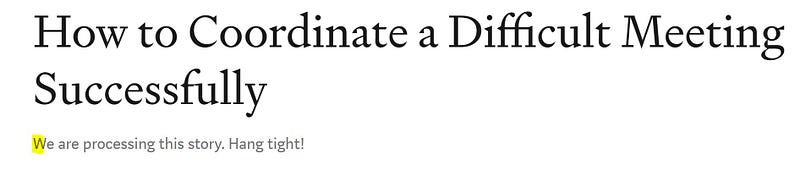
The above-shown message indicates that the story is not outright rejected by the curation algorithm — which is a good sign. Yes, the algorithm does reject articles immediately after getting published if it does not meet its standard. Most likely, no one, other than who coded it, knows what those criteria are.
From here, there are two possibilities — Either your article gets selected for curation, or it will get rejected.
If your article meets the high standard of curation, then it will be selected by the editors. You will get notified through email. You will also be able to see the categories under which your story is curated by checking the stats page.
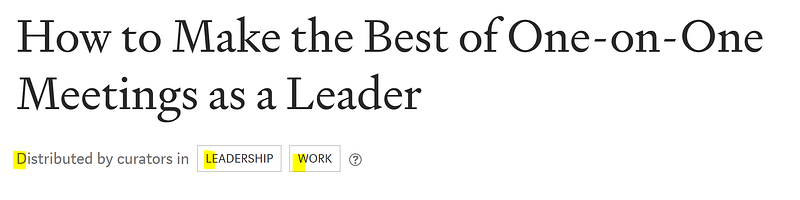
In case your article is not selected by the curators, then there will be no notification. You can check the status of the curation on the stats page. The message will now show as ‘Not distributed in topics.’.
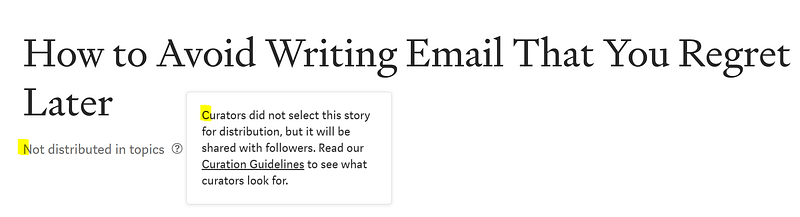
That’s the only way you can find out about the rejection in the curation process. There will be no feedback about why curators did not select it.
Well, there is a third scenario.
[Update: From 1.Oct.2020 the third scenario is no longer clearly visible to writers on Medium stats page due to UX changes made by Medium]
In the few weeks of not getting curated at all, all my articles remained in the ‘Hang Tight!’ message. It was neither getting selected nor rejected by the curators.
In Medium’s own words, the FAQ page about curation states —
Most stories are reviewed within two weeks.
As a newbie to the platform, I was curious to find out what happens to my article after two weeks from the publication date. Will the story surely get picked up for review within the two weeks? What if it does not? What happens next?
I found out that there is a third possible scenario.
After two weeks from the publishing date, the stats page for one of my articles showed the dreaded message — ‘Not distributed in topics.’.
I thought editors reviewed the article and did not like the content. But, to my surprise, when I clicked on the question mark next to the message, it did not show the standard rejection message.
Instead, it shows a message stating — ‘This story has been shared with your followers and may be reviewed by Medium curators for broader distribution.’.
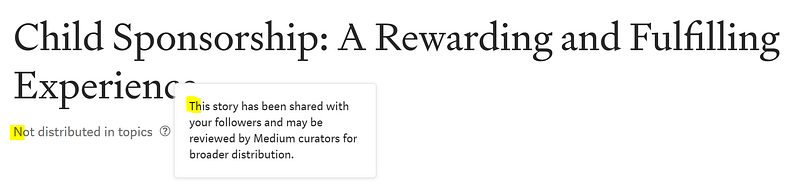
I tried to find more detail about it in FAQs and articles from other writers but to no avail. Over the next few days, many of my stories got into the same status message.
With more articles getting into this unknown territory of curation, I was able to establish a trend.
The common factor is that the articles were all exactly past 14 days mark from the date of publishing. So, I kept checking the rest of my published articles, which were pending for review.
I wondered if they meet the same fate when they reach the two weeks mark. And, it is true — once the 14 days period is over from the date of publication, the article automatically moves to the third scenario.
Now I have seven articles that are past 14 days period and marked as not distributed in topics. It has the comment — Medium curators may review it. As per various Facebook groups, many writers have faced this status for their articles. No one knows why it happens, but I have a theory based on my above findings.
Medium is getting a large number of submissions from writers. Many of them are good enough to pass the curation algorithm’s initial quality check. Hence, these stories are not getting rejected outright. In the next step, an editor needs to manually read and approve them to get distributed under specific topics.
Maybe the editors are not able to review the massive volume of pending items anymore within the two weeks of publication. Articles that are not getting the share of editor’s review time get bucketed under the third category.
I am not sure whether it is a good thing or a bad thing to be in this third category. I think it is certainly better than getting rejected as you still have hope of getting selected. Maybe when it gets considered, the editor might like the story and curate it. Some writers have received curation to their stories many months after publishing them.
How I kept myself going
I have no experience with the ups and downs of a writing career before. However, for weeks when none of my published articles got reviewed, I had to find ways to keep myself going. Giving up was not an option.
I did what I thought is the best way, and it worked great for me. Here is how you can also get yourself motivated when you need it.
1. Read articles of successful writers
I had followed many successful writers for the last two years when I was using Medium for purely reading purposes. I started scanning the platform for their success stories.
These writers have tried many different ways of writing for years. With experimentation, they have built their own style. They have found out how to make the readers come back to read their articles regularly.
There are a lot of great writing tips in these writer’s stories. Many have graciously shared their knowledge on how to achieve better success in curation. Also, please pay attention to their style while reading the articles. It will make you realize the different formats and techniques they are using in their writing.
2. Join Facebook groups for Medium writers
I joined several Facebook groups to learn from its group members. Medium Writing and Medium Writing Academy: Writers Mastermind is two such groups that have benefited me in my writing endeavors.
In these groups, people come together and share their experiences. They help each other to review and provide feedback on articles.
People get opinions regarding their titles and subtitles for yet to be published articles. Many writers post their daily success stories, which acts as a consistent source of motivation. There are so much positivity and excellent information on an everyday basis in these groups. All this kept me motivated to continue writing.
3. Keep writing
Even though my articles were not getting reviewed for curation, I continued to write every single day. It was quite hard to keep writing as the source of motivation was limited.
But I kept reminding myself — if I don’t write, I will have nothing to get curated.
It is difficult for me to write for long hours as I have a full-time job. I am passionate about my work, and I give on an avg ten plus hours a day to it. So, I have to wake up early to make some extra time for writing before I start working on my day job.
I committed to writing 600 words a day and stick to the commitment. It did not have to be a complete article. I just wrote whatever came to me on the topic I wanted to write. Many times it took multiple days to write all the words for an article. But with this habit, I was able to complete stories in two to three days.
When there is very little motivation, completing a five minutes article also helps to increase confidence.
4. Research your ideas
In my first week of writing, I wrote everything from my experience. I did not take any help from online for inspiration.
Reading through many ‘How to write’ articles on the platform, I learned that it is advisable to research the topic before writing.
You have many ways to present the same topic. There is a high chance that others would have already published posts on similar subjects. Hence, it is better to scan through those articles. Reading them will provide you with many different points of view on the same issue that you want to write.
With research, you gain more knowledge and perspective. You can then concentrate on what unique value you want to add on top of what is already written.
5. Pitch to prominent publication
Initially, I did not send my stories to large publications. I had convinced myself if I can get curated thrice in my first week of writing, then I don’t have to send my articles to the prominent publications. Deep down, I was afraid of rejection.
When my stories stopped getting reviewed, I had to devise more efficient ways to reach a broader audience. Curation is not the only way to do it. Publications with a large number of followers can bring in a reasonable amount of readers to the story.
If I don’t pitch to prominent publications, my articles will anyway not get published in them.
At least if I pitch and get rejected, the editors might provide their valuable feedback. I can use them to improve my writing. Hence, I started sending my articles to prominent publications with more than 100K followers.
I was pleasantly surprised when my very first article to ‘The Ascent’ got selected by the publication. Not only that, but the story also got curated within a few minutes of getting published. It was a fantastic feeling to get published in Ascent and also finally get curated. The same day another article, which was pending with ‘Hang tight!’ message, got curated.
Take away
I learned a lot during these few weeks. I am now more confident in my writing. I write with much more vigor than before.
Getting curated twice on the same day provided an immense boost to my motivation level. Also, getting published in Ascent made me drop my fear of rejection. Now I know I can do it again. If I get rejected, I will learn from it.
If you are struggling with your writing or if your articles are not getting curated as frequently as you would like — don’t lose your heart. Do the following, and you will be on track to a successful writing career ahead.
- Learn from the stories of successful writers
- Join Facebook groups for like-minded people
- Keep writing — there is no substitute for hard work and consistency
- Research your ideas to learn different perspectives on the subject
- Keep publishing and pitch to prominent publications
[Update]
From 1.October.2020, Medium has redesigned the user interface and brought in a number of changes to how curation works.
I have added the updates to one of my previous articles on the curation process.
Thanks for reading the article. You might also like to check out:


