
How I “Engineer” Books to Reach My Income Goals
Don’t leave sales to chance.

When I first started the publishing arm of my content business, I approached it like an author.
I came up with a topic I was interested in, wrote and edited a book, and uploaded it to Amazon.
I even paid to have a “professional” cover made.
Day after day, I eagerly waited for sales to start rolling in…
But nothing.
Nada.
Crickets.
I followed all the conventional advice for self-publishing a book — so why wasn’t it working?
“Maybe I needed to run some Amazon ads?”
I did my best to conjure up a few keywords I thought might be relevant to my book and then set up my first Amazon ad.
Then, I watched as Amazon quickly burned through my ad budget without delivering so much as one single sale.
What gives?
Maybe Amazon is just too saturated?
That MUST be it.
It couldn’t possibly be that there was a fatal flaw in my publishing process.
Could it?
The Problem With the “Author” Mentality
I frequently get emails from self-published authors who are in this exact same boat.
They self-published a book based on their interests and experiences — and they aren’t making any sales.
Don’t get me wrong, creative expression is a beautiful thing.
But there seems to be a disconnect between creativity and profitability.
You see, most authors, artists, and creatives prefer to be “discovered.”
They secretly hope a publisher will come along, decide that their work is “worthy” of promotion, and offer them a contract with a fat payout.
Or, they hope and pray that the Amazon algorithm will magically push their book out to the masses.
Unfortunately, this rarely happens.
So, why do so many authors fall into this trap?
Because writers aren’t supposed to care about money.
In this space, it’s all about “the craft.”
Authors who create books with the intention of making a profit are often labeled sellouts, charlatans, and “not-real-writers.”
(Or, so I’ve been told.)
However, if someone else discovers YOU, you don’t have to feel bad about getting paid for your work.
It’s absolutely absurd if you ask me.
The reality is that this mindset is keeping a lot of talented people from being fairly compensated for their creative work.
A recent study revealed that the average self-published author makes less than $1,000 a year from ALL of their books combined.
Last month, my top-selling book brought in $1,458.00

I have quite a few more, earning between $500 and $1000+ per month.
These aren’t complex “prize-winning” novels, either.
Many of them are under 100 pages.
They’re a mix of simple non-fiction titles and activity-style books for adults and kids.
So, how is it that I’m able to earn thousands in royalties per month while the average self-published author barely makes $1,000 in an entire year?
I Adopted a “Publisher” Mindset
Do you know what publishers care about?
Making money.
They are literally in the business of selling books.
They don’t care about “your craft” or “creative process.”
What matters to them is that the book sells.
Unlike us, they have the luxury of cherry-picking books that already exist and approving proposals that are sent to them by writers who are eager to please.
They then decide which books to put their resources behind based on market research and consumer buying behavior.
Now don’t get it twisted.
This doesn’t mean that the “best-written” books will always find their way to the top.
An example of this is Brittney Spears’ upcoming memoir.
(Love her, but her recent social posts… if you know, you know.)
It was published by Gallery Books, an imprint of Simon & Schuster (one of the largest book publishers in the world.)
Assuming it was written by her (I have my doubts), how good do you think the writing quality is?
The truth is, it doesn’t matter.
What matters is that her book is going to sell a boatload of copies because of consumer demand.
This is the publisher's mindset.
The Missing Ingredient
At this point, I’ve highlighted the contrast between your typical self-published author (who writes about what they want) and most major publishers (who primarily care about sales.)
But what if you were able to combine the two?
What if you put on your “publisher” hat before you sat down to write your next book?
What if you could predict (within a margin of error) how many sales your book would make each month before you wrote it?
Wouldn’t that be cool?
So what’s the magical missing ingredient?
Data analysis.
I can already hear groans and scoffs from all of you “creative types” who are still reading this.
But I promise you, THIS is the key to making money from your books.
If your dream is to work as a full-time self-published author, it is 100% possible and within your control.
But you must learn and master this skill first.
What Kind of Data Are We Analyzing Here?
There are three things I always look at before creating a new book:
- Keyword volume — how many people are interested in the topic?
- Profit potential — How much can I earn IF I do everything right?
- Competitor analysis — what do I need to do to compete with the top-ranking title for my main keyword?
Let’s break this down further, shall we?
1. Keyword Research
Let’s say I have an idea for a workbook that will help English-speaking adults learn Spanish.
That sounds like it could be a good idea, right?
Well, maybe.
Before I get to work on this project, I should probably see what the data says about my idea.
Tools
Keyword research is typically done using a software tool.
I use Helium 10 to do Amazon keyword research because (in my opinion) it’s by far the most advanced tool available right now.
However, if you are looking for a simple keyword research tool that’s more cost effect and will get the job done, I recommend checking out Publisher Rocket or Book Beam.
How I Do Keyword Research
If I know the general topic of the book I want to create, I go to Amazon and type it in the search bar.
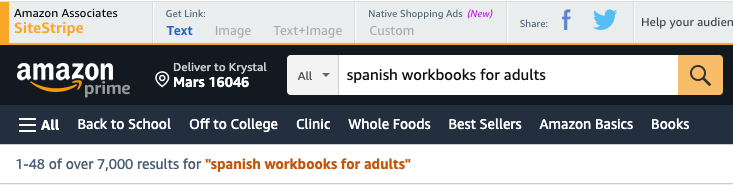
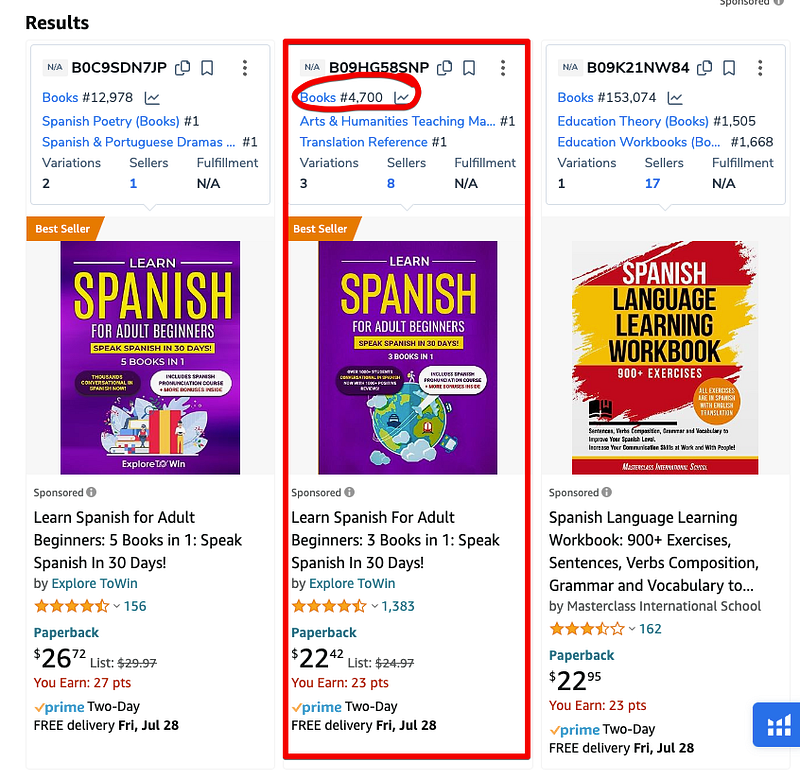
Next, I find the top-ranked book on page 1 of the search results, and I click on it to see more detail.
This is also the “model” I’ll be using for my competitor analysis later on.
Next, I scroll down to the section of the page that contains Helium 10’s data.
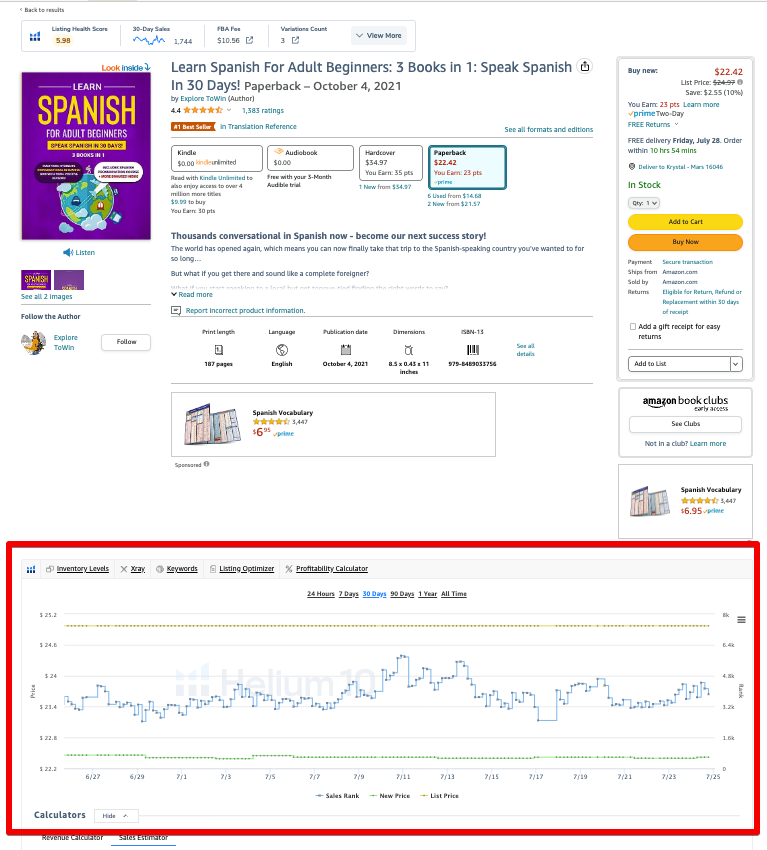
(Note: I can see this additional data on Amazon because I have the Helium 10 plugin installed on my Google Chrome browser. I have a tutorial on how to set this up here.)
Next, I click on the “Keywords” link.
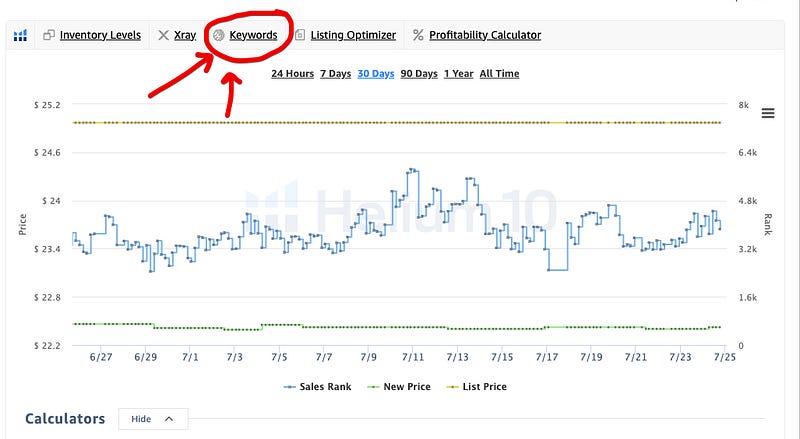
This will show me all the keywords that this book is currently ranked for on Amazon, along with the number of searches and sales that are attributed to each keyword on a monthly basis.
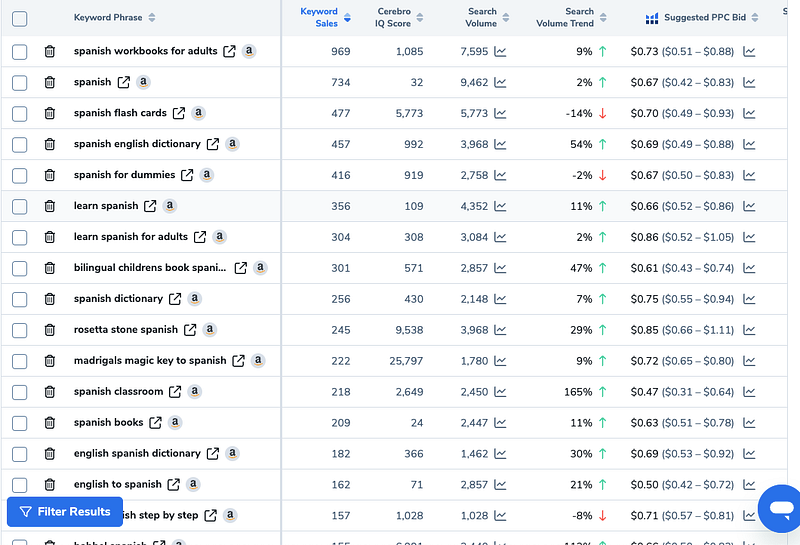
Now, what I’m typically looking for are highly relevant keywords that have at least a thousand searches per month and are making at least a hundred sales per month.
In this case, the keyword phrase “Spanish workbooks for adults” has a monthly search volume of 7,595 and is resulting in 969 sales per month on Amazon.
This would probably be my “main” keyword — meaning if I did go ahead and create a “Spanish workbook for adults”, I would want to include this keyword phrase in my title and description.
This will help me rank for the keyword.
But don’t stop there.
The goal is to find as many highly relevant keywords as possible to find your (approximate) total search and sales volume numbers.
Warning: If the top relevant keyword has a monthly search volume that is very low (0–50), that’s a sign that there’s not a lot of demand for the topic.
You can obviously create whatever your heart desires, but if your goal is to take a data-driven approach to publishing, you should NOT ignore this.
If you are interested in diving even deeper into Amazon keyword and category analysis with Helium 10, I have a very detailed tutorial on that here.
Once I validate that there is demand for my topic and find a short list of keywords that I want to target, I move on to Step 2.
2. Profit Potential
This is where you figure out how much you could potentially earn with your book (assuming you do everything right — which we’ll get to in a moment.)
Odds are, if you are new to publishing, you probably aren’t going to do everything right, so keep that in mind when doing this analysis.
What I do is take the top keyword (or phrase) that I identified in Step 1 and pop it into the Amazon search bar.
I’m going to stick with our Spanish workbook example.
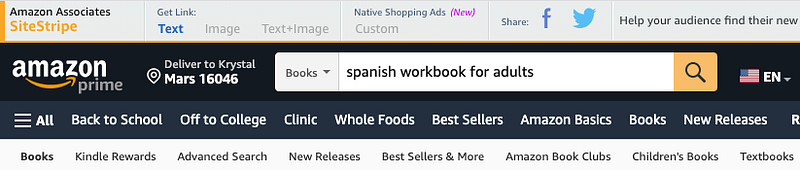
Again, I’m going to look for the top-ranked book on page 1 of the search results.
This is the book with the lowest “BSR” or “best seller’s rank” number. Every book on Amazon has a BSR.
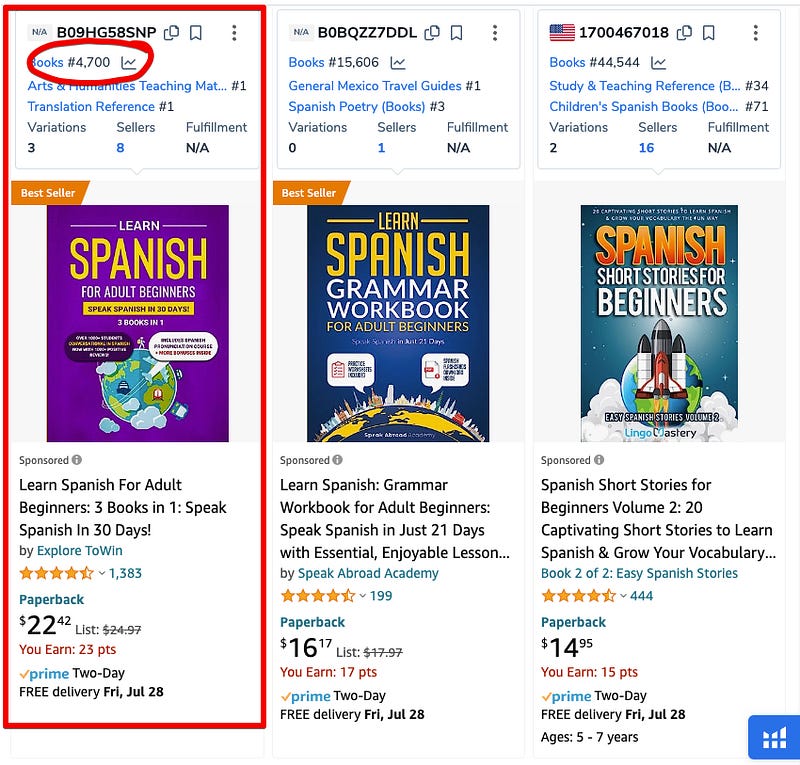
Next, I’m going to click to view the product page, and I’m going to scroll back down to the section that contains my Helium 10 data.
Only this time, I’m going to click on “Xray.”
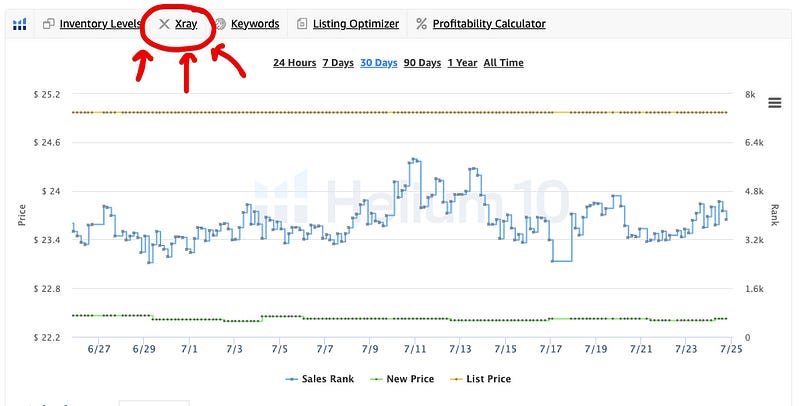
This will tell you how many units this book has sold in the last 30 days and how much revenue the author earned from those sales.
You can also see this data for each version of the book (i.e., paperback, ebook, etc.)
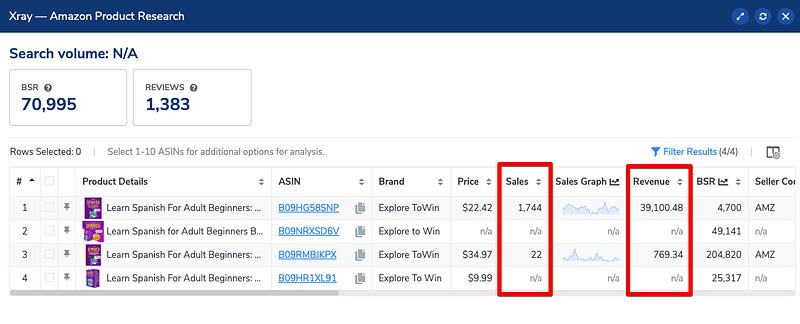
We can see here that this book has made $39,869 in revenue in the past 30 days.
Note: Revenue is NOT the same as profit.
To calculate profit, you need to calculate YOUR book's specific royalty per sale. This is based on the unique features of your book, such as price, page count, print color, size, etc.
You would then multiply your royalty rate (by) units sold (minus) any other expenses to calculate your monthly profit.
Since this is currently the best-selling book on page 1 for this keyword, I would set this number as the “cap” on my profit potential.
For example, if you are able to take over the #1 spot for this keyword, you could potentially earn $39,896 per month in revenue.
…
Next, I want to find the “worst-ranked” book on page 1 of results for this keyword search.
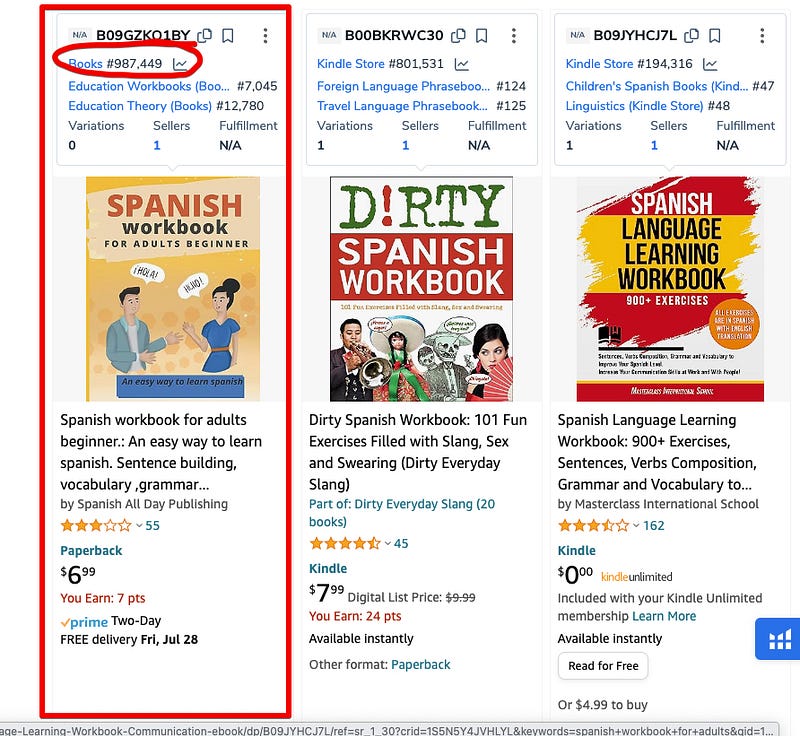
I’m going to do the same thing I just did above — click to see the detail page, scroll down to the Helium 10 data, and click on “Xray” to view this book's sales data.
I can see that this title has sold 7 copies and earned $48.93 in revenue in the past 30 days.
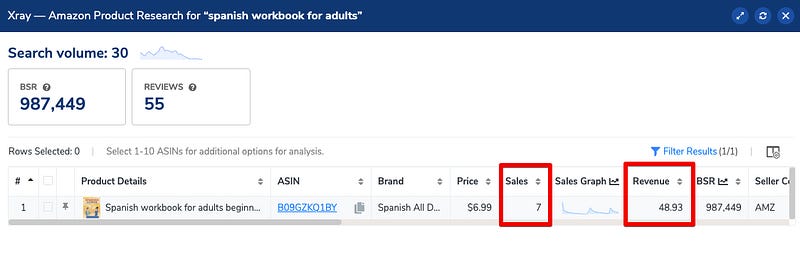
For my purposes, I‘m going to assume that the “profit potential” for a book on this topic is between $48 and $39,896.
Now you might be thinking,
Holy moly! That’s a HUGE profit range.
Yes, it is.
But let me tell you WHY I love to see this!
The fact that there is a book showing up on the first page of search results that’s ranked 987,449 and making just 7 sales per month tells me that it would be relatively easy to get my book ranked on page 1 as well.
It also tells me that this is an underserved niche.
Whenever you find a keyword where just a few books are making most of the sales, that means there is plenty of room for new competitors to come in and take some of that market share.
While I can’t precisely predict how much my book would earn in this niche (until I launch and test it), I would expect to make at least $1,000 per month profit (based on my current skills and experience.)
However, to achieve this, I will need to create a book that is capable of competing with the other best-selling titles on page 1 of the keyword search results.
This is easier than you might think.
3. Competitor Analysis
In this step, I’m studying all of the books on page 1 of the search results for my keyword phrase, especially the top-ranked title.
That’s the one I’m gunning for.
Specifically, I’m looking at:
- the cover,
- keywords in the title,
- book description,
- customer reviews, and
- what keywords this book is running ads on.
When you are “designing” a book to potentially knock a competitor from the top spot, the cover is of upmost importance.
It’s more important than what’s inside the book.
Your cover has to be as good (but ideally better) than your competitor’s cover.
If you don’t have THE DESIGN SKILLS to do this yourself, find a professional cover designer.
If you’re serious about this process, it will be money well spent.
Next, I recommend studying your competitor’s reviews to see where you can find a competitive advantage.
The goal is to create a similar product that is BETTER than the existing top-competitor.
If you can do this, you can make money with publishing.
The last piece of the puzzle is to understand which keyword your competitor is running ads against.
You can get this data from Helium 10.
Just click on the book you want to analyze on Amazon, scroll down to the Helium 10 section (after installing the plugin), and click on the “Keywords” tab.
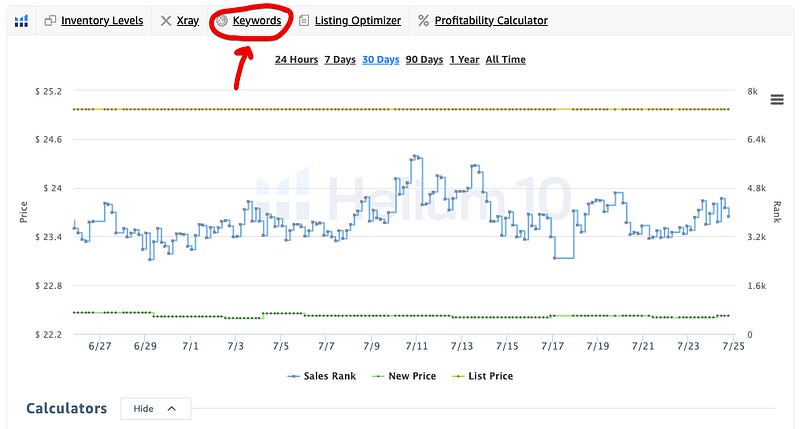
Next, filter by “Match Type” and select “Sponsored,” then click the “Apply Filters” button.
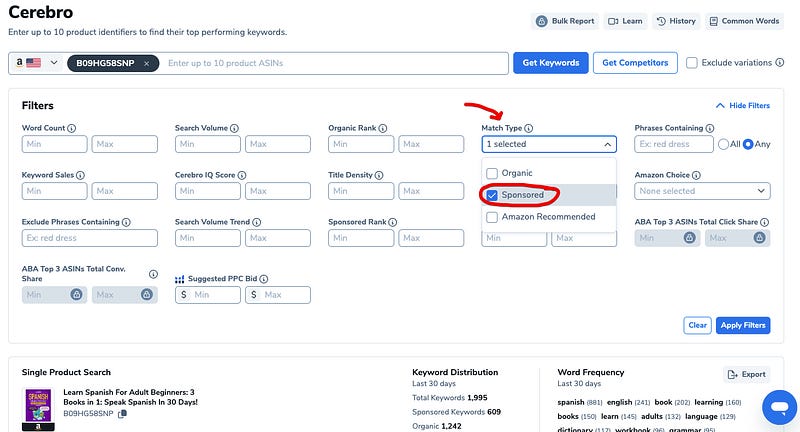
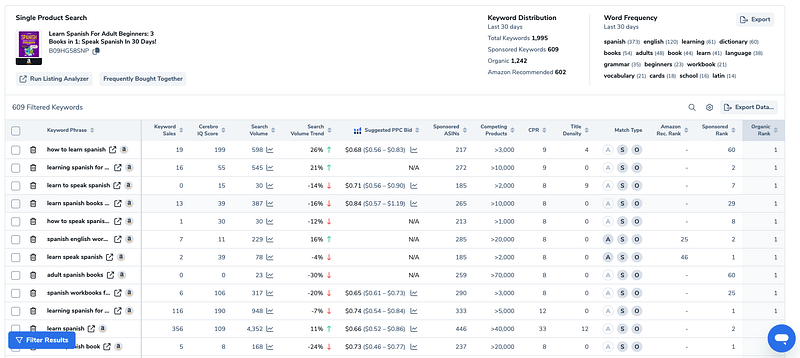
This will show you a list of all of the keywords the book is currently using in its Amazon ads.
For example, I can see that my top competitor is targeting 609 different keywords with ads.
I can also see which keywords are resulting in the most sales.
The final thing I want to mention here is that it’s not necessary to bid on ALL of your competitor’s keywords.
Often, you’ll see that a lot of the keywords on this list aren’t “highly relevant.”
This could be because they were targeted with an “auto” ad.
The point is that you can go through this list and discard any keywords that aren’t “highly relevant” and use the best-performing keywords in your ads.
Reverse engineering profitable books is 100% possible when you dig into the data and follow these steps to create better products that the ones that already exist.
And that’s really what being a creative entrepreneur is all about, right?
This article contains my referral links for Helium 10, which along with Jasper AI, are some of my absolute favorite business tools for content creators.
If you purchase a premium subscription to one of my favorite software tools, I will receive a small commission at no additional charge to you.


