
How I Beat the S&P500 by 549% Using Leverage
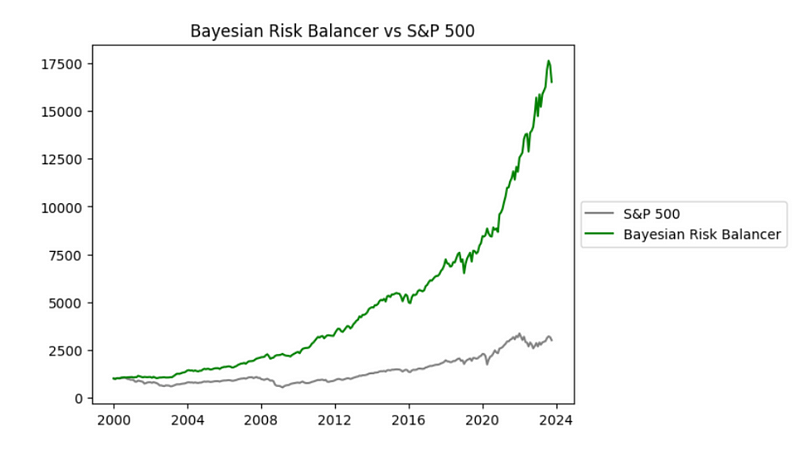
This year is being great so far for investors. We are in the middle of a bull market led by the AI sector and people who got in on time are doing very, very well. That’s why now, in the face of all this boom, it’s perhaps the best moment to make a sobering and realistic claim: if you are a retail investor like me, without access to insiders information, you won’t beat the market by picking stocks.
Before you complain, wait a second: I didn’t say that you won’t make money, in fact if you invested in Nvidia recently you probably made a lot. I didn’t even say that you won’t beat the market, you might be beating it right now. I said you won’t beat it because of your stock picking skills.
Now, let’s reflect on this. When we, as humble retail investors sitting at home, pick a stock, why do we do it?
Might be because its great fundamentals. Might be you like the product or you know the sector pretty well. You might even do it because some “analyst” or “expert” in a recommendation website told you so.
Now, honestly, do you think that decision has an edge? Do you think those reasons incorporate any knowledge that the market doesn’t know? To be frank, I don’t believe so.
Unless you are Bill Gates or Sam Altman, how could you have known some years ago that Microsoft would overtake Google in the AI race? You might make a bet and be lucky, but the truth is that your decisions won’t have a solid basis to justify them, and without that, your strategy is lacking a foundation for winning in the long term.
It took me some time so accept this, the temptation to try and play Warren Buffet was big, but at some point, I decided to take a more serious approach with my investments, and now I am happy that I did it.
The Most Simple Strategy to Beat the Market
I am going to start giving you the most profitable piece of advice I can give you, in fact, if you do this, you will be instantly beating the market tomorrow: look for an online broker with low fees and get some leverage.
It’s true that some time ago, leverage was much cheaper, but even now, with high interest rates, it continues to be the easiest way to beat the market. Again, let’s reflect on this to check that is is mathematically true.
If you borrow money at a cost of 6% (currently offered in many popular brokers) from your broker and invest it in the S&P500 which has an average return of 10% then you are bassically printing money. In fact, there is not a single reason not do it and it is the first element of my investment strategy.
Now, a beginner trader might be wondering: why not get a massive amount of leverage, as much as possible, and just become rich? Well, this is an interesting question.
When you use leverage, you are playing with more money that you really have, this allows you to multiply your winnings but unfortunately it also magnifies your loses, and when this happens, the entity lending you the money needs to implement some mechanism to make sure that they will get paid, that’s why they created margin calls.
Margin calls are the reason why leverage is dangerous and why beginners might lose a lot of money. They occur when your funds go below your broker maintenance margin.
The process by which leverage can ruin your account is as follows: if you take too much leverage, you risk getting margin calls to deposit large sums of money in your account very often, if you don’t have cash available to cover these calls, you will get expelled out of your positions.
Now you risk remaining out of the market for a long time until you can save some cash to come back in, by that time the market might have gone up again and you will incurre a huge loss to get back in your positions. This is what destroys your performance in the long term.
So, as you can see, while using a small amount of leverage is a no-brainer, managing a large amount of leverage is not an easy task, and this is where things get interesting.
Quantitative Trading Strategies
As an Artificial Intelligence engineer, I have been interested in quantitative trading strategies for quite a while. Believe me, I have tried an embarrassingly high number of models, with the exception of High Frequency Trading -which involves a too high barrier to entry- I tried pretty much everything available to a retail trader sitting at a home desk.
Things like statistical arbitrage, option pricing with non-constant volatility, multivariate regression, ARIMA, SARIM, Prophet, Random Forests, XGBoost and of course, Deep Learning techniques like LSTMs and GPT-like Transformers. I told you, you name it and I tried it.
After all of this trial and error, I came to some important conclusions about quantitative trading and also about the limitations of popular techniques like Deep Learning models. So, at this point I’m ready to share with you the main takeway after all this learning process: Bayesian Models are the supreme tool to solve any kind of decision making under uncertainty conditions.
And this is so because they don’t give you predictions only, they give you probability distributions for your predictions, which allows you make decisions based on how confident you are about your bets.
We need to switch the focus from trying to predict the exact price of stocks at some point in the furure. We should rather focus on measuring how convinced we are of our predictions about the direction of the market.
Bayesian statistics coupled with leverage are the strongest pack that you can bring to trading stocks. They will allow you to implement a strategy in which you make decisions based on probability. Just as in Poker it is crucial to size your bets basing on probabilities, in stock trading your main skill will be sizing your bets and hedging them.
The Bayesian Trader won’t be saying: I have X dollars in my account so I will just buy X dollars of stocks because my model predicted the market will raise by 15% in 6 months. This is not a smart strategy.
The Bayesian Trader will rather be saying: my model predicts the market to go up with a probability distribution of mean “M” and variance “V” therefore to maximize the value of my bets I will allocate for example 80% of my portfolio for long positions but will hedge it with 20% for short positions that will protect me in case stocks go down.
To sum up, a Bayesian approach combined with leverage, allows you maximize your profits both during bull and bear markest. You will adjust your long and short positions according to probabilities in your bayesian model and this will maximize your profits in the long term.
Bayesian Risk Balancer
Thanks for reading until the end. Before you go:
- If you enjoyed this article, visit bayesianriskbalancer.com to gain access to the bayesian model that I use for my personal investments.
- Visit my YouTube Channel: youtube.com/@ModernaiTrading for more detailed video contents.
- Stay tuned and follow me on Medium because in next articles I will dive deeper on Bayesian Models and how to use them in trading.


