
The World Around Us
How High is the Tide?
A tough question of mathematics, the sun, moon and the planets and something I live with every day on my boat
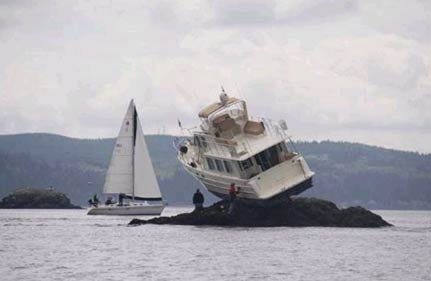
This story explores several interesting aspects of the tides and was prompted by something I learned during a recent voyage around the top of Australia. Despite having studied oceanography as a post-grad (which included the tides), I’d never known how long ago it was first believed that the tides were mainly influenced by the moon.
Surprise #1
It was the Aborigines of Arnhem Land (the Top End of Australia) who first made the connection:
The Yolngu people of northeastern Arnhem Land in the Northern Territory of Australia identified a link between the Moon and the tides, which they mythically attributed to the Moon filling with water and emptying out again.
They used the knowledge to predict good fishing days.
In many Aboriginal and Torres Strait Islander traditions, the Moon is generally viewed as masculine whilst the Sun is generally feminine. In Yolngu traditions of coastal Arnhem Land, Ngalindi is the Moon-man. Yolngu traditions describe water filling Ngalindi as he rises, becoming full at high tide. This causes him to grow as he rises becoming full at high tide. When the water drains out, there is a corresponding ebb in the tides. When full, he is viewed as fat and lazy. Anger drives him to kill his sons as punishment for not sharing their food. In retribution, his wives attack him, carving his body with their axes, causing him to wane away. He eventually dies for three days (New Moon) before resurrecting as a crescent (waxing Moon), growing again until full. The cycle then begins anew. — University of Melbourne
Today we know that it’s a little more complicated than that.
And I still don’t know how long ago it entered the Aboriginal oral history in songs, stories and ceremonies.
Sadly, that great navigator and explorer, Captain Cook, thought that they were savages.
Equations galore
Over the centuries many theories of the tide were advanced in civilizations from Iran to Spain.
Newton and Laplace started to refine the model with new mathematical tools. Today, harmonic analysis forms the basis of the tidal prediction model and the theory of tides is well established. We know that to forecast tides with great accuracy there are over 400 terms in the equation.
In fact, an early form of analogue computer was developed to predict the tides:
Tide prediction machine at the National Oceanography Centre Liverpool. There were only ever around 30 Machines made and they were used around the world to predicted the tide between 1872 and 1960s when Digital took over. This one was built by Authur Thomas Doodson after taking resident at Bidston Observatory in 1929. Still in full working order. This actual machine helped predicted the tide for the D-Day Landing. Text credit: Paul Frost (sic)
Even in the time since I first studied the tides, about 60 terms (‘tidal constituents’) have been added to the prediction model which is now run on digital computers.
Doodson is an important name in the annals of tide prediction, building on the earlier work of George Darwin. ‘Doodson numbers’ are still used today.
Location, location, location
The pattern of the tides varies considerably depending on location. Principal locations are known as standard tidal stations or standard ports. Each standard station has measured constants (established over many years) which are used to build the prediction for that location.
Tides can vary hugely between locations only a few mile apart. Secondary tidal stations have their tides based on Standard stations.
The term ‘station’ and ‘port’ are used interchangeably.
For example, in Bournemouth, England, the tidal range is typically 1.5m, whereas 30 mile away in Portsmouth the range is of the order three times larger.
I sailed through the Cook Strait in New Zealand a couple of years ago and the graph show how the tides vary by location:
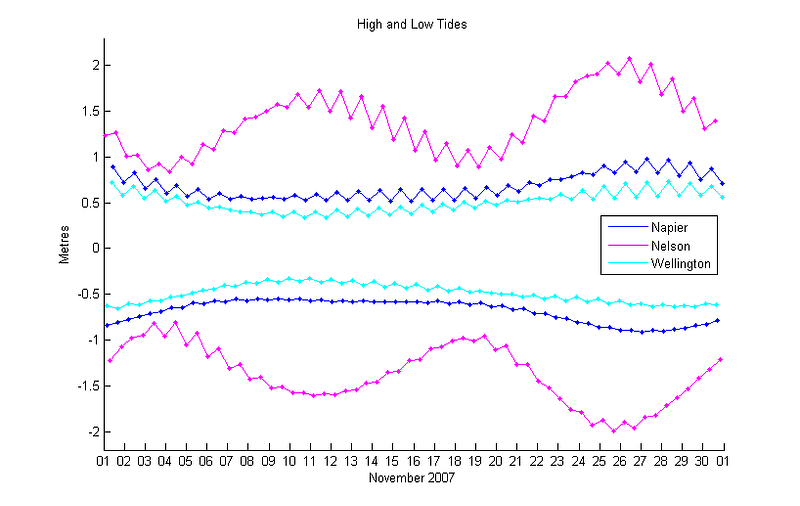
It can be a scary place to sail, but fortunately it was flat calm when I went through.
In my younger days, tidal calculations were made by extracting data from tables and applying ‘corrections’. It was an error-prone process but extremely important to get right if one was to navigate safely.
Today the answer comes instantly from a PC.
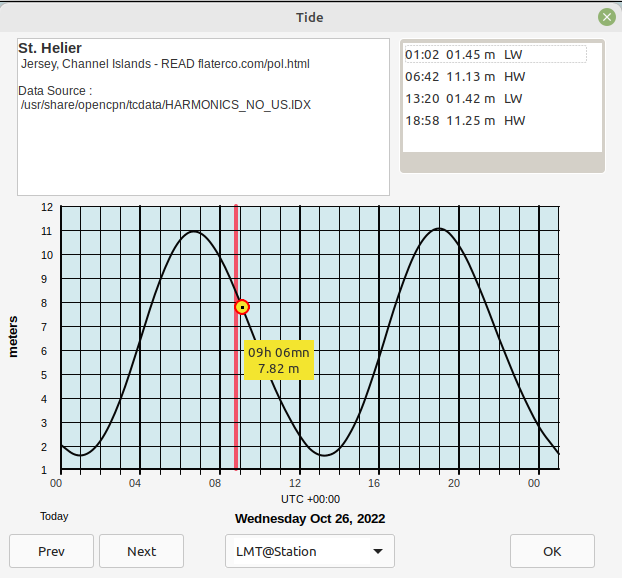
This is what my tidal prediction program shows for St. Helier in the British Channel Islands for 26 October 2022.
The world’s highest tides
These occur in the Bay of Fundy in Canada where the northeastern part of the bay, Burncoat Head, has the record for the highest average tidal range in the world, measuring 38.4 feet (or 11.7 metres).
I learned to sail in the Bristol Channel (UK) where the tides at the top end have average tidal ranges of 31.5 feet (7.6 metres) and I’ve also sailed a lot in Brittany, France, with tides today of 40.42 ft (12.32 metres) although the average there is lower.
These tides generate tremendous currents which stir up the bottom and can cause turbulence, whirlpools and overfalls. In some areas, such as off Portland Bill in Dorset, UK, ships have been completely overwhelmed and sunk when strong gales have blown against the outgoing tide.
This video is taken at the Corryvreckan in Scotland on a quiet day.
What causes the tides?
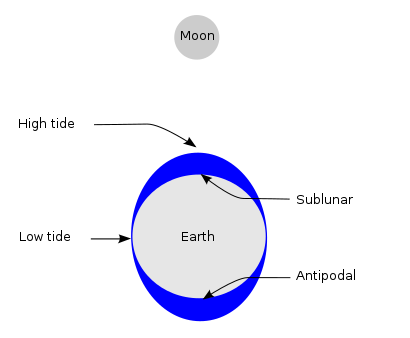
Principally the moon’s gravity. Although much smaller that the sun, it’s much closer so its effect on the oceans is stronger. The sun also has a marked effect.
Earth tides
The solid earth itself is subject to tidal effects, although its ‘stiffness’ prevents them being of any significance in our daily lives.
Earth tide (also known as solid Earth tide, crustal tide, body tide, bodily tide or land tide) is the displacement of the solid earth’s surface caused by the gravity of the Moon and Sun. Its main component has meter-level amplitude at periods of about 12 hours and longer. The largest body tide constituents are semi-diurnal, but there are also significant diurnal, semi-annual, and fortnightly contributions. Though the gravitational force causing earth tides and ocean tides is the same, the responses are quite different. — Wikipedia
And the other surprise…
And the other was completely unrelated: theoryof tides.com — the music
Theory of Tides continues to innovate with their “Dark Side”; the Switchblade Symphony meets Stevie Nicks sound to the lyrics here is made the more haunting through the inclusion of additional vocal layers. “Elated” comes forth with a wind-swept sound that, while rooted in an eighties dance style seems to touch the “futuristic” sound of a “Mr …
The American Mathematical Society has set the tidal harmonics to music. This is the sound of Sakhalin Island:
https://www.ams.org/samplings/feature-column/fcarc-tidesound2.mp3
There is more tidal music at:
I hope that you enjoyed the brief tour of the tides. They are all around us at sea and on land, even affecting our bodies and moods. But not, it seems, madness and crime levels.
About me: If you follow me I guarantee variety in your inbox with some unusual perspectives! I write on a wide range of topics including humor, tech, space, geopolitics and travel, together with daily news events and the minutiae of my daily life living on a boat. Yes, I really do live on a boat (some readers don’t believe that). I also write about…
…my water level
If you appreciate stories like these and want to support other writers and me, consider signing up to become a Medium member. It’s only $5 a month, giving you unlimited access to incredible stories on Medium. If you sign up using my link below, I’ll earn a small commission at no extra cost to you.
Or maybe just buy me a coffee? and tell me what you liked reading (or not)!


