
How Google And Amazon Monopolized Trust To Make Billions
Two of the most trusted companies ever turn that trust into fountains of cash
In part one, we looked at why consumer brands (non-luxury) were an important part of the value chain and the product purchase decision in years past. Today we will look at how Google and Amazon usurped the profitable position of brands in helping consumers to build the required amount of trust necessary to purchase something.
A theme in this series of strategy articles is the importance of controlling bottlenecks. The stronger your hold on a key bottleneck in the value chain, the greater your profit-making potential. To that I would add that the closer the bottleneck is to the customer (or the more aware the customer is of your product), the greater your profit-making potential as well. That’s what was so genius about the “Intel Inside” marketing campaign. Not only did the other PC component makers know that the Intel CPU was the irreplaceable bottleneck that everyone else had to optimize around, but now customers knew it too. The marketing campaign made customers believe that the performance of their PC or laptop was correlated to whether there was an Intel processor inside, further strengthening Intel’s hold on the PC value chain.
In the consumer products world, the trust and awareness that brands cultivated with customers over years of marketing to them was used to sell product. This was necessary because before the Internet, there wasn’t easily accessible and trusted information out there about the usefulness and quality of products.
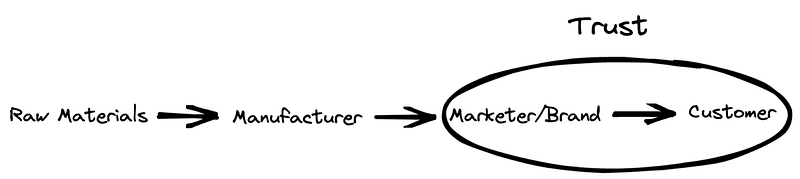
That changed with Google and Amazon. The Internet quickly transitioned the world from too little information to too much. And Google and Amazon (as well as other companies) helped to organize all that information — Google by indexing the Internet so it could be searched and Amazon by collecting extensive user reviews for literally every product.
This more or less disrupted brands, significantly devaluing them. People are much less inclined to pay a premium for the branded version when thousands of user reviews attest that the unbranded alternative is just as good. Instead of trusting the brands themselves, people moved to trusting the results of a Google search and the product ratings on Amazon.
At the same time that they stole the trust-establishing role from brands, Google and Amazon found that they could make a lot of money by connecting businesses that wanted to sell things to the millions of users that trusted Google and Amazon. Essentially, because Google and Amazon are so trusted and so many product searches started on either one or the other, they were able to wall off their users from advertisers and start charging for access.
It does sound a bit shady if you think about it. It’s like when your trusted advisor (who gives you a good amount of free and objective advice too) gets a kickback when you buy something based on his recommendation.
The way that each monetizes is somewhat different. Google does it via the promoted links (a.k.a. ads) that are at the top of your results when you search for something, allowing it to make a few pennies from almost every search (it really adds up when you consider how many searches occur every second). Amazon does it by allowing third party sellers to use its marketplace (people think something must be trustworthy if its on Amazon, plus they can always return it thanks to Amazon’s generous returns policy), allowing sellers to pay to promote their products, and by learning from user reviews to create Amazon branded versions of successful products with good ratings. And because so many product searches begin on Amazon thanks to trust, that, its huge variety, its perception of offering competitive prices, and the convenience of Prime has allowed Amazon to take an increasingly larger share of consumers’ wallets.


