
When Brands Ruled The World
Part 1 of a series explaining how Google and Amazon turned brands into commodities
I’ve been writing a lot recently about how value chain bottlenecks create opportunities to earn big profits (here). And how when the structure of the value chain shifts, those bottlenecks and accompanying profits often shift somewhere rather than vanishing (here).
In this series, let’s look at how Google and Amazon benefited from this type of shift to become the world-beaters that they are today.
In the Intel example I used in my previous posts, Intel was able to earn attractive profits because the CPU was the bottleneck in terms of a PC’s performance. This meant that other component makers as well as software makers had to standardize (commoditizing themselves) and optimize themselves in order to maximize the performance of Intel CPUs. This made everyone else a commodity (besides Microsoft, which enjoyed a similar position) and made Intel irreplaceable in the PC value chain.
Why We Needed Brands
But the bottleneck doesn’t have to be a technological one. It can also be whatever inhibits potential customers from making a purchase. Take something as mundane as laundry detergent. In the pre-Internet days when people went to a store, they tended to buy branded laundry detergent (like Tide or Downy) even if it costed a bit more. Why? Because very few people showed up to a store as a detergent expert (or were willing to spend the time to become one), so most folks would rather have paid a bit more for the brand’s quality guarantee than gamble on some unknown detergent (and risk getting a rash or ruining their clothes).
Thinking about this another way, the biggest obstacle that prevented someone who wanted to buy detergent from actually buying it was a lack of trust. If you showed up to a no-name store and saw a bunch of shady looking detergent bottles from manufacturers you’d never heard of, there’s a good chance that you would have gone home empty-handed. Because you didn’t trust those manufacturers to deliver a reliable and safe product.
The less we know about a product, the more important a role that trust plays towards the purchase. For cookies, I don’t mind taking a chance on products I’ve never heard of. I am familiar with cookies and the downside of eating a not so good cookie (assuming I’m not food poisoned) is just disappointment. Another factor is cost — the less costly the purchase, the more likely it is that we would be willing to pay a small premium for the branded version. Whereas I might take a chance on the no-name dishwasher to save a few hundred bucks, I’d be perfectly fine with spending an extra dollar on Tide detergent for the peace of mind.
So there’s a large subset of consumer products (shampoo, detergent, baby formula, toothpaste, etc.) where for many decades, brands really mattered. The value chain looked like this:
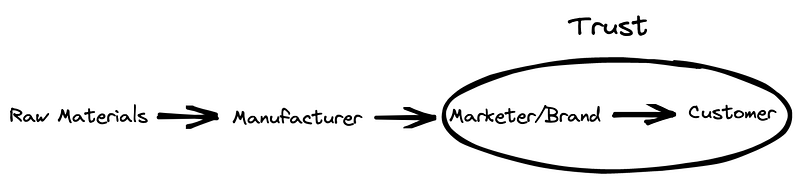
Brands (non-luxury ones) were built on trust. Customers trusted brands to consistently provide a reasonably good product (and save them the time and stress from needing to do their own product research). Thus, brand companies like Procter & Gamble (P&G) were the key enablers of transactions in the product value chain. Without the trust engendered by the brand, the transaction would likely not occur — making brands the bottleneck that earned the most attractive profits in the product value chain.
And as expected, those around the bottleneck were forced to commoditize and optimize. Manufacturers bent over backwards to meet the product specs and cost requirements decreed by the P&Gs and the Unilevers of the world, commoditizing themselves. And supermarkets and other stores optimized their store layouts to showcase the top brands front and center.
In Part 2, we will see how the product value chain shifted and allowed Google and Amazon to usurp most individual brands as the arbiters of trust, a move that allowed them to earn massive amounts of money.