
How Do Young People Become Future Leaders?
We Need New Leadership. Three Connections Will Show the Way.
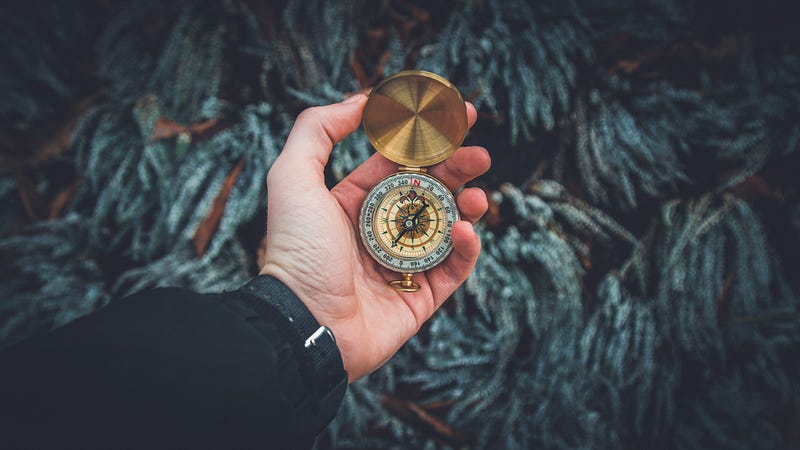
We’re all leaders in our own way. Leaders in our own groups of family, friends, business, and society. We all develop our internal wisdom and hopefully, this will lead us towards a regenerative future. A future in which many more values than only money can take up space.
In my time, leadership didn’t come with a compass. The result was that I found my wisdom only later in life.
However, I see many young people who can hold on to their natural wisdom much better than I did. You develop your personalities without masks and you go for the best life you can have. You make brave choices for what’s really important and you lead the way.
I applaud you! And to make your life a bit easier, I want to show you a compass that helped me a lot on my journey of purpose. Before I tell you about this compass though, let’s have a look at changing worldviews.
Mechanistic world view
In the 16th century, the scientist and philosopher René Descartes (1596–1650) became an important influencer of our Western worldview. “Cogito, ergo sum”, translated as: “I think, therefore I am” is his widely known philosophical statement. His view of life was a mechanistic one. He taught us how everything can be broken down into parts and if we know the details of a part, we will know the whole.
In his wake, everyone and everything was treated like a machine. Our science became completely rational. There hasn’t been much space for senses, experiments, qualitative research, etc. The scientists who followed in his footsteps all became specialists in one field, not looking beyond the boundaries of their expertise.
I am not saying they did a lousy job though, we now know about DNA and many other specialist subjects. We have come far.
“Cogito, Ergo Sum” — “I think, therefore I am”
René Descartes (1596–1650)
The results of this Cartesian worldview are everywhere around us. And the results are not only positive. It also means our technologies solve partial problems, never looking beyond the boundaries of one problem. If a certain technology brings a problem in another field, we give it to society to solve.
Toxic waste? Polluted rivers? Pesticides on our food? Society has to solve it. Our business models are linear, maximizing the profit of one company instead of looking at its contexts and optimizing a whole set of interlinked values.
Our economies are money-driven, based on endless growth. Whereas many other values such as clean air, drinkable water, sense of community and health are suffering. All these everyday things we mostly take for granted, are influenced by the Cartesian worldview. We often just don’t realize it.
Activism and Life
Even our activism has this pitfall. People are fighting against inequality or against climate change. They are feminists or environmentalists. It’s all the same, though.
The big step is to embrace LIFE. And put life, all life, all lives in the center of everything we do. So, if you think this article is only about nature and environmentalism, it isn’t. If we put life in the center, we would solve all.
We would make technology that supports life. We would empower all humans, regardless of race or gender. We would even change our activism and allow only the strong, very influential, non-violent kind.
So, please read on with that picture in your mind. It’s all about LIFE.
Systemic worldview
The mechanic worldview is shifting now and another one is taking up space. I see it everywhere around me. The new worldview is a holistic one. Everything is connected. Many scientists looking at systems nowadays.
A good example is the Austrian-American scientist Fritjof Capra. He wrote many great books, but the one he wrote with the Italian Chemistry Professor Pier Luigi Luisi ‘The Systems View of Life’ makes the new systemic worldview most clear.
Yes, there are parts, but maybe their relationships with each other are more important than the actual parts themselves. And perhaps space between matter contains important information.
Systemic thinking is gaining momentum. Complexity is the reality of our time and we better learn to deal with it. We think the world looks like the left illustration because this picture fits within our rational mind. It makes it simple, understandable.
But sorry, the reality of our world is shown in the right picture. Everything is connected. And with that realization, large groups of people around the world are exploring new business models, new technologies and are restoring ecosystems.
It can be done. We just have to change our worldview and learn to take it into our daily lives.

Live, love and explore
Pfff, that looks complicated. How can we live in such a complex world, let alone be a leader? Well, there are ways. And whenever you want to navigate in unknown surroundings, a compass is a good companion.
Young people I know show a great longing for purpose. We have become consumers, but we want to be creators. We want to live our best lives. We don’t want to be machines, we want to live, love and explore.
Well, how do we do that without becoming overwhelmed by the reality of complexity? And how do we walk our own paths without becoming confused? Moreover, how do we become leaders in our own small or bigger groups?
Bringing back the soul
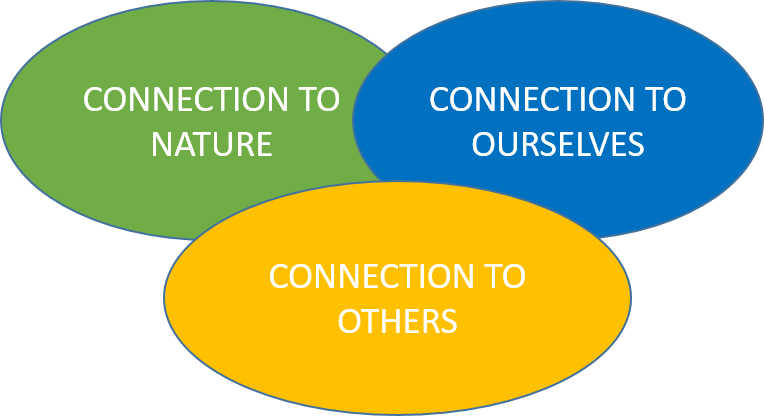
The answer lies in bringing back the soul. Recognizing our own soul, other peoples’ souls, and nature’s soul. And in order to do that we need to train our connection to these three elements: nature, ourselves, and others.
The further we come on the path of mastering the three connections, the better leaders we will become for a regenerative future.
Connection to nature
“Nature heals. Just a walk in the woods or a stroll by the beach on a sunny morning can awaken the innermost feelings of happiness and peace, and Environmental Psychology has gone a long way proving this fact (Bell, Fisher, Baum, Greene, 1996).” This quote is from Madhuleena Roy Chowdhury, BA clinical psychology. She explains the benefits of nature for our health well in her science-backed article on environmental psychology.
Nature has great intelligence of its own and has a positive effect not only on our wellbeing but also on our attention and focus, problem-solving skills and creative abilities. These are all traits that serve leaders well.
Moreover, learning from nature will give us insights on how to build a regenerative future within the boundaries of our planet.
How? Dance and darkness
So how do we connect to nature? I explained some ideas in ‘7 Ways to Connect to Nature’. These three I like best:
- Choose a GAIA place and spend a little time there every day. It can be as simple as underneath a tree near your front door. Get to know the place intimately, connect to the creatures, plants, birds, insects and enjoy all seasons and all weather conditions
- Dance without limits. Feel the flow, don’t mind the opinions of others and connect to the music, real or in your head. Go from minimal movement to radical expression, just the way you feel it at that moment
- Embrace darkness. Train the other senses by limiting the dominant one: eyesight. Fear can kick in, so train yourself by stretching your limits gradually. Start in your backyard and then go to a place you know well in daylight
If you really want to learn deeply about nature connection I can recommend the books: ‘Coyote’s Guide to Connecting with Nature’ by Jon Young and ‘Becoming Nature’ by Tamarack Song.
Connection to ourselves
If we want to be future leaders we should know ourselves intimately. We should know when we wear our masks. We should be able to feel when we are open, in the present moment, completely servant to the situation.
We should be aware of our strengths and pitfalls. We should be able to embrace the light and dark in ourselves. There are many ways to achieve this, many schools of personal development.
I am not going to share mine here, because I think you should follow your own fascination. Start somewhere, anywhere and remain curious. Feel what makes your heart sing and follow that tune. Teachings are everywhere around us.
Some people need rational explanations in order to grow, others learn best when singing, painting or dancing and not think too much about it.
How? Meditation and mindfulness
Whatever way you choose for personal growth, meditation and mindfulness are always a good idea to connect to ourselves and quieten the stories in our heads. It is hard to stay focused in a chaotic world and meditation helps you find the calm you need to grow.
A zen master once told me that meditation will not suppress thinking, meditation will surpass it. I like that explanation because the voices in my head never become silent, they just get calmer and my thinking is much clearer.
The process of meditation is a growing subfield of neurological research and results tie the process to calming, increased happiness, emotional wellbeing, and better focus.
Try it yourself and feel what it does for you. There are many different ways to learn it, from an app to a course, from experimenting alone or together with friends. Also here I don’t want to share my own preferences. Start somewhere, anywhere and feel which method you like. Be your own guru!
Okay, if you still want a link, I will share the one by TreeSisters. Their free gift Journey of Awakening is a great meditative journey for personal growth ánd connection to nature.
Connection to others
A leader is always part of a group. She has to be aware of the group's needs and wants and has to be able to make deep connections. A real connection with another person is not always easy. They have their own prejudices, you have yours.
A leader will understand this and bring people together based on what connects them instead of what divides them. Finding opposites is often much easier than finding common ground. Be aware of both. Start from the trust of common ground and explore the opposites from there. You don’t have to be the same, you just have to become aware of the other person’s worldview.
Stay curious! Always!
How? Listening, observing and heart connection
Listening is a very important virtue, more so than speaking. Be quiet. Observe. Find out what drives the other person. Ask questions. Open questions, that cannot be answered by yes or no, but which need a more extensive answer.
And observe how the energy flows in a group. See how energy shifts when something happens or new members enter the group. Don’t analyze with your brain, just observe. And when the moment comes to speak, connect to the person with your heart. Look them in the eye (yes, it took me some time to be able to do that), imagine a cord from your heart to theirs and speak.
Your words will be wiser this way. And you will be able to feel compassion, be less judgemental.
“Speech is silver, silence is gold” Proverb
After you have gained some experience in the three connections for future leadership, you will take action. Leadership doesn’t mean you will go up on a mountain and stay there, contemplating, being a philosopher. You will create things! Live, love and explore!
If you start the actions from the three connections you will not run around mindlessly, just doing, stressing and stumbling. Instead, you will take time, you will sharpen your intuition. You will know what to do, when to act and how to act mindfully.
Your life will be much less stressful, and much more effective. That’s what leadership is about. And people will recognize it in you.

It’s time for you to shine. Take action on the subjects you care about. Things will evolve from there. They will emerge. And don’t worry if not every day is positive.
Every cloud has a silver lining. Embrace the dark feelings, breathe through them, accept them and go on. A little training every day:
- Be alert when speaking to someone, even if it’s the checkout girl in the supermarket. Remember one smile, one compliment can make someone’s day
- Don’t judge yourself harshly. Be your own best friend. If your best friend would tell you things, you would be sympathetic, I’m sure. So why not be sympathetic to yourself?
- Next walk in the park, open all your senses. Smell the wet soil, hear the birdsong and feel the bark of the tree. Look up at the clouds and smile when you see bunny ears…
And if you want to connect, please find me on LinkedIn, Facebook, Twitter or in our food forest, connecting to trees, insects, and badgers…


