
How Do You Learn to Pivot?
Lessons on making adjustments and thriving in constantly-changing, trying times
The text came in just before I went to bed last night. I’d been busying myself all day in the garden getting my house ready for final photographs. We’re going live very soon, as the real estate market is just about ready to open to physical walk-throughs. Baby steps. Real estate is a critical part of the economy, and the states are beginning to inch loose of the reins.
Last Friday I had found my Dream House. The moment I saw it I was in love with it. Apparently, so were a lot of other people. Two friends of mine, upon seeing in, promptly informed me they were moving in. It was that fine a house. Small, too, cuddled by forest, top of a hill but still close in. Doesn’t get any better.

My own house isn’t on the market yet, and a great many Californians whose houses have already sold and/or who have plenty of cash in hand (hahahahahaha, I don’t) leapt at the opportunity. I was pre-qualified, my credit impeccable, but my house has to sell. The sellers would have to wait.
The best I could do was make an offer contingent upon the sale of my house. As with ebay, we put an escalation clause onto the contract, good for ten grand above the house price. I was out of state on top of everything else.
It wasn’t enough. The sellers, frustrated by their situation and eager to move on, chose the buyer with cash. Of course they did. I probably would have too, given their circumstances.
My Dream House disappeared into the starlight.
I woke up this morning with a bit of a headache, which for me is common if I have invested a lot of feelings into something that implodes.
Along with the very long list of chores that crowds my quarantine life, I reopened Zillow to continue the hunt.

Pivot.
To turn swiftly, like a dancer does on her toes. To move immediately in a new direction.
I’d be a fool to try to tell you that watching that beautiful custom log cabin house, that forever dream of mine promptly disappear, slip right through my hands like the morning fog, didn’t hurt.
Of course it fucking hurt.
Like losing my adventure travel work, my upcoming trips to Mongolia and Uruguay this year, most of the income I was making on Medium and a hundred hundred other carefully-laid plans, the result of years of hard work and sacrifice. All happening as I am aging towards 70, with some of my options beginning to shift.
Here’s just one example: the travel insurance I use, which is exceptionally good and very reasonable, shuts me off at 70. Suddenly I go from $250 to probably closer to $1000 for the same trip, same coverage, different company. Assuming those trips still happen, that makes a huge difference for someone on a limited income.
In our ageist society, such things are inevitable.
To be fair, the insurance I use is specifically designed for adventure travelers. (So while the typical person over 70 might well be a risk, most of us in this category are not only serious athletes in excellent health, but we are far less likely to take harebrained risks and chances that those a third or a half our age might take. Which in fact make us far better risks than those younger in the same category. But try to explain that to the insurers.)
So you and I and most everyone else I know are all suffering losses in one way or another. Some of them vastly more devastating than having a Dream Home disappear. Some of our loved ones have disappeared.
There’s no midair pivoting on that one, but this article isn’t about human losses. It’s about what you and I can do, if we are wise enough to use these times to teach us, to build us rather than tear us down.
PIVOT.
If you’re a nurse working in the emergency room, and you have a slew of patients that have been brought in, you’re doing everything you can possibly to do focus on the most immediate and pressing needs. If your patient perishes, you pivot. You have to. Immediately and with as little grief as possible, you move on. There really just is no other choice. You’ve done all you can, that person is gone. NEXT.
On a battlefield, the same thing. My fellow military can understand. I haven’t seen combat, but I trained for it. You have to save whom you can save. If you’re a leader and you lose people in your squad, you constantly have to regroup with the resources left to you. Thriller movies are made of such stuff. In many ways we are living a thriller movie right now. Most of us can attest that it’s not particularly thrilling.
Situations are constantly changing. Think about what an air traffic controller has to deal with every day at busy airports. Constantly changing life and death decisions. Pivoting every few seconds.
Those who survive are those who can let go as swiftly as possible and attend to the next most pressing need. Those who thrive are those who honor the fact that we have to save time to mourn later, and they do take the time to mourn. For mourn we must.
There are a great many people in the world making these kinds of terrible decisions every single day. I have met my share: people escaping sure death in Syria and moving into Turkey, people who have lost everything to war, people who will not survive these Conditions, trapped in grinding poverty while being told to wash their hands, and there is no running water for miles.
Not getting my Dream House, well. Grow up. Something else will present itself. Including not being able to sell and move at all.
This morning as I nursed my headache, I found this article which speaks in part to what I mean:
My fellow Illumination writer Paul Myers MBA writes a lot about leadership, as I do on occasion. I recommend his pieces, and I would invite his input on this piece.
What strikes me about the Quartz article is the point the author makes about those who find themselves successful, then locked in creative place by that very success. He refers to the second shift, if you will, as understanding the need for forward momentum. We can’t rest on our laurels, we must keep on creating.
AND most importantly, taking greater risks for failure than we did coming up the ladder the first time. It is ever so easy to buy into our so-called Mastery, which fades swiftly, and avoid the potential pain of being made a fool by the authority of life all over again.
The ability to let go of one thing and reach for another is an essential element of being successful in anything: love, business, writing, speaking. While each of us, according to our personality archetypes and preferences, has vastly different tolerances for risks, the demands are the same. If one thing ends, what then? Do you possess the mental fortitude and courage to reach for the next?
I found this paragraph from the above article very telling in light of the armed protests about the lock down:
People within these cultures don’t care about the organization as a whole. They only care about what the organization can do for them. They also only engage in relationships so far as those relationships benefit them. It’s all about them. And for this reason, they suffer. They can’t think beyond their own needs and wishes. Thus, their vision for themselves and the world is actually quite small and limited.
To this I might recommend an article that speaks to the impatience, selfishness and demands made by my fellow ‘muricans who fit the above description:
Successful companies pivot. To this: major corporations which have shifted their productions to disinfectants, masks and PPE.
Successful individuals pivot. They look around for how to make a difference, take care of their neighbors, give what they can to people in greater need, and they do everything they can to protect themselves AND others. They let go of what was, possibly for now, possibly forever, and focus on what is. What can be. How to make a difference right here, right now.
You and I are asked to pivot nearly every single day. While I am developing momentum to sell and move, that may not happen. May not happen at all. Just like my plans to build my business, continue my beloved travel, and all the things that have long mattered to me. Those may have to sit another few years as this monumentally unprepared country of ours sorts through the detritus of pigheaded, selfish leadership, shortsightedness and ignorance.
Meanwhile, you and I can learn extraordinarily high-level life and success skills. There is no better time than right now.
Something important to you end? PIVOT. Plan to take the time to mourn your losses, but while you are shifting, you are developing critical momentum. What’s next? What’s still possible?
If that ends, do the same. Just keep pivoting.
Because as you learn to let go immediately of what is not meant to be yours, be it a failed relationship, a business idea, a potential future, you can swiftly redirect that same energy to something new.
If you don’t think you can, think of every time you tried to play with a persnickety, impatient child. This toy? NO. What about this one? NO. Let’s read a story. NO. How about walking the dog with me? NO.
Learning to pivot is an awful lot like having that exact conversation with the angry part of us that didn’t like having the toy taken away because it was busted and now dangerous.
I can’t move on is the adult’s version of I want my toy.
Another critically important piece from the Quartz article is this:
An even higher order principle is collaborating with others who are far advanced of your current level.
Rosennab wrote me the other day that when she started running, a tiny white woman, ten years older than her 41, invited to her come along. People assumed that Rosenna was the experienced athlete, when actually, she was eating her new friend’s dust. For a while, at least.
Now Rosenna, 57, runs marathons.
I am having conversations with Rosenna, who in many ways has headed off in directions that leave ME in the dust. Which is precisely why I want to be affiliated and working with her. These people can either- with your permission- cause you to feel jealous, inadequate, resentful and small, or- with your full permission- be the living invitation to rise and push and become and expand and explode into what’s next.
In the course of my life I’ve had to pivot thousands of times. My first instincts were not to simply shift and redirect. Those losses and failures hurt. They left scars, for in my youth I took them personally. Over time I’ve learned to love the extraordinary ability to change directions in mid-air. To swiftly pivot, to know that there will be time later for me to experience my emotions as I must, but that in that moment I must indeed let go and move on.
I have consistently surrounded myself with people smarter, faster, better, brighter and talented in ways I am not. Never will be. But their input opens me up to new thinking, diverse approaches, and wholly different ways of being. All of those add to my ability to pivot.
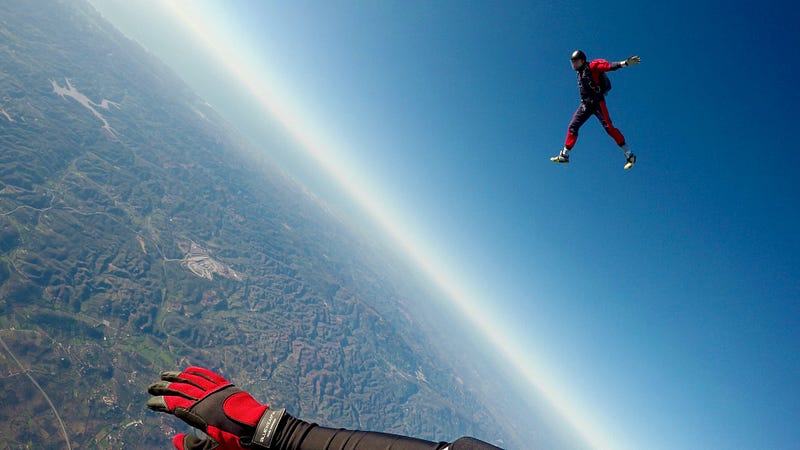
In 1990, I was skydiving regularly. I was doing what’s called a ten-point two-way, or practicing high-level skills with another skydiver over the Colorado countryside. We waved off at about 3200', turned and tracked away from each to give each of us a safe opening space in the sky.
I was streaking through the air close to 100 mph, in addition to my downward speed of about 120 mph. I reached back, jerked my pilot chute out of its compartment, and instead of throwing the pilot chute out perpendicular to my body, threw it behind me. A simple mistake, but potentially deadly.
The small chute promptly curled itself tightly around my left ankle, preventing my main rig from deploying.
In 1974, I watched a girlfriend of mine hurtle to her death while trying to “fix” her chute. Only took a few seconds at those speeds.
What I did was so automatic and so swift I don’t recall a single bit of it. The fact that I can write about it attests to the accuracy of my pivot.
When the chute didn’t open, I gave my body an instant side-to-side jink to loosen the chute, which sometimes works. You don’t have time to turn around, look, and try to figure the fucking thing out.
Didn’t. I immediately released my main and pulled the pin on my reserve, which opened with all the gentility of being hurled to the ground by an angry elephant.
Hurts. But you bloody well live.
Then I calmly watched my beautiful blue and while primary parachute float like a twisting butterfly to the ground below as I negotiated my one and only landing squarely in the center of the peas.
PIVOT.
I’ve had to call on the ability to utterly and dispassionately do what has to be done in order to stay alive. You worry about your feelings and shock later. You worry about minor injuries later. You simply pivot NOW and tend to what is in front of you. Or create something new.
My fellow travelers and adventurers can speak in detail to how we have had to learn to pivot constantly to deal with the unpredictability of life in the wild. A bad rain that causes a mighty river to overflow, and you have to move your entire campsite, horses, gear and food to higher ground in the dead of night, in pouring rain, and with animals in all directions, many of which aren’t very picky about what’s on the menu. Those experiences, along with all the failures and flops and falters have taught me the art of pivoting.
Losses still hurt. Failures still sting. Flops still are feedback. But what defines success in life has far more to with our ability to acknowledge what is real, immutable and non-negotiable, including those things which are for now unavailable to us.
Are you able to turn your necessary pivots into a daily dance? What is happening right now for you to swiftly change your attention and direction from what was and must for now be released, to what is and offers promise? Can you learn to embrace these things with the humor that they deserve, the grace that they offer, and the courage to step into the Next New Thing that is being offered you?
However long it takes for you to make that pivot is right for you. However, the more you practice, the easier it gets to refocus as life requires. To let go of a chapter, a person, a hope, a Dream House. It will happen. For many of us right now it’s happening damned near every single day, if not every hour.
We are not always privy to what may come to us next. However, I have learned that the more swiftly I turn to what’s coming rather than I what I may have lost, the more swiftly I can build momentum. Momentum does indeed help drive success, however you and I may define it.
Pivoting has taught me how to dance in mid-air.

It has its costs. No question. But I have learned to change directions as swiftly as any bird in mid-flight.
Right now, that is making all the difference.