
How Do You Differentiate a Komodo Dragon From an Asian Water Monitor?
They’re two giant lizards, but actually have several key differences!
I decided to try something different for the new year: content I don’t normally publish or even see on Medium. Instead of boring content about new year’s resolutions or complaining about algorithms, why not tap into something you LOVE? One of my greatest loves after toads is gigantic monitor lizards!
As one of Twitter’s resident herpetology enthusiasts with some giant reptile husbandry experience, I get asked lots of questions about those big puppy lizards I love sharing. One of the most common questions is, “How do you tell the difference between a Komodo dragon and an Asian water monitor? What IS the difference?”
For starters, they’re both giant lizards from the same taxonomical family, the varanidae family. Most of the genera under varanidae have gone extinct, except for the varanus genus. This is why lizards in this family are also known as varanids and why you see “varanus” in the scientific names of giant lizards.
Asian water monitors and Komodo dragons share some features and behaviors, but they’re absolutely two different giant lizards.
The 5-Second Movie version is that Asian water monitors are thriving as a species for the most part, can make great pets, and they got a nasty bite and sharp claws but are generally not venomous (that’s lizards in the heloderma genus, like Gila monsters).
However, this isn’t the case for Komodo dragons! They’re highly endangered giant lizards, with less than 1,500 in the wild. Their bite is even nastier, as they’re the only known varanids that have a venomous bite. While Asian water monitors can be socialized even if they’re wild-caught, adult Komodo dragons in the wild definitely earned their ferocious reputation. Their venom can take down a water buffalo, and any cuts or bites from a Komodo dragon will absolutely send you to the hospital.
When you see a reptile in film or TV and it’s introduced as a Komodo dragon, it’s likely an Asian water monitor or crocodile monitor since they can be tamed, bred captively, and aren’t endangered.
Although the recent success at the Bronx Zoo in captive-breeding Komodo dragons offers a glimmer of hope for reptile conservation, and for reptile hobbyists like me — seeing how even the largest and most dangerous varanids in the world also have potential to just be these sweet, lumbering dinosaur puppies.
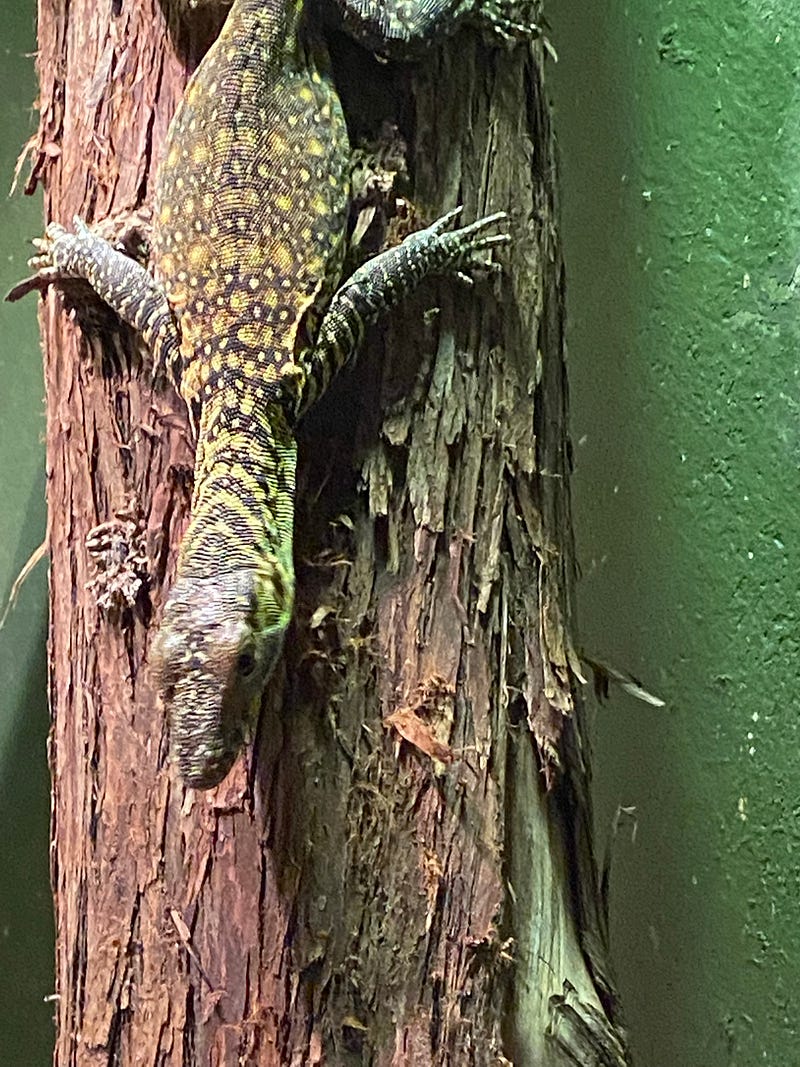
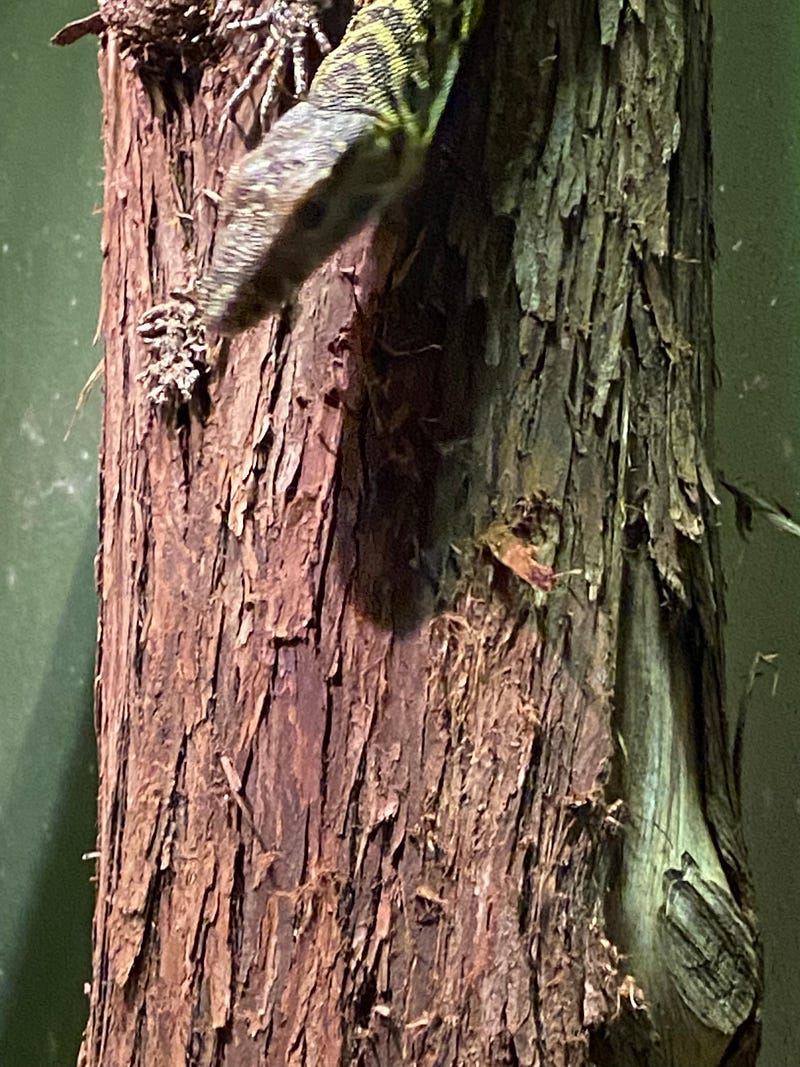
Except for the adorable yellow markings all over the hatchling’s back, I would’ve thought this sweet baby was one of the incredibly well-socialized, multigeneration captive-bred Asian water monitors from NERD. He was extremely friendly and curious, exploring the environment and climbing the tree.
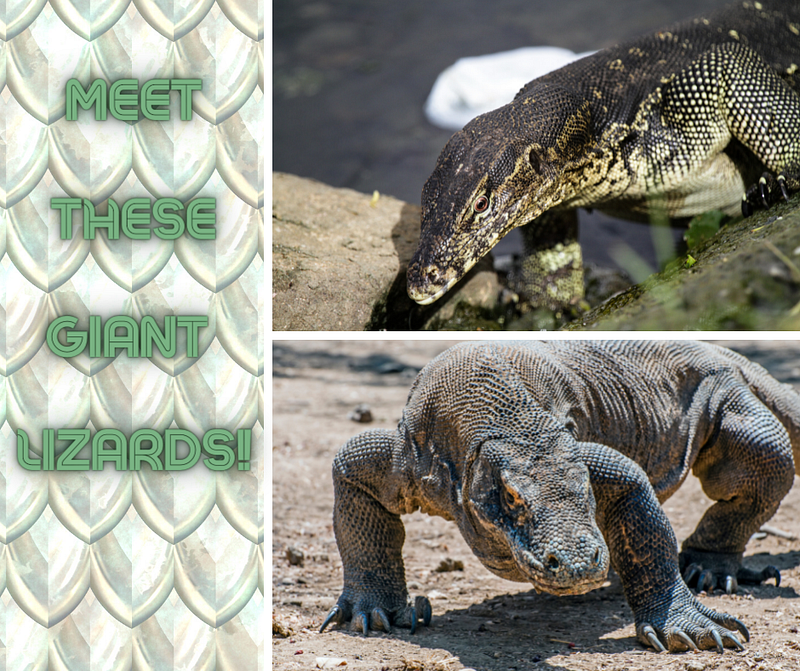
Take a look at these hatchlings, and the adult lizards in the thumbnail image.
One of the most obvious ways to tell the difference is that Komodo dragons are WAY bigger. We’re talking the difference between a horse and a pony as far as size goes. They’re the largest lizard in the world, while the Asian water monitor is the second largest. Some Asian water monitors get enormous, so if you ever wanted to really tell the difference, just look at their face shapes. Asian water monitors have pointy snouts and narrower faces than Komodo dragons, the latter has that unmistakable large square snout.
Komodo dragons tend to be monochromatic, while Asian water monitors carry genes for different colors.
Most Asian water monitors that you see in the reptile community in the US are gray or dark brown with some slight patterns on their backs, such as the notable Slinky of Kamp Kenan. Just like humans, giant monitor lizards carry dominant and recessive genes which can affect their coloration, patterns, size, and other aspects of their appearance.
Rusty and his siblings at the Reptile Zoo are sulphur monitors, which have distinctive patterns with more white than black.
Monitor lizards can also carry T- and T+ genes, which pertains to the presence of the enzyme tyrosinase, which synthesizes melanin.
T- sulphur monitors can be marbled white and black like Rusty here, but they can also be T- to the point of being albino (which NERD has successfully bred). T+ monitors will have higher degrees of melanin that give them more black areas instead of those patterns you see on their backs. Diametrically opposite of albino lizards, the T+ melanated monitor is rarer and harder to breed, and is also known as the Black Dragon.
Black Dragons aren’t a separate species, they’re just extremely gothed up varanus salvators. They can also grow freaking enormous and strong, so it’s like if Peter Steele was reincarnated as a giant lizard.
Komodo dragons are also monogamous.
While the appearance makes them easy to tell apart, their behaviors also serve as major tells — and not just in how they interact with humans where tamed Asian water monitors are essentially like scaly puppies while Komodo dragons definitely should not be approached in the wild.
While female Asian water monitors and Komodo dragons will basically try to murder males that try to mate with them, the latter is monogamous which is pretty rare for lizards. Once she bonds with a male, she’s the one who puts a ring on it. (Claw on it?)
Komodo dragon males will fight each other over the females in a display of strength and ferocity, then do some tongue flicks to gauge her interest. (I do not suggest human males reading this try it. You’re going to get side-eyed and laughed at on Twitter.)
But did you know that some female monitors will engage in this behavior when they just don’t want to mate?
If you just got into the reptile hobby, you may have heard the term “breeding females”. Just like humans — some of these lady monitors just DO NOT want to make hatchlings. As a human woman who doesn’t want to have kids, I get it and it only makes me love these big lizards even more. But there’s lizards who are down, and they’ll happily mate and produce clutches of eggs.
Unlike the Komodo dragon though, Asian water monitors can be fairly polyamorous. Although while female monitors don’t engage in parthenogenesis? There has been one recorded instance of a lesbian Asian water monitor pair that resulted in fertile eggs that hatched!
Giant lizards are endlessly fascinating. Observations in the wild combined with us hobbyists who keep them as pets or breed them professionally are constantly teaching us more about these amazing creatures, and now the Internet is making them less misjudged and misunderstood.
Now that I’m in a warmer clime, I can’t wait to get an urban dinosaur or two of my own.


