
How do I have White Privilege?
I’ve had obstacles in life. How can they say I’m privileged?
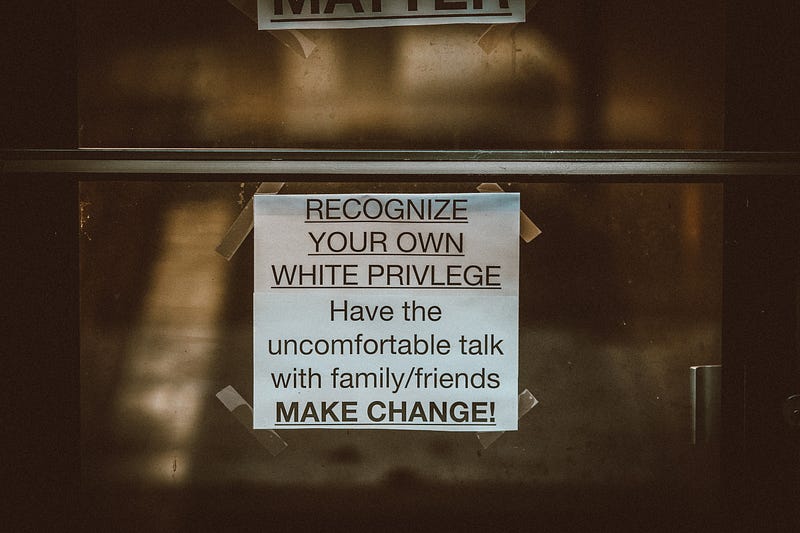
I’m a white, gay male, and the only child of a single mother. Nearly everyone on my mother’s side having heart attacks, my mom having a stroke my sophomore year of high school, my father being an alcoholic, family members moving across the country to be with someone they’ve barely known. Neither of my parents graduated college. I’ve had to work hard for most of what I have.
How can society tell me I have it better than everyone else just because of my skin color?
Ta-Nehisi Coates wrote an exceptional article about this topic. I’ll summarize the first section for you: There was a man named Clyde Ross born in 1923 in Mississippi. He moved to Chicago in 1947 and got a job at Campbell’s Soup. He and his wife bought a house in 1961 for $27,500, while the seller had bought it six months earlier for $12,000. “If he missed a single payment, he would immediately forfeit his $1,000 down payment, all his monthly payments, and the property itself.” Ross tried to get a legitimate mortgage elsewhere, but the truth was the redlining dominated neighborhoods across the country and prevented him from moving up in the world.
The system was built against him. Despite all of his hard work, he still wasn’t treated fairly. As of 2014 when the article was written, “Clyde Ross still lives there. He still owns his home.”
“Two hundred fifty years of slavery. Ninety years of Jim Crow. Sixty years of separate but equal. Thirty-five years of racist housing policy. Until we reckon with our compounding moral debts, America will never be whole.”
I emphasized dates here because of how recently all of this took place. Even 60 years later, he and his family feel the effects that redlining and discrimination had on the housing market. Completely ignoring any current inequities that exist, look at how past injustices continue to affect families today. Money that he could have used to fund his children’s education had to go to his mortgage. Imagine a scenario where his family is compared to another that had a legitimate mortgage: out of the two, whose children do you think have higher salaries? Whose children do you think became more ‘successful?’
For more information, check out the rest of Coates’s article here:
Now that we’ve looked at how your parents’ lives can impact your success, let’s examine how other people’s lives can.
In modern American society, what generally determines an individual’s success? Their job, family, wealth? What influences their job and level of wealth? Their education, parents’ wealth? What impact the type of education an individual receives?
And what determines where a student goes to school? That would be their neighborhood, unless their parents are affluent enough to purchase a private education, homeschool their student, or drive to a better school district. But it’s likely that if their parents are wealthy enough to do these things, they won’t need to anyway. Schools receive most of their resources through state and local funding. Of course, local funding comes from property taxes. Schools in wealthy districts obtain more money in property taxes than those in poorer ones. Wealthy students are then able to obtain more resources, better teachers, and more support from their parents, so they go to college and get better jobs, continuing the cycle for their own children.

Those in poorer districts on the other hand, have to work harder with less resources and learn in schools with higher student:teacher ratios, just to get a chance at a better life than their parents had. Therefore, it’s more difficult to go to college or get a high-paying career.
Check out this article for more information on how schools receive funding:
Check out this article for more information on how historically black neighborhoods impact residents’ futures:
So how do I have white privilege?
I have white privilege because I had to work a ‘normal level’ or hard work to succeed. Others had to work at a ‘high level’ of hard work just to stay afloat, even when they did everything right.
I’ve had obstacles in life, but so have other people. I’m lucky that my family wasn’t taken advantage of due to their skin color. I’m lucky that I go to the school that I do, which isn’t the one I’m zoned for. I wouldn’t have gone there had my mother not pushed me when I was young. Imagine if she had to take on a second job or find one that was an hour away from where we live: my life definitely wouldn’t be the same today.
It isn’t about putting white people down or telling them that their stories don’t matter. It’s about achieving equity within American society and allowing disadvantaged groups to have the same opportunities that we do.
Any little part of an individual’s life has the power to change their future forever. The success of their parents, the street they grew up on, and the people they hung out with as children all impact the person they grow up to be. Even events that happened 60 years ago have an effect on the present as Clyde Ross’s story proves to us. Remember that nobody else has the same experiences as you, so it’s important to be respectful when they relay them to you. Listen. Learn.
“Live so that when your children think of fairness, caring and integrity, they think of you.”
— H. Jackson Brown Jr.
If you enjoyed this article, please give it a clap and follow me to see more like it! If you have anything to add, be sure to let me know in the comments.