
How did Michael Rockefeller die? Riddle solved? The millionaire was eaten by cannibals?
Michael Rockefeller was about to be eaten by Papuan cannibals. The whole world was talking about this story. What really happened in 1961?
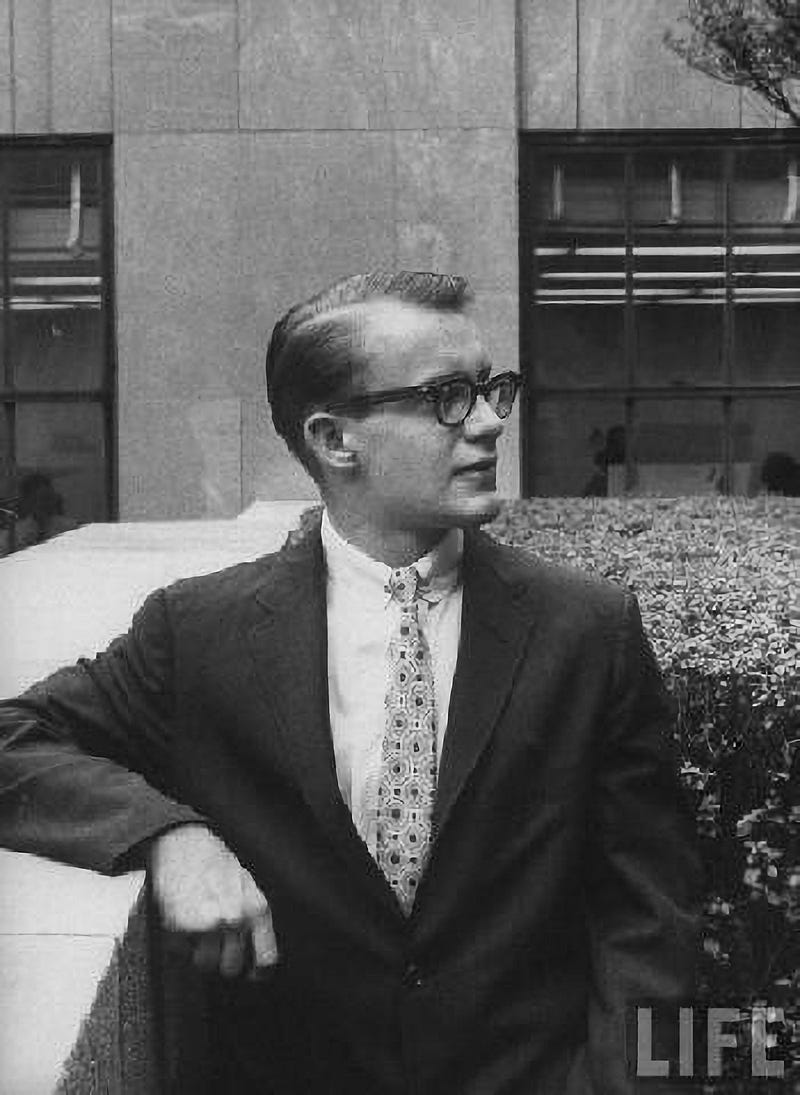
Michael Rockefeller, a recent graduate of Harvard University’s anthropology department, traveled to Papua in 1961 at the behest of his father. Nelson Rockefeller, the mayor of New York City, instructed him to assemble a collection of tribal art for the family-funded New York Metropolitan Museum of Art. After spending several months in the Baliem Valley, Michael traveled south of the island to the coast of the Arafura Sea. This was the territory of the Asmat tribe, who had a reputation as Oceania’s most sophisticated carvers, but also headhunters and cannibals.
Previously, the Rockefeller collection had included random works of art from Papua, collected by army officers, colonial officials, and a few missionaries. Determining the origin of these artifacts was often impossible. Therefore, Michael decided to do something that no one before him had done — get to the very source. He set out for the “heart of darkness.”
For several months he traveled through the Asmat villages, collecting and documenting art and wowipitsj (wood carvers). Then he sailed toward the Kazuarin Coast. On November 17, 1961, a few kilometers offshore, rough waves overturned a catamaran several meters long. On board were Michael Rockefeller and Dutch anthropologist Rene Wassing and local guides, who immediately swam for help. However, no help was forthcoming. After two days of drifting, the boat drifted 20 km to shore. Impatient, Michael decided to swim back to shore. He was young and strong and believed that he would reach his destination in a dozen or so hours. Just in case, he tied himself with a rope to which two fuel canisters were attached.
Early in the morning he set off towards the land visible on the horizon. After a few dozen minutes he disappeared from the sight of his companions and the trace of him vanished.
The missing millionaire
Today, in the age of cell phones, GPS and satellite communications, it is hard to imagine such a situation. However, more than half a century ago, despite setting a reward and organizing a months-long search campaign in which hundreds of people were involved, no trace of the missing anthropologist could be found. Speculations multiplied — nobody wanted to believe that Michael Rockefeller simply drowned in shallow coastal waters.
It seemed more likely that he had fallen prey to a shark or one of the powerful saltwater roseate crocodiles then common in those waters. It was also suggested that the anthropologist, surrounded by natives, went deep into the jungle, like Kurtz, the hero of Joseph Conrad’s “Heart of Darkness”, or died at the hands of cannibals. However, none of the options was confirmed by facts and in 1964 Michael Rockefeller was declared dead.
For decades his legend attracted adventurers and adventurers to Papua. Reportedly, in the late 1970s, the Rockefeller family hired a private investigator who managed to trade a boat engine for three white skulls in one of the Asmat villages. Locals maintained that these were the remains of the only three whites killed and eaten in the area. Whether one of them belonged to the missing anthropologist and whether the finder received a quarter million dollar reward for bringing it back to the United States is unknown. The Rockefellers have never confirmed or debunked these rumors.
References to Rockefeller’s death appear in the memoirs of Tobias Schneebaum, an art collector who spent many months in the late 1970s in the Asmat areas, living among the locals and continuing Michael’s work. Reportedly, in one village Schneebaum met warriors who confessed to participating in the killing and eating of a white anthropologist. Given the traditions cultivated by the Asmat, this version seemed highly likely.
Who are the Asmat?
The Asmat were first described by James Cook in his journal of an expedition in 1770. His ship anchored at the mouth of the Kuti River. Two boats full of people set out to find a source of fresh water. The mariners encountered a flotilla of dugout canoes filled with armed warriors — a skirmish ensued in which 20 of Cook’s men were killed by gunfire.
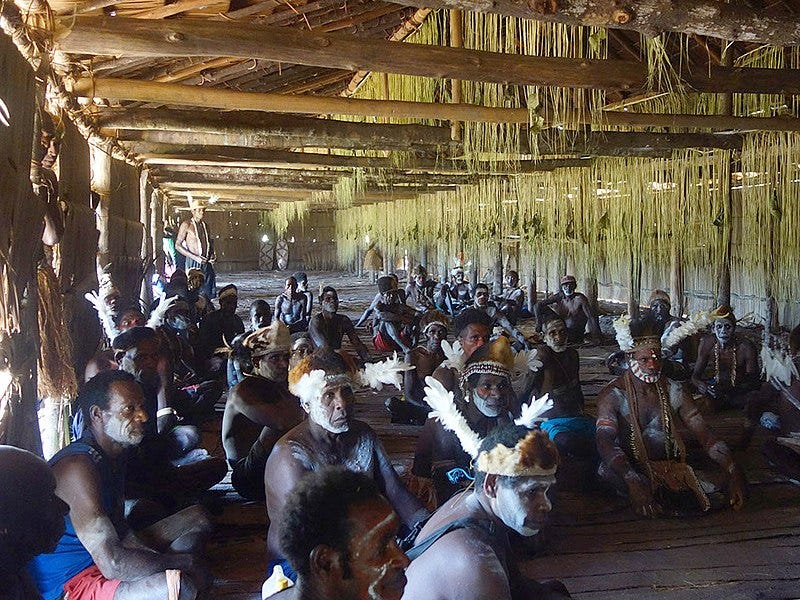
Over the next few centuries, the hostile terrain, harsh climate, and grim reputation of merciless headhunters discouraged any contact or expeditions to the area. The first missionaries arrived only in the late 1940s and early 1950s. They found the villages immersed in permanent war. The Dutch administration made attempts to pacify the headhunters from the south of the island, and military posts were set up in the areas of the Marind-Anim and Asmat tribes. Participants of the headhunting expeditions were tried and punished, but the jurisdiction of the colonial authorities reached only a few miles from the post.
Until the early 1960s, the area was under Dutch control as part of the Dutch East Indies. Today, the villages located on the coast of the Arafura Sea belong to Indonesia. They have permanent contact with the world — in most of them there are posts of the Indonesian army and police, and next to the Asmat villages there are settlements of Indonesians resettled from Java and Sulawesi.
The most dangerous region in the world
The south of New Guinea is one of the least human-friendly regions in the world. From the foot of the Snowy Mountains to the shore of the Arafura Sea stretches a few hundred kilometers wide belt of swampy lowland jungle, crossed by a dense network of rivers with murky water, and muddy channels inhabited by crocodiles rosary. Every day the salty waters of the tide rush tens of kilometers inland. There are no roads here, and no land can be cultivated. Settlements in the tidal range of the Arafura Sea, clinging to the muddy banks of rivers and streams, can be reached for a few hours a day, when the water level is high enough that boats hollowed out of tree trunks don’t get stuck in the mud. The rest of the time the villages are cut off from the world.
People depend on what they can catch in the sea and rivers and what the unfriendly jungle produces. And the jungle doesn’t seem to produce much — semi-wild bananas, sago and wild tobacco — often in places that are many hours away from the village by boat. It takes a long time to get food, and villages seem to be completely deserted for most of the day. Their inhabitants camp in the jungle near sago palm groves or on hunting grounds.
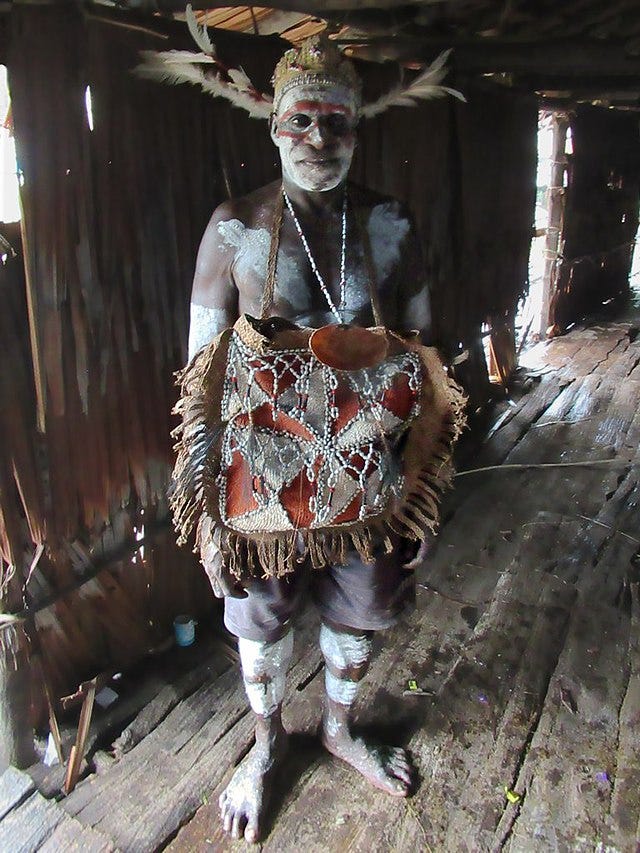
The settlements usually consist of a dozen or more houses, gathered around a jeu — a long house of men facing the shore. Jeu is the heart of the community — all preparations for ceremonies and rituals take place there. Only men have access to the house — they sleep there, carve or simply protect themselves from the heat and women, and smoke tobacco. Each of the clans living in the village has its own hearth in the long house (or in one of several long houses if the village is larger), guarded by carvings of ancestors.
Ceremonial objects belonging to the clan are kept above the hearth: drums, masks and heads captured during military expeditions. The Asmacs have always gone on expeditions to get them, and in the communities more distant from civilization this custom was secretly cultivated until recently. Only a few or a dozen years ago it happened that people disappeared without a trace, and after some time new trophies appeared in one of the neighboring villages. A freshly captured head was an essential prop in initiation rituals, and the number of captured heads represented a man’s social status.
Who are the cannibals
War expeditions and the capture of heads were accompanied by cannibalism. Although deeply rooted in ritual and ceremony, it had a very mundane basis in this region. Human meat was an essential supplement to a diet poor in animal protein — humans, along with ostrich-like flightless cassowaries, crocodiles and wild pigs, were the primary game in the jungles of New Guinea. The bodies of slain enemies were quartered and butchered according to rules passed down from generation to generation. Meat from cut off limbs and guts was mixed with sago flour after roasting in fire. This is how the sacred bread was made, which was served to all the participants of the feast. Everyone also rubbed themselves with the blood of the killed person mixed with the ash from his tanned hair. Thanks to this they could unite with him. The skin was removed from the roasted head. With a blow of a stone axe a hole was punched in the skull, from that moment the axe bore the name of the slain. The brain mixed with sago flour and baked in the leaf was reserved for the elders.
A skull without a mandible (just in case the deceased decided to want revenge) was decorated with braided beads and seeds, feathers, and hung over the hearth as a trophy confirming the social status of the killer. Cannibalism was practiced by most inhabitants of New Guinea. Although forbidden and severely exterminated by Indonesian authorities, it turned out to be so deeply rooted in the culture and beliefs that some tribes living in the interior — such as the Korowai — still cultivate it today. It is the tales of the cannibals that attract tourists to this unfriendly region. Nowadays, whites can feel relatively safe — all indications are that only a few outsiders disappeared in the region during the 20th century.
Who ate Rockefeller?
All signs point to yes. Several years ago, fascinated by the legend of Rockefeller, American reporter Carl Hoffman began to explore archival materials on the circumstances of the death and search for the missing anthropologist. The research led him to embark on an expedition in search of the last living witnesses of those events. In 2012, he traveled to West Papua to uncover a grim secret that had been hidden for two generations. Traveling in the footsteps of an anthropologist, he reached the last living witnesses of the events in a village lost among the swamps. The locals confirmed the most horrifying version of Rockefeller’s last moments — presenting the journalist with a peculiar re-enactment of his death. The fascinating account of the journey and search was published a few months ago in a book entitled “Savage Harvest”.
It turned out that after several hours in the water, exhausted to the limit of his strength, Michael Rockefeller swam to the shore. There, eight long boats with several dozen warriors from the village of Otsjanep were waiting for him. Unluckily, a few years earlier a Dutch patrol had killed several inhabitants of this settlement as part of a pacification operation. Now the opportunity arose to kill someone from the white tribe, raising his social status and showing courage towards his cousins and relatives. As Hoffman relates, a warrior named Pep, without thinking long, drove a spear blade into the white man’s belly. His companions helped him drag the lashing Rockefeller into the boat. They rowed toward a small cove, where, in accordance with the age-old rules, they completed the ritual by quartering and eating the flesh. Thus, for a time, they restored the shattered, fleeting balance.
Does the story described in the book close the case? Hoffman’s version seems plausible and grounded in the realities of the area. Unfortunately, there is no hard evidence — one can speculate that one of the three white skulls brought back by the detective was in fact a Rockefeller skull. This could be confirmed by DNA testing, but here the move belongs to the Rockefeller family. Michael’s death was a huge trauma for them, especially for the anthropologist’s sister, so it is hardly surprising that they no longer want to pursue the case and have left the book without comment.
Cool that you made it to the end of this article. I will be very pleased if you appreciate the effort of creating it and leave some claps here, or maybe even start following me. Thank you!


.jpg)