
How Can You Take Advantage of The Third Industrial Revolution
The ‘Internet of Things’ will connect everything with everyone: a new consciousness for a new era.
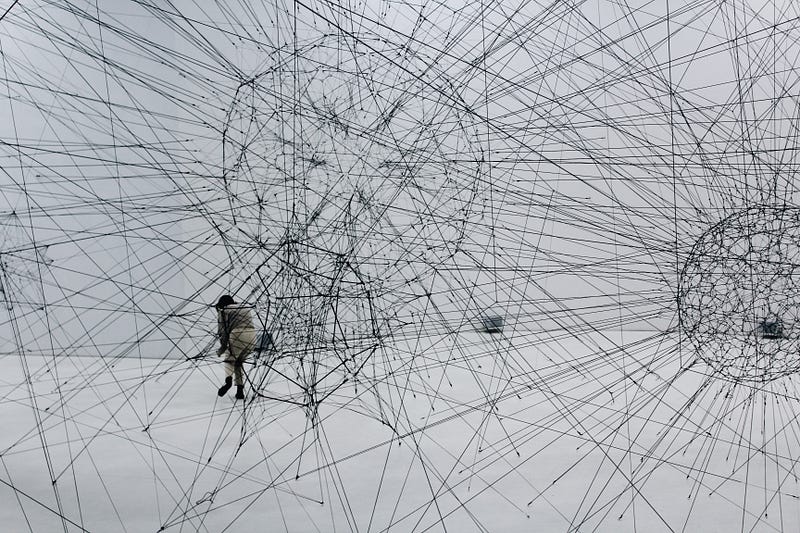
Baby boomers and older generations have been living in a vertical political system for centuries.
However, the Millennials to GenZ grew up in the Internet generation. They grew up thinking that power has to do with the network they’re engaged in. So for them, power is not vertical; it’s lateral.
For younger generations, power is being meshed network after network where they benefit each other, in an open-source philosophy.
Yet, the power of communities is arising; there’s no way out. The Internet of Things is here to stay and evolve into the next boom, the next renascence of the modern era.
The beauty of living in a renaissance moment is that we can retrieve what we lost the last time around. Just as medieval Europeans retrieved the ancient Greek conception of the individual, we can retrieve the medieval and ancient understandings of the collective. We can retrieve the approaches, behaviors, and institutions that promote our social coherence.- Douglas Rushkoff in We Went From Tribal to Individual. Something Else Must Come Next.
But what is The Internet of Things, and how will it impact our lives and change our habits?
Life is the art of drawing without an eraser.
Our scientists today say that we’re in the sixth extinction event of life on Earth. Yet, it doesn’t appear in the newspaper's headlines.
This is a dramatic story about the human race, and nobody seems to care.
There have been five major extinction events over the last 450 million years. And each time the chemistry of our planet changed dramatically, passing the turning point, it turned into a massive die out.
After the massive die out, it takes up to 10 million years to get new life back on Earth.
I know everybody hopes for us to go to Mars and beyond, but are we really able to mess up our fabulous planet? Are we going to mess up our entire species because we weren’t smart enough to realize we’re playing with fire?
Scientists say that we could lose over half the species of life that inhabit the blue planet in the next seven decades.
We’re all messing up big!
We, human beings, are the younger species on Earth. We’ve just been here about 200,000 years. But there’s no guarantee we’re going to make it.
The ocean currents are being changed with ice freshwater melts in Greenland and the Arctic. As a result, massive storms have been more frequent, and a few decades from now, they will be massively catastrophic.
Do we want this future for our kids and grandchildren?
If we want to escape this dangerous extinction, we must drastically change our worldwide plan to deploy that terrible vision of human being’s extinction.
We have to be off carbon in four decades everywhere. And this is not a political issue; it’s a survival one. So, in this matter, there is no China or UK, there is no European Union of the USA. There’s one single beautiful blue planet to take care of.
How can we project a plan of this magnitude?
As Jeremy Rifkin mentioned:
What are those three technologies?
First, new communication technologies that turn our economy more efficient. In the first industrial revolution, in the 19th century, the British started with communication by inventing the steam-powered printing. Steam-powered printing was a giant leap forward, allowing the population to have quick fresh information.
Second, new sources of energy to more efficiently power our economic activities. For example, in the second industrial revolution, in the 20th century, the Americans invented the centralized electricity grid, which allows the telephone, another invention, to absolutely revolutionized entire industries boosted with cheap Texas oil.
And third, new forms of mobility and logistics allow us to move our daily economic activities more efficiently. In the 21st century, the self-driving cars will radically transform cities’ landscapes, daily routines, structural jobs, everything.
When communication revolutions join with new energy sources and new modes of transportation, it radically changes our way of life- it actually even changes our consciousness and governance.
Can we reach biosphere consciousness and global empathy in time to avert planetary collapse?
“In the 24 hours since this time yesterday, over 200,000 acres of rainforest have been destroyed in our world. Fully 13 million tons of toxic chemicals have been released into our environment. Over 45,000 people have died of starvation, 38,000 of them children. And more than 130 plant or animal species have been driven to extinction by the actions of humans. (The last time there was such a rapid loss of species was when the dinosaurs vanished.) And all this just yesterday.- In “ The last hours of ancient sunlight “ by Thom Hartmann
If we could jump into the future, future generations would identify the Bronze Age, the Iron Age, and the Oil Age. This last one would be characterized as an era where the entire global population went into hysterical exploitation of natural resources and almost brew up the whole ecosystem.
It’s all about fossil fuels.
Even our fertilizers, pesticides, or pharmaceuticals are made out of fossil fuels.
Everything is dependent on fossil fuels.
This is a convulsion of growth-shutdown, growth-shutdown, growth-shutdown.- Jeremy Rifkin
When some other countries out of the OPEC (The Organization of the Petroleum Exporting Countries) tried to get out of the oil dependence, searching for alternative forms of producing energy, the OPEC countries started to flood the world with an oil price point around $30.
What happened to companies that started producing shale gas in the US and tar sands in Canada? OPEC wiped them out in a year and a half. Bankrupcies all around the US and Canada and a potentially new renewable industry suddenly disappeared.
After the bankruptcy process ends, the price of the barrel starts to go up again. Yet, where the oil production exists, failed states also exist. And we live in this strange global dynamical spiral — an unstable world for the next decades.
When Germany, one of the most efficient productive countries in the world dependent on oil infrastructures, post-industrial revolution communication infrastructures, and mobility and logistic groundwork from three decades ago, what have we been missing?
Economics is governed by the same laws that govern the universe, the solar system, and the biosphere on Earth. Not Newton’s law that made us humans only account for 14% of the productivity.
“For every action, there’s an equal and opposite reaction” made modern economists use it for the supply and demand premise- for every action of the supply side, there’s an equal and opposite reaction on the demand side.
However, we’ve been modeling the entire economy under a false premise.
The planet Earth has had plenty of energy coming from the Sun for billions of years. But we don’t have more different matter coming down here in terms of fixed matter on our planet.
So, we extract energy from nature, and through our value chains, we store it, ship it, produce goods and services from it, consume it, and recycle some of it back to nature.
At every step of the conversion, we lose some energy in the process. In economics, it’s called “aggregate efficiency.”
Aggregate efficiency is the ratio of the potential work to the actual valuable work that gets embedded into a product or service.
Imagine a lioness chasing an antelope and kills him. Then, only 10 to 20% of the energy comes from the antelope into the lioness. That energy transfer is called aggregate efficiency.
The US started the second industrial revolution at the beginning of the 20th century with 3% aggregate efficiency. By 1990, the US got up to about 14% aggregate efficiency.
Germany reached 18.5% aggregate efficiency in the 2000s, and the world’s record comes from Japan with 20% aggregate efficiency in the 1990s.
If the infrastructures are yet from the 20th-century industrial revolution in these ultra-efficient countries, we’re trying to operate the infinite game with a finite mindset. Meaning, we want to take steps into a new revolution, but we’re still fighting to survive with the old infrastructures.
Knowledge is the share experience you have as a social being.
Recent economists that happen to study physics added a third factor to productivity:
Better machines, better workers, aggregate efficiency.
A new conversion to communication, energy, and transportation will create the third industrial revolution.
Actually, in Germany, the Chancellor Angela Merkel already started it. President Biden has a 6 trillion dollar check from the Federal Reserve also to try to catch up.
With its Silk Road Economic Belt, China will improve multimodal transport connectivity on multilateral trade and economic growth in countries and regions across Europe, Africa, and Asia, in a 4 trillion dollar investment. It’s running fast to the third industrial revolution.
The Internet of Things will be the base of the internet of communications, the internet of energy, and the internet of transportations. It will connect everything to everyone.
Millions and millions of sensors in the agriculture industry, in factories, in smart homes, in logistic pipelines, in self-driving cars, in warehouses, and in intelligent roads are sending data. All of them are collecting data into these three internet platforms, communication, energy, and transportation, to manage power and move economic life.
We’re building a “nervous system” that connects everything to everyone that’s going to allow everyone on this planet, at a meager cost, to engage with each other on a global Internet of Things.
This is the revolution.
This third industrial revolution is not centralized but globally distributed. It will be collaborative, open, and transparent. It will use smart contracts to disrupt the middleman and get ultra-efficient.
A vast expansion of entrepreneurialism will rise into global neutral networks in a Snowden’s fashionable way.
Every citizen will share their data and pick up some of them to mine it, giving input into the ecosystem, and everything will exponentially grow in an open-source network.
Final Thoughts
Entire industries have been disrupted in the 17 years since Napster.
The music industry has shrunk. The television audiences have shrunk since Youtubers created a new industry. Facebook has disrupted our social network, Tesla has disrupted the auto industry, and Amazon has disrupted the retail sector.
In 1978, the price of the kilowatt/hour on solar was $78. Today, power and utility companies are quietly buying long-term contracts for solar and wind in Europe and the US for 4 cents per kilowatt/hour.
It’s game over for the oil industry.
Thousand of new enterprises have been created new projects under completely opposite premisses. They are making the networks, the connectivity, the platforms, and the blockchains.
The zero margin call and sharing society are gaining terrain, transforming the old analog ecosystems into new ones. Margin call societies are the new economic structure built under a deflationary ecosystem. Meaning, new projects are being designed to be efficient, at zero cost margin, creating new bases for new creations, sectors, or industries in endless cycles.
There are some doubts about the robotization of the entire industry- if it will eliminate job opportunities or create new ones.
However, for the next two decades, things will change dramatically and quickly, like any other technological disruption.
Economic attributes like digital thinking, mechanical and electronic competencies, and biological skills will be powerful tools to dominate this new economy.
Also, human attributes like kindness, competence, communication skills, artistic capabilities, vision, courage, and organized capacities will be human characteristics that will outstand in a robotized economy.
You must be open-minded in the following decades to thrive through this new technological disruptive era.
Knowledge will be the best asset to shift our mindsets into this new world.
This article is for informational purposes only, it should not be considered Financial or Legal Advice. Consult a financial professional before making any major financial decisions.
Sign up for my email list and join the happiest readers on Medium. https://nunofabiao.medium.com/subscribe (This is where you get exclusive access to my daily activities, experiences, and daily thoughts)