…</p><p id="2ed0">We are overstepping planetary boundaries big time, as you can see in recent studies by the <a href="https://www.stockholmresilience.org/research/planetary-boundaries/">Stockholm Resilience Center</a>. Nitrogen, phosphorous, climate change, biodiversity loss…</p><p id="9c15">And it can be done differently. We saw the clean air above China when production was closed for a few weeks. Nature herself is very resilient.</p><div id="0883" class="link-block">
<a href="https://readmedium.com/environment-does-the-coronavirus-trigger-new-economic-ways-with-less-pollution-19642e9fbeb5">
<div>
<div>
<h2>Does the Coronavirus Trigger New Economic Ways With Less Pollution?</h2>
<div><h3>NASA satellite footage shows an astonishing drop in Chinese pollution</h3></div>
<div><p>medium.com</p></div>
</div>
<div>
<div style="background-image: url(https://miro.readmedium.com/v2/resize:fit:320/1*jEZvOYKvT06bhDBP7lBtUQ.png)"></div>
</div>
</div>
</a>
</div><p id="5824"><b>2 Ecologists have been warning us for years that viruses will transfer from animals to humans</b> <b>because of our destruction of their habitats.</b></p><p id="1626">It’s really a logical conclusion. Viruses have unique animal hosts. We destroy the habitats of these hosts. So they find new hosts. Us, humans. New pandemics are born. We are to expect more of those…</p><div id="0021" class="link-block">
<a href="https://www.theguardian.com/environment/2020/may/07/promiscuous-treatment-of-nature-will-lead-to-more-pandemics-scientists">
<div>
<div>
<h2>‘Promiscuous treatment of nature’ will lead to more pandemics — scientists</h2>
<div><h3>Humanity’s “promiscuous treatment of nature” needs to change or there will be more deadly pandemics such as Covid-19…</h3></div>
<div><p>www.theguardian.com</p></div>
</div>
<div>
<div style="background-image: url(https://miro.readmedium.com/v2/resize:fit:320/0*CiaeNdqRNvjPvaZ3)"></div>
</div>
</div>
</a>
</div><h2 id="3b00">Alternative Routes</h2><p id="3045">So how can we get through the storm taking a different route? I want to address 4 points:</p><ul><li>Jobs and Money</li><li>Food Security</li><li>Responsible Business</li><li>Real Estate Speculation</li></ul><p id="57fd">And then I want to give you some real-life transitional examples in Europe.</p><h2 id="27ba">Jobs and Money</h2><p id="b7d7">What if we would spend the money not on wasteful, big businesses but on the workers directly? What if we would spend all these trillions on a Universal Basic Income (UBI)?</p><p id="09ac">There’s overwhelming evidence that the most efficient way to pull people out of poverty, is by giving them an income without patronizing them.</p><p id="adbc"><a href="undefined">Rutger Bregman</a> speaks about it in <b>“Poverty isn’t a lack of character, it’s a lack of cash.”</b></p>
<figure id="e024">
<div>
<div>
<img class="ratio" src="http://placehold.it/16x9">
<iframe class="" src="https://cdn.embedly.com/widgets/media.html?src=https%3A%2F%2Fwww.youtube.com%2Fembed%2FydKcaIE6O1k%3Ffeature%3Doembed&display_name=YouTube&url=https%3A%2F%2Fwww.youtube.com%2Fwatch%3Fv%3DydKcaIE6O1k&image=https%3A%2F%2Fi.ytimg.com%2Fvi%2FydKcaIE6O1k%2Fhqdefault.jpg&key=a19fcc184b9711e1b4764040d3dc5c07&type=text%2Fhtml&schema=youtube" allowfullscreen="" frameborder="0" height="480" width="854">
</div>
</div>
</figure></iframe></div></div></figure><p id="64a1">As Rutger explains, it will get people out of the scarcity mindset that causes bad decisions connected to poverty. Well, that’s what we want: an <b>abundance mindset</b> will define our future…</p><p id="e2a9">The bottom line: we can give people a safety net that ensures they won’t drop below the poverty line. It will be enough to afford basic needs: food, shelter, education. Everyone can live a less-stressed life and make better choices.</p><p id="95ad">But can we afford it?</p><p id="ed46">Left and right-wing politicians make different choices and calculations. But both are exploring the possibilities and the bottom line of their calculations seems to be: YES.</p><p id="b9e2">Europe can afford a UBI if we implement it via a negative income tax.</p><p id="5137">And please realize that we will not implement it in an unchanged society. We will transition our societies with it. A UBI will save money as well.</p><ul><li>If we start trusting people, we need much less bureaucracy</li><li>Many social problems will decrease. Crime, health problems, addictions</li><li>Voluntary work will increase if people don’t have to worry about income</li><li>Bottom-up entrepreneurship for the transition will flourish</li></ul><p id="ae06">I just hope some of our leaders will have the guts…</p><p id="5077">And if they don’t, I hope communities will embrace their own money systems. Their own economic models and Universal Basic Incomes. Time for local, tokenized economies? Time for <a href="http://valueinstrument.org/">value instruments</a>?</p><h2 id="17a9">Food security</h2><p id="194b">Food security is very important. At this moment our subsidy system for farmers is complex, bureaucratic, and not achieving what we want to achieve.</p><p id="6808">Industrial farming is ruining our planet and producing food that’s designed for quantity instead of nutritional value.</p><p id="cad0">We can do better. Farmers are the people who know about soil, know about nature, know how to do it better. But they are stuck in the current system, too. We can help them transition.</p><p id="3a3f"><b>With <a href="https://en.wikipedia.org/wiki/Regenerative_agriculture">regenerative farming</a>, we can ensure high-quality food production.</b></p><ul><li>We should produce high-quality food by putting the focus on healthy soil</li><li>Ecological intensification will help produce enough food and make the business models work. E.g. growing edible mushrooms on organic rest streams can provide healthy proteins and provide extra income</li><li>We can restore ecosystems and unleash the abundance of nature again</li><li>Restoring water cycles will be much easier with healthy soil around</li><li>The use of mechanical energy can be minimized and renewable, so our output of calories will be bigger than our input. We will be creating more calories than we invest</li></ul><p id="d48c">So, what if we would invest our billions of subsidies to help farmers transition to regenerative farming? What if we would redirect the subsidy streams for universities towards agroecology wisdom instead of industrial farming?</p><p id="099f">Regenerative farmers can build an awesome bridge between the natural systems and our human systems, producing healthy food in the process.</p><p id="0e2a">It would certainly give us completely different opportunities for food security within planetary boundaries.</p><h2 id="930f">Responsible Businesses</h2><p id="d9c8">What about the businesses, you ask? Are they left to fend for themselves? My first answer is yes.</p><p id="f5dc">It cannot be that big companies make millions of profit, years in a row. And then ask for taxpayers’ money when the going gets tough.</p><p id="2a6b">Businesses are responsible for their profits AND all of their costs. Including social and environmental costs. They should solve these issues within their business models.</p><p id="9c56"><a href="https://www.theblueeconomy.org/cases-101---112.html">Blue Economy shows a wealth of innovations and technologies</a> that are systemic and aligned with the natural world. We can change the way we make our products. Make beautiful furniture from kelp, build with bamboo, make batteries from waste streams, make mobile phones without a battery, etc.</p><p id="d775">Let’s unleash all of our entrepreneurial talents
Options
and be makers instead of consumers! We can build resilient, local, active economies like never before!</p><p id="c5ea">Why do we need one beer brewer who owns all the pubs and gives us boring uniformity? Why not have multiple beer brewers? Challenge our taste buds? They can make their businesses work with <a href="https://readmedium.com/business-models-from-linear-to-circular-to-regenerative-9f10c19f337">regenerative business models</a>!</p><p id="5c94">And of course, the companies can be helped with laws. Taxing resources instead of labor? Make job creation easier like this?</p><p id="12cf">When employees have a basic income, the rewarding system for employees will shift as well. Properly organizing and rewarding the purposeful, necessary jobs, so people feel proud and satisfied to fulfill them…</p><h2 id="3c19">Stop Speculation</h2><p id="e654">Our current economies are making a lot of money with speculation. Banking products are complex and speculative. Kerosine prices are kept stable with speculation as you could read in the article about KLM. And land speculation is driving our housing prices through the roof.</p><p id="3a15">It’s like the game <a href="https://en.wikipedia.org/wiki/Monopoly_(game)">Monopoly</a>.</p><p id="5eee">Whoever is first to buy the expensive streets, will win. No doubt about it.</p><p id="75f5">So what if we stopped land and real estate speculation?</p><p id="681d">Houses would become affordable again. It’s an interesting thought that cities, economists, and banks are actually experimenting with in several ways.</p><h2 id="d530">Real Life Economic Transition Projects</h2><p id="aae4">Let me give you two examples of European economies in transition. They are aligning economy and ecology. One in the Netherlands, one in Spain.</p><h2 id="888e">Doughnut Economy in Amsterdam</h2><p id="e59a">The city of Amsterdam embraces the <a href="https://en.wikipedia.org/wiki/Doughnut_(economic_model)">Doughnut Economy</a>. This economic model written about by economist Kate Raworth is supported by Oxford University’s Environmental Change Institute.</p><div id="8bdd" class="link-block">
<a href="https://www.theguardian.com/world/2020/apr/08/amsterdam-doughnut-model-mend-post-coronavirus-economy">
<div>
<div>
<h2>Amsterdam to embrace 'doughnut' model to mend post-coronavirus economy</h2>
<div><h3>A doughnut cooked up in Oxford will guide Amsterdam out of the economic mess left by the coronavirus pandemic. While…</h3></div>
<div><p>www.theguardian.com</p></div>
</div>
<div>
<div style="background-image: url(https://miro.readmedium.com/v2/resize:fit:320/0*_MIazlFv11LLffWo)"></div>
</div>
</div>
</a>
</div><p id="55ff">The Doughnut Economy will help the city of Amsterdam find new ways to thrive within planetary boundaries.</p><p id="d8c9">The inner ring of the doughnut describes the minimum we need to lead a good life, based on the <a href="https://www.globalgoals.org/">UN Global Goals</a>.</p><p id="e6c4">The outer ring of the doughnut represents the ecological ceiling drawn up by earth-system scientists. The so-called <a href="https://www.stockholmresilience.org/research/planetary-boundaries/planetary-boundaries/about-the-research/the-nine-planetary-boundaries.html">planetary boundaries as described by The Stockholm Resilience Center</a>.</p><p id="0d73">Between the rings, in the thick of the doughnut, is where we want to be. It’s where our needs are met without overstepping the limits of our planet.</p><p id="a154">Amsterdam has made the model practical by e.g. finding systemic solutions for housing problems and seaport activities.</p><h2 id="2412">Blue Economy in Spain</h2><p id="b456">On the island of El Hierro, the smallest Canary Island, the <a href="https://www.theblueeconomy.org/">Blue Economy</a> line of thought has been adopted already more than 20 years ago.</p><div id="c9fe" class="link-block">
<a href="https://readmedium.com/heroes-of-el-hierro-part-i-e6e45fa6ee85">
<div>
<div>
<h2>Heroes of El Hierro, Part I</h2>
<div><h3>A European Regenerative Economy. It can be done!</h3></div>
<div><p>medium.com</p></div>
</div>
<div>
<div style="background-image: url(https://miro.readmedium.com/v2/resize:fit:320/1*63VdxjgT3VuTaj6NvM1VHg.jpeg)"></div>
</div>
</div>
</a>
</div><p id="3c42">The basics of the model are based on a vision of independency for basic needs. El Hierro has become self-sufficient in energy, freshwater, food (farming and fishing), and animal feed. They built a resilient, vibrant economy on top of that.</p><p id="a3b1">Because the solutions are for a large part inhabitant-owned, every year € 23.5 million stays in the local economy. El Hierro-inhabitant Javier Morales gave a presentation about efforts and results.</p>
<figure id="4d0b">
<div>
<div>
<img class="ratio" src="http://placehold.it/16x9">
<iframe class="" src="https://cdn.embedly.com/widgets/media.html?src=https%3A%2F%2Fwww.youtube.com%2Fembed%2FbXKhcRWhtQA%3Ffeature%3Doembed&display_name=YouTube&url=https%3A%2F%2Fwww.youtube.com%2Fwatch%3Fv%3DbXKhcRWhtQA&image=https%3A%2F%2Fi.ytimg.com%2Fvi%2FbXKhcRWhtQA%2Fhqdefault.jpg&key=a19fcc184b9711e1b4764040d3dc5c07&type=text%2Fhtml&schema=youtube" allowfullscreen="" frameborder="0" height="480" width="640">
</div>
</div>
</figure></iframe></div></div></figure><h2 id="b136">Conclusion</h2><p id="0f4d">Let’s face it: we do need an economy that’s aligned with ecology and the human spirit. How will we get there?</p><ul><li>Look beyond trodden paths</li><li>We’re in transition</li><li>The change will never happen if we keep being stuck in old patterns</li><li>We need to rethink the paradigm of an unlimited growth economy</li></ul><p id="1d0b">The music has changed. Please, don’t try to mend a broken record.</p><p id="35ec">Let’s think about <b>more values than just money</b> and build a beautiful economy that’s aligned with ecology and the human spirit.</p><p id="5ca6">Our future depends on it!</p><p id="9031">If you want to connect, you can find me on <a href="https://www.linkedin.com/in/desireedriesenaar/">LinkedIn</a> or somewhere in the eye of the storm…</p><p id="c82d"><i>Thank you, Mike, for adding your wise energy to my words on economic transition.</i></p><h2 id="25b2">Further reading</h2><div id="8624" class="link-block">
<a href="https://readmedium.com/learning-about-climate-change-sustainability-and-systemic-solutions-3888545c9194">
<div>
<div>
<h2>Learning about Climate Change, Sustainability, and Systemic Solutions</h2>
<div><h3>ReGeneration has started! Let’s restore ecosystems and learn how to live within planetary boundaries.</h3></div>
<div><p>medium.com</p></div>
</div>
<div>
<div style="background-image: url(https://miro.readmedium.com/v2/resize:fit:320/1*en8GrAXsLW4kuls9SG97Mg.jpeg)"></div>
</div>
</div>
</a>
</div><div id="9161" class="link-block">
<a href="https://readmedium.com/business-models-from-linear-to-circular-to-regenerative-9f10c19f337">
<div>
<div>
<h2>Business Models: from Linear to Circular to Regenerative</h2>
<div><h3>How can we create regenerative business models? How can business models benefit from synergy and create abundance for…</h3></div>
<div><p>medium.com</p></div>
</div>
<div>
<div style="background-image: url(https://miro.readmedium.com/v2/resize:fit:320/1*Cn2C62fhDmjAnqwwMVWfiQ.png)"></div>
</div>
</div>
</a>
</div></article></body>
Future Economy
How Can We Get Through the Economic Storm of Transition?
We’re in the eye of the storm. A more beautiful future is waiting. How do we transition through the economic turmoil after COVID-19?
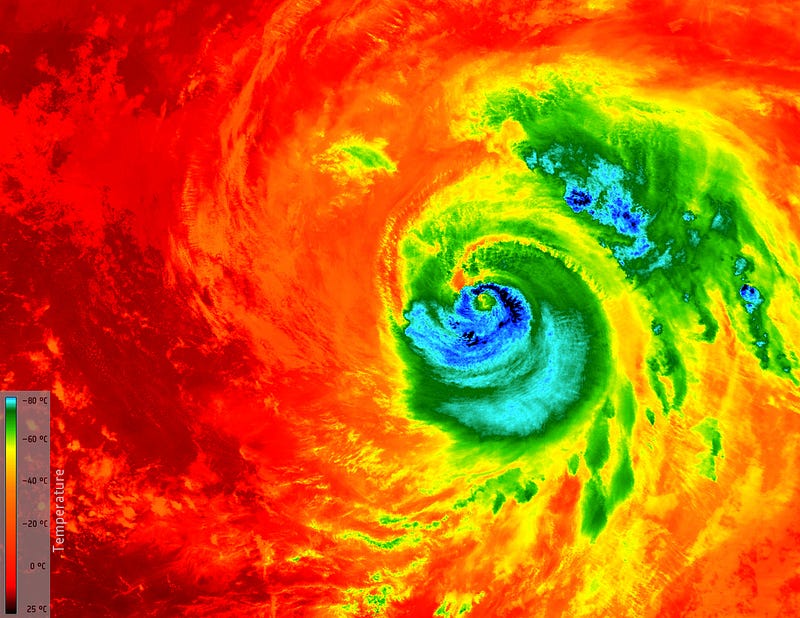
My writing focuses on aligning economy, ecology, and the human spirit because I think it’s much needed. Because I think we urgently have to give wings to the transition.
Until now, I’m either in the eye of the storm, quietly studying the alternatives to current solutions and writing about them. Or I’m working beyond the storm on real-life systemic solutions surpassing the current unlimited-growth-paradigm.
A fast-growing group of people is creating a future economy with many more values than just money.
The Panel of an International University Webinar
Last week, I was invited to a panel of an international university webinar.
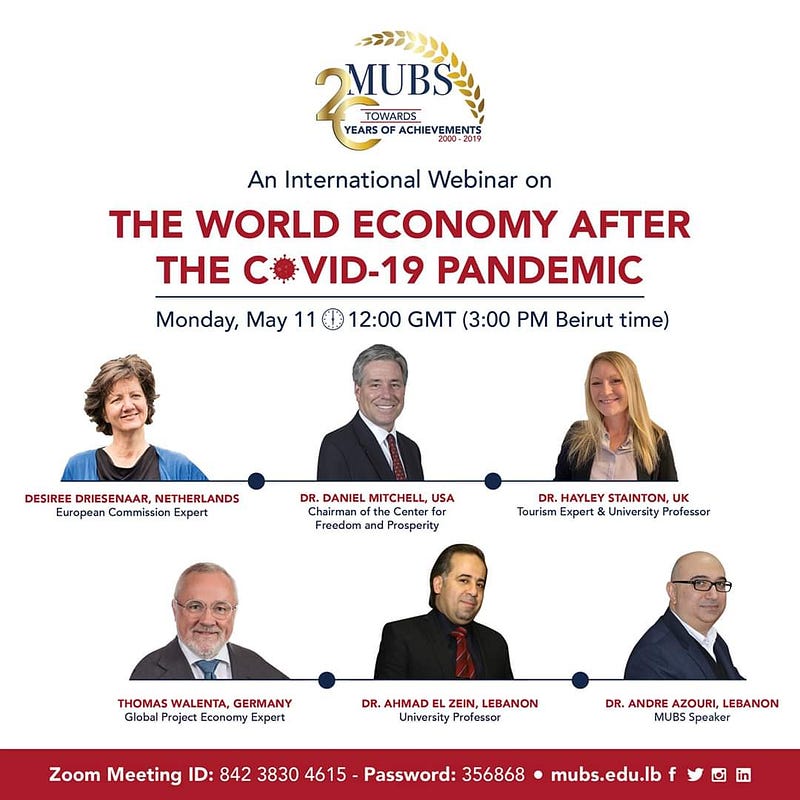
Illustration made by the University of Lebanon
I hesitated before saying yes.
Indeed, I’m an external Blue Economy expert on projects for the European Commission. But I’m in no way inclined to speak for them. I’m an independent. My views are my own.
And my Blue Economy vision is different from conventional views. Very relevant, but different.
We look at the world systemically. We build an economy with entrepreneurs who collaborate instead of competing. We build our regenerative business models with synergy instead of scale as a driver.
We use stranded assets for investments. We use local, abundantly available materials and non-toxic production processes. Waste is designed as a resource for other products.
We design all processes very carefully. We innovate in line with nature. With physics, biology, and non-toxic chemistry. We unleash the abundance of nature. And with that, we create a multiplier effect for bioregional, human economies. All with buckets of mindfulness.
Most importantly, we think of more values than just money.
Clean air.
Clean water.
Healthy soil.
Would I be able to stand my ground in between these university professors? Would questions of the audience drive me into a certain corner? Into a political wasp's nest?
And then I said yes. I decided to take on the challenge…
Economic Outlook by the European Commission
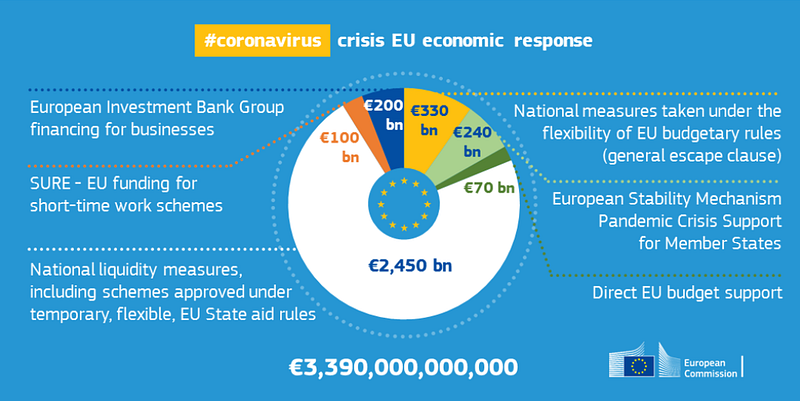
First of all, here’s a short overview of the economic figures of the European economies. It’s bad. Very bad. It’s like a card house falling down.
“The Gross Domestic Product is expected to fall with more than 7% this year. Far deeper than during the Global Financial crisis in 2009. In 2021, a rebound of only 6% is expected.
Uncertainty about the pandemic remains huge, and different assumptions than the ones underpinning the baseline scenario analysis on which this forecast is anchored would lead to very different projections.
The COVID-19 crisis is hurting all Members States. Their strong economic interconnectedness is magnifying the aggregate demand and supply shocks.”
This is the projected growth (decline) map of the EU.
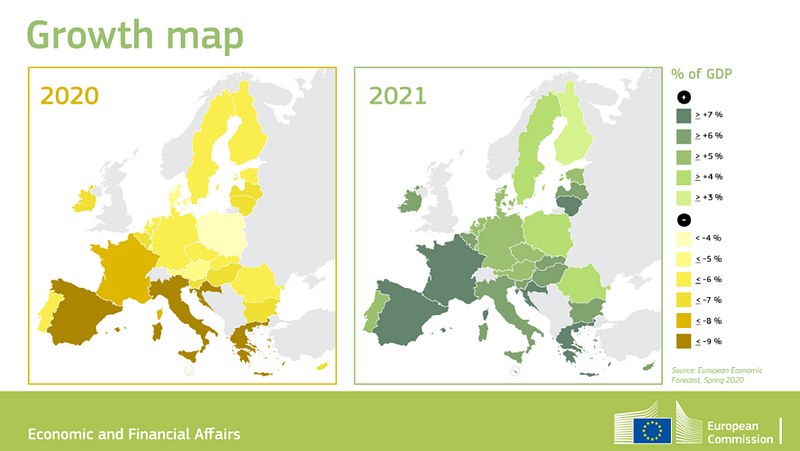
“During this health crisis, it is vital that we not only protect the critical sectors of our economy, but also our assets, technology and infrastructure. And above all we need to protect jobs and workers.”
“The Commission acts where it can to support different industry sectors, notably those vital for the production, supply of food and tourism.”
Why Align Economy and Ecology?
All this bombastic money throwing at businesses got me thinking.
Yes, I understand very well that we want to lessen the pain. That we want to preserve jobs and workers. But is this money really going where we want it to go?
I wrote this article about speculation and taxpayers’ money spent on kerosine NOT being used.
This can never be the meaning of taxpayers’ support, can it?
Don’t we have to change the paradigm? Do it differently altogether?
“We cannot solve our problems with the same thinking we used when we created them” — Albert Einstein
Why do I focus so much on aligning economy, ecology, and the human spirit, do you ask? And why is it now, during and after COVID-19, more important than ever to do so?
Well, there are two main reasons to think about economy and ecology in one breath.
“We conclude that humanity is dangerously in a state of overshoot”
— Limits to Growth, the 30-Year Update.
The most common points of criticism in 1972 were: technology and the adaptive resilience of the free market will prove you wrong. But 30 years later, all projections are still the same or worse…
We are overstepping planetary boundaries big time, as you can see in recent studies by the Stockholm Resilience Center. Nitrogen, phosphorous, climate change, biodiversity loss…
And it can be done differently. We saw the clean air above China when production was closed for a few weeks. Nature herself is very resilient.
2 Ecologists have been warning us for years that viruses will transfer from animals to humansbecause of our destruction of their habitats.
It’s really a logical conclusion. Viruses have unique animal hosts. We destroy the habitats of these hosts. So they find new hosts. Us, humans. New pandemics are born. We are to expect more of those…
So how can we get through the storm taking a different route? I want to address 4 points:
Jobs and Money
Food Security
Responsible Business
Real Estate Speculation
And then I want to give you some real-life transitional examples in Europe.
Jobs and Money
What if we would spend the money not on wasteful, big businesses but on the workers directly? What if we would spend all these trillions on a Universal Basic Income (UBI)?
There’s overwhelming evidence that the most efficient way to pull people out of poverty, is by giving them an income without patronizing them.
Rutger Bregman speaks about it in “Poverty isn’t a lack of character, it’s a lack of cash.”
As Rutger explains, it will get people out of the scarcity mindset that causes bad decisions connected to poverty. Well, that’s what we want: an abundance mindset will define our future…
The bottom line: we can give people a safety net that ensures they won’t drop below the poverty line. It will be enough to afford basic needs: food, shelter, education. Everyone can live a less-stressed life and make better choices.
But can we afford it?
Left and right-wing politicians make different choices and calculations. But both are exploring the possibilities and the bottom line of their calculations seems to be: YES.
Europe can afford a UBI if we implement it via a negative income tax.
And please realize that we will not implement it in an unchanged society. We will transition our societies with it. A UBI will save money as well.
If we start trusting people, we need much less bureaucracy
Many social problems will decrease. Crime, health problems, addictions
Voluntary work will increase if people don’t have to worry about income
Bottom-up entrepreneurship for the transition will flourish
I just hope some of our leaders will have the guts…
And if they don’t, I hope communities will embrace their own money systems. Their own economic models and Universal Basic Incomes. Time for local, tokenized economies? Time for value instruments?
Food security
Food security is very important. At this moment our subsidy system for farmers is complex, bureaucratic, and not achieving what we want to achieve.
Industrial farming is ruining our planet and producing food that’s designed for quantity instead of nutritional value.
We can do better. Farmers are the people who know about soil, know about nature, know how to do it better. But they are stuck in the current system, too. We can help them transition.
We should produce high-quality food by putting the focus on healthy soil
Ecological intensification will help produce enough food and make the business models work. E.g. growing edible mushrooms on organic rest streams can provide healthy proteins and provide extra income
We can restore ecosystems and unleash the abundance of nature again
Restoring water cycles will be much easier with healthy soil around
The use of mechanical energy can be minimized and renewable, so our output of calories will be bigger than our input. We will be creating more calories than we invest
So, what if we would invest our billions of subsidies to help farmers transition to regenerative farming? What if we would redirect the subsidy streams for universities towards agroecology wisdom instead of industrial farming?
Regenerative farmers can build an awesome bridge between the natural systems and our human systems, producing healthy food in the process.
It would certainly give us completely different opportunities for food security within planetary boundaries.
Responsible Businesses
What about the businesses, you ask? Are they left to fend for themselves? My first answer is yes.
It cannot be that big companies make millions of profit, years in a row. And then ask for taxpayers’ money when the going gets tough.
Businesses are responsible for their profits AND all of their costs. Including social and environmental costs. They should solve these issues within their business models.
Blue Economy shows a wealth of innovations and technologies that are systemic and aligned with the natural world. We can change the way we make our products. Make beautiful furniture from kelp, build with bamboo, make batteries from waste streams, make mobile phones without a battery, etc.
Let’s unleash all of our entrepreneurial talents and be makers instead of consumers! We can build resilient, local, active economies like never before!
Why do we need one beer brewer who owns all the pubs and gives us boring uniformity? Why not have multiple beer brewers? Challenge our taste buds? They can make their businesses work with regenerative business models!
And of course, the companies can be helped with laws. Taxing resources instead of labor? Make job creation easier like this?
When employees have a basic income, the rewarding system for employees will shift as well. Properly organizing and rewarding the purposeful, necessary jobs, so people feel proud and satisfied to fulfill them…
Stop Speculation
Our current economies are making a lot of money with speculation. Banking products are complex and speculative. Kerosine prices are kept stable with speculation as you could read in the article about KLM. And land speculation is driving our housing prices through the roof.
Whoever is first to buy the expensive streets, will win. No doubt about it.
So what if we stopped land and real estate speculation?
Houses would become affordable again. It’s an interesting thought that cities, economists, and banks are actually experimenting with in several ways.
Real Life Economic Transition Projects
Let me give you two examples of European economies in transition. They are aligning economy and ecology. One in the Netherlands, one in Spain.
Doughnut Economy in Amsterdam
The city of Amsterdam embraces the Doughnut Economy. This economic model written about by economist Kate Raworth is supported by Oxford University’s Environmental Change Institute.
The basics of the model are based on a vision of independency for basic needs. El Hierro has become self-sufficient in energy, freshwater, food (farming and fishing), and animal feed. They built a resilient, vibrant economy on top of that.
Because the solutions are for a large part inhabitant-owned, every year € 23.5 million stays in the local economy. El Hierro-inhabitant Javier Morales gave a presentation about efforts and results.
Conclusion
Let’s face it: we do need an economy that’s aligned with ecology and the human spirit. How will we get there?
Look beyond trodden paths
We’re in transition
The change will never happen if we keep being stuck in old patterns
We need to rethink the paradigm of an unlimited growth economy
The music has changed. Please, don’t try to mend a broken record.
Let’s think about more values than just money and build a beautiful economy that’s aligned with ecology and the human spirit.
Our future depends on it!
If you want to connect, you can find me on LinkedIn or somewhere in the eye of the storm…
Thank you, Mike, for adding your wise energy to my words on economic transition.