
How to Change Negative Karma with Buddhism
What you sow is NOT what you reap if you practice Nichiren Buddhism
What is karma?
Karma is defined as an accumulation of thoughts, actions, and words, lodged deep within your life, manifesting in good or bad outcomes. Buddhism takes this definition a step further and says karma is the accumulation of your thoughts, actions, and words from the present and previous lifetimes. Karma in Buddhism follows a strict law of cause and effect that none can escape.
But how do we know the depth of our karma and if it’s negative or positive?
An easy way to figure this out is by looking at your present life. Are you happy in every aspect of life from health, to finances, and relationships? If the answer is no for any area, then it means you have negative karma accumulated in that area from your current or previous lifetimes.
Nichiren Daishonin a 13th-century Buddhist sage quotes from the Lotus Sutra: “If you want to understand the causes that existed in the past, look at the results as they are manifested in the present. And if you want to understand what results will be manifested in the future, look at the causes that exist in the present” (“The Opening of the Eyes,” The Writings of Nichiren Daishonin, vol. 1, p. 279).
Buddhism says that unhappiness in your present life stems from negative causes you have made in the past. If you want to change your future for the better, then you must change the actions you are taking now. Notice the emphasis on the word you.
Every action is followed by a reaction etched deep within your life. Some reactions manifest themselves in immediate results while others appear with the right stimulus. But one thing is absolute, no one can escape the shackles of their karma- good or bad.
Who is responsible for your karma?
Spoiler alert — YOU.
The karmic tendencies you exhibit in your life are based on your own actions, thoughts, and words, not your partners/parents/in-laws/government/neighbors.
So at some point, you have to stop blaming ‘others’ and take sole responsibility for your actions.
The effects of your actions reside deep inside your life, and you carry them around lifetime-to-lifetime as ‘karma baggage’.
This may explain why a completely innocent baby is born with physical disabilities. After all, what did this newborn infant do to deserve this? The Buddhist view says that this child’s previous life's karmic tendencies are manifesting in this lifetime as poor physical health. The same applies to being born in a poor or dysfunctional family — it’s a karmic game.
So, if one positive action erases a negative action can you undo your bad karma by living a totally positive life?
Not so easily, for two reasons.
First, it’s not possible to live a 100% positive life 24–7 because humans are bound to make mistakes and accumulate bad karma.
Second, even if you did your best to live more purely in this lifetime, it may not be enough to eradicate the heavy ‘karma baggage’ of your previous lifetimes. Bummer.
Then what’s the point of this whole karma theory?
The good news is that Nichiren Daishonin’s Buddhism states that you can change the deepest, darkest, and most negative of your karmic tendencies in this lifetime and free yourself from the shackles of fundamental darkness.
In other words, by changing negative karma (because no one wants to change positive karma) you can become profoundly happy — NOW.
How can you change negative karma?
By awakening your highest potential through practicing Nichiren Daishonin’s Buddhism.
Let’s take the example of a fictitious person named Megan. No matter how hard she tries; Megan simply cannot sustain a happy and fulfilling personal relationship. On the surface, she is beautiful, kind, professionally successful, and an intelligent person but her success falls short in the realm of her love life. On the personal front, she moves from one relationship to another, arriving at the same place —distraught and broken-hearted.
Despite following the sage advice of relationship gurus, well-meaning friends, and family, nothing helps. Every person she encounters exhibits similar negative tendencies — her relationships suffer from the same problems with every new person.
What’s going on here?
It’s called negative relationship karma etched deep within Megan’s life. Something she has to recognize and change within herself.
Like the fictitious Megan here, everyone has some area in their life where they lack fortune.
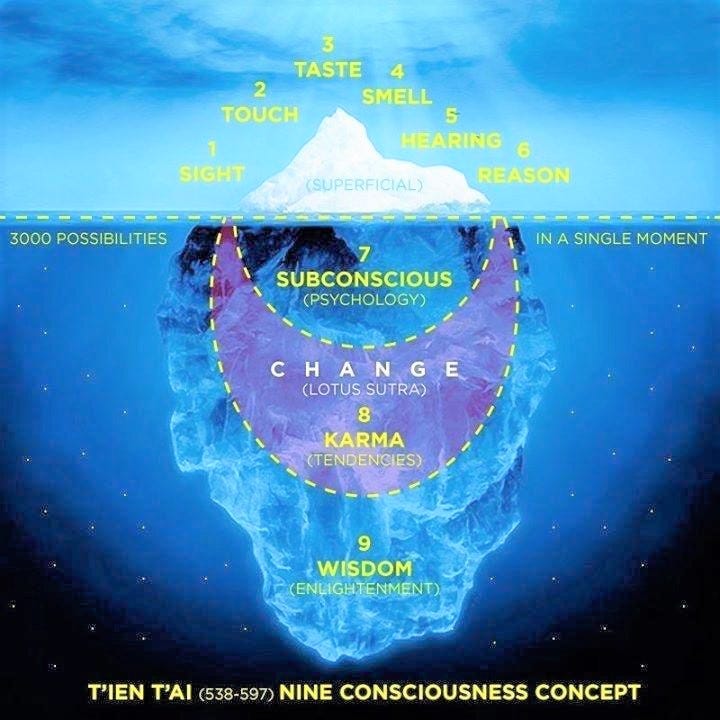
So in areas of your life where you lack fortune, you can do the identical thing you see your neighbor doing, to get the object of your desire but that object seems to move further away from you. No matter what strategies you apply with your brain to solve this issue, your brain can only go to the 8th level of consciousness — the karma baggage house (Shown in the image above). But this is the place where you lack fortune in this particular area so your brain can only devise a solution based on your lack of fortune.
No matter how hard you try, you simply reinforce the same pattern over and over in your life and get results that lead you back to square one.
Nichiren Buddhism explains that when Megan recognizes the depth of her negative relationship karma and addresses it with Buddhist prayer and study, she can change her negative karma and end this vicious cycle.
But how?
The concept of changing karma can be explained using the 9 consciousness concept shown in the illustration above. Nichiren Buddhism posits that you have 9 levels of consciousness in your life.
The first five states of consciousness are your sense of sight, hearing, smell, taste, and touch.
The sixth level of consciousness, called reasoning, incorporates the information from the five senses and processes how you interact with your environment.
The seventh level of consciousness is where self-awareness or ego originates, and where your subconscious resides. Interestingly, this is the level of consciousness that psychologists tap into their psychotherapy sessions.
Ever wonder why those expensive psychotherapy sessions failed? It’s because they are not tapping into your deeper life states, the place where your negative karma resides.
Nichiren Buddhism takes the concept of consciousness deeper and says that there are two more levels of consciousness.
There is the 8th level of consciousness called the karma storehouse, which accumulates all your karmic tendencies (positive and negative) from current and past lifetimes, and finally the 9th level of consciousness — the seed of Buddhahood (wisdom and enlightenment) that exists in every human being (Buddhist or non-Buddhist).
The 9th level of consciousness is the pure, unchanging reality of your life. This level of consciousness lies latent until the time it is evoked. Once evoked, it changes your karma.
“The ninth consciousness is itself the ultimate reality of all things and is equivalent to the universal Buddha-nature. Buddhism teaches that we can change our deepest karma through drawing upon this inner capacity of our lives”. Dr. Daisaku Ikeda
By practicing Nichiren Buddhism you can awaken this 9th level of consciousness from the depth of your life. Once awakened, it eliminates the darkness residing in the 8th-level — karma storehouse and changes even the most negative karma into something positive and meaningful.
Just like lighting a match in a dark cave, once you strike the match, it illuminates the entire space despite it being dark for countless years.
Similarly, the 9th consciousness, once awakened, evokes the highest potential of a human, and changes their negative (dark) karma.
Going back to our earlier example, when Megan starts practicing Nichiren Buddhism, she is awakened to her highest potential that pierces through her negative karma, unaffected by it, and taps into the 9th consciousness — the pure unchanging reality and infinite wisdom of her life that overturns her karmic tendencies. Awakening this level of consciousness brings fortune into the area of her personal relationships by impacting her thoughts, actions, and words.
Now when she encounters a new love interest, that person matches her changed and higher life condition, and she enjoys a more fulfilling and positive relationship with this individual.
How long does it take to change your karma?
Unlike some other forms of religion that allude to a positive afterlife, or that your life is dictated by fate, Nichiren Daishonin’s Buddhism stresses that karma can be changed here and now in your present life.
This means no matter how deep and negative your karma is, you can change it and become a happier, fulfilled, and awakened individual in your present lifetime.
“Our karmic energy mutually impacts our loved ones and indeed all humankind. It even affects animals and plants. A positive change in the karmic energy in the depths of one’s life becomes the cogwheel for change in the lives of others.” Dr. Daisaku Ikeda (Unlocking the Mysteries of Birth and Death, p. 160)