
How Buddhism rescued me when I was losing my religion
Life is a constant flux between joy and sorrow. Buddhism gives us the tools to stay balanced.
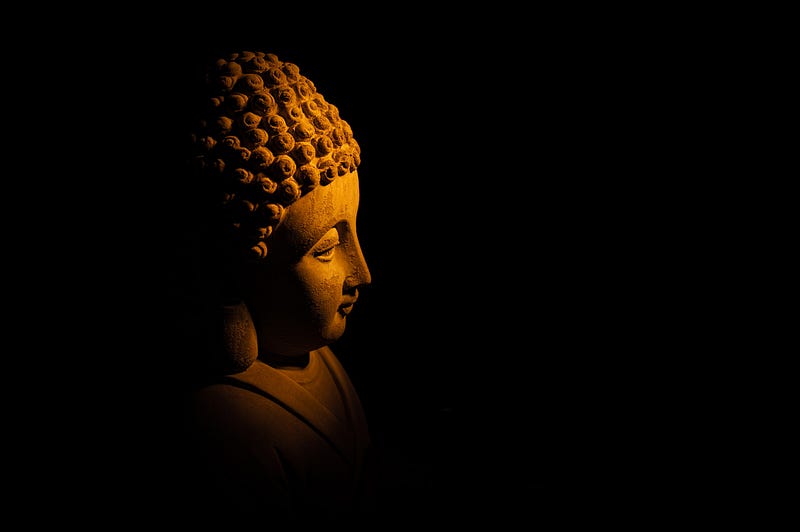
How does a girl born in a devout Hindu Brahmin family, educated in Catholic schools, end up practicing Japanese Buddhism?
Here’s my story.
Born into Hinduism
Hinduism, the dominant religion of India, has 4 sub-castes.
I was born in a Hindu Brahmin family, a caste that commands an elite status in traditional Indian society. I never looked at it that way.
My paternal family members are Brahmin pundits, highly educated with a proverbial chip on their shoulders. A classic trait.
My grandmother came from a stately family and religion was her anchor. She fasted assiduously thrice weekly, and local temple priests visited her home to conduct religious ceremonies on special occasions.
I spent several summer holidays with her, admiring how she spent hours praying and chanting mantras to a dozen gods (Hindu Vedas record 33 gods and goddesses) in her home temple.
She followed these traditions judiciously, her entire life.
For someone so deeply rooted in the service of god and daily prayers, her life rarely reflected positivity. She lamented financial burdens, was often surrounded by family drama, and seemed visibly discontent with her life.
This astute contradiction between practicing religion and still being miserable in life was reflected in several other members of my Brahmin family.
Despite devoutly following all the Hindu traditions and rituals, they were never, genuinely happy.
Years later, I remember writing in my high school journal. What is the purpose of religion? Why are the religious people in my family so unhappy?
Life would reveal these answers in time.
Raised with Catholicism
If I wasn’t already confused with Hinduism, my parents added to the complexity by sending me to a Catholic boarding school.
Although India had won its political freedom from the British in 1947, they left their mark through several catholic schools and universities across the country. These were regarded as prestigious educational institutions.
My parents picked the Convent of Jesus and Mary, nestled in the picturesque hills of Mussoorie, India as a perfect place to intensify my religious chaos.

The school was beautiful, pristine, and disciplined. The academics were great, but the religion; was tough! Especially for a 5-year-old me.
In hindsight, the school felt like a luxurious prison, where kids were released twice a year, once for a short summer break and later for a 3-month winter holiday. The remainder 9 months were spent studying, playing, and a lot of praying.
We were awoken early on Sunday mornings to attend mass at the school Chapel. The hymns were melodious, but the sermons were unbearably long. I recall fidgeting distractedly in the pews hoping for it to end soon so we could eat breakfast.
Sometimes we were made to recite the rosary repeatedly. The nuns said this was an ideal way to atone for our sins.
Sins? What sins had I committed at 5? Too young to dig for answers, I just followed their instructions.
Aside from the religious aspect, the school lived up to its reputation and my parents were happy with my academic performance. I spent 12 years of my school life in two different branches of the Convent school. Was that enough? No.
For university, my parents suggested that I continue my education at The Jesus and Mary College (JMC). Why?
Because it was a prestigious college, and the Late Indian Prime Minister, Rajiv Gandhi’s daughter was studying there. Case settled, JMC it is.
Thankfully, College was not heavy on the religious aspect. A huge relief.
With 16 years of Catholic education and religious indoctrination, I was confused about religion and its true purpose.
I began to view religion as an opium for the masses.
My religious indifference felt justified till I hit a low point in my personal life.
I had made some poor life choices and was clearly suffering. My mother sensed my pain and suggested I follow a spiritual path to become happy. I did what most teens would do and ignored her.
Finding myself through Buddhism
Around my early twenties, ruled by arrogance, anger, and ambition, I was preparing for a second trip to the United States, against my parents will.
The goal was to pursue higher education, as far away as possible from home.
An evening before my flight, Mom walked up to me with a magazine in hand. It had an article on Indians following Nichiren Daishonin’s Japanese Buddhist teachings, to become happy.
She pointed to a photo in the article and said, “Look at the happiness radiating on their faces.” I instantly retorted, “Yes, because they are saying cheese to the camera. What do you expect?”
Unperturbed, she insisted that their faces reflected inner happiness. Rolling my eyes, I begrudgingly read the article. It explained how Nichiren Daishonin Buddhists chant “Nam MyoHo Renge Kyo”, to become happy.
What a gibberish phrase. It sounded too bizarre.
I still remember the condescending tone in which I told her that I had no time for religion and would consider it when I was in my 50s. Plus, what kind of mother forces a Hindu-Brahmin girl to follow Japanese Buddhism?
Seriously, a mother’s desperation sees no limit. Ah, my youthful pride.
Life in America as a young student was tough. The Universities were expensive, and I urgently needed a job to manage my living and tuition expenses. My ambitions and plans were falling apart.
Through some common friends, I met a friendly Indian lady who helped me find a perfect marketing position at a software startup. The company sponsored my H1 B visa and even agreed to pay for my university tuition. Perfect, life’s back on track. Or is it?
When I visited her home to thank this Indian lady for her kindness, she told me that she was chanting for me to get this job.
Chanting for me? That’s sweet.
She took me to her prayer room where I expected to see an assortment of Indian Deities but was surprised to find a quaint-looking wooden altar and a gong bell.
She opened her altar, sat down, and chanted, “Nam MyoHo Renge Kyo”.
Wait, what?
This was the same gibberish phrase my mom had read in the magazine a few months back. How did she know about it?
What are the odds of encountering an Indian lady in America, whom you’ve never met, but who is kind enough to help you find a job, AND is practicing Japanese Buddhism? The exact type, that my mother accidentally read about in India.
The coincidence was startling. I told her how my mother had introduced this chant to me, a night before I left for America and the lady said, “Yes, India has a growing number of Nichiren Buddhists.”
That was it. I was intrigued to learn more.
It was January 2000 when I first walked into the Nichiren Buddhist Center and this year marks 21 years of living and practicing Buddhism. For me, it’s not a religion but a way of life and inner transformation.
Unlike most religions, Nichiren Buddhists are encouraged to chant for their earthly desires; a better job, good health, positive relationships, financial goals, etc.
The logic is simple. To survive in this modern world, we need food, money, loving relationships, and good health. If any of these are missing, it creates unhappiness.
Buddhism gives us the tools to fill to change any poison into medicine by putting faith into action.
Prayer is the first step and action is the second. One without the other is incomplete. Buddhism guarantees an answer to all our prayers, though the answer may not always be what we asked for but is something, even better.
It is a religion that does not expect you to have blind faith but instead, it shows actual proof with daily practice.
As an analytical person, this philosophy resonated with me. I put it to the test. I made a list of my life goals and began my Buddhist journey. 21 years later, this philosophy continues to be the bedrock of my life. Every desire was fulfilled be it in the realm of my career, finance, relationship, or health.
Some may think it’s crude to pray for personal desires, like money. It is not. Try paying your mortgage/rent with a prayer and a smile.
Money is an essential commodity to live a fulfilled life. As a practical philosophy, Buddhism assures us that our desires will be fulfilled.
What’s the catch you ask? None.
As we practice this religion to achieve our personal goals, there is an inner transformation that happens alongside. We call it the human revolution, the cornerstone of Nichiren Buddhism.
“Human revolution cannot be pinned down to one specific thing. It is any action that leads to positive change or improvement in the inner realm of a person’s life. It is an ongoing process. The important question to ask yourself is whether you’re on a path of continuous personal growth.” — Dr. Daisaku Ikeda
As we pray for our goals, the prayer cleanses our negative karmic tendencies.
For a person struggling with money issues, the prayer helps them realize their own shortfalls in managing finances. It gives them the wisdom to change that behavior and once their inner blueprint with money changes, that perfect job or business opportunity manifests itself. They realize that finding a job or business was never the real issue, it was their poor attitude towards money that needed reform.
This also applies to other areas of our lives like relationships, career, and health. Buddhist prayer awakens us to our own shortcomings and areas that need self-improvement.
With an inner awakening and a transformed approach to our problems, we begin to manifest positive results in our environment.
Buddhism is not magic. It’s based on the strict law of cause and effect that treats everyone equally.
There are 4 core tenets of Nichiren Buddhism.
1. Karma is not fixed- Karma is thoughts, actions, and words that are permanently etched in our life (from present and past births) that manifest in a positive or negative way to shape our lives. Nichiren Buddhism teaches that our karma is not fixed, we can change our negative karma in this lifetime and reveal our highest potential.
2. The law of cause and effect is strict- life at any given point reflects our past and present actions. So, if we don’t like our current life, it’s our responsibility to change the causes we are making and the effect will manifest itself in a better life.
3. Absolute happiness is not dependent on external influences- We all want to become happy. Buddhism shows us the path to ‘Absolute Happiness’, a state independent of any external circumstances. Simply put, the key to happiness lies within us and is not based on outside factors like our careers, finances, relationships, or possessions.
4. We’re all Buddhas- Buddhism says every human being is a Buddha (enlightened one). Whether we practice Buddhism or not, there is a Buddha in us. The difference is that we are not awakened to this fact.
Buddhism gives us the tools to manifest our highest, enlightened self and live the purest, most fulfilling, and happy life.
In over two decades of practicing Buddhism, I have gained many benefits but the most important one is the transformation within me. My parents were the first to notice a change. Unlike my eye-rolling teenage self, today, I am eternally grateful to my mother for her wisdom in nudging me onto the path of Nichiren Buddhism.
Older and hopefully wiser, I no longer consider religion opium for the masses. When practiced correctly, the essence of every religion is good and I’m glad to have found my fountain of happiness in Buddhism.